Vitalik 放狠话:年底前未达标的 Layer 2,将不再被视为二层网络

深潮2024-09-18 tarihinde yayınlandı2024-09-18 tarihinde güncellendi

Vitalik Buterin认为,如果到今年年底仍未达到第1阶段,就不应被视为第2层。

原文作者:CHRISTOPHER ROARK

编译:Alvis,火星财经

据 L2Beat 称,六个以太坊第 2 层已经达到第 1 阶段,而其他大多数仍停留在第 0 阶段。

以太坊联合创始人 Vitalik Buterin 于 9 月 12 日表示,如果某个网络到今年年底还未达到“第 1 阶段”,他将不再将其视为“第 2 层”。

他表示:“rollup 被美化为多重签名的时代即将结束”,并补充道,“加密信任的时代已经到来”。

网络是否为第 2 层的问题不仅仅是以太坊社区的技术问题。

它决定了网络是否依赖于以太坊的安全性,因此可以信任它来保护用户的资金,或者它是否是一个完全独立的网络,可能安全也可能不安全。

6 月 2 日,去中心化金融协议 Velocore 遭到攻击并造成 260 万美元损失,这一问题因此被推到了风口浪尖。

Velocore 在 Linea 网络上运行,该网络声称是以太坊第 2 层。然而,该团队迅速停止了区块生产,以防止攻击者将资金提取到以太坊。

批评者认为,如果网络的安全依赖于以太坊,那么这种区块生产的暂停就不应该发生。毕竟,当局不能暂停以太坊。

由于这一事件,许多批评者声称以太坊生态系统去中心化的速度太慢。

在 Velocore 攻击发生前一个月, Buterin 就已经对这个话题发表了评论。他表示,所有以太坊第 2 层都需要在 2024 年底前达到“第 1 阶段”。如果没有达到,社区就不应该再将它们称为“第 2 层”。

但是第一阶段到底是什么?

权力下放的阶段

“第 1 阶段第 2 层”一词源自 Buterin 于 2022 年 11 月 2 日在以太坊魔术师联盟留言板上发布的帖子。

在帖子中,Buterin 认为以太坊第 2 层仍处于开发的早期阶段,不能指望马上实现完全去中心化。

相反,应该给开发者一个宽限期来充分开发其网络组件。一开始,这些网络会高度集中。但随着时间的推移,它们将变得完全无需许可,保证无审查交易。

第 0 阶段网络称自己为第 2 层或“汇总”,其所有交易的压缩版本都发布到以太坊。

此外,该团队还提供了一个“rollup 完整节点”,只要它拥有来自两个层的完整交易数据,它就可以独立确认第 2 层的状态。只要团队不主动尝试通过在以太坊上发布虚假状态根来阻止用户,用户就可以在没有团队帮助的情况下退出网络。

在第 1 阶段汇总中,以太坊上的网络智能合约包含“欺诈证明或有效性证明方案”,可阻止开发人员发布无效的状态根。

如果开发商试图以欺诈手段提取不属于其的资金或者阻止用户合法提款,这些交易在正常情况下都会失败。

然而,开发人员可以通过网络安全委员会八名成员中至少六名成员的投票推翻欺诈证明。如果开发人员发现欺诈证明系统中存在错误,则存在此漏洞。

此外,安全理事会的八名成员中至少有三名必须来自开发团队之外,因此理论上开发团队不可能独自推翻这些证明。

网络升级也必须至少延迟七天才能实施,除非得到安全理事会的批准。

自 Buterin 发表该帖子以来的两年里,大多数自称是第 2 层的网络仍然停留在第 0 阶段或更低的阶段,导致人们批评说整个以太坊生态系统未能兑现其承诺。

然而,六家网络却逆势而上,成功进入至少第一阶段。

已达到第 1 阶段的网络
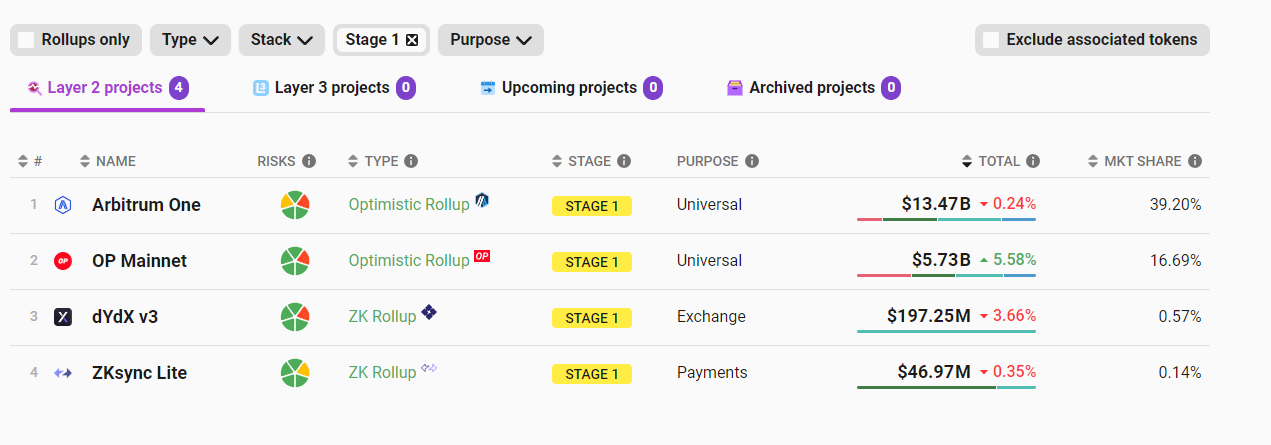
L2 第一阶段列表,来源:L2Beat

根据区块链分析平台 L2Beat 的研究,以下是声称属于第 2 层 (L2s) 且已达到第 1 阶段的网络的完整列表。此列表按总锁定价值 (TVL) 排序,持有资产最多的网络列在最前面。

Arbitrum One

Abitrum One 已进入第一阶段。该网络由 14 名验证者运行,他们使用一组欺诈证明处理提款和存款。如果验证者试图提交欺诈交易,除非这些证明被明确覆盖,否则以太坊上的智能合约将拒绝这些交易。

欺诈证明可以被 12 名成员组成的 Arbitrum 安全委员会推翻。但是,根据 Arbitrum 的文件,任何单一组织都不得在安全委员会中拥有超过三名成员。开发团队也不能免受此限制。

Arbitrum 去中心化自治组织(ArbitrumDAO)可以升级网络,但这样会有 12 天零八小时的延迟,而安理会则可以毫无延迟地升级网络。

如果 Arbitrum 排序器停止运行,用户可以直接从以太坊网络提款,但提款将在发起后延迟一天。据 L2Beat 称,如果用户不同意 ArbitrumDAO 发起的升级,他们有两天的“退出窗口”。如果他们在这两天的窗口期内退出,即使 DAO 腐败或被攻击者接管,ArbitrumDAO 也无法自行阻止他们。

如果用户不同意安全理事会执行的升级,则没有退出窗口,因为安全理事会升级几乎是即时的。

Optimism

6 月 10 日,随着“Cannon”防错系统的实施,Optimism进入了第 1 阶段。8 月 17 日,在发现该系统存在错误后,它又回到了第 0 阶段。然而,它于 9 月 11 日重新启用了防错功能,现在又回到了第 1 阶段。

如果 Optimism 验证者试图处理欺诈交易,Optimism 以太坊智能合约中的防错系统将拒绝这些交易。安理会投票可以推翻这些防错机制,但如果没有其他组织的合作,任何组织都没有足够的席位来实现这一点。

据 L2Beat 称,OptimismDAO 未经安理会同意不得实施网络升级。升级实施毫不拖延。

dYdX v3

DYdX v3 是第一阶段的以太坊 L2,与基于 Cosmos 的 dYdX v4 完全独立。它使用零知识有效性证明来确保所有有效提款都得到处理,并且不会处理无效提款。

dYdX 验证者可以通过拒绝将提款纳入交易来阻止提款长达 14 天。如果发生这种情况,用户可以在 14 天期限过后在以太坊上启动“强制退出”以取回资金。

正常情况下,升级会延迟 9 天,如果优先级控制器批准升级为紧急升级,则只需延迟 2 天。L2Beat 警告称,如果治理受到恶意行为者的控制,它可以通过阻止提款 14 天并启动在 9 天内实施的合约升级来阻止提款。

即便如此,L2Beat 仍认为 dYdX 处于第 1 阶段,因为正常情况下升级会延迟 9 天,超过了 7 天的最低要求。

ZKsync Lite

ZKsync Lite 使用零知识证明来验证交易,正常情况下团队无法处理无效交易,也无法阻止有效交易的确认。

如果团队发起升级,则升级需要 21 天才能生效。如果 ZKsync 验证器拒绝将用户的提款纳入交易,用户可以在以太坊上发起强制提款,并在 14 天内收回资金。根据 L2Beat 的报告,升级需要 21 天,为用户提供 7 天的“退出窗口”。

ZKsync Lite 没有智能合约功能;它专门用于加密支付。

除了这些网络之外,L2Beat 还将 DeGate v1 和 Fuel v1 列为已实现第 1 阶段的网络。事实上,这些网络被视为“第 2 阶段”,即完全去中心化。它们的总 TVL 约为 5100 万美元。

同意 Buterin 标准的用户应该在 1 月 1 日之后继续将上述网络称为“第 2 层”,只要他们不反对 L2Beat 的某些分析。

未入选的四大Layer2

目前未被 L2Beat 指定为第 1 阶段的前四个网络要么未满足第 1 阶段所需的其中一项标准,要么仍在评估中。

所有这些网络都已进入第 0 阶段,因此它们仍有可能在今年年底进入第 1 阶段。

Base

Coinbase 的 Base 网络不运行欺诈证明。它是 Optimism 超级链的一部分,Optimism 已经实施了欺诈证明。因此,Base 实施欺诈证明会很简单,并且可能在年底前进入第一阶段。但到目前为止,它还没有这样做。
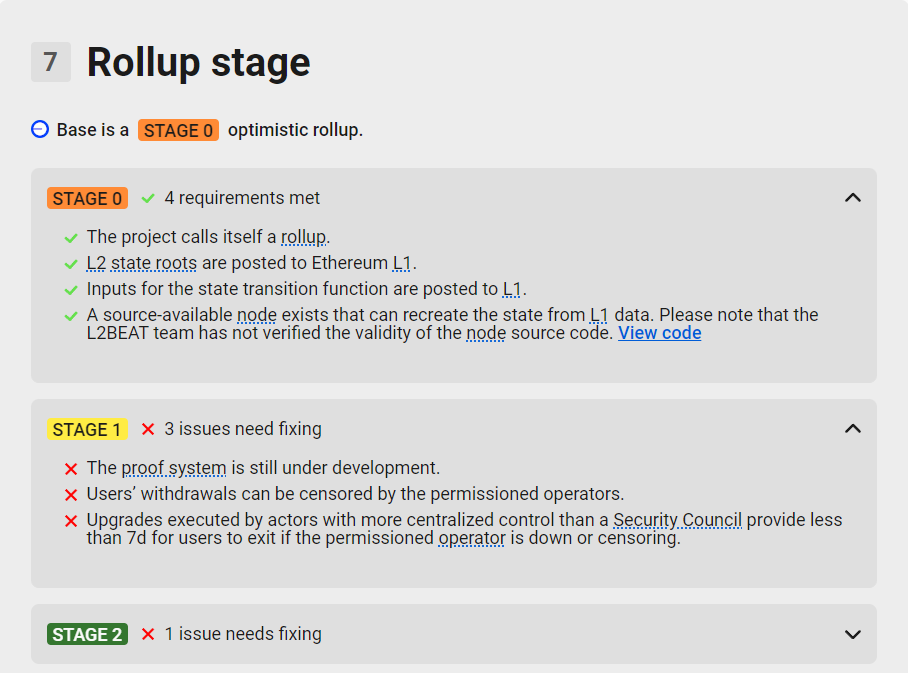
基础网络第一阶段问题,来源:L2Beat

Blast

L2Beat 认为 Blast 是一个“第 0 阶段”网络。用户可以独立运行 Blast 节点来检查存款和取款的有效性。但是,只有当取款无效时,软件才会发出警告。用户无法违背 Blast 管理机构的意愿提取资金。

Blast 可能会在今年年底之前发布欺诈证明,在这种情况下,它将在 2025 年继续被标记为“第 2 层”。但它目前并不满足第 1 阶段汇总的所有标准。

ZKsync Era

据 Matter Labs 称,该网络的开发商 ZKsync Era 使用零知识证明来验证存款和取款。L2Beat 目前正在评估该系统的工作原理。ZKsync Era 可能已经处于第一阶段,或者可能很快就会到达第一阶段。

9 月 12 日,该团队宣布了一项新的治理系统,该系统指定“守护者”在发生治理攻击时保护用户。该团队在公告中声称,它正试图实现第二阶段的完全去中心化。

即便如此,L2Beat 目前将 ZKsync Era 归类为第 0 阶段,因为它尚未完成对网络第 1 阶段元素的评估。

Starknet

Starknet 已在其智能合约中实现了零知识有效性证明。但是,这些证明可以被白名单操作员覆盖,并且用户无法在未经第 2 层验证者许可的情况下提款。

由于 Starknet 已经实施了有效性证明,因此应用第一阶段网络的其他标准将相对简单。因此,Starknet 可能会在 12 月 31 日之前进入第一阶段,但目前还未达到标准。

少数其他 TVL 低于 6 亿美元的网络仍被认定为第 0 阶段。

其中包括 Mode、Lisk、Polygon zkEVM、Taiko、Bob、Loopring、Zora、Kroma、Kinto、Paradex、Boba、ZKSpace 等。

这些网络均已达到第 0 阶段,并且一些网络已满足第 1 阶段的至少一项标准。但尚未有一个网络满足达到第 1 阶段的所有标准。

Scroll 和 Linea 仍处于 Stage 0 以下

根据 L2Beat 的数据,有两个网络的 TVL 超过 7 亿美元,虽然它们声称已经达到第 2 层,但甚至还没有达到第 0 阶段。

第一个是 Scroll,其合约中锁定了超过 11 亿美元的加密货币。L2Beat 表示,Scroll“没有可用的节点软件可以从 L1 数据重建状态”,因此用户无法独立验证其交易。

第二家是 Linea,其合约锁定了超过 7.8 亿美元。与 Scroll 一样,Linea 也没有开发可供公众检查其交易有效性的节点软件。

这些网络既符合又不符合 Buterin 所倡导的 2025 年“第 2 层”的定义。

以太坊支持者可能会继续敦促团队让他们的网络更加去中心化,如果他们不这样做,他们就会越来越多地不再称他们为第 2 层。但有些网络会继续声称他们正在努力,而另一些网络则会声称这无关紧要。只有时间才能告诉我们哪一方会在长期内胜出。

İlgili Okumalar

On-chain Analyst: Why Are Most Zcash Transactions Still Traceable?

Title: Why Most Zcash Transactions Remain Traceable Zcash, a privacy-focused cryptocurrency launched in 2016, was designed to offer anonymity by hiding transaction details like sender, receiver, and amount using zero-knowledge proof technology (zk-SNARKs). However, in practice, a significant portion of ZEC transactions are still traceable on-chain. The key reason is Zcash's dual-address system. It features transparent addresses (t-addresses), which work like standard Bitcoin addresses with all data public, and shielded addresses (z-addresses) that encrypt transaction details. There are four transaction types with varying privacy levels: fully transparent (t→t), partially shielded (t→z and z→t), and fully private (z→z). Despite its privacy capabilities, most real-world Zcash activity involves transparent addresses, primarily because major exchanges and institutions use them for regulatory compliance. As a result, blockchain analytics platforms like Arkham can track and attribute a substantial volume of Zcash transactions. Arkham reports it has identified entities behind over $420 billion in ZEC transaction volume. Case studies highlight this traceability: the U.S. government holds seized Zcash from a dark web case, visible via its transparent wallet, and individual traders' profitable moves are trackable from purchase to exchange deposit. In conclusion, Zcash's privacy is not inherent but user-dependent. While purely shielded (z→z) transactions remain cryptographically private, the prevalence of transparent address usage makes much of the network's activity traceable. The actual privacy protection offered depends entirely on how users choose to transact.

marsbit16 dk önce

On-chain Analyst: Why Are Most Zcash Transactions Still Traceable?

marsbit16 dk önce

From Power Infrastructure to Token Economy: The 'Seven-Layer Cake' of the AI Industry Chain

From Power Grid to Token Economy: The AI Industry's "Seven-Layer Cake" The AI industry is shifting from a "model-centric" paradigm focused on massive training to a "token-centric" industrial era driven by inference demand. This new phase revolves around the production, distribution, scheduling, and consumption of tokens—the units of computation used by AI agents for every interaction and task. The article proposes a "seven-layer cake" framework for the AI economy: 1. **Power**: The foundational energy source, with competition shifting to securing stable, low-cost electricity. 2. **AIDC (AI Data Centers)**: Large-scale "Token factories." A trend toward smaller, modular, and regionally deployed AI Factories is emerging for efficiency and proximity to users. 3. **GPU**: The core production hardware for tokens. While NVIDIA dominates, competition exists from AMD, ASIC makers, and Chinese chipmakers, with a growing focus on inference efficiency. 4. **LLMs**: The "engines" that generate tokens. The competition is evolving beyond model size to prioritize factors like token cost, inference efficiency, and operational synergy with infrastructure. 5. **Token Distribution**: The "grid" that allocates and rents out compute resources, led by cloud giants and specialized AI-native platforms. 6. **Token Optimization & Intelligent Scheduling**: The critical "brain" layer that intelligently routes tasks (e.g., to local, cloud, or edge models) for optimal cost, latency, and privacy—maximizing the value of each token. 7. **AI Agents & Models**: The end consumers of tokens. The vision involves billions of AI agents working and interacting concurrently, consuming vast amounts of tokens. Currently, the industry faces fragmentation and inefficiencies between these layers. The true "mass adoption era" of AI will begin only when this seven-layer infrastructure is fully integrated and operates as a cohesive, intelligent network—transforming AI from a software tool into a global industrial system spanning energy, hardware, and compute logistics.

marsbit37 dk önce

From Power Infrastructure to Token Economy: The 'Seven-Layer Cake' of the AI Industry Chain

marsbit37 dk önce

Semiconductors up 78% annually, software down 12% annually: The 'Liquidity Siphon' is playing out within tech stocks

Semiconductor ETFs like SOXX have surged 78.5% year-to-date, while software ETFs like IGV have dropped 12.5%, creating a record performance gap exceeding 90 percentage points. This reflects a major "liquidity suction" within tech stocks, with capital flooding into semiconductors as software faces selling pressure. Driving the semiconductor boom are staggering capital expenditure plans from hyperscalers like Microsoft, Alphabet, Amazon, and Meta, whose combined 2026 capex is projected near $700 billion. This fuels demand for chips, with companies like SanDisk (up 426%), Intel (up 222%), and Micron (up 154%) leading the S&P 500. In contrast, major software firms like Microsoft, Adobe, and Salesforce are all down over 17% year-to-date. The software sector faces a dual challenge: capital is being redirected to semiconductors, and the rise of AI agents like Claude Code threatens traditional SaaS business models, triggering a narrative of AI displacement. Key unanswered questions remain: How long can hyperscalers sustain their massive capex, given potential free cash flow pressures? And will capital eventually rotate back into the deeply oversold software sector? While some analysts warn of a potential semiconductor bubble akin to the dot-com era, the sector's powerful momentum continues, making market timing exceptionally difficult.

marsbit37 dk önce

Semiconductors up 78% annually, software down 12% annually: The 'Liquidity Siphon' is playing out within tech stocks

marsbit37 dk önce

İşlemler

Spot
Futures
活动图片