4种山寨币有望在9月份大涨:STX、TAO、FET和TON

金色财经2024-09-11 tarihinde yayınlandı2024-09-11 tarihinde güncellendi

1. STX

Stacks 最近一个月内部署了超过 1,400 个智能合约,比上个月增长了 30%。这一增长发生在备受期待的 Nakamoto 升级全面启动之前,该升级于 8 月 28 日在比特币区块 840,360 开始推出。

人们对比特币第 2 层 (L2) 项目的兴趣日益浓厚,这反映在风险资本投资中,仅在 2024 年第二季度就有超过 9460 万美元分配给此类项目。 
7tSee3z23opL6ueJOxASLYo40JhZildRhAq5sur9.jpeg

而且Stacks 有望挖掘比特币生态系统中约 8000 亿美元的潜在资本。这个不断发展的生态系统可以大大扩展 BTC 的实用性,使其超越传统用途。

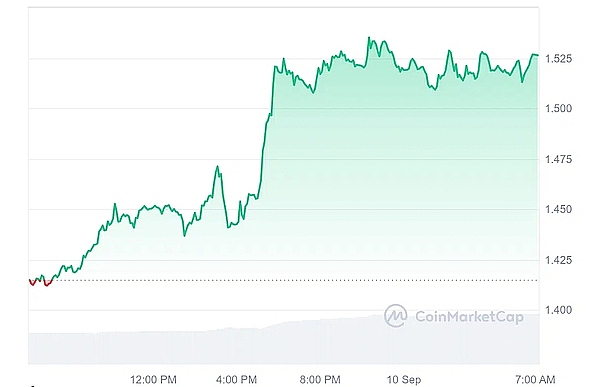
Stacks 代币的表现也非常出色。STX 交易价格为 1.55 美元,在过去一周上涨了 8.68 %。过去一年,该代币上涨了 228.48 %,表现优于 86% 的前 100 种加密资产。该代币的交易价格高于 200 天简单移动平均线,并表现出持续的势头。例如,在过去 30 个交易日中,它有 15 个交易日呈正增长。此外,其流动性与其市值相比仍然强劲。

2. TAO

Bittensor 是一个将区块链技术与人工智能 (AI) 相结合的去中心化网络。实施学习证明 (PoL) 可确保节点贡献可靠的 AI 模型,同时保护用户隐私。其跨链功能和原生代币 TAO 旨在扩展去中心化的 AI 生态系统,促进社区内的协作。
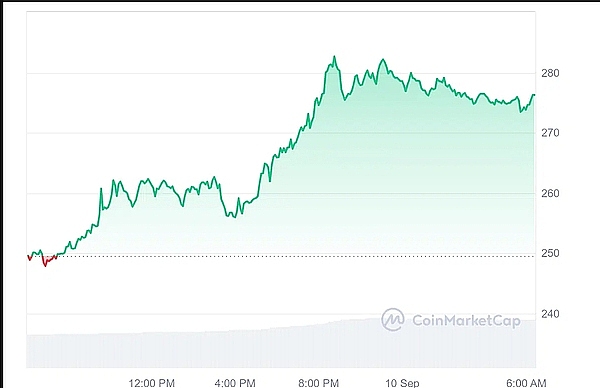
wVu1dAUwPi7EkMU6CJyXo1CRmFDyQEwmiBh05s8A.jpeg

截至今日,Bittensor 的代币 TAO 的价格为 279.37 美元,过去 24 小时内上涨了 1.56 %。在过去一年中,其价值飙升了 446.82 %,表现优于 92% 的前 100 种加密货币。 

目前,其交易价格比 200 天简单移动平均线高出 127.22%,表明上涨势头强劲。Bittensor 在过去一个月内有 15 个交易日呈绿色,显示出积极的短期趋势。预测表明,TAO 可能会大幅上涨,到 2024 年 10 月达到 897.19 美元,涨幅为 227.33%。 

3.FET

随着人工智能 (AI) 和加密货币行业的发展,两者之间的合作也正在加深。一个值得注意的发展是 SingularityNET 和人工智能超级智能联盟在 Cardano 区块链上推出了原生 FET 代币(即将更名为 ASI)。此举标志着 SingularityNET、Fetch.ai 和 Ocean Protocol 之间的合并。

ASI 代币的价格为 1.3 美元,在过去 24 小时内上涨了 6.41%。
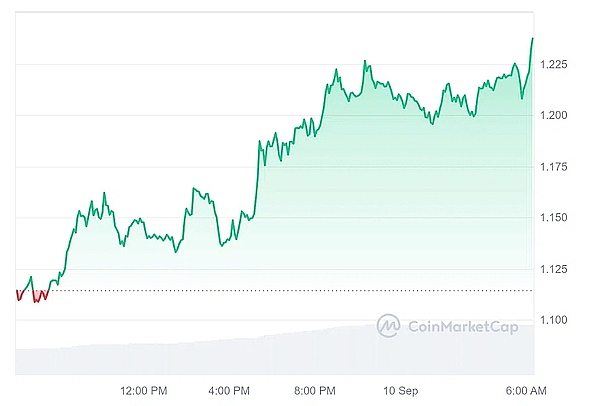
gJQgq4hM9keDE96HK01kbSAFJtMKEy417rVc6Mt5.jpeg

分析近期的价格走势,我们观察到波动水平各不相同。价格在过去 24 小时内短期内出现了显著波动,而过去一周的波动则呈现出不同的趋势。图表中的布林带显示了这种波动,布林带越宽,表示价格波动越大。

过去一周,交易量下降了 39.0%,而流通量则略有增加,增加了 0.11%。目前的流通量为 25.2 亿,约占最大供应量 26.3 亿的 95.84%。Fetch.ai 或 FET 的市值排名为 32,价值 28.7 亿美元。

4. TON

与 Telegram 平台密切相关的加密货币 Toncoin (TON) 上个月大幅下跌,价值下跌超过 20%。此次下跌是在 Telegram 首席执行官 Pavel Durov 被捕之后发生的。

然而,Toncoin 的价格本周开始回升,回升至 5 美元左右。市场分析表明,到本周末,Toncoin 可能会突破 5.5 美元。如果出现这种情况,它可能为进一步突破 6 美元铺平道路,使 Toncoin 成为值得关注的山寨币。
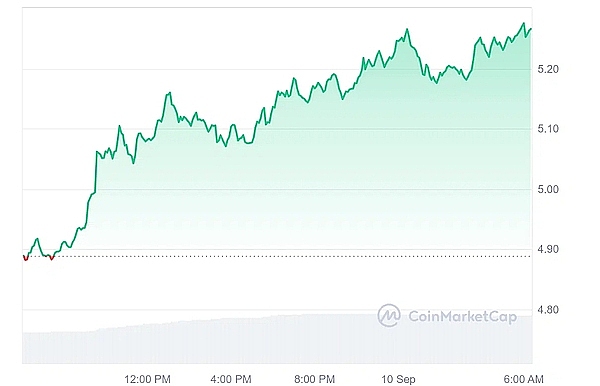
hEuZsrsANHbBylKOauYRiB2FXUDTOw812TW4WMou.jpeg

交易活动显著增加,过去 24 小时内交易量激增 148%。TON 上的永续期货总价值达到 5.1125 亿美元,而现货市场交易增长了 115%,单日总额达到 3 亿美元。

Toncoin 今日价格为 5.29 美元,过去 24 小时内上涨了 1.57 %。在过去一年中,该代币上涨了 194.17 %,交易价格比其 200 天简单移动平均线 (SMA) 2.03 美元高出 158%,表明相对于其历史价格而言表现强劲。最近的上涨和交易活动的增加表明,Toncoin 仍然是一种值得关注的加密货币,尤其是在它接近潜在的周期高点时。
İlgili Okumalar

The Richest Fed Chair in 112 Years Is Here: Kevin Warsh Is Rewriting the Rules

Kevin Warsh, with a personal fortune exceeding $130 million, became the 112nd and wealthiest Chair of the U.S. Federal Reserve on May 22nd. A former Wall Street investment banker and key figure during the 2008 financial crisis, Warsh lacks a traditional academic background for a central banker but brings deep market experience. He proposes an unconventional policy approach of simultaneously reducing the Fed's balance sheet ("quantitative tightening") while cutting interest rates, arguing that a smaller balance sheet would allow for more effective rate policy. His ascent marks a potential regime change at the Fed. Warsh aims to reform the institution's decision-making processes, tighten communication discipline among officials, and reduce reliance on forward guidance like the "dot plot." This shift responds to the Fed's current dilemma: fiscal policy is expanding the government's balance sheet through deficits, while monetary policy's ability to shrink its own $6.7 trillion balance sheet is severely constrained, creating pressure on long-term interest rates. Analysts expect Warsh's tenure to sustain high volatility in the U.S. Treasury market due to persistent supply pressures. Furthermore, his leadership coincides with a gradual, structural erosion of dollar dominance, evidenced by its declining share in global reserves and cracks in the petrodollar system, with increased use of alternatives like the Chinese yuan in oil trade. For investors, this environment underscores the importance of portfolio diversification, including assets like gold and Chinese sovereign bonds, amid a fluctuating dollar credit anchor.

链捕手5 dk önce

The Richest Fed Chair in 112 Years Is Here: Kevin Warsh Is Rewriting the Rules

链捕手5 dk önce

τ Scaling: Huawei's New Growth Engine Designed for the Post-Moore Era

**Tau Scaling: Huawei's New Growth Engine for the Post-Moore Era** For 60 years, progress in semiconductors was driven by Moore's Law – making transistors smaller, denser, and cheaper. This path has now stalled due to plummeting returns below 7nm, astronomical lithography costs, and rising per-transistor expenses. After six years and testing 381 production chips, Huawei’s semiconductor team proposes a fundamental shift: **stop competing on size, start competing on time**. This is the core of their "τ (Tau) Scaling" theory. It treats *time* as the key optimization metric, compressing characteristic delays (τ) across all levels – from transistor switching (picoseconds) to data center tasks (seconds), spanning 12 orders of magnitude. **What is τ Scaling?** It holistically minimizes delay/time constants (τ) across four layers: transistors (switching speed), circuits (signal delay), chips (compute/memory access), and systems (end-to-end communication). The goal is to align optimization from process and circuit design to architecture and systems using this unified metric. **Mobile Application: LogicFolding** Without advancing the process node, this technique vertically stacks chips using ultra-precision hybrid bonding, distributing critical paths across layers ("stacking floors"). Results include a 55% transistor density increase, 41% better energy efficiency, over 40% higher SRAM frequency, and a roadmap targeting 4GHz by 2029. **AI Data Center Application: Full-Link Latency Compression** With 80% of AI cluster energy and 70% cost spent on data movement, the focus is slashing communication time. Key innovations include: 1. **Unified Bus:** Cuts multi-layer protocols, reducing remote access latency from microseconds to ~100 nanoseconds – 500x faster. 2. **Hi-ONE Optical Interconnect:** Replaces copper with fiber, enabling 8Tb/s per module and scaling distances from 1m to 100m for 10,000-chip clusters. 3. **3D Folding:** Solves the "interface bottleneck" of 2.5D packaging by vertically integrating memory, power, and optical I/O alongside compute, predicting over 100x integration density gain by 2035. **Re-fusion of Logic and Memory** The AI era, where data movement is more critical than computation, demands tight 3D integration of logic and memory, shifting industry influence towards memory and advanced packaging. **Remaining Challenges** include adapting EDA tools for 3D design, optimizing wafer-to-wafer process variation and vertical interconnect losses, and establishing new energy efficiency and benchmarking standards. **Conclusion:** The era of scaling physical dimensions is over. The era of scaling time has begun. By leveraging 3D stacking, system architecture, and interconnect optimization—rather than solely chasing advanced lithography—performance and efficiency can continue to advance. This is poised to be the semiconductor industry's core roadmap for the next decade.

marsbit43 dk önce

τ Scaling: Huawei's New Growth Engine Designed for the Post-Moore Era

marsbit43 dk önce

NodeStrategy: The First Ordinals DAT Project, Bringing the Strategy Treasury Narrative to NFTs

**Summary: The Fundamental Flaws of NodeStrategy, the 'First Ordinals DAT'** NodeStrategy presents itself as the first Ordinals Digital Asset Treasury (DAT) on Bitcoin. Its model mirrors MicroStrategy's treasury narrative but for NFTs, specifically targeting the NodeMonkes collection (not officially affiliated). The project's core mechanism is a four-step flywheel: a 10% fee on all trades (90% to treasury, 10% to radFi/Bound marketplace) is used to buy NodeMonkes. These NFTs are then listed for sale on Satflow, with 100% of the sale proceeds used to buy back and burn the project's token, NODESTRAT, aiming to create a perpetual value cycle. However, the design contains critical, self-defeating flaws: 1. **Platform Lock-In:** As a Bitcoin Rune, NODESTRAT lacks smart contract functionality and cannot natively enforce the 10% fee. The fee can only be collected on the radFi/Bound marketplace itself. This makes the entire flywheel dependent on a single platform. If liquidity moves elsewhere, fee revenue drops to zero, halting the mechanism. 2. **Self-Suffocating Economics:** The 10% fee acts both as the flywheel's fuel and a major drag on demand. A buy/sell roundtrip incurs a 20% cost, creating a massive hurdle for traders. This strangles the very trading volume needed to generate fees. 3. **Ineffective Value Support:** The flywheel is starved. Low daily volume (~$9K) generates minimal fees for NFT purchases. The NFT "ladder" sales are slow and unpredictable (only 39 total sold), meaning buybacks are infrequent. While 30.77% of the supply has been burned, this supply reduction cannot lift price without corresponding demand, which is suppressed by the high transaction tax. 4. **Meaningless NAV:** The Net Asset Value (NAV), currently at a 0.46x discount to market cap, is merely a marketing figure. There is no redemption mechanism for token holders to claim the underlying NodeMonkes assets. Price is set by market liquidity flows, not by this theoretical backing. In essence, NodeStrategy's design forces its revenue source (trading fees) to simultaneously cripple the demand and liquidity required for its own success, trapping the project in a stagnant state.

marsbit50 dk önce

NodeStrategy: The First Ordinals DAT Project, Bringing the Strategy Treasury Narrative to NFTs

marsbit50 dk önce

Agentic Design Patterns: A Book That Made Me Re-Understand "What Is an Agent, Really?"

"Agentic Design Patterns" is a 2025 book by Antonio Gullí, a Google engineering director, which offers a systematic framework for AI Agent development through 21 design patterns. A core contribution is the "Four Levels of Agency": Level 0 (bare LLMs) are not true agents. Level 1 agents actively decide when and how to use tools. Level 2 agents engage in strategic planning, context engineering (curating and filtering information), and self-reflection. Level 3 involves multi-agent collaboration with defined communication topologies. The book introduces **Context Engineering** as a superset of prompt engineering, managing four layers of information for the agent: system prompts, external data, implicit context (user history, environment), and feedback loops for automated optimization. A key pattern is **Reflection (Producer-Critic)**, where two distinct agents with different prompts collaborate iteratively—one produces output, the other critiques it—until quality is satisfactory or a max iteration limit is reached. For **Memory**, a three-layer model is proposed: Session (ephemeral conversation context), State (temporary task data), and Memory (persistent, long-term storage). Regarding **Multi-Agent Systems**, the book advises against unnecessary complexity, recommending simple topologies like Supervisor or Peer-to-Peer based on task needs. It emphasizes perfecting a single Level 2 agent before moving to multi-agent setups. The author concludes with three actionable takeaways: 1) Add a Critic agent to existing workflows, 2) Practice Context Engineering beyond simple prompts, and 3) Avoid premature multi-agent complexity; first master a robust single agent. The book provides a practical map, codifying common challenges like reflection, memory, and coordination into reusable patterns, saving developers from reinventing foundational solutions.

链捕手1 saat önce

Agentic Design Patterns: A Book That Made Me Re-Understand "What Is an Agent, Really?"

链捕手1 saat önce

İşlemler

Spot
Futures

Popüler Makaleler

TON Nasıl Satın Alınır

HTX.com’a hoş geldiniz! The Open Network (TON) satın alma işlemlerini basit ve kullanışlı bir hâle getirdik. Adım adım açıkladığımız rehberimizi takip ederek kripto yolculuğunuza başlayın. 1. Adım: HTX Hesabınızı OluşturunHTX'te ücretsiz bir hesap açmak için e-posta adresinizi veya telefon numaranızı kullanın. Sorunsuzca kaydolun ve tüm özelliklerin kilidini açın. Hesabımı Aç2. Adım: Kripto Satın Al Bölümüne Gidin ve Ödeme Yönteminizi SeçinKredi/Banka Kartı: Visa veya Mastercard'ınızı kullanarak anında The Open Network (TON) satın alın.Bakiye: Sorunsuz bir şekilde işlem yapmak için HTX hesap bakiyenizdeki fonları kullanın.Üçüncü Taraflar: Kullanımı kolaylaştırmak için Google Pay ve Apple Pay gibi popüler ödeme yöntemlerini ekledik.P2P: HTX'teki diğer kullanıcılarla doğrudan işlem yapın.Borsa Dışı (OTC): Yatırımcılar için kişiye özel hizmetler ve rekabetçi döviz kurları sunuyoruz.3. Adım: The Open Network (TON) Varlıklarınızı SaklayınThe Open Network (TON) satın aldıktan sonra HTX hesabınızda saklayın. Alternatif olarak, blok zinciri transferi yoluyla başka bir yere gönderebilir veya diğer kripto para birimlerini takas etmek için kullanabilirsiniz.4. Adım: The Open Network (TON) Varlıklarınızla İşlem YapınHTX'in spot piyasasında The Open Network (TON) ile kolayca işlemler yapın.Hesabınıza erişin, işlem çiftinizi seçin, işlemlerinizi gerçekleştirin ve gerçek zamanlı olarak izleyin. Hem yeni başlayanlar hem de deneyimli yatırımcılar için kullanıcı dostu bir deneyim sunuyoruz.

644 Toplam GörüntülenmeYayınlanma 2024.12.10Güncellenme 2025.03.21

TON Nasıl Satın Alınır

Tartışmalar

HTX Topluluğuna hoş geldiniz. Burada, en son platform gelişmeleri hakkında bilgi sahibi olabilir ve profesyonel piyasa görüşlerine erişebilirsiniz. Kullanıcıların TON (TON) fiyatı hakkındaki görüşleri aşağıda sunulmaktadır.

活动图片