Crypto Products Face $305 Million Weekly Outflows Amid Negative Market Sentiment – Report

bitcoinist2024-09-03 tarihinde yayınlandı2024-09-03 tarihinde güncellendi

Özet

A recent report revealed that crypto-based investment products saw significant outflows last week. The negative flows, led by the largest...

A recent report revealed that crypto-based investment products saw significant outflows last week. The negative flows, led by the largest cryptocurrency by market capitalization, surpassed $300 million on August 31, suggesting a broader adverse sentiment among investors in various regions.

The US Leads Crypto ETPs $305M Outflows

European digital asset manager CoinShares’ most recent report showed that crypto investment products were hit with $305 million in outflows in the past week. According to data from different providers and regions, the outflows hinted at a widespread negative sentiment, seemingly prompted by stronger macro data in the US.

The adverse sentiment appears to be driven by “stronger-than-expected economic data in the US,” which reduced the expectation of a 50-basis point interest rate cut this month.
Crypto

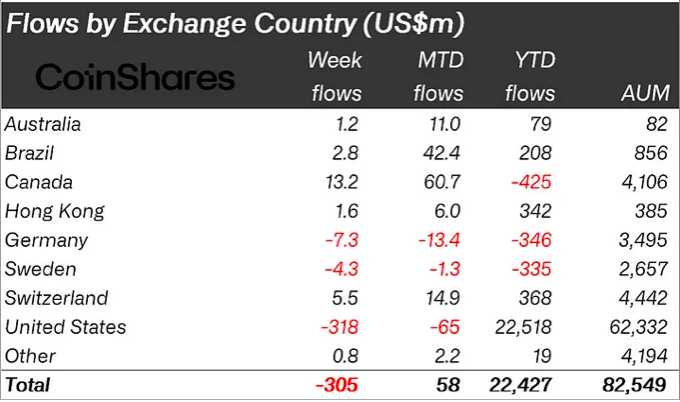
Last week flows by country: Source: CoinShares

The US led the negative net flows regionally with $318 million outflows from August 26 to August 31. Additionally, the country has seen the highest outflows Month-to-Date (MTD), registering $65 million in negative flows.

Comparatively, Germany and Sweden saw $7.3 million and $4.3 million in outflows last week. These countries also ranked second and third in MTD negative flows, with $13.4 and $1.3 million in outflows, respectively.

Meanwhile, Canada led the positive net flows with inflows totaling $13.2 million despite being the country with the largest outflows Year-to-Date (YTD). The digital asset manager expects crypto assets and the market sentiment to continue being highly sensitive to the interest rate expectations:

 We continue to expect the asset class to become increasingly sensitive to interest rate expectations as the FED gets closer to a pivot.

Negative Sentiment Focuses On Bitcoin

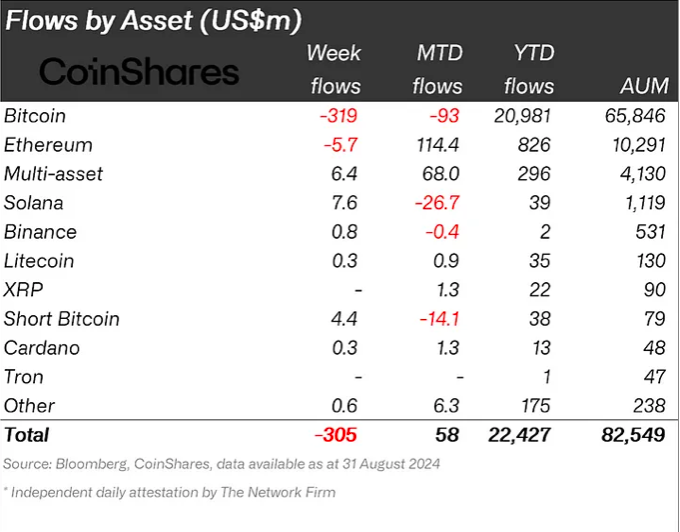
Per the report, Bitcoin, the flagship cryptocurrency, led the negative sentiment with $319 million in outflows, followed by Ethereum’s $5.7 million. The downturn was focused on Bitcoin ETFs (exchange-traded funds), which registered most of the losses by investment products.
crypto

Last week flows by asset. Source: CoinShares

ARK 21Shared Bitcoin ETF (ARKB) was the exchange-traded product (ETP) with the largest negative flow, seeing $220.95 million in outflows. Grayscale Bitcoin Trust (GBTC) and ProShares Bitcoin Strategy ETF (BITO) saw $119.19 million and $78.28 million respectively.

Nonetheless, iShares Bitcoin Trust ETF (IBIT) topped the inflows list with a remarkable $210.55 million positive net flow. Similarly, Short BTC investment products registered a second consecutive week of inflows with $4.4 million, the largest since March 2024.

Ethereum’s trading volumes were stagnated in the past week. Per the report, ETH-based products saw volume levels comparable to those before the spot ETH ETFs launched. Moreover, these levels only accounted for 15% of the volume registered on US ETFs launch week.

According to Farside Investors’ data, Ethereum ETFs showed no activity on Friday. The ETH investment products saw no inflows or outflows across all issuers on August 30, which has not been seen since the launch of US spot crypto-based ETFs in January.

It’s worth noting that, throughout the week, ETH ETFs registered minimum activity, with most issuers seeing no volume and Grayscale Ethereum Trust (ETHE) showing negative numbers. Conversely, Solana-based products saw $7.6m in inflows last week.
crypto, TOTAL

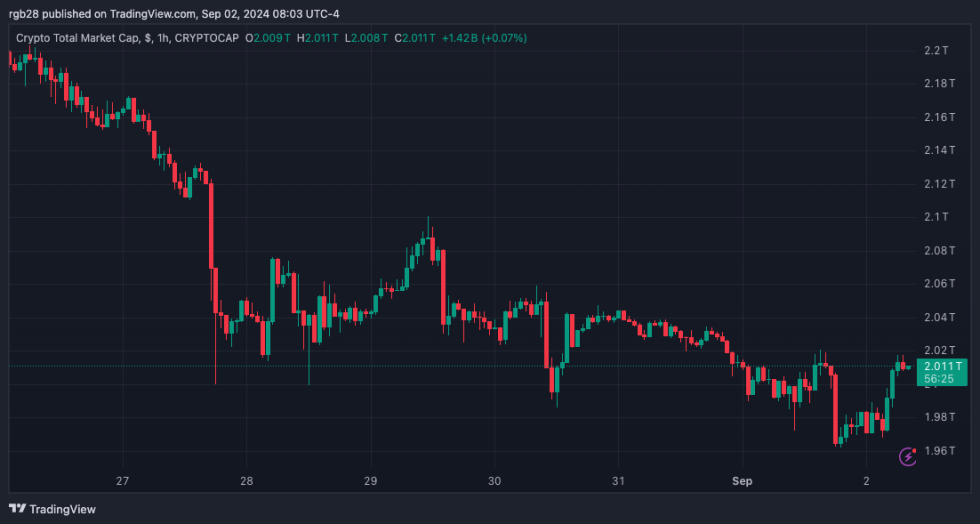
Total crypto market capitalization is at $2.01 trillion in the weekly chart. Source: TOTAL on TradingView
Featured Image from Unsplash.com, Chart from TradingView.com
Rubmar Garcia

Rubmar Garcia

Rubmar is a crypto enthusiast who likes learning and improving constantly. She enjoys reporting on the latest news and developments in the crypto industry. Rubmar also enjoys scrapbooking, crafting, simulation games, and watching football.

İlgili Okumalar

SpaceX Faces Heavy Selling After IPO Followed by Massive Bond Issue 'Angers' the Market

Following a record-breaking IPO, SpaceX's massive $25 billion bond issuance faced fierce selling pressure in the secondary market. The aggressive financing pace of the long-unprofitable rocket and AI company quickly backfired, eroding investor confidence and causing its bond spreads to widen sharply, nearing speculative-grade ("junk") levels. Within 48 hours of pricing, SpaceX's bonds plummeted. The 10-year bond yield rose to nearly 6%, with its spread over US Treasuries widening to over 160 basis points (bps). Longer-dated bonds saw spreads surge to 193 bps and 201 bps, significantly worse than the average spread for BB-rated junk bonds at 167 bps. This rapid deterioration shocked fixed-income traders. Initial strong demand, with nearly $90 billion in orders, was driven largely by short-term speculative "fast money" rather than traditional buy-and-hold investors. When these funds sought quick profits, heavy selling ensued. Analysts describe a "perfect storm" caused by SpaceX's post-IPO market cap decline, technical selling pressure from the enlarged deal size, and investor uncertainty in pricing its unique risk profile. The core concern for bond investors is SpaceX's fundamentals: while it reported $18.7 billion in 2025 revenue, it posted a net loss of $4.9 billion. Creditors focus on actual cash flow for debt repayment, not future growth expectations tied to AI. Heavy reliance on CEO Elon Musk's leadership and weak corporate governance were also cited as key credit weaknesses. The selloff highlights broader systemic risks as tech giants embark on a massive debt spree to fund AI projects. AI-related debt issuance has soared 357% year-to-date. This supply surge is increasing sector leverage and putting pressure on credit spreads across the market, potentially threatening the tech capital expenditure cycle if the pace continues.

marsbit35 dk önce

SpaceX Faces Heavy Selling After IPO Followed by Massive Bond Issue 'Angers' the Market

marsbit35 dk önce

Metrics Ventures Market Observation: The World's Fragility is Rapidly Accumulating

Metrics Ventures' market observation highlights the rapid accumulation of global fragility. Since 2022, persistent supply chain disruptions have progressively eroded the economic resilience and policy autonomy of nations like Japan, South Korea, and Europe, building momentum for potential future capital market shocks. Market trends reveal a liquidity drought across most sectors except AI and specific commodities. Vulnerable economies are increasingly doubling down on concentrated trades—a risky strategy unlikely to succeed in the current geopolitical climate. For cryptocurrency markets, these global pressures have formed a significant overhang since late last year, raising the unprecedented need to evaluate the possibility of MSTR liquidating part of its BTC holdings. Furthermore, the appeal of BTC as a short-side hedge against other assets is growing, presenting a challenging medium-term outlook. Technically, key markets are at critical junctures: Japanese and Korean equities face major resistance, the US Dollar Index has broken past a year-long ceiling, and the US 2-Year Treasury yield shows an upward trend. A potential sudden liquidity contraction could trigger algorithm-driven sell-offs from leveraged funds, amplifying global volatility. While precious metals like gold and silver may face short-term pressure, such a shakeout could precede a major rally. For Bitcoin, a deeper-than-expected correction is a plausible scenario within this risk-release cycle. Despite unforeseen events like the Hormuz situation shaping H2, this period of elevated risk also presents significant opportunities.

marsbit38 dk önce

Metrics Ventures Market Observation: The World's Fragility is Rapidly Accumulating

marsbit38 dk önce

İşlemler

Spot
活动图片