Более 60% трейдеров на pump.fun потеряли деньги

investing.ru2024-08-22 tarihinde yayınlandı2024-08-22 tarihinde güncellendi

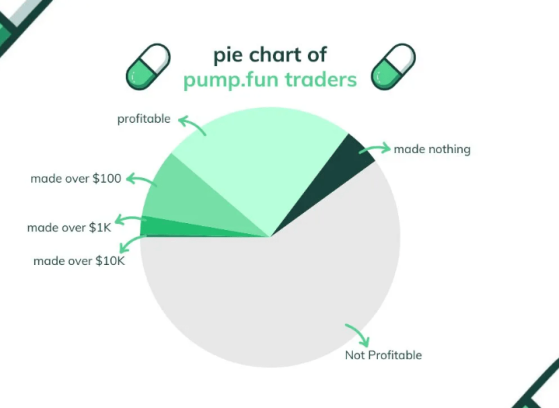
Happycoin.club - Только 3% трейдеров, торгующих мемными токенами на платформе pump.fun, заработали более $1000. Менее 0,8% пользователей площадки получили прибыль свыше $10 000.

Согласно данным аналитического сервиса Dune, у большинства трейдеров на pump.fun не было ни одной прибыльной сделки, несмотря на то, что ежедневно на платформе запускаются тысячи мемкоинов.

Главная проблема платформы для генерации мемкоинов на базе Solana состоит в том, что процент запуска созданных там токенов составляет всего 1,21%-1,41%. Другим словами, более 98% шуточных активов не получают дальнейшего развития.

Так, за последние 24 часа менее 160 из 10 700 мемных токенов, созданных на pump.fun, попали из сервиса в децентрализованный протокол Raydium на базе Solana. Большая часть сгенерированных за сутки активов либо осталась на прежнем уровне, либо потеряла объём и ликвидность, поскольку трейдеры поспешили зафиксировать прибыль или сократить свои убытки.

Это означает, что большинство токенов не смогли бы даже достичь рыночной капитализации в $60000, которая необходима, чтобы актив попал в пул ликвидности Raydium. Только в этом случае мемкоин считается запущенным.

Слабые показатели трейдеров и маленький процент запуска мемкоинов не мешает pump.fun зарабатывать – с 10 по 17 августа доходы платформы составили $6,3 млн. Это более чем в два раза больше апрельского показателя в $2,5 млн и на 50% больше доходов, полученных в мае.

Читайте оригинальную статью на сайте Happycoin.club
İlgili Okumalar

Dialogue with BNB Chain Growth Executive Director: Why Am I Bullish on BNB's Next Decade?

Nina Rong, the newly appointed Growth Executive Director at BNB Chain, discusses the platform's future and growth strategies in an interview. She highlights the success of the recent BNB Chain hackathon in Abu Dhabi, noting the participation of non-blockchain developers—including a winning student team—as a positive signal for broader adoption. Having transitioned from Arbitrum to BNB Chain, Nina emphasizes BNB’s strengths: a strong technical team, a large and active user base, and mature infrastructure. She believes these elements form a significant barrier to entry for new Layer 1 competitors, making it difficult for them to reach BNB Chain’s scale. Nina outlines her growth strategy focused on three core user groups: retail users, institutional players, and developers. While the Chinese-speaking community remains a key strength, she plans to expand into欧美, Latin American, and Middle Eastern markets with tailored approaches—such as focusing on institutional partnerships in the U.S. and developer outreach in Latin America. She advises newcomers to Web3 to embrace a founder’s mindset, stay engaged with the market through hands-on participation, and continuously build industry knowledge. For those interested in joining BNB Chain or building on the ecosystem, she encourages direct outreach via social channels and values candidates with deep market insight and execution drive.

marsbit14 dk önce

Dialogue with BNB Chain Growth Executive Director: Why Am I Bullish on BNB's Next Decade?

marsbit14 dk önce

Solana Users Beware: Your SOL Is Being Quietly Harvested in These Ways

A recent article titled "Payment for Order Flow on Solana" has exposed exploitative practices in Solana’s fee market, drawing widespread attention. Similar to traditional finance PFOF models—like Robinhood’s zero-commission trading—Solana applications are leveraging information asymmetry to extract hidden fees from users. Front-end apps and wallets control transaction routing, execution, and fee structures, creating multiple avenues for rent-seeking. These include selling user order flow to market makers, enabling toxic MEV strategies like sandwich attacks, and inflating priority fees and tips. Users—especially retail—are often overcharged due to fear of transaction failure, even when the network isn’t congested. Data shows significant fee disparities: for instance, Axiom users pay median priority fees 200x higher than those paid by high-frequency traders. Much of these excess fees are believed to be captured by the applications themselves, often through kickback arrangements with landing services like Jito. To address these issues, Solana is proposing protocol-level upgrades such as Multiple Concurrent Proposers (MCP) to reduce monopolistic control, Priority Ordering to ensure fair transaction ordering, and a Dynamic Base Fee mechanism to return fee pricing power to the protocol and users. These changes aim to create a more transparent and equitable market structure, essential for Solana’s long-term growth and credibility.

marsbit27 dk önce

Solana Users Beware: Your SOL Is Being Quietly Harvested in These Ways

marsbit27 dk önce

İşlemler

Spot
Futures

Popüler Makaleler

Tartışmalar

HTX Topluluğuna hoş geldiniz. Burada, en son platform gelişmeleri hakkında bilgi sahibi olabilir ve profesyonel piyasa görüşlerine erişebilirsiniz. Kullanıcıların PUMP (PUMP) fiyatı hakkındaki görüşleri aşağıda sunulmaktadır.

活动图片