MATIC 价格预测:Polygon 能否上涨到 1.15美元

金色财经2024-08-05 tarihinde yayınlandı2024-08-05 tarihinde güncellendi

图片

MATIC 价格上涨超过 5%,并测试了 0.950 美元的阻力位。多边形多头完全掌控局面,他们可能会瞄准 1.00 美元以上的更多上涨空间。

多边形价格开始新一轮上涨

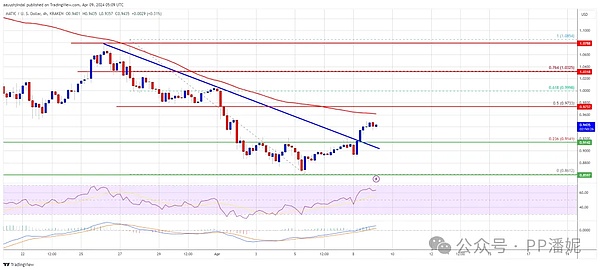
在 0.8620 美元上方形成基础后,Polygon 的价格开始新一轮上涨。MATIC 清除了 0.880 美元和 0.8950 美元附近的许多障碍,进入积极区域,如比特币和以太坊。

还突破了 0.90 美元阻力位和 100 简单移动平均线(4 小时)。多头将价格推升至 23.6% 斐波那契回撤位(从 1.0854 美元的波动高点跌至 0.8612 美元的低点)。

此外,MATIC/USD 货币对的 4 小时图表上突破了关键看跌趋势线,阻力位为 0.9150 美元。MATIC 的交易价格高于 0.9250 美元和 100 简单移动平均线(4 小时)。

直接阻力位于 0.960 美元区域附近。第一个主要阻力位在 0.9720 美元附近,即从 1.0854 美元波动高点到 0.8612 美元低点的下行走势的 50% Fib 回撤位。如果向上突破 0.9720 美元阻力位,价格可能会继续上涨。
图片

下一个主要阻力位在 1.00 美元附近。明显突破 1.00 美元阻力位可能会开始稳步上涨。在上述情况下,价格甚至可能尝试升至 1.100 美元或 1.150 美元水平。

MATIC 的跌幅有限吗?

如果 MATIC 的价格未能升至 0.9720 美元的阻力位上方,则可能会开始下行修正。下行的直接支撑位于 0.915 美元水平和同一趋势线附近。

主要支撑位在 0.880 美元附近。跌破 0.880 美元水平可能为新一轮跌向 0.8620 美元打开大门。下一个主要支撑位在 0.8250 美元附近。

技术指标:

4 小时 MACD – MATIC/美元 MACD 在看涨区域中获得动力。

4 小时 RSI(相对强弱指数)——MATIC/USD 的 RSI 目前高于 50 水平。

主要支撑位 – 0.9150 美元和 0.880 美元。

主要阻力位 – 0.9720 美元、1.00 美元和 1.15 美元。
İlgili Okumalar

Wall Street Begins to Question Tech Giants' AI Narrative

Wall Street Questions the AI Narrative of Tech Giants Wall Street is shifting its focus from the hype surrounding artificial intelligence (AI) to a rigorous financial reality check. Following strong earnings reports from companies like Google and a massive $500 billion financing initiative from Nvidia for AI infrastructure, the market reaction has been mixed and skeptical. The core concern revolves around the massive capital expenditure (CapEx) required for AI development—building data centers and acquiring chips—and whether future cash flows can justify these upfront costs. Investors are now scrutinizing free cash flow (FCF), which measures the cash left after operational expenses and capital investments. A negative FCF, as seen recently with Alphabet (Google's parent company), signals heavy immediate spending, even if profits are growing. The divergent stock reactions highlight this new scrutiny. Microsoft's stock surged after its earnings, supported by strong operating cash flow, growing cloud revenue (Azure), and a large backlog of committed business. In contrast, Alphabet's stock fell despite profit growth because its capital spending caused FCF to turn negative for the first time. Similarly, Nvidia's announcement of a $500 billion financing platform, while potentially expanding its market, raised questions about whether AI build-out has become too expensive for tech companies to fund internally. Analysts are moving beyond simply asking if there is AI demand—which cloud revenue growth confirms—to deeper questions: the speed at which AI investments translate into revenue, profit, and ultimately, cash returns. The market is evaluating the "return on invested capital" (ROIC) over the long term, considering factors like rapid chip obsolescence, energy costs, and future competition. In summary, Wall Street's AI narrative is evolving from grand vision to a detailed financial and operational examination. The key question is no longer if AI is transformative, but whether companies can generate cash returns fast enough to outpace the immense costs of building it. Free cash flow has become a critical first filter in this reassessment.

marsbit48 dk önce

Wall Street Begins to Question Tech Giants' AI Narrative

marsbit48 dk önce

An Unexpected Player Enters the Lithography Machine Arena

In the spring of 2026, Elon Musk unveiled the TeraFab chip manufacturing plan, aiming to meet the immense computing power needs of SpaceX and Tesla. He subsequently signaled a move into the photolithography machine market, with speculation centering on a Free Electron Laser (FEL) approach to challenge the dominance of traditional EUV technology. Currently, ASML, utilizing Laser-Produced Plasma (LPP) EUV光源, holds a near-monopoly. However, LPP faces bottlenecks in energy conversion efficiency, tin debris contamination, and a power ceiling. In contrast, FEL technology, pursued by companies like xLight (where former Intel CEO Pat Gelsinger serves as executive chairman), offers a different path. It generates EUV light by accelerating electrons, potentially providing higher power without plasma conversion and its associated contamination, targeting the sub-13.5nm "beyond-EUV" wavelength range. The photolithography landscape shows three main trajectories: ASML's incremental evolution (like High-NA EUV),光源革新 like FEL targeting ASML's core component, and non-EUV alternatives like Nanoimprint Lithography (NIL) or Electron Beam Lithography (EBL). While ASML remains the dominant player with strong financials and产能 expansion plans, new entrants are challenging the status quo. xLight claims its FEL could boost productivity by 50-100%. Other paths include Substrate's particle-accelerator-based X-ray lithography and Chinese research into LPP alternatives. Musk's TeraFab is a high-stakes bet that FEL can move from lab to fab, that "plug-and-play"光源 replacement can circumvent ASML's ecosystem, and that massive future compute demand justifies a new supply chain. His public endorsement of FEL signifies that the photolithography business is no longer ASML's game alone.

marsbit49 dk önce

An Unexpected Player Enters the Lithography Machine Arena

marsbit49 dk önce

İşlemler

Spot
活动图片