Beyond the Model Lies the Harness: Deepseek Enters the Arena, Why Has the Main Battlefield of China's AI Competition Shifted?
In mid-to-late May 2026, Deepseek internally established a new Harness team focused on code agent products, internally benchmarked against Anthropic's Claude Code. This move, marked by the formula "Model + Harness = Agent" in their job postings, signals a major shift in China's AI competition: the main battlefield is transitioning from developing large models to building toolchains and achieving workplace integration.
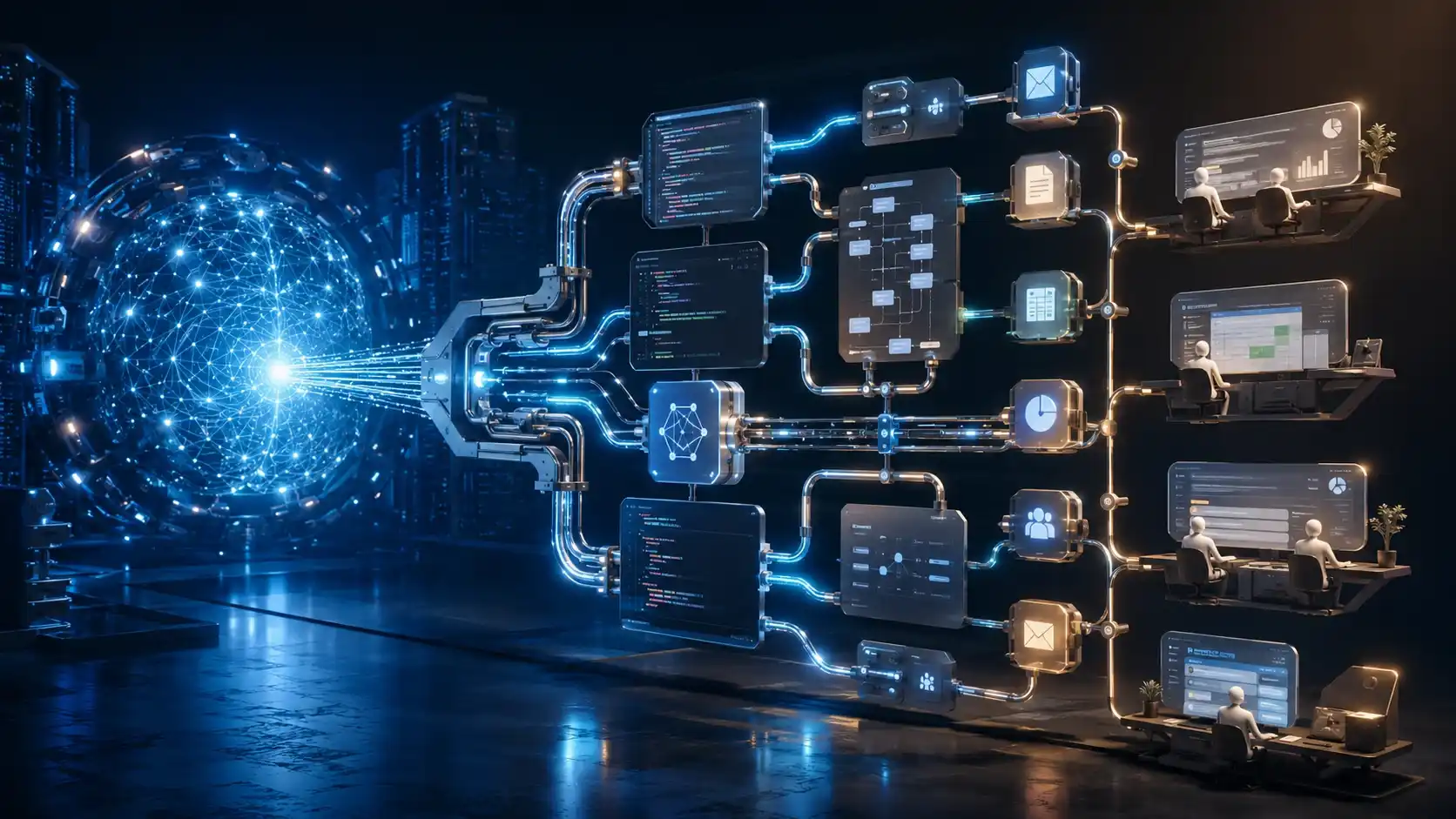
Deepseek's direct involvement in Harness development aims to secure control over interface design and training data feedback loops, moving beyond open-sourcing powerful models. Harness, the runtime infrastructure for AI agents, handles everything beyond model reasoning—task orchestration, tool calling, context management, safety checks, and error recovery. It is crucial because agent products are not just outputs of model capability but also training grounds for it. Real-world task failures recorded by Harness can feed back into model training, creating a flywheel effect. Engineering Harness is more critical than optimizing prompts, as poor context management or error handling can drastically reduce agent success rates in multi-step, real-world scenarios.
This shift is not isolated. Other major Chinese tech companies are also pursuing differentiated toolchain strategies. Tencent leverages its enterprise ecosystem (WeChat Work, Tencent Cloud) to build connectors for organizational-level AI collaboration and complex task delivery. Alibaba focuses on lowering automation barriers on the web with a front-end, browser-based GUI Agent framework, PageAgent. This diversification shows the industry recognizes that success lies not in a perfect general agent, but in vertically focused solutions built with robust engineering.
The trend is validated by overseas success, such as Poland's Viktor, an AI coworker on Slack achieving $20M ARR by autonomously executing complex, multi-step tasks. This proves a shift in enterprise willingness to pay—from "AI-assisted generation" to "AI-autonomous execution." As Harness matures to provide safety guards and reliability, AI transitions from a human-supervised intern to an independent outsourcer.
The competition now faces key engineering challenges: preventing "token explosion" through intelligent context compression, and building "thick frameworks" with features like sandbox isolation and checkpoint recovery for enterprise-grade stability. Geopolitical restrictions on tools like Claude Code further create a significant market vacuum for domestic solutions like Deepseek's Harness.
For enterprises and developers, the focus must shift from comparing model benchmarks to evaluating a vendor's engineering capabilities, error recovery mechanisms, context management, and ecosystem compatibility when choosing AI products and platforms.
marsbit46 dk önce
:format(jpg)/cloudfront-us-east-1.images.arcpublishing.com/coindesk/G7ON4KI3D5C2DOXNGZQ6CGD544.png)