2026 TradFi x Crypto Outlook: 8 Macro Forces and 7 Investment Trends Driving 2026

marsbit2026-01-22 tarihinde yayınlandı2026-01-22 tarihinde güncellendi

Özet

CoinFound's "TradFi x Crypto 2026 Outlook" report identifies 2025 as an inflection point of convergence and predicts an acceleration of "programmable finance" in 2026. It outlines eight key macro forces, including a fiat currency trust crisis driving demand for hard assets like Bitcoin, geopolitical shifts fostering parallel blockchain-based settlement systems, and AI automation necessitating machine-to-machine payments. The report also highlights seven major investment trends, forecasting a structural explosion in the RWA market, with stablecoins reaching a $320B base. Key developments include the evolution of stablecoins 2.0 competing for global payment infrastructure, rapid growth in tokenized stock liquidity, and a shift in private credit RWA towards asset-driven models due to default risks. A major prediction for 2026 is the shift of RWA from yield-bearing assets to high-frequency trading instruments, accompanied by credit expansion into riskier assets like corporate bonds. The overarching theme is the unification of TradFi and Crypto under "On-chain Finance," though the complexity of off-chain defaults triggering on-chain liquidations remains a significant systemic risk.

Author: CoinFound,A TradFi × Crypto Data Technology Company

On January 21, CoinFound officially released the "CoinFound Annual Report: TradFi x Crypto 2026 Outlook." This report focuses on the deep integration trends between TradFi and Crypto. Below is a summary of the report's content:

2025 is the "tipping point for integration," and 2026 will enter an acceleration period for "programmable finance."

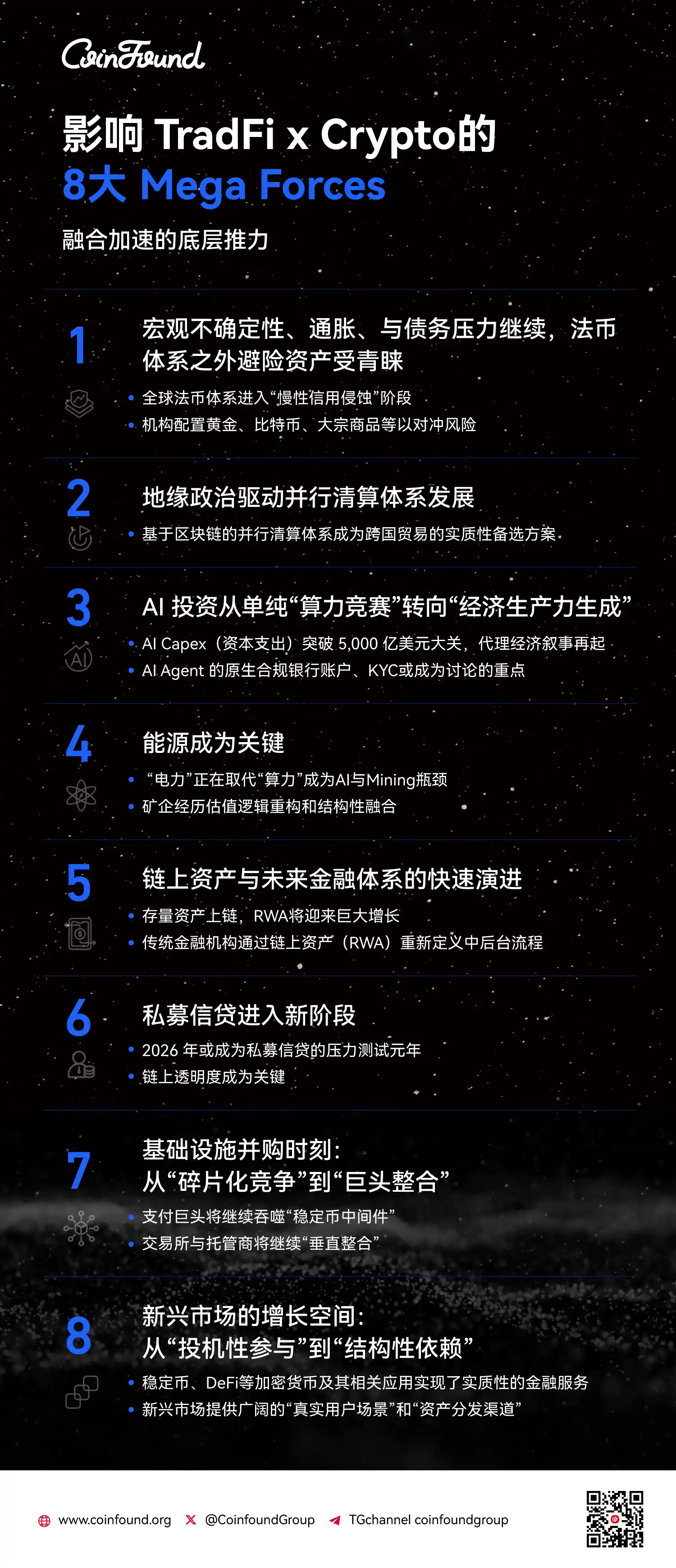
The report distills 8 Mega Forces and 7 trend outlooks: from Stablecoin 2.0 competing for global payment infrastructure, to RWA moving from "issuance" to "utility," and key variables such as stock tokenization, and the divergence and concentration of DATs.

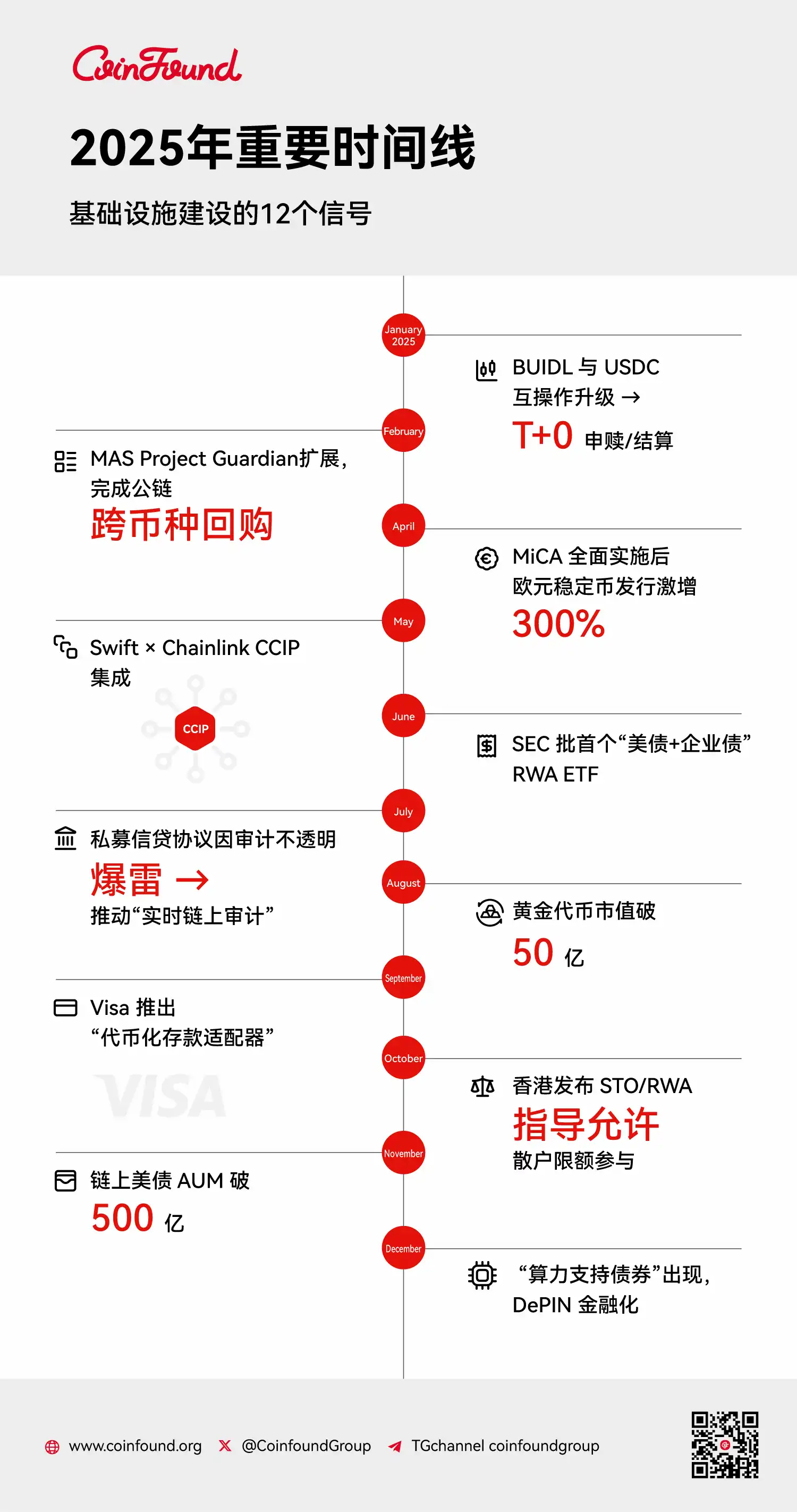
2025 Timeline of Key Events for Traditional Finance x Crypto
In 2026, the following macro trends will impact the TradeFi x Crypto field:

  • Fiat System Trust Crisis and Return to Hard Assets: Facing a global debt spiral and "fiscal dominance" risks, institutions are accelerating allocations to "hard assets" like gold, Bitcoin, and commodities to hedge against fiat currency credit erosion.
  • Geopolitics Driving the Implementation of Parallel Clearing Systems: The need for "de-weaponization" of financial infrastructure is pushing blockchain as an alternative settlement solution independent of SWIFT, with atomic settlement mechanisms effectively reducing trust and counterparty risks in cross-border transactions.
  • AI Productivity Monetization and the Rise of Machine Payments: The focus of AI investment is shifting from computing hardware to generating economic productivity, spurring a rigid demand from AI Agents for compliant stablecoins and on-chain automatic settlement to achieve value attribution between machines.
  • Energy as a Core Asset and the Infrastructure-ization of Mining Companies: Power shortages are driving mining companies to transform into "hybrid computing centers." Their scarce power access rights (Time-to-Power) are triggering acquisitions by tech giants, driving the revaluation of mining companies towards data center infrastructure.
  • On-Chain Assets (RWA) Moving from Issuance to Utility: Asset tokenization is entering the "programmable finance" stage. RWA is no longer just a digital certificate but serves as 24/7 core collateral, significantly enhancing the capital efficiency of repo markets and全域 liquidity.
  • Private Credit Faces Stress Tests and Transparent Transformation: The 2026 debt maturity wave may trigger default risks, forcing the industry to shift from "black boxes" to real-time on-chain transparent audits based on zero-knowledge proofs (ZK) to avoid DeFi chain liquidation crises.
  • Infrastructure Moves from Fragmented Competition to Giant Consolidation: The market is entering a consolidation period similar to the telecommunications industry. Payment and financial giants are acquiring stablecoin middleware and custodians to secure their positions, eliminating redundancy and building compliance moats. Emerging markets shift from speculation to structural dependence: Crypto assets have deepened into underlying tools for payments and remittances in emerging markets. Vast real-user scenarios make them a core hub connecting traditional financial assets with global retail liquidity.

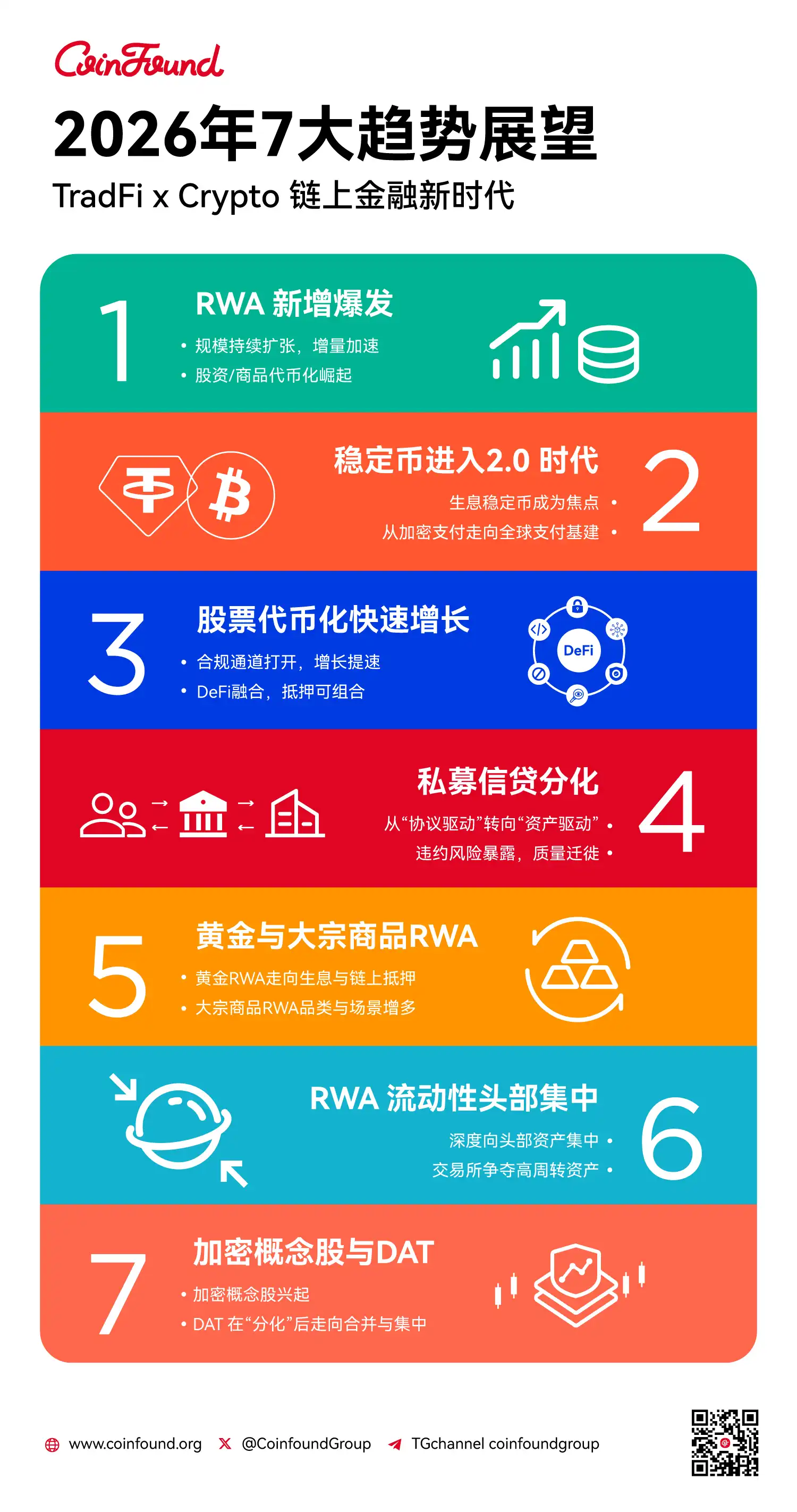
The trend outlook for 2026 is as follows:

1. Structural explosion in the RWA market, stablecoins forming a base of a 3200 billion market, equities and commodities becoming new growth points

2. Stablecoins enter the 2.0 era, moving from crypto payments to competing for global payment infrastructure

3. Stock tokenization liquidity may grow rapidly, DeFi integration will be key

4. Private credit RWA shifts to "asset-driven," may accelerate differentiation under "default" risk pressure

5. Gold and commodity RWA usher in a new era of "full asset collateral"

6. RWA liquidity will further concentrate, three types of RWA assets are gaining favor with exchanges

7. The "rise" of crypto concept stocks, the "divergence" and "concentration" of DATs
Summary

2025 Summary: 2025 was a year of "demystification and integration" for TradeFi and Crypto. Blockchain technology is being还原 (restored) from the光环 (halo) of "revolution" to an efficient bookkeeping and settlement technology. The success of treasury RWA proved the feasibility of putting traditional assets on-chain, and the full entry of giants like BlackRock provided irreversible credit endorsement for the industry.

2026 Prediction: 2026 will be a year of "secondary market explosion and credit expansion." We judge:

  • Liquidity Explosion: With the improvement of infrastructure, RWA will shift from "hold-to-earn" to "high-frequency trading."
  • Credit Downward Drift: Asset classes will drift down from high-credit government bonds to corporate bonds, stocks, and emerging market credit. Risk Premium will become a new source of yield.
  • Risk Warning: As the scale of RWA expands, the complexity of off-chain default transmission to on-chain liquidation will be the biggest systemic risk.

In 2026, both TradeFi and Crypto will be unified under the banner of "On-chain Finance."

Full report link for "CoinFound Annual Report: TradFi x Crypto 2026 Outlook": https://app.coinfound.org/zh/research/4


İlgili Sorular

QWhat are the 8 Mega Forces that will influence the TradFi x Crypto field in 2026 according to the CoinFound report?

AThe 8 Mega Forces are: 1. Fiat system trust crisis and the return to hard assets. 2. Geopolitics driving the implementation of parallel clearing systems. 3. AI productivity realization and the rise of machine payments. 4. Energy as a core asset and the infrastructuralization of mining companies. 5. On-chain assets (RWA) moving from issuance to utility. 6. Stress testing and transparency transformation in private credit. 7. Infrastructure moving from fragmented competition to giant integration. 8. Emerging markets shifting from speculation to structural dependence.

QWhat are the 7 key investment trends outlined for 2026 in the report?

AThe 7 key investment trends for 2026 are: 1. Structural explosion of the RWA market with stablecoins forming a $320B base. 2. Stablecoins entering the 2.0 era, competing for global payment infrastructure. 3. Rapid growth in stock tokenization liquidity, with DeFi integration being key. 4. Private credit RWA shifting to 'asset-driven' models, potentially accelerating differentiation under default risk. 5. Gold and commodity RWA ushering in a new era of 'full-asset collateralization'. 6. Further concentration of RWA liquidity, with three types of RWA assets favored by exchanges. 7. The rise of 'crypto concept stocks' and the 'differentiation' and 'concentration' of DATs.

QHow does the report summarize the key difference between 2025 and the predicted landscape for 2026?

AThe report summarizes 2025 as a year of 'disillusionment and integration' where blockchain technology was reduced from a 'revolutionary'光环 to an efficient bookkeeping and settlement technology. In contrast, it predicts 2026 will be a year of 'secondary market explosion and credit expansion', characterized by liquidity爆发 (shifting from 'holding for yield' to 'high-frequency trading'), credit下沉 (expanding from high-credit sovereign bonds to corporate bonds, stocks, and emerging market credit for risk premium), and new systemic risks from off-chain defaults triggering on-chain liquidations.

QWhat is identified as the major systemic risk associated with the growing RWA market in 2026?

AThe major systemic risk identified is the complexity of off-chain asset defaults (Off-chain Default) triggering chain上清算 (On-chain Liquidation) as the scale of Real-World Assets (RWA) expands.

QWhat overarching concept does the report predict will unify both TradFi and Crypto by 2026?

AThe report predicts that by 2026, both TradFi and Crypto will be unified under the banner of 'On-chain Finance'.

İlgili Okumalar

From South Korea to the United States: Blue-Collar Jobs Are Becoming Increasingly Popular, Thanks to AI

AI is reshaping the labor market's value proposition. The traditional four-year college degree is losing its appeal as a guaranteed career path, while skilled blue-collar trades like electricians, welders, and plumbers are experiencing historic demand and wage premiums. This shift is driven by dual pressures: AI's displacement of certain white-collar roles and a booming need for physical infrastructure and data center construction. Data confirms the trend. In the U.S., vocational school revenue surged, and a significant portion of recent layoffs are AI-related. Surveys show a majority of Gen Z adults plan to pursue blue-collar work, citing better job security against AI automation. Vocational education interest has exploded recently. Experts cite a psychological shift as younger generations seek tangible, AI-resistant careers and avoid high student debt. In many cases, salaries for skilled trades now match or exceed those requiring a bachelor's degree. In South Korea, semiconductor vocational high schools boast near-total employment, with graduates securing high-paying roles at companies like Samsung. The shortage is structural, exacerbated by a retiring baby boomer workforce and massive infrastructure projects. Companies like JPMorgan Chase, Meta, and Lowe's are investing heavily in training programs. However, overcoming historical stigma and a "perception gap" around trade careers remains a key challenge to closing the talent gap.

marsbit1 saat önce

From South Korea to the United States: Blue-Collar Jobs Are Becoming Increasingly Popular, Thanks to AI

marsbit1 saat önce

Qualcomm: AI Hype Subsides, When Will Smartphones Emerge from the Gloom?

Qualcomm reported its Q3 FY2026 results (ending June 2026), with revenue of $9.95B, down 4% YoY but above expectations. Gross margin declined to 53.1%, pressured by rising costs across manufacturing and memory. Key business segments showed mixed performance: Handset revenue fell 19.6% YoY to $5.09B, dragged by an 11% decline in non-Apple Android shipments and weaker high-end mix. Conversely, Automotive revenue surged 61% to $1.59B, and IoT grew 9% to $1.83B. Core operating profit dropped 41% YoY due to margin compression and higher expenses. Management's Q4 FY2026 guidance projects revenue of $9.7B-$10.5B, in line with consensus, but Non-GAAP EPS guidance of $2.05-$2.25 fell short of expectations. Amidst persistent weakness in its core handset market, Qualcomm is pursuing growth in AI, focusing on Edge AI (smartphones, PCs, automotive) and Data Center AI. Its data center strategy includes four pillars: AI accelerators (e.g., AI200), commercial CPUs (Dragonfly C1000), custom silicon, and connectivity solutions. While these initiatives initially boosted its stock, concerns over AI capital expenditure sustainability have since erased those gains. The company targets $5B in data center revenue for FY2027 and $15B for FY2029. The report concludes that with the traditional handset business still under pressure, the data center opportunity is currently viewed as a longer-term option, and a more conservative valuation based on core operations may be warranted until AI contributions materialize.

marsbit1 saat önce

Qualcomm: AI Hype Subsides, When Will Smartphones Emerge from the Gloom?

marsbit1 saat önce

From TPU to Self-Evolving Agents: How Jeff Dean Predicts the Next Step in AI

At the 2026 YC Startup School, Jeff Dean outlined his vision for AI's next phase, shifting focus from simply scaling models to building intelligent, autonomous systems. He believes AI's progress is no longer just about creating smarter models, but about integrating them into systems capable of long-term, iterative work, automated experimentation, and continuous learning. This evolution moves the competition from "who has the bigger model" to "who can best organize intelligence." Dean suggests AI capabilities are now comparable to a junior engineer, enabling the automation of complex workflows. However, the true challenge and opportunity lie in managing these AI "workers" at scale. He emphasizes the importance of **context engineering**—structuring tools, memory, and feedback loops—over raw model power. For startups, this means building deep expertise in niche domains where general models currently fail (near 0-1% success rates), leveraging proprietary data, specialized tools, and domain-specific evaluators. A recurring theme is re-examining fundamental constraints. Dean's past work, like moving Google's search index to memory or creating the TPU, stemmed from questioning outdated assumptions about hardware and cost. He sees similar inflection points today, particularly in **specialized inference hardware** to drastically reduce latency and energy consumption for real-time Agent operation. Notably, he points out that in modern AI systems, the dominant cost is often not computation but **data movement**. Reliable, long-running Agents require robust system design, borrowing concepts from distributed computing like checkpointing, state management, and parallel exploration to handle failures and maintain progress over days or weeks. As AI automates execution, the scarcest human skills will shift to **defining clear specifications**, **judging what problems are worth solving** (taste), and designing effective feedback loops. Ultimately, Dean's framework prioritizes understanding the problem deeply, identifying the true bottlenecks, and systematically building closed-loop systems where AI can not only perform tasks but also improve AI itself.

marsbit1 saat önce

From TPU to Self-Evolving Agents: How Jeff Dean Predicts the Next Step in AI

marsbit1 saat önce

İşlemler

Spot
活动图片