2026 Prediction Market: The Seven Differentiated Strategies for New Players to Break Through

marsbit2026-02-12 tarihinde yayınlandı2026-02-12 tarihinde güncellendi

Özet

By 2026, the prediction market landscape is expected to become highly competitive, with new entrants leveraging differentiation to capture market share. Established platforms, while holding liquidity and regulatory advantages, are often burdened by technical debt, creating opportunities for agile newcomers. Differentiation can be achieved across seven key dimensions: 1. **Product Quality**: Superior UX, API stability, transparent fees, and diverse order types. 2. **Asset Variety**: Offering exclusive markets, especially in underserved niches. 3. **Capital Efficiency**: Utilizing yield-bearing collateral and innovative margin mechanisms. 4. **Oracle & Settlement**: Enhancing reliability with hybrid or AI-driven oracles for new markets. 5. **Liquidity Provision**: Incentivizing market makers or adopting pooled liquidity models. 6. **Regulatory Compliance**: Tapping into restricted markets via localized licensing. 7. **Strategic Focus**: Choosing between horizontal (infrastructure-focused) or vertical (end-to-end user experience) approaches. Success will hinge on excelling in one or more of these areas to challenge incumbents.

Author: Jake Nyquist, Founder of Hook Protocol

Compiled by: Blockchain Knight

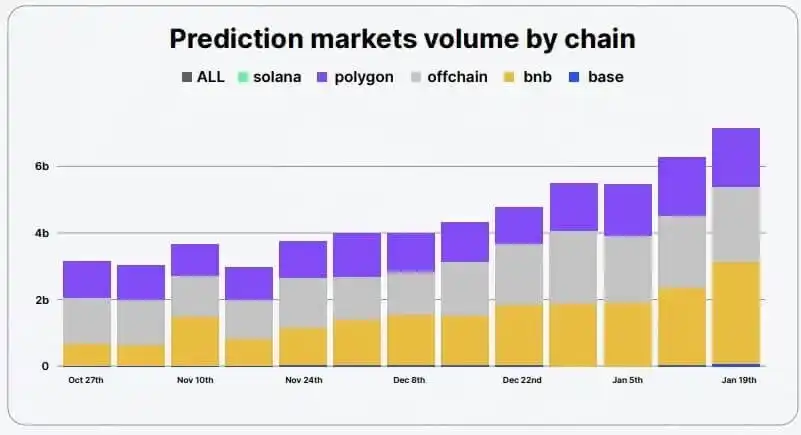
In 2026, major institutions are launching new prediction markets.

From the competitive battles of the past five years between NFTs and perpetual contract exchanges, we have learned that differentiated products can quickly capture market share.

Although leading platforms currently hold advantages in liquidity and regulation, they are burdened with heavy technical debt, making it difficult to respond flexibly to new players.

So how should newcomers compete? In my view, the core of differentiation in prediction markets revolves around seven dimensions:

1. Product Quality

Founding teams can differentiate in areas such as front-end user experience, API stability, development documentation, market structure, and fee mechanisms.

Currently, many established platforms have obvious shortcomings: unreasonable tier settings, opaque fee rules, slow and unstable APIs, and limited order types.

A high-quality product experience, especially services for API-based programmatic traders, is itself a lasting core advantage, enabling a platform to hold its ground even against competitors with stronger channel capabilities.

3. Capital Efficiency

Capital efficiency determines how effectively traders can use their collateral. Currently, there are two key levers:

First, yield-bearing collateral: Instead of letting idle funds earn only treasury yields, platforms can offer higher returns, similar to Lighter supporting LP deposits as collateral or HyENA's USDC-margined perpetual contract model.

Second, margin mechanisms. Due to gap risk, the value of leverage in prediction markets is generally underestimated. However, platforms can offer limited leverage for continuous markets or implement portfolio margin for hedging positions.

Exchanges can also subsidize lending pools or act as market-making counterparties to internalize gap risk, rather than passing losses on to users.

4. Oracles and Market Settlement

Oracle reliability remains a systemic weakness in the industry. Settlement delays and incorrect outcomes significantly amplify trading risks.

Beyond improving stability, platforms can implement innovative oracle mechanisms: human-machine hybrid systems, zero-knowledge proof-based solutions, AI-driven oracles like Context, etc., to unlock new markets that traditional oracles cannot support.

5. Liquidity Provision

Exchanges cannot survive without liquidity. Viable approaches include: paying to onboard professional market makers, using token incentives to encourage ordinary users to provide liquidity, and adopting Hyperliquid's HLP aggregated liquidity model.
Some platforms can also fully internalize liquidity, emulating FTX's model of relying on Alameda as an internal trading team.

6. Regulatory Compliance

Kalshi, with its US regulatory approval, has achieved embedded distribution through Robinhood and Coinbase, capturing retail traffic that Polymarket cannot reach.

There are still numerous jurisdictions and regulatory frameworks available for exploration. Compliant prediction markets can unlock similar channels, such as adapting to US state gambling regulations.

7. Vertical Strategy vs. Horizontal Strategy

Horizontal Strategy: Similar to Hyperliquid in the perpetual contracts space, focusing on building top-tier underlying trading infrastructure, inviting third parties to build front-ends and vertical scenarios, and encouraging ecosystem builders to add markets and develop revenue-generating front-ends (e.g., Phantom) through proposals.

Vertical Strategy: Exemplified by Lighter, which controls the front-end, launches mobile apps, and creates an end-to-end user experience, focusing on integrated experiences and direct user connections.

Polymarket's resistance to deeply embedded partnerships, contrasted with Kalshi's open attitude, is a clear reflection of the trade-offs between these two strategies.


İlgili Sorular

QAccording to the article, what are the seven key dimensions for differentiation in the prediction market competition?

AThe seven key dimensions are: 1. Product Quality, 2. Asset Types and Market Selection, 3. Capital Efficiency, 4. Oracles and Market Settlement, 5. Liquidity Provision, 6. Regulatory Compliance, and 7. Vertical Strategy vs. Horizontal Strategy.

QHow can new prediction market exchanges compete with established platforms that have liquidity and regulatory advantages?

ANew players can compete by focusing on product differentiation, such as superior user experience, stable APIs, better documentation, unique market offerings, innovative capital efficiency mechanisms, reliable oracles, creative liquidity solutions, navigating different regulatory frameworks, and adopting a focused vertical or horizontal strategy.

QWhat two core methods are mentioned for improving capital efficiency in prediction markets?

AThe two core methods are: 1. Interest-bearing collateral, which allows idle funds to earn higher yields, and 2. Margin mechanisms, which can provide limited leverage for continuous markets or portfolio margin for hedged positions.

QWhat is the difference between a horizontal strategy and a vertical strategy for a prediction market platform, as described in the article?

AA horizontal strategy, like Hyperliquid's, focuses on building top-tier underlying trading infrastructure and inviting third parties to build front-ends and verticals. A vertical strategy, like Lighter's, involves controlling the front-end, launching mobile apps, and crafting a full user experience to connect directly with users.

QWhich platform is cited as an example of using regulatory compliance to gain access to retail traffic unavailable to competitors like Polymarket?

AKalshi is cited as the example, as it leveraged its US compliance credentials to achieve embedded distribution with platforms like Robinhood and Coinbase.

İlgili Okumalar

Breaking: OpenAI Undergoes Major Reorganization, President Brockman Assumes Command

OpenAI has announced a major internal reorganization just months before its anticipated IPO. The company is merging its three flagship product lines—ChatGPT, Codex, and the API platform—into a single, unified product organization. The most significant leadership change involves co-founder and President Greg Brockman moving from a background technical role to take full, permanent control over all product strategy. This follows the indefinite medical leave of AGI Deployment CEO Fidji Simo. Additionally, ChatGPT's longtime lead, Nick Turley, has been reassigned to enterprise products, with former Instagram executive Ashley Alexander taking over consumer offerings. The consolidation, internally framed as a strategic move towards an "Agentic Future," aims to break down internal silos and create a cohesive "Super App." This planned desktop application would integrate ChatGPT's conversational abilities, Codex's coding power, and a rumored internal web browser named "Atlas" to autonomously perform complex user tasks. The reorganization occurs amid significant internal and external pressures. OpenAI has recently seen a wave of high-profile departures, including Sora co-lead Bill Peebles and other senior technical leaders, leading to concerns about a thinning executive bench. Externally, rival Anthropic recently secured funding at a staggering $900 billion valuation, surpassing OpenAI's own. Google's upcoming I/O developer conference also poses a competitive threat. Analysts suggest the dramatic restructure is a pre-IPO move to present a clearer, more focused narrative to Wall Street—streamlining operations and demonstrating decisive leadership under Brockman to counter internal turbulence and intense market competition.

marsbit58 dk önce

Breaking: OpenAI Undergoes Major Reorganization, President Brockman Assumes Command

marsbit58 dk önce

Two Survival Structures of Market Makers and Arbitrageurs

Market makers and arbitrageurs represent two distinct survival structures in high-frequency trading. Market makers primarily use limit orders (makers) to profit from the bid-ask spread, enjoying high capital efficiency (nominally 100%) but bearing inventory risk. This "inventory risk" arises from passive, fragmented, and discontinuous order fills in the limit order book (LOB). This risk, while a potential cost, can also contribute to excess profit if managed within control boundaries, allowing for mean reversion. Market makers essentially sell "time" (uncertainty over execution timing) to the market for price control and low fees. In contrast, cross-exchange arbitrageurs typically use market orders (takers) to exploit price differences or funding rates, resulting in lower nominal capital efficiency (requiring capital on both exchanges) and higher transaction costs. Their risk exposure stems from asymmetries in exchange rules (e.g., minimum order sizes), execution latency, and infrastructure risks (e.g., ADL, oracle drift). These exposures are active, exogenous gaps that primarily erode profits rather than contribute to them. Arbitrageurs essentially sell "space" (capital sunk across venues) for localized, immediate certainty. Both strategies engage in a trade-off between execution friction and residual risk. Optimal systems allow for temporary, controlled risk exposure rather than enforcing zero exposure at all costs. Their evolution converges towards hybrid models: arbitrageurs may use maker orders to reduce costs, while market makers may use taker orders or hedges for risk management. Ultimately, both use different forms of risk exposure—market makers exposing inventory, arbitrageurs immobilizing capital—to extract marginal, hard-won certainty from the market.

链捕手58 dk önce

Two Survival Structures of Market Makers and Arbitrageurs

链捕手58 dk önce

Who Will Define the Rules of the AI Era? Anthropic Discusses the 2028 US-China AI Landscape

This article, based on Anthropic's analysis, outlines the intensifying systemic competition between the U.S./allies and China for AI leadership by 2028. It argues that access to advanced computing power ("compute") is the critical bottleneck, where the U.S. currently holds a significant advantage through chip export controls and allied innovation. However, China's AI labs remain competitive by exploiting policy loopholes—via chip smuggling, overseas data center access, and "model distillation" attacks to copy U.S. model capabilities—keeping them close to the frontier. The piece presents two contrasting scenarios for 2028. In the first, decisive U.S. action to tighten compute controls and curb distillation locks in a 12-24 month AI capability lead, cementing democratic influence over global AI norms, security, and economic infrastructure. In the second, policy inaction allows China to achieve near-parity through continued access to U.S. technology, enabling Beijing to promote its AI stack globally and integrate advanced AI into its military and governance systems, altering the strategic balance. Anthropic contends that maintaining a decisive U.S. lead is essential for shaping safe AI development and governance. The core recommendation is for U.S. policymakers to urgently close compute and model access loopholes while promoting global adoption of the U.S. AI technology stack to secure a lasting strategic advantage.

marsbit2 saat önce

Who Will Define the Rules of the AI Era? Anthropic Discusses the 2028 US-China AI Landscape

marsbit2 saat önce

İşlemler

Spot
Futures
活动图片




