2026 Altcoin Season Guide: Is It Time to Welcome the Altcoin Season?

marsbit2026-07-19 tarihinde yayınlandı2026-07-19 tarihinde güncellendi

Özet

The Altcoin Season Guide for 2026 examines the phenomenon where alternative cryptocurrencies outperform Bitcoin. Defined by the Altseason Index, an altcoin season occurs when over 75% of the top 50 altcoins beat Bitcoin's returns over a rolling 90-day period, typically lasting 2-6 months. This cycle differs due to the "ETF wall," where institutional capital in Bitcoin ETFs may limit immediate flows into altcoins. A genuine season requires Bitcoin's dominance to fall below 50-55%, coupled with strength in key pairs like ETH/BTC. Historical patterns show capital rotation through distinct phases: accumulation, early narrative-driven breakouts (e.g., AI, RWA, DePIN), and a peak phase marked by high volatility and retail frenzy. Successful strategies involve portfolio diversification, sector rotation, and strict risk management. The next major altcoin season is anticipated 18-30 months post the 2024 Bitcoin halving, potentially in 2026-2027, driven by macroeconomic conditions, institutional adoption, and strong narratives in emerging sectors. Preparation involves building a watchlist of projects with solid fundamentals and active ecosystems.

Written by: Maciej Zerelik

Compiled by: AididiaoJP, Foresight News

The altcoin season kicks off when alternative cryptocurrencies start outperforming Bitcoin. However, accurately pinpointing its exact start is not easy. This guide will provide a detailed explanation of the cyclical patterns of altcoin seasons, the impact of the ETF Wall, narrative-driven sector rotations, and potential cross-chain strategies for 2026.

Understanding Altcoin Season

Definition of Altcoin Season

Many newcomers wonder, what exactly is an altcoin season, and why does it attract so much attention from crypto investors.

Altcoin season refers to a phase where at least 75% of the top 50 cryptocurrencies outperform Bitcoin over a rolling 90-day period. Analysts use this benchmark to gauge whether capital is flowing from BTC into other digital assets.

This concept became widely known during the 2017-2018 bull market. At that time, countless investors shifted Bitcoin profits into Ethereum and other smaller tokens, resulting in many altcoins delivering returns far exceeding BTC within months.

Historically, a complete altcoin season typically lasts 2 to 6 months, though the rhythm varies each cycle.

"Outperform" means that an altcoin has a higher return than Bitcoin over the same period. For example, if Bitcoin rises 25% over 90 days, and Solana rises 80%, then Solana has significantly outperformed BTC. When most leading cryptocurrencies exhibit similar performance, the market is usually considered to be in an altcoin season.

Bitcoin vs. Altcoin Dynamics: The ETF Wall

Bitcoin Dominance represents Bitcoin's share of the total cryptocurrency market capitalization. When this indicator begins to decline, investors often interpret it as a signal that capital is flowing into altcoins.

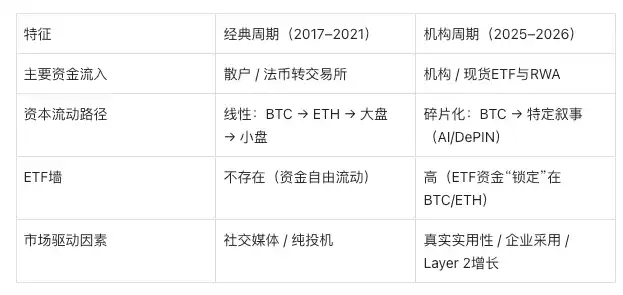
However, this market cycle is different from previous ones due to the existence of the so-called "ETF Wall."

Spot Bitcoin ETFs launched by asset managers like BlackRock and Fidelity have attracted tens of billions of dollars from institutional investors. These investors typically only gain Bitcoin exposure through regulated financial products, effectively locking this portion of capital within the BTC ecosystem.

In the 2017 bull market, retail capital could flow more freely into thousands of altcoins. In 2026, for a broad altcoin season to occur, it may require Bitcoin profit-taking alongside a new wave of retail and on-chain liquidity injection before capital can diffuse into the broader market.

Comparison between classic cycles (2017–2021) and institutional cycles (2025–2026):
How to Identify Altcoin Season

Identifying an altcoin season early can make a huge difference, as entering after the biggest gains often carries higher risks and less upside potential.

Altcoin Season Index and New 2026 Indicators

The Altcoin Season Index is one of the most popular tools for tracking market rotation. Developed by Blockchaincenter, it measures the performance of major cryptocurrencies against Bitcoin over the past 90 days on a scale of 0-100.

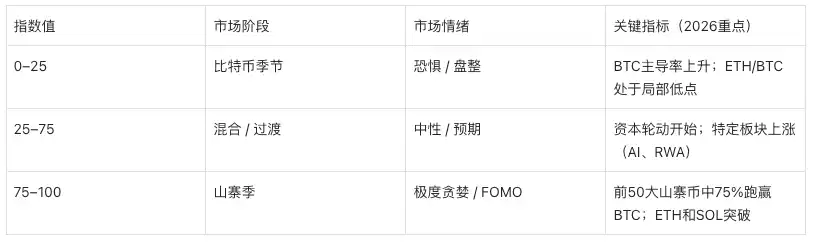
An index below 25 indicates Bitcoin season, 25-75 indicates a mixed market, and when the index rises above 75, the market is usually considered to be in an altcoin season, as most leading altcoins are outperforming BTC.
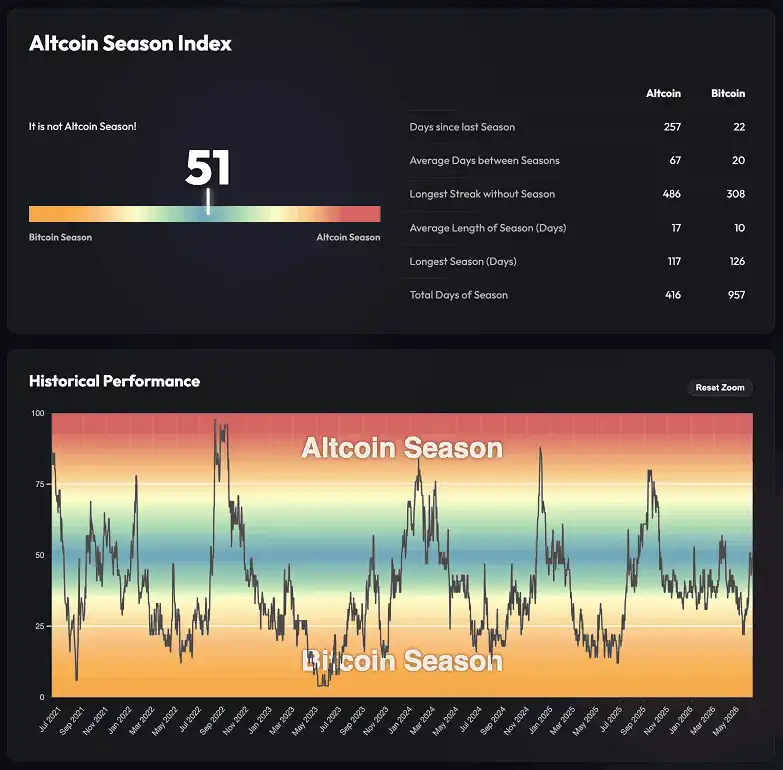
(Chart: Altcoin Season Index, BlockchainCenter, June 10, 2026)

However, the 2026 market requires additional confirmation. Many analysts now also observe the ETH/BTC and SOL/BTC trading pairs. If Ethereum and Solana fail to strengthen against Bitcoin, even if the index exceeds 75, it might only be short-term speculation rather than a sustainable rotation. Strong performance in benchmark pairs often confirms that capital has flowed from Bitcoin into the broader ecosystem.

Table of index values corresponding to market phases:
Key Metrics and Indicators

No single metric can perfectly predict the market. Experienced investors combine multiple signals to judge whether a new rotation is genuinely starting.

One of the strongest indicators is Bitcoin Dominance. When it retreats from above 50% to 40% or lower, it typically means capital is moving away from BTC into altcoins. Simultaneously, the total altcoin market cap growth rate should significantly outpace Bitcoin's, ideally by 2-3 times.

Trading activity also provides important clues. A week-over-week increase in altcoin/BTC trading volume exceeding 50% often indicates growing investor interest. Social media engagement and Google Trends can corroborate this, especially when search terms like "best altcoins" or "altcoin season" grow 30-50% within a few weeks.

When multiple indicators align, the probability of a genuine altcoin season is much higher than relying on the Altcoin Season Index alone.

Historical Altcoin Bull Run Patterns

Each major altcoin rally leaves valuable lessons, helping investors identify recurring trends and avoid emotional decisions in future cycles.

2017-2018 and 2020-2021 Bull Markets

Although both cycles produced astonishing returns, the driving forces behind them were entirely different.

The 2017-2018 altcoin season was driven by the ICO frenzy. Hundreds of new blockchain projects raised funds directly from retail investors, with speculation often outweighing fundamentals. As Bitcoin hit new highs and slowed down, capital quickly shifted to smaller tokens, with many coins surging hundreds of percent within months.

The 2020-2021 cycle followed a different path. Market focus shifted to DeFi protocols, NFT platforms, Layer 1 blockchains, and later, meme coins. Meanwhile, institutional investors entered the crypto space through companies, funds, and regulated products, bringing in capital far exceeding previous levels.

Retail investors still played a significant role in the NFT and meme coin mania, but institutional participation made the market larger and more mature. This shift also changed the way capital rotated, making the leadership role of Ethereum and key sectors more important than broad speculation. Therefore, future altcoin seasons may become increasingly selective rather than lifting all projects simultaneously.

Phases of an Altcoin Season: From BTC to Narrative-Driven

Modern altcoin cycles are no longer about all tokens rising in sync. Capital now rotates among different narratives, rewarding those sectors with the strongest adoption and momentum. Understanding these phases helps investors see where money is flowing, rather than chasing projects that have already peaked.

Phase comparison table:
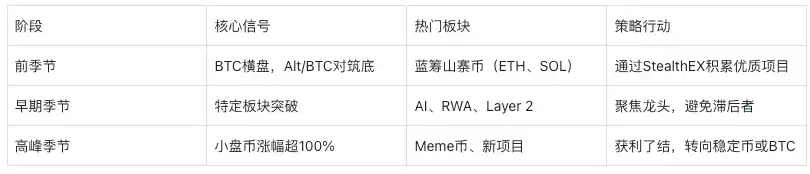
Pre-Season (Accumulation Phase)

The accumulation phase typically begins when Bitcoin is range-bound or corrects by 10-20%. During this time, many altcoins may fall another 20-40% from their local highs, leading to disappearing retail interest.

Trading volume remains low, social media activity declines, and discussions are filled with negative sentiment. Behind the scenes, experienced investors are gradually accumulating fundamentally strong projects at discounted prices.

This phase often ends when Bitcoin stabilizes, Ethereum starts outperforming BTC, and trading volume slowly recovers. For long-term investors, this is the best time to research projects, build watchlists, and establish positions before widespread market attention returns.

Early Season: Narrative-Led Breakouts

Many investors ask, when does the altcoin season start? In today's market, the answer is often linked to narratives rather than market cap.

Not all top-ten cryptocurrencies will rise simultaneously; capital first flows into the most talked-about sectors. AI agents, Real-World Assets (RWA), and DePIN projects have recently become typical examples of this trend.

The traditional strategy of buying the largest altcoins simply because they are in the top ten is much less effective. Early winners are increasingly those projects with clear use cases, growing ecosystems, and the ability to attract fresh liquidity.

Peak Season (Maximum Activity)

When mid- and small-cap coins achieve 100-500% gains within weeks, does that mean we are in the common altcoin season? In this phase, optimism reaches extremes, and the Fear & Greed Index often exceeds 80.

Retail investors aggressively buy every dip, while experienced traders begin gradually reducing positions and locking in profits. New token launches surge, leverage amplifies, and social media is flooded with unrealistic price predictions.

These conditions are often warning signs rather than buying opportunities. Rising volatility, excessive leverage, and parabolic moves typically indicate the market is approaching exhaustion. Historically, this peak phase lasts 2 to 6 weeks, followed by significant corrections or broader market rotations.

Trading Strategies for Altcoin Season

Successful altcoin investing depends on a clear plan. A structured strategy helps investors manage risk, protect profits, and avoid emotional decisions during extreme volatility.

Portfolio Allocation and Sector Rotation

A balanced portfolio should match your risk tolerance and market environment. Conservative investors allocate more capital to Bitcoin, Ethereum, and stablecoins, while aggressive traders increase exposure to high-growth sectors during strong trends.

Sector rotation is equally important. Capital rarely stays in one narrative for the entire cycle. For example, profits taken from AI-related projects may later rotate into RWA, DePIN, gaming, or other emerging sectors. Following liquidity rather than chasing past winners often yields better long-term results.

Risk Management and Stop-Loss Discipline

Even the strongest altcoin seasons eventually end, so risk management is one of the most crucial parts of any strategy.

Many experienced investors limit single positions to 5-10% of their portfolio to minimize the impact of any one trade failing. Diversifying across 8-12 carefully selected projects further reduces overall risk while maintaining exposure to multiple narratives.

Keeping a portion of the portfolio in stablecoins also provides flexibility. A stablecoin reserve allows you to buy quality assets during pullbacks and protect profits when the market overheats. Combined with preset stop-losses and profit targets, this disciplined approach often leads to more consistent outcomes than trying to maximize gains on every trade.

Altcoin Season vs. Bitcoin Season

Understanding the transition between Bitcoin season and altcoin season helps investors identify market rotations and adjust strategies before capital shifts.

Key Differences and Rotation Signals

The difference between altcoin season and Bitcoin season lies in capital flow. During Bitcoin season, BTC dominance typically rises above 50-60%, showing investor preference for the market's largest, most mature asset. Simultaneously, many altcoins underperform or decline against BTC even if their USD price is stable.

Altcoin season is the opposite story. Bitcoin dominance tends to fall back to 40% or lower, and Ethereum and other major cryptocurrencies begin to attract more liquidity. This rotation eventually spreads to mid-cap and small-cap projects, creating the cycle's strongest gains.

Investor profiles also change. Bitcoin season attracts more conservative investors and institutions seeking lower volatility and long-term exposure. Altcoin season brings more speculative capital, with traders accepting higher risk in pursuit of significantly higher returns.

Historically, Bitcoin dominant phases can last for months, while intense altcoin seasons may only last 2-6 weeks before momentum fades. Therefore, watching BTC dominance is critical. If dominance begins rising again, stablecoin inflows increase, and leading altcoins start weakening against Bitcoin, these are often early signals that capital is flowing back to BTC or defensive positions, signaling the altcoin season is about to end.

Expert Predictions and Future Outlook for Altcoin Season

While all predictions involve uncertainty, understanding altcoin season forecasts and their key catalysts can help investors build smarter long-term strategies.

When Will the Next Altcoin Season Start

Many investors ask when the altcoin season will start, but no indicator can give an exact date. Successful prediction relies on a combination of macroeconomic conditions, Bitcoin market cycles, and capital rotation.

Historically, the strongest altcoin rallies have occurred 18 to 30 months after a Bitcoin market bottom, often following a halving event. Given the most recent Bitcoin halving occurred in April 2024, many analysts believe 2026-2027 could still offer favorable conditions if liquidity continues to improve.

Macroeconomic factors will play a significant role. Lower interest rates, global liquidity expansion, and stronger investor risk appetite may encourage capital flow into high-risk digital assets. Institutional adoption will also support the market, though much investment remains concentrated in Bitcoin ETFs rather than altcoins.

Technological progress will likely shape the next cycle alongside macroeconomics. Narratives like AI infrastructure, real-world asset tokenization, DePIN, next-gen DeFi, and blockchain gaming may become the primary destinations for fresh capital. Investors should not expect all cryptocurrencies to rise in unison but should focus on sectors attracting real users, active developer engagement, and institutional attention.

When Will the 2026 Altcoin Season Start

The official confirmation of a 2026 altcoin season has not yet begun, as Bitcoin currently represents about 56-60% of the total market cap. Analysts predict that a sustained shift to altcoins will only occur when Bitcoin dominance falls below 50-55% and the Altcoin Season Index reaches the 75 threshold.

How to Prepare for the Next Altcoin Season

Preparing during calm market periods often creates better opportunities than reacting after prices have already skyrocketed. A solid plan allows you to act confidently when momentum returns.

Building a Watchlist

The best watchlists focus on quality over quantity. Before adding a project, investors should confirm it has a real product, active users, an experienced and public development team, reasonable valuation, and a strong community supporting long-term growth.

A practical research checklist should include: token utility, ecosystem activity, developer updates, partnerships, liquidity, tokenomics, and competitive advantages. Regularly reviewing these factors makes it easier to distinguish lasting projects from short-term hype.

Frequently Asked Questions

What is the current Altcoin Season Index value?

You can view the Altcoin Season Index in real-time on Blockchaincenter. A score of 0-25 indicates Bitcoin season, 25-75 indicates a mixed market, and 75-100 suggests an altcoin season. Although the index updates daily, checking weekly often provides clearer signals and avoids overtrading due to short-term noise.

When is the altcoin season coming?

Many investors ask when the altcoin season is coming, but there is no fixed date. Historically, major altcoin rallies have often occurred 12-18 months after a Bitcoin halving. While the most recent halving was in April 2024, market conditions, Bitcoin dominance, liquidity, and ETH/BTC strength are more important than the calendar.

If Bitcoin crashes, can an altcoin season still happen?

No. A broad altcoin season requires Bitcoin to remain stable or rise moderately. When Bitcoin drops more than 20% in a short period, capital typically leaves the entire crypto market rather than rotating into altcoins. Historically, significant altcoin rallies have occurred during Bitcoin consolidation or moderate uptrends, with only a few exceptions during minor BTC pullbacks.

When will altcoins surge?

The answer to when altcoins will surge usually depends on market rotation. Altcoins tend to accelerate after Bitcoin dominance peaks above 50-55% and begins to decline, while the ETH/BTC ratio strengthens. A 15-30% rise in ETH/BTC often heralds a broader rally, with capital gradually flowing from Ethereum to large-cap, then mid-cap, and finally small-cap altcoins.


Trend Kriptolar

İlgili Sorular

QWhat is the key metric used by analysts to define an 'alt season', and what does it measure?

AThe key metric used to define an 'alt season' is the Altseason Index, which measures the percentage of the top 50 cryptocurrencies that have outperformed Bitcoin over a rolling 90-day period. An index value above 75 typically indicates an alt season is underway, signaling a capital rotation from BTC into other digital assets.

QWhat is the 'ETF wall' mentioned in the article, and how does it differ from previous market cycles?

AThe 'ETF wall' refers to the massive capital inflows into spot Bitcoin ETFs from institutional investors via firms like BlackRock and Fidelity. Unlike the 2017 cycle where retail capital flowed freely into altcoins, a significant portion of institutional capital in the current cycle is locked into regulated BTC products. This creates a structural difference, potentially making a broad alt season reliant on bitcoin profit-taking and a new wave of retail or on-chain liquidity to spread to the wider market.

QAccording to the article, what additional confirmation is needed in 2026 beyond the Altseason Index to signal a sustainable alt season?

AIn 2026, analysts look for additional confirmation beyond the Altseason Index reaching above 75. Specifically, they monitor the strength of key trading pairs like ETH/BTC and SOL/BTC. If major cryptocurrencies like Ethereum and Solana are not strengthening against Bitcoin, a high index score might indicate short-term speculation rather than a sustained, broad-based capital rotation.

QWhat are the typical stages of a modern altcoin cycle as described in the guide, and what characterizes the 'Early Season'?

AThe typical stages of a modern altcoin cycle are: Accumulation Phase (Pre-Season), Early Season, and Peak Season (Maximum Activity). The 'Early Season' is characterized by narrative-led breakouts, where capital flows first into the most compelling thematic sectors (like AI agents, RWA, or DePIN projects) rather than all top altcoins rising simultaneously. Winners are increasingly projects with clear use cases and growing ecosystems.

QUnder what market condition is a broad alt season unlikely to occur, and why?

AA broad alt season is unlikely to occur if Bitcoin experiences a sharp crash. Historically, when Bitcoin drops more than 20% in a short period, capital tends to exit the entire crypto market rather than rotate into altcoins. Significant altcoin rallies usually happen during periods of Bitcoin consolidation or moderate uptrends, with only minor exceptions during slight BTC pullbacks.

İlgili Okumalar

Should Developers Build on Corporate Chains Like Base and Robinhood? Five Key Risks to Consider

Should developers build on enterprise chains like Base and Robinhood? While offering enticing initial benefits like user access, these chains pose significant risks due to the inherent conflict of interest when the operator controls both the platform and a leading on-chain application. The primary lure is the promise of traffic and user distribution (e.g., through a parent company's app). However, five key risks emerge: 1. **Direct Competition**: The platform can use its exclusive data and positioning to launch competing products against third-party developers, mirroring cases like Amazon and Microsoft. 2. **Wallet Multi-Chain Reality**: Associated wallets (like Coinbase Wallet) must support multiple chains to remain competitive, diluting the promised exclusive traffic advantage for the enterprise chain. 3. **Exclusion by Platform Rivals**: Competing platforms (e.g., Coinbase vs. Robinhood) have no incentive to promote applications built on each other's chains, limiting growth avenues. 4. **Profit Squeeze**: The party controlling the end-user interface holds superior bargaining power and can capture a disproportionate share of value, squeezing developer profits. 5. **Unfulfilled Promises**: Promised traffic support can fail to materialize due to shifting platform priorities or strategic changes. In contrast, neutral blockchains like Ethereum and Solana avoid these platform risks. To mitigate risks on enterprise chains, developers should consider strategies like securing substantial onboarding grants, obtaining formal commitments (though these have weak historical enforceability), or, most effectively, pursuing a multi-chain deployment strategy while building independent user acquisition channels. Enterprise chains may be useful for initial cold-start user acquisition, but the core goal should be cultivating an independent user base rather than long-term dependence.

Foresight News8 dk önce

Should Developers Build on Corporate Chains Like Base and Robinhood? Five Key Risks to Consider

Foresight News8 dk önce

Crypto Watch This Week: Uniswap Fee Switch Vote Starts Today, CLARITY Act Could Face Senate Vote This Week

**Weekly Crypto Watch: Key Events & Catalysts** This week’s crypto focus is on pivotal governance votes, potential regulatory progress, and major protocol upgrades. **Uniswap** takes center stage with two crucial on-chain proposals going to vote from July 19-26. The first aims to activate protocol fees for Uniswap V2/V3 on the new Robinhood Chain and direct them to a UNI token burn mechanism. The second seeks to activate V4 fees across seven major chains, including Ethereum and Base. Robinhood Chain has already seen over $60B in Uniswap volume since its launch 18 days ago. The proposals build on last year's UNIfication plan, which transformed UNI into a fee-generating asset. On the **U.S. regulatory front**, the **CLARITY Act** could face a Senate floor vote this week. While some lawmakers are optimistic, the bill faces hurdles, needing at least 60 votes to overcome a filibuster. Prediction market Polymarket currently gives it only a 34% chance of being signed into law this year. Other notable catalysts include: * **Morpho's** fixed-rate lending protocol, **Morpho Midnight**, is set for its public launch, starting with a single market (cbBTC/USDC) on Base. * **Derive** (formerly Lyra) is preparing for its largest-ever upgrade, **V3**, which will reportedly introduce 0DTE options and a more retail-friendly UX. * **Pendle** will hold a community call on July 22 to share its roadmap, with a focus on expanding its RWA (Real World Assets) capabilities. * An undisclosed privacy-focused application for **Polymarket**, built on **Starknet**, is reportedly launching on July 20.

marsbit1 saat önce

Crypto Watch This Week: Uniswap Fee Switch Vote Starts Today, CLARITY Act Could Face Senate Vote This Week

marsbit1 saat önce

Citi's Interpretation: Upgrading China, Downgrading South Korea, Is the Emerging Markets Rally Beginning to Broaden?

In its latest emerging markets strategy report, Citi has upgraded China to overweight from neutral, while downgrading South Korea to neutral from overweight. It maintains an overweight rating for China-Taiwan markets. The report sets MSCI EM index targets of 1870 by end-2026 and 2050 by mid-2027, implying further upside of approximately 12% and over 20% respectively from current levels. Citi's move reflects a search for "broadening" opportunities beyond the concentrated rally in AI hardware and tech, which has driven EM gains year-to-date, led by South Korea and China-Taiwan markets. The upgrade for China is based on factors including light investor positioning, potential benefits from lower oil prices, and relative attractiveness in a recovering global growth cycle. While maintaining a strong long-term view on South Korea, Citi notes its recent outperformance and elevated volatility prompted a tactical downgrade. The report highlights that EM earnings revisions remain narrow, with the IT sector contributing about 85% of 2026 EPS estimate upgrades. For a sustained rally, Citi argues that market gains need to broaden to other sectors and regions. China, South Africa, and Mexico rank highly as potential "broadening candidates" based on factors like sensitivity to a weaker dollar, lower bond yields, and oil prices. Key uncertainties include the sustainability of AI capital expenditure returns, geopolitical risks, and Federal Reserve policy. Citi's stance is cautiously optimistic, suggesting the rally has room to broaden rather than signaling a confirmed broad-based EM bull market. The path to higher index targets depends on whether non-tech earnings revisions improve and if capital rotates from concentrated winners into a wider set of markets.

marsbit1 saat önce

Citi's Interpretation: Upgrading China, Downgrading South Korea, Is the Emerging Markets Rally Beginning to Broaden?

marsbit1 saat önce

İşlemler

Spot

Popüler Makaleler

$S$ Nedir

SPERO'yu Anlamak: Kapsamlı Bir Genel Bakış SPERO'ya Giriş İnovasyonun manzarası gelişmeye devam ederken, web3 teknolojilerinin ve kripto para projelerinin ortaya çıkışı dijital geleceği şekillendirmede önemli bir rol oynamaktadır. Bu dinamik alanda dikkat çeken projelerden biri SPERO, $$s$$ olarak adlandırılmaktadır. Bu makale, SPERO hakkında ayrıntılı bilgi toplamak ve sunmak amacıyla, meraklılar ve yatırımcıların web3 ve kripto alanlarındaki temellerini, hedeflerini ve yeniliklerini anlamalarına yardımcı olmayı amaçlamaktadır. SPERO,$$s$$ Nedir? SPERO,$$s$$, kripto alanında merkeziyetsizlik ve blok zinciri teknolojisi ilkelerini kullanarak etkileşimi, faydayı ve finansal kapsayıcılığı teşvik eden bir ekosistem yaratmayı amaçlayan benzersiz bir projedir. Proje, kullanıcıların yenilikçi finansal çözümler ve hizmetler sunarak eşler arası etkileşimleri yeni yollarla kolaylaştırmayı hedeflemektedir. SPERO,$$s$$'nin temel amacı, bireyleri güçlendirmek ve kripto para alanındaki kullanıcı deneyimini artıran araçlar ve platformlar sağlamaktır. Bu, daha esnek işlem yöntemlerini mümkün kılmayı, topluluk odaklı girişimleri teşvik etmeyi ve merkeziyetsiz uygulamalar (dApp'ler) aracılığıyla finansal fırsatlar yaratmayı içermektedir. SPERO,$$s$$'nin temel vizyonu kapsayıcılık etrafında dönmekte olup, geleneksel finansal sistemlerdeki boşlukları kapatmayı ve blok zinciri teknolojisinin faydalarından yararlanmayı hedeflemektedir. SPERO,$$s$$'nin Yaratıcısı Kimdir? SPERO,$$s$$'nin yaratıcısının kimliği bir miktar belirsizdir, çünkü kurucusu(ları) hakkında ayrıntılı arka plan bilgisi sağlayan sınırlı kamuya açık kaynaklar bulunmaktadır. Bu şeffaflık eksikliği, projenin merkeziyetsizlik taahhüdünden kaynaklanabilir—birçok web3 projesinin paylaştığı bir etik anlayışı, bireysel tanınmanın yerine kolektif katkıları önceliklendirmektedir. Topluluk ve onun kolektif hedefleri etrafında tartışmaları merkezileştirerek, SPERO,$$s$$, belirli bireyleri öne çıkarmadan güçlendirme özünü taşımaktadır. Bu nedenle, SPERO'nun etik anlayışını ve misyonunu anlamak, tek bir yaratıcının kimliğini belirlemekten daha önemlidir. SPERO,$$s$$'nin Yatırımcıları Kimlerdir? SPERO,$$s$$, kripto sektöründe yeniliği teşvik etmeye adanmış girişim sermayedarlarından melek yatırımcılara kadar çeşitli yatırımcılar tarafından desteklenmektedir. Bu yatırımcıların odak noktası genellikle SPERO'nun misyonuyla uyumlu olup, toplumsal teknolojik ilerlemeyi, finansal kapsayıcılığı ve merkeziyetsiz yönetimi vaat eden projeleri önceliklendirmektedir. Bu yatırımcı temelleri, yalnızca yenilikçi ürünler sunan projelere değil, aynı zamanda blok zinciri topluluğuna ve ekosistemlerine olumlu katkılarda bulunan projelere de ilgi duymaktadır. Bu yatırımcıların desteği, SPERO,$$s$$'yi hızla gelişen kripto projeleri alanında dikkate değer bir rakip haline getirmektedir. SPERO,$$s$$ Nasıl Çalışır? SPERO,$$s$$, onu geleneksel kripto para projelerinden ayıran çok yönlü bir çerçeve kullanmaktadır. İşte benzersizliğini ve yeniliğini vurgulayan bazı temel özellikler: Merkeziyetsiz Yönetim: SPERO,$$s$$, kullanıcıların projenin geleceğiyle ilgili karar alma süreçlerine aktif olarak katılmalarını sağlayan merkeziyetsiz yönetim modellerini entegre etmektedir. Bu yaklaşım, topluluk üyeleri arasında sahiplik ve hesap verebilirlik duygusunu teşvik etmektedir. Token Kullanımı: SPERO,$$s$$, ekosistem içinde çeşitli işlevler sunmak üzere tasarlanmış kendi kripto para token'ını kullanmaktadır. Bu token'lar, işlemleri, ödülleri ve platformda sunulan hizmetlerin kolaylaştırılmasını sağlayarak genel etkileşimi ve faydayı artırmaktadır. Katmanlı Mimari: SPERO,$$s$$'nin teknik mimarisi, modülerlik ve ölçeklenebilirliği destekleyerek projenin evrimi sırasında ek özelliklerin ve uygulamaların sorunsuz bir şekilde entegrasyonuna olanak tanımaktadır. Bu uyum sağlama yeteneği, sürekli değişen kripto manzarasında geçerliliği sürdürmek için hayati öneme sahiptir. Topluluk Katılımı: Proje, işbirliği ve geri bildirim teşvik eden mekanizmalar kullanarak topluluk odaklı girişimlere vurgu yapmaktadır. Güçlü bir topluluk oluşturarak, SPERO,$$s$$, kullanıcı ihtiyaçlarını daha iyi karşılayabilir ve piyasa trendlerine uyum sağlayabilir. Kapsayıcılığa Odaklanma: Düşük işlem ücretleri ve kullanıcı dostu arayüzler sunarak, SPERO,$$s$$, daha önce kripto alanında yer almamış bireyler de dahil olmak üzere çeşitli bir kullanıcı tabanını çekmeyi hedeflemektedir. Bu kapsayıcılık taahhüdü, erişilebilirlik yoluyla güçlendirme misyonuyla uyumludur. SPERO,$$s$$ Zaman Çizelgesi Bir projenin tarihini anlamak, gelişim yolculuğu ve kilometre taşları hakkında kritik bilgiler sağlar. Aşağıda, SPERO,$$s$$'nin evriminde önemli olayları haritalayan önerilen bir zaman çizelgesi bulunmaktadır: Kavram Geliştirme ve Fikir Aşaması: SPERO,$$s$$'nin temelini oluşturan ilk fikirler, blok zinciri endüstrisindeki merkeziyetsizlik ve topluluk odaklılık ilkeleriyle yakından uyumlu olarak geliştirildi. Proje Beyaz Kağıdının Yayınlanması: Kavramsal aşamayı takiben, SPERO,$$s$$'nin vizyonunu, hedeflerini ve teknolojik altyapısını ayrıntılı bir şekilde açıklayan kapsamlı bir beyaz kağıt yayımlandı ve topluluk ilgisini ve geri bildirimini toplamak amacıyla sunuldu. Topluluk Oluşturma ve Erken Katılımlar: Projenin hedefleri etrafında tartışmalar yürüterek destek toplamak ve erken benimseyenler ile potansiyel yatırımcılar için bir topluluk oluşturmak amacıyla aktif iletişim çabaları gerçekleştirildi. Token Üretim Etkinliği: SPERO,$$s$$, yerel token'larını erken destekçilere dağıtmak ve ekosistem içinde başlangıç likiditesini sağlamak amacıyla bir token üretim etkinliği (TGE) gerçekleştirdi. İlk dApp'in Yayınlanması: SPERO,$$s$$ ile ilişkili ilk merkeziyetsiz uygulama (dApp) faaliyete geçti ve kullanıcıların platformun temel işlevleriyle etkileşimde bulunmalarını sağladı. Sürekli Gelişim ve Ortaklıklar: Projenin tekliflerine sürekli güncellemeler ve iyileştirmeler yapılmakta olup, blok zinciri alanındaki diğer oyuncularla stratejik ortaklıklar, SPERO,$$s$$'yi rekabetçi ve gelişen bir oyuncu haline getirmiştir. Sonuç SPERO,$$s$$, web3 ve kripto paranın finansal sistemleri devrim niteliğinde dönüştürme ve bireyleri güçlendirme potansiyelinin bir kanıtıdır. Merkeziyetsiz yönetime, topluluk katılımına ve yenilikçi tasarlanmış işlevselliğe olan bağlılığıyla, daha kapsayıcı bir finansal manzaraya doğru bir yol açmaktadır. Hızla gelişen kripto alanındaki herhangi bir yatırımda olduğu gibi, potansiyel yatırımcılar ve kullanıcılar, SPERO,$$s$$ içindeki devam eden gelişmelerle ilgili olarak kapsamlı bir araştırma yapmaları ve düşünceli bir şekilde katılmaları teşvik edilmektedir. Proje, kripto endüstrisinin yenilikçi ruhunu sergileyerek, sayısız olasılığını keşfetmeye davet etmektedir. SPERO,$$s$$'nin yolculuğu hala devam ederken, temel ilkeleri, teknoloji, finans ve birbirimizle etkileşim biçimimizi etkileyebilir.

188 Toplam GörüntülenmeYayınlanma 2024.12.17Güncellenme 2024.12.17

$S$ Nedir

AGENT S Nedir

Agent S: Web3'te Otonom Etkileşimin Geleceği Giriş Web3 ve kripto para dünyasında sürekli gelişen manzarada, yenilikler bireylerin dijital platformlarla etkileşim biçimlerini sürekli olarak yeniden tanımlıyor. Bu tür öncü projelerden biri olan Agent S, açık ajans çerçevesi aracılığıyla insan-bilgisayar etkileşimini devrim niteliğinde değiştirmeyi vaat ediyor. Otonom etkileşimlerin yolunu açarak, Agent S karmaşık görevleri basitleştirmeyi ve yapay zeka (AI) alanında dönüştürücü uygulamalar sunmayı hedefliyor. Bu detaylı inceleme, projenin karmaşıklıklarına, benzersiz özelliklerine ve kripto para alanındaki etkilerine dalacaktır. Agent S Nedir? Agent S, bilgisayar görevlerinin otomasyonunda üç temel zorluğu ele almak üzere özel olarak tasarlanmış çığır açıcı bir açık ajans çerçevesidir: Alan Spesifik Bilgi Edinimi: Çerçeve, çeşitli dış bilgi kaynaklarından ve iç deneyimlerden akıllıca öğrenir. Bu çift yönlü yaklaşım, alan spesifik bilgi açısından zengin bir veri havuzu oluşturmasını sağlar ve görev yürütmedeki performansını artırır. Uzun Görev Ufukları Üzerinde Planlama: Agent S, karmaşık görevlerin verimli bir şekilde parçalanmasını ve yürütülmesini kolaylaştıran deneyim artırımlı hiyerarşik planlama kullanır. Bu özellik, çoklu alt görevleri etkili ve verimli bir şekilde yönetme yeteneğini önemli ölçüde artırır. Dinamik, Homojen Olmayan Arayüzlerle Başlama: Proje, ajanlar ve kullanıcılar arasındaki etkileşimi geliştiren yenilikçi bir çözüm olan Ajan-Bilgisayar Arayüzü'ni (ACI) tanıtmaktadır. Çok Modlu Büyük Dil Modellerini (MLLM'ler) kullanarak, Agent S çeşitli grafik kullanıcı arayüzlerini sorunsuz bir şekilde gezinebilir ve manipüle edebilir. Bu öncü özellikler aracılığıyla, Agent S, makinelerle insan etkileşimini otomatikleştirmede karşılaşılan karmaşıklıkları ele alan sağlam bir çerçeve sunarak, AI ve ötesinde birçok uygulama için zemin hazırlıyor. Agent S'nin Yaratıcısı Kimdir? Agent S'nin kavramı temelde yenilikçi olsa da, yaratıcısı hakkında spesifik bilgiler belirsizliğini koruyor. Yaratıcı şu anda bilinmiyor, bu da projenin yeni aşamasını veya kurucu üyeleri gizli tutma stratejik tercihini vurguluyor. Anonimlikten bağımsız olarak, odak çerçevenin yetenekleri ve potansiyeli üzerinde kalıyor. Agent S'nin Yatırımcıları Kimlerdir? Agent S, kriptografik ekosistemde oldukça yeni olduğundan, yatırımcıları ve finansal destekçileri hakkında ayrıntılı bilgiler açıkça belgelenmemiştir. Projeyi destekleyen yatırım temelleri veya organizasyonları hakkında kamuya açık bilgilerdeki eksiklik, finansman yapısı ve gelişim yol haritası hakkında sorular doğuruyor. Destekleyicilerin anlaşılması, projenin sürdürülebilirliğini ve potansiyel pazar etkisini değerlendirmek için kritik öneme sahiptir. Agent S Nasıl Çalışır? Agent S'nin temelinde, çeşitli ortamlarda etkili bir şekilde çalışmasını sağlayan son teknoloji bir sistem yatmaktadır. İşleyiş modeli birkaç ana özellik etrafında inşa edilmiştir: İnsan Benzeri Bilgisayar Etkileşimi: Çerçeve, bilgisayarlarla etkileşimleri daha sezgisel hale getirmeyi amaçlayan gelişmiş AI planlaması sunar. Görev yürütmedeki insan davranışını taklit ederek, kullanıcı deneyimlerini yükseltmeyi vaat eder. Anlatı Belleği: Yüksek düzeyde deneyimlerden yararlanmak için kullanılan Agent S, görev geçmişlerini takip etmek amacıyla anlatı belleğini kullanarak karar verme süreçlerini geliştirir. Episodik Bellek: Bu özellik, kullanıcılara adım adım rehberlik sağlayarak, çerçevenin görevler gelişirken bağlamsal destek sunmasına olanak tanır. OpenACI Desteği: Yerel olarak çalışabilme yeteneği ile Agent S, kullanıcıların etkileşimleri ve iş akışları üzerinde kontrol sağlamasına olanak tanır ve Web3'ün merkeziyetsiz felsefesiyle uyumlu hale gelir. Dış API'lerle Kolay Entegrasyon: Çeşitli AI platformlarıyla uyumluluğu ve çok yönlülüğü, Agent S'nin mevcut teknolojik ekosistemlere sorunsuz bir şekilde entegre olmasını sağlar ve geliştiriciler ile organizasyonlar için cazip bir seçenek haline getirir. Bu işlevsellikler, Agent S'nin kripto alanındaki benzersiz konumuna katkıda bulunarak, karmaşık, çok aşamalı görevleri minimum insan müdahalesi ile otomatikleştirir. Proje geliştikçe, Web3'teki potansiyel uygulamaları dijital etkileşimlerin nasıl gelişeceğini yeniden tanımlayabilir. Agent S'nin Zaman Çizelgesi Agent S'nin gelişimi ve kilometre taşları, önemli olaylarını vurgulayan bir zaman çizelgesinde özetlenebilir: 27 Eylül 2024: Agent S'nin kavramı, “Bilgisayarları İnsan Gibi Kullanan Açık Bir Ajans Çerçevesi” başlıklı kapsamlı bir araştırma makalesi ile tanıtıldı ve projenin temelini sergiledi. 10 Ekim 2024: Araştırma makalesi arXiv'de kamuya açık olarak yayınlandı ve çerçevenin derinlemesine bir incelemesini ve OSWorld benchmark'ına dayalı performans değerlendirmesini sundu. 12 Ekim 2024: Agent S'nin yetenekleri ve özellikleri hakkında görsel bir içgörü sağlayan bir video sunumu yayımlandı ve potansiyel kullanıcılar ve yatırımcılarla daha fazla etkileşim sağlandı. Bu zaman çizelgesindeki işaretler, sadece Agent S'nin ilerlemesini değil, aynı zamanda şeffaflık ve topluluk katılımına olan bağlılığını da göstermektedir. Agent S Hakkında Ana Noktalar Agent S çerçevesi gelişmeye devam ederken, birkaç ana özellik öne çıkmakta ve yenilikçi doğasını ve potansiyelini vurgulamaktadır: Yenilikçi Çerçeve: İnsan etkileşimine benzer bir bilgisayar kullanımı sağlamak üzere tasarlanan Agent S, görev otomasyonuna yeni bir yaklaşım getiriyor. Otonom Etkileşim: GUI aracılığıyla bilgisayarlarla otonom olarak etkileşim kurabilme yeteneği, daha akıllı ve verimli hesaplama çözümlerine doğru bir sıçrama anlamına geliyor. Karmaşık Görev Otomasyonu: Sağlam metodolojisi ile karmaşık, çok aşamalı görevleri otomatikleştirerek süreçleri daha hızlı ve daha az hata payı ile gerçekleştirebilir. Sürekli İyileştirme: Öğrenme mekanizmaları, Agent S'nin geçmiş deneyimlerden öğrenmesini sağlar ve sürekli olarak performansını ve etkinliğini artırır. Çok Yönlülük: OSWorld ve WindowsAgentArena gibi farklı işletim ortamlarında uyumlu olması, geniş bir uygulama yelpazesine hizmet edebilmesini sağlar. Agent S, Web3 ve kripto alanında kendini konumlandırırken, etkileşim yeteneklerini artırma ve süreçleri otomatikleştirme potansiyeli, AI teknolojilerinde önemli bir ilerlemeyi temsil etmektedir. Yenilikçi çerçevesi aracılığıyla, Agent S dijital etkileşimlerin geleceğini örneklemekte ve çeşitli sektörlerde kullanıcılar için daha sorunsuz ve verimli bir deneyim vaat etmektedir. Sonuç Agent S, AI ve Web3'ün birleşiminde cesur bir sıçramayı temsil ediyor ve teknoloji ile etkileşim biçimimizi yeniden tanımlama kapasitesine sahip. Henüz erken aşamalarında olmasına rağmen, uygulama olanakları geniş ve çekici. Kritik zorlukları ele alan kapsamlı çerçevesi ile Agent S, otonom etkileşimleri dijital deneyimin ön plana çıkmasına taşımayı hedefliyor. Kripto para ve merkeziyetsizlik alanlarına daha derinlemesine girdikçe, Agent S gibi projelerin teknoloji ve insan-bilgisayar işbirliğinin geleceğini şekillendirmede önemli bir rol oynayacağı kesin.

661 Toplam GörüntülenmeYayınlanma 2025.01.14Güncellenme 2025.01.14

AGENT S Nedir

S Nasıl Satın Alınır

HTX.com’a hoş geldiniz! Sonic (S) satın alma işlemlerini basit ve kullanışlı bir hâle getirdik. Adım adım açıkladığımız rehberimizi takip ederek kripto yolculuğunuza başlayın. 1. Adım: HTX Hesabınızı OluşturunHTX'te ücretsiz bir hesap açmak için e-posta adresinizi veya telefon numaranızı kullanın. Sorunsuzca kaydolun ve tüm özelliklerin kilidini açın. Hesabımı Aç2. Adım: Kripto Satın Al Bölümüne Gidin ve Ödeme Yönteminizi SeçinKredi/Banka Kartı: Visa veya Mastercard'ınızı kullanarak anında Sonic (S) satın alın.Bakiye: Sorunsuz bir şekilde işlem yapmak için HTX hesap bakiyenizdeki fonları kullanın.Üçüncü Taraflar: Kullanımı kolaylaştırmak için Google Pay ve Apple Pay gibi popüler ödeme yöntemlerini ekledik.P2P: HTX'teki diğer kullanıcılarla doğrudan işlem yapın.Borsa Dışı (OTC): Yatırımcılar için kişiye özel hizmetler ve rekabetçi döviz kurları sunuyoruz.3. Adım: Sonic (S) Varlıklarınızı SaklayınSonic (S) satın aldıktan sonra HTX hesabınızda saklayın. Alternatif olarak, blok zinciri transferi yoluyla başka bir yere gönderebilir veya diğer kripto para birimlerini takas etmek için kullanabilirsiniz.4. Adım: Sonic (S) Varlıklarınızla İşlem YapınHTX'in spot piyasasında Sonic (S) ile kolayca işlemler yapın.Hesabınıza erişin, işlem çiftinizi seçin, işlemlerinizi gerçekleştirin ve gerçek zamanlı olarak izleyin. Hem yeni başlayanlar hem de deneyimli yatırımcılar için kullanıcı dostu bir deneyim sunuyoruz.

1.8k Toplam GörüntülenmeYayınlanma 2025.01.15Güncellenme 2026.06.02

S Nasıl Satın Alınır

Tartışmalar

HTX Topluluğuna hoş geldiniz. Burada, en son platform gelişmeleri hakkında bilgi sahibi olabilir ve profesyonel piyasa görüşlerine erişebilirsiniz. Kullanıcıların S (S) fiyatı hakkındaki görüşleri aşağıda sunulmaktadır.

活动图片