2025 Prediction Market Review: Total Trading Volume Exceeds $50 Billion, Top Two Players Hold Over 97.5% Market Share

Odaily星球日报2026-01-08 tarihinde yayınlandı2026-01-08 tarihinde güncellendi

Özet

2025 Prediction Market Review: Total Trading Volume Exceeds $50 Billion, Duopoly Holds Over 97.5% Market Share In 2025, the prediction market sector reached a total trading volume of $50.25 billion, with Kalshi and Polymarket dominating the landscape by capturing over 97.5% of the market share. The remaining ecosystem accounted for just $1.25 billion in trading volume, involving emerging platforms like Azuro, TrendleFi, and others. Kalshi reported a record-breaking year with a nominal trading volume of $23.8 billion, marking a 1,108% year-over-year increase. December alone saw $6.38 billion in trades, setting multiple historical highs. Polymarket’s annual volume was estimated at approximately $22 billion, though data varied across sources like DefiLlama and Dune. Sports dominated Kalshi’s trading volume (85%), while Polymarket saw a more diversified distribution: sports (39%), politics (34%), and cryptocurrency (18%). Other categories like economics and tech/science also saw significant growth, with open interest expanding substantially throughout the year. Trading activity surged in the second half of 2025, driven by major events and elections. November and December were particularly strong, with combined monthly volumes for Kalshi and Polymarket nearing $10 billion and exceeding $13 billion, respectively. The top platforms by historical trading volume were Kalshi ($27.1B), Polymarket ($23.2B), Opinion ($13.1B), Limitless ($512M), and Azuro ($444M). The sector is poised...

Original|Odaily Planet Daily(@OdailyChina)

Author|Wenser(@wenser 2010 )

As 2025 concludes, the prediction market sector has delivered its report card.

According to data from PredictionIndex.xyz, the total trading volume in the prediction market sector for 2025 reached $50.25 billion. Excluding Kalshi and Polymarket, the trading volume for the rest of the ecosystem was $1.25 billion. Additionally, data released by KalshiData shows that Kalshi's total nominal trading volume for the year reached $23.8 billion, a year-on-year increase of 1108%. With both Polymarket and Kalshi achieving valuations exceeding $10 billion, these results undoubtedly provide a strong boost of confidence to the capital markets and user base. In 2026, the prediction market sector will continue to be a focal point in crypto.

Odaily Planet Daily will provide a梳理 (overview) and brief analysis of the overall 2025 prediction market data in this article for readers' reference.

Overall Scale of the 2025 Prediction Market: The $50 Billion Level, Kalshi and Polymarket Hold Over 97.5% Market Share

PredictionIndex.xyz conducted end-to-end index tracking of the prediction market ecosystem, covering markets, infrastructure, end-users, and new experimental projects. The final results are as follows—

  • According to incomplete statistics from the platform, the total trading volume of the prediction market in 2025 was approximately $50.25 billion.
  • Excluding Kalshi and Polymarket, the trading volume for the rest of the ecosystem was $1.25 billion.
  • This long-tail market is crucial for testing and evolving new market designs, incentives, and ideas, involving projects such as azuroprotocol, TrendleFi, hyperstiti0ns, Limitless, MyriadMarkets, overtime, footballdotfun, xodotmarket, predictonfliq, DGbet_official, and BRKTgg.
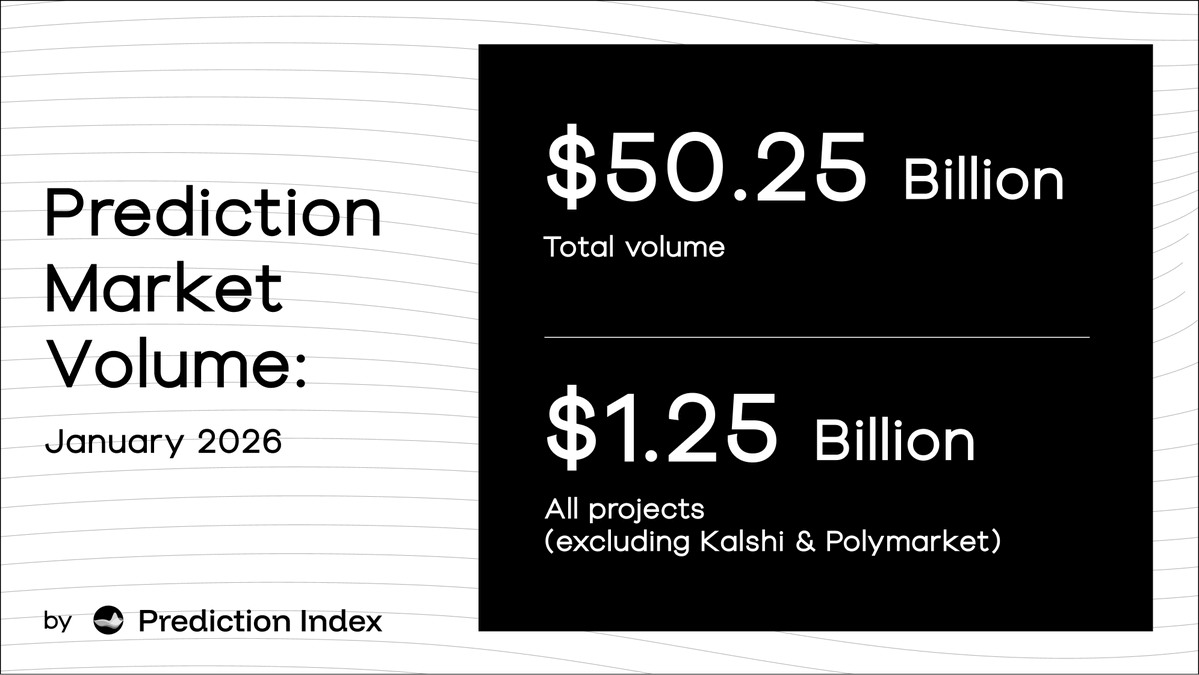
If such data shows us the current "duopoly"格局 (landscape) of the prediction market, then the 2025 annual data provided by KalshiData, under the Kalshi platform, gives us a more detailed view of the火热程度 (hotness) of the current popular sectors.

Kalshi's 2025 Report Card: Trading Volume Reaches $23.8 Billion, Over 11x Year-on-Year Growth

On January 3rd, KalshiData announced that Kalshi achieved record growth across all metrics in 2025.

In terms of nominal trading volume, the annual total reached $23.8 billion, a year-on-year increase of 1108%, approximately 12.1 times.

  • December set a monthly historical high of $6.38 billion;
  • The 4th week of December set a weekly historical high of $1.7 billion;
  • December 21st set a daily historical high of $381.7 million.

In terms of the number of trades, the annual total reached 97 million, a year-on-year increase of 1680%, approximately 17.8 times.

  • December saw 27.67 million trades;
  • The 4th week of December saw 7.6 million trades;
  • December 21st saw 1.5 million trades, all setting historical highs.

In terms of open interest, the total reached $225 million, a year-on-year increase of 169%, approximately 2.7 times.

  • March 9th set a daily historical high of $533 million,
  • The 1st week of March set a weekly historical high of $530 million,
  • February set a monthly historical high of $499.5 million.

In terms of the number of contracts traded, the annual total reached 23.8 billion, a year-on-year increase of 1108%, approximately 12.1 times.

  • December set a monthly historical high with 6.38 billion contracts;
  • The 4th week of December set a weekly historical high with 1.7 billion contracts;
  • December 21st set a daily historical high with 382 million contracts.

According to data from the KalshiData website, since its launch on June 28, 2021, Kalshi's historical total trading volume has reached $2,725,575,718, with a daily average trading volume of $16,619,364, and a total number of trades of 27,242,274,566.
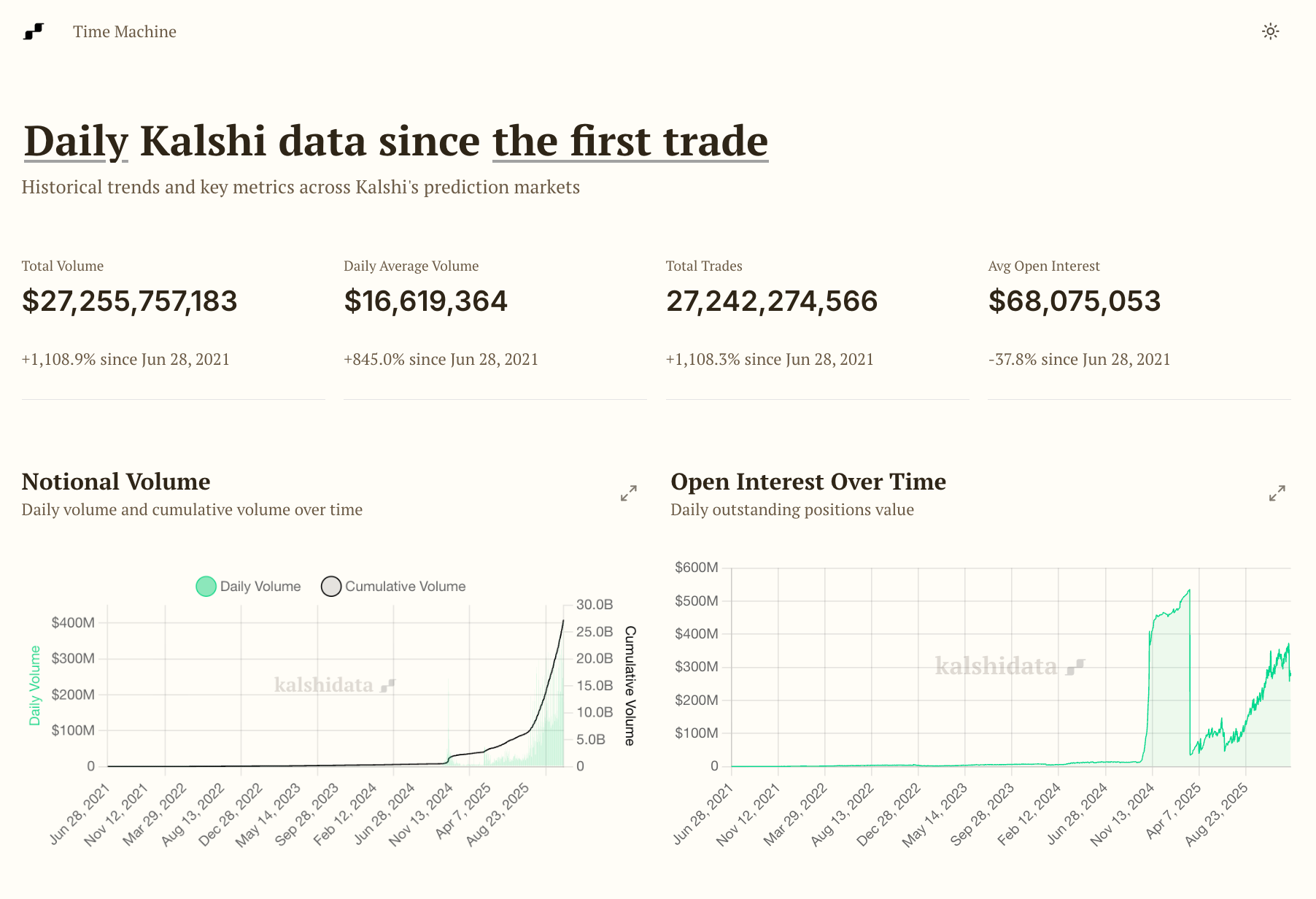
As for Polymarket, although it promotes the concept of an "on-chain prediction market," perhaps due to differences in statistical calibers and trading data channels, its 2025 trading volume data is relatively模糊 (vague).

Polymarket's 2025 Report Card: Trading Volume Estimated Around $22~25 Billion

According to DefiLlama data, Polymarket's annual DEX trading volume for 2025 was approximately $10.5 billion.

According to information from a Dune dashboard, Polymarket's annual trading volume for 2025 was approximately $22.5 billion.

According to information from the PredictionIndex.xyz website, Polymarket's historical cumulative trading volume is $23.2 billion.

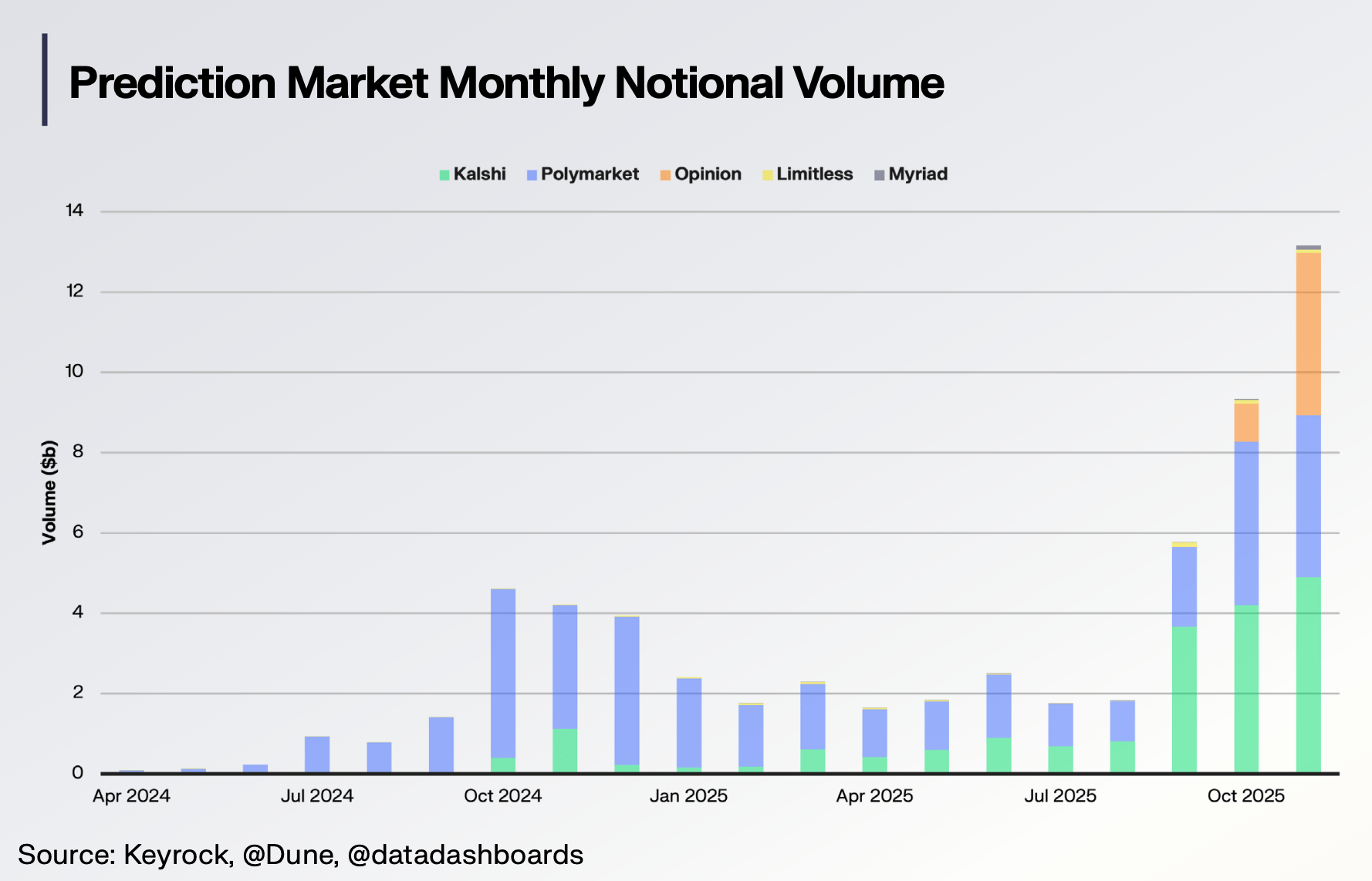
According to the "Prediction Market Report" jointly issued by Keyrock and platforms like Dune, the total transaction volume of the prediction market in 2025 was $44 billion, of which Polymarket's trading volume was approximately $21.5 billion (Odaily Planet Daily Note: In contrast, Kalshi's trading volume was about $17.1 billion).

综合以上信息以及 Kalshi 官方平台在前文中给出的 “Kalshi 年度交易量为 238 亿美元”的数据来看,我们取一个相对中间值,预估 Polymarket 2025 年总体交易量约为 220 亿美元左右。 (Synthesizing the above information and the data "Kalshi's annual trading volume is $23.8 billion" given by the official Kalshi platform earlier, we take a relatively median value and estimate Polymarket's total trading volume for 2025 to be approximately $22 billion.)
Prediction Market Segments: Sports Rank First, Political Events and Crypto Rank Second and Third

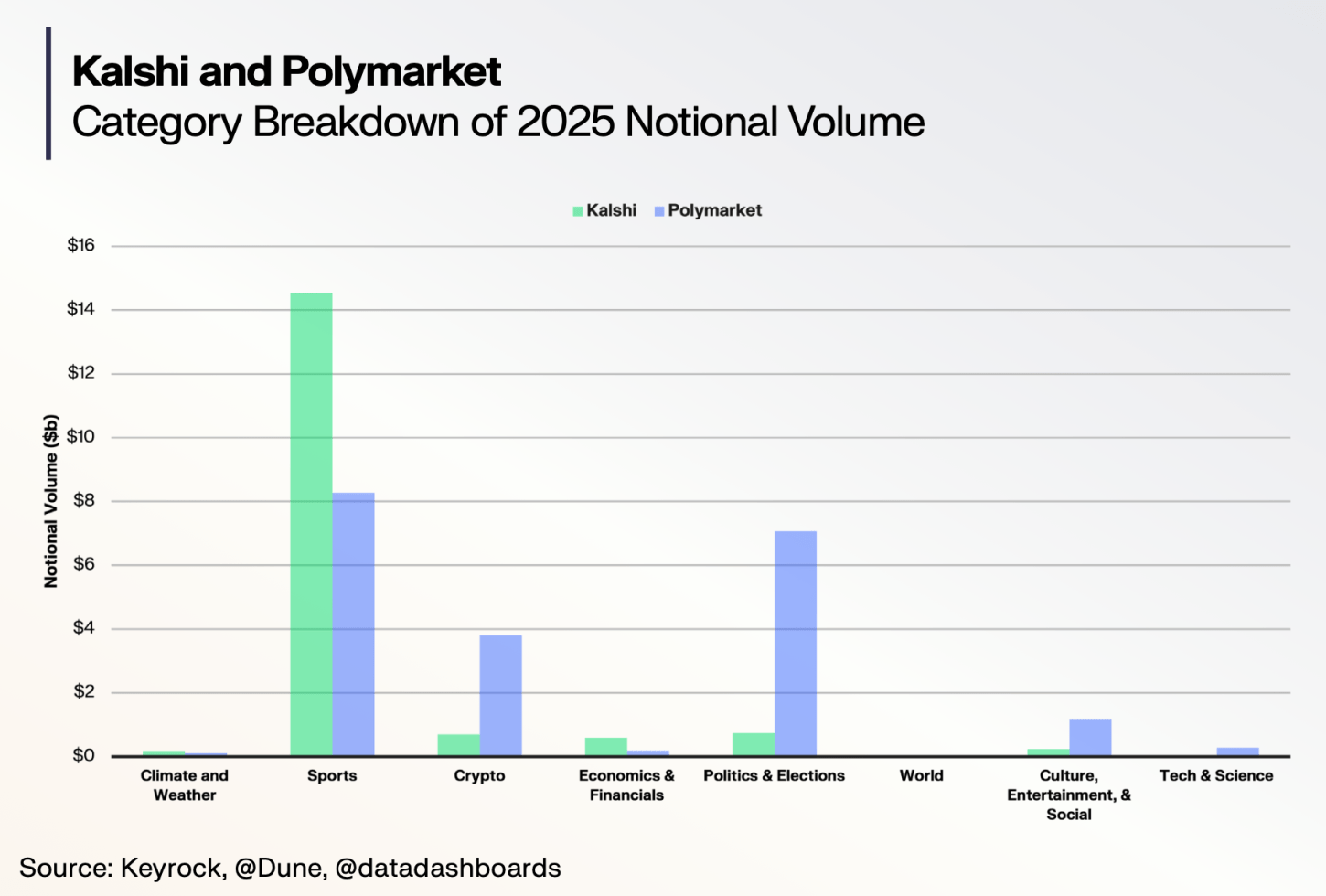
According to relevant information from the "Prediction Market Report" jointly issued by Keyrock and platforms like Dune, specifically regarding prediction market betting events,

In 2025, Kalshi still focused on sports, with sports accounting for about 85% of the nominal trading volume.

In contrast, Polymarket exhibited a more diversified portfolio—

Sports (39%), politics (34%), and cryptocurrency (18%) together drove over 90% of prediction market betting activity.
Furthermore, calculated by trading volume,

  • Trading volume for prediction events in the economics field grew 905%, reaching $112 million;
  • Trading volume for prediction events in technology and science grew 1637%, reaching $123 million;
  • Open betting events were led by economics (grew 7x to a market size of about $800 million) and social & culture (grew 6x to a market size of about $700 million), showing increasing use for macro hedging and long-term positioning.
  • Other categories (e.g., culture, society) also saw significant growth, with the overall contract opening trading size growing from about $3.3 billion at the beginning of 2025 to around $13 billion, indicating a substantial improvement in market depth and liquidity.

Prediction Markets Also Have "Peak and Off-Peak Seasons": The Second Half of the Year Saw a Trading Volume Surge

It is worth noting that, as of late August 2025, data showed that Polymarket's trading volume was still maintained at a market size of around $7.5~8 billion. However, with the surge of various unexpected events, political events, and sporting events in the second half of the year, both Polymarket and Kalshi experienced a "trading explosion period":

September: Combined trading volume of Kalshi and Polymarket reached $1.44 billion;

October: Prediction market trading volume reached $8.7 billion, with Kalshi leading and Polymarket following;

November: Combined trading volume of Kalshi and Polymarket approached $10 billion,其中 (among which), Kalshi's trading volume reached $5.8 billion, a month-on-month increase of 32%; Polymarket's trading volume reached $3.74 billion, a month-on-month increase of 23.8%.

In December 2025, analyst Patrick Scott stated that in November 2025, prediction market trading volume exceeded $13 billion, more than three times the trading volume during the peak of the 2024 election. Polymarket, Kalshi, and OPINION accounted for the vast majority of the trading volume. Binary options are now applied to political speeches, sporting events, and listed company earnings reports, becoming a probability layer for world events and news.

Combined with Kalshi's December trading volume of $6.38 billion, Polymarket's trading volume势必同样不遑多让 (must surely be equally impressive). The overall prediction market trading volume in December 2025 might have reached a scale of $13-15 billion.

Top 5 Star Players in the Prediction Market: Kalshi, Polymarket, and Others

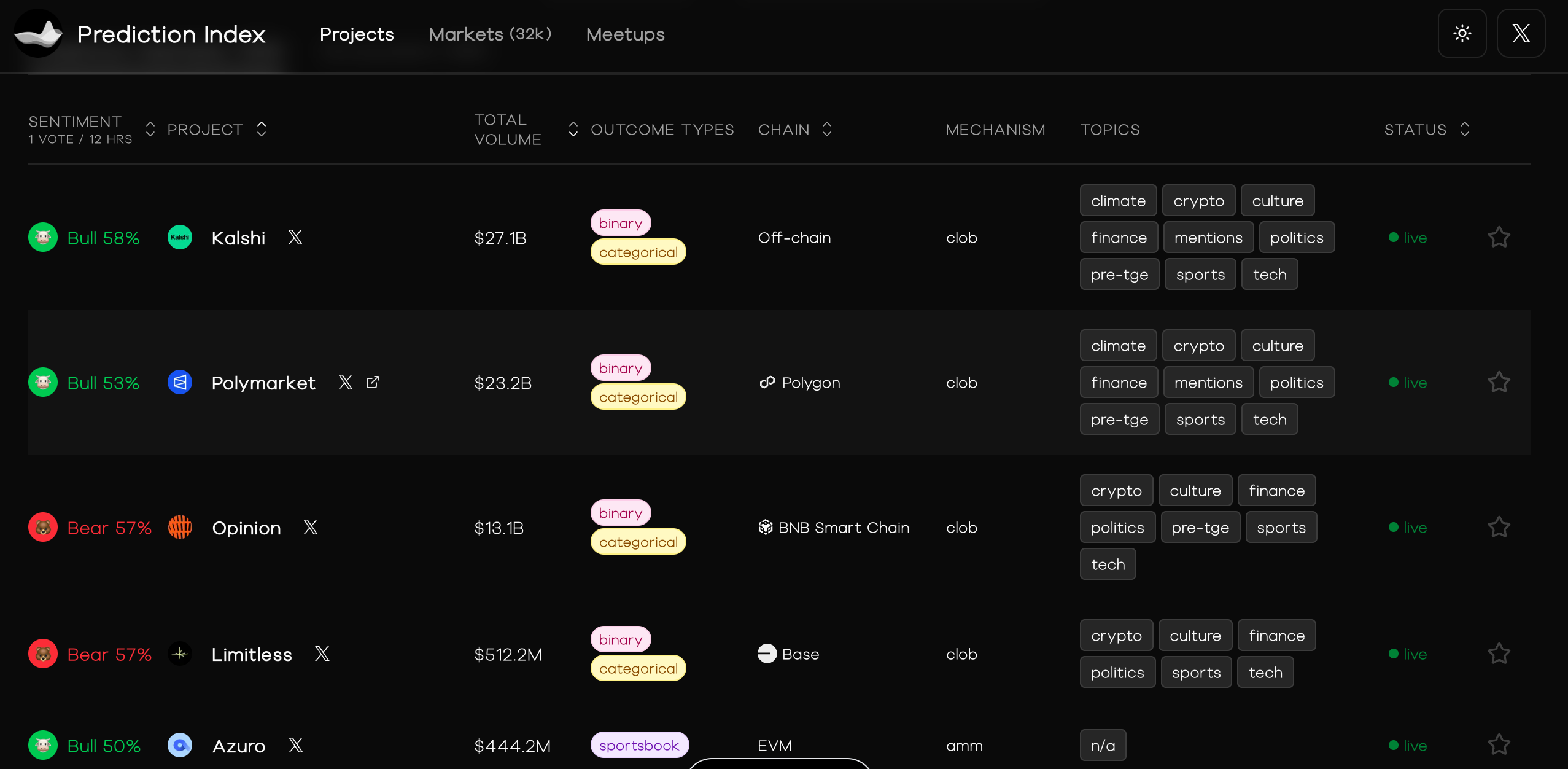
Finally, we can refer to the existing statistical data on the PredictionIndex.xyz website. As of the time of writing, the Top 5 platforms by prediction market trading volume are the following players:

  • Kalshi, platform historical trading volume approximately $27.1 billion;
  • Polymarket, platform historical trading volume approximately $23.2 billion;
  • Opinion, platform historical trading volume approximately $13.1 billion (Odaily Planet Daily Note: Considering the platform's launch time and platform mechanisms, there may be issues with wash trading. Here we only use the data statistics platform information as a reference);
  • Limitless, platform historical trading volume approximately $512 million;
  • Azuro, platform historical trading volume approximately $444 million.
Previously, Kalshi's CEO stated that the prediction market size is around $150 billion. Although the final total trading volume for 2025 was only one-third of what he mentioned, considering that the prediction market sector was not even fully formed in 2024, his statement of a "$150 billion market size" is not空谈 (empty talk). Combined with the certainty of major prediction events in 2026 such as the US midterm elections and the World Cup and other large sporting events, the overall market size of the prediction market in 2026 may still maintain 10x growth.

Of course, as we mentioned earlier in "Only One in Ten Prediction Markets Will Survive Until the End of the Year, Not an Exaggeration," a hot sector does not mean all projects and platforms will thrive. For ordinary players like us, considering liquidity depth and capital allocation constraints, perhaps specializing in 1-3 mainstream platforms is a better choice.


İlgili Sorular

QWhat was the total trading volume of the prediction market in 2025, and what percentage of this did the top two platforms (Kalshi and Polymarket) hold?

AThe total trading volume of the prediction market in 2025 was $50.25 billion. The top two platforms, Kalshi and Polymarket, held a combined market share of over 97.5%.

QWhat was Kalshi's year-over-year growth in nominal trading volume for 2025, and what was its total volume?

AKalshi's nominal trading volume for 2025 was $23.8 billion, representing a year-over-year growth of 1108% (approximately 11 times).

QAccording to the article, what were the top three event categories by betting activity on the Polymarket platform in 2025?

AThe top three event categories by betting activity on Polymarket in 2025 were Sports (39%), Politics (34%), and Cryptocurrency (18%).

QWhich month in 2025 set a new all-time high for monthly trading volume on Kalshi, and what was the volume?

ADecember 2025 set a new all-time high for monthly trading volume on Kalshi, with a volume of $6.38 billion.

QWhat is the estimated historical total trading volume for the Polymarket platform as mentioned in the article?

AThe estimated historical total trading volume for the Polymarket platform is approximately $23.2 billion.

İlgili Okumalar

KOL's Perspective: Why Is SOL Set to Rise from This Point?

**Summary: Why SOL is Positioned for Growth at This Level** The article argues that SOL is poised for an upward move from its current price point, citing several key factors. Primarily, SOL has just broken out of a 4-month consolidation phase. This breakout signals a return of risk appetite to the broader crypto market, as SOL is seen as a key indicator of overall crypto health. The token's ownership has reportedly shifted from short-term traders and tourists to long-term accumulators, leading to low volume. Any meaningful increase in trading activity could thus trigger significant upward momentum. Fundamental strengths include strong institutional adoption, integration with DeFi and RWAs (Real-World Assets), and the potential benefits from the Clarity Act. Despite its high volatility—having dropped 70% from its all-time high but still up 12x from its bear market low—SOL is highlighted as one of the few tokens from the last cycle to reach new highs. It boasts a robust ecosystem of applications, users, and protocols. Future catalysts include the expected influx of AI developers following the Miami Accelerate conference, which focused on AI on Solana. Furthermore, Solana is positioned as the premier chain for memecoin activity, a trend expected to continue and drive network usage and fees. The article concludes that recent price action reflects a healthy transfer to long-term holders, setting the stage for growth.

marsbit9 dk önce

KOL's Perspective: Why Is SOL Set to Rise from This Point?

marsbit9 dk önce

Those Pre-Bitcoin PoW Protocols Have Recently Been Reimplemented

This article details a recent surge in replicating pre-Bitcoin Proof-of-Work (PoW) protocols, specifically focusing on Hal Finney's 2004 RPOW (Reusable Proofs of Work). Within five days in May 2026, multiple independent builders in the Bitcoin/cypherpunk community launched projects inspired by this early electronic cash proposal. The initiative began with Fred Krueger's `rpow2.com`, a centralized but auditable system that replaced RPOW's original IBM 4758 hardware with Ed25519 signatures. Initially a faithful replica, it later adopted Bitcoin-like features (21M supply cap, difficulty adjustment) and a controversial 5.24% founder allocation. This sparked rapid forks, including `rpow4.com` which incorporated full Bitcoin parameters, a prediction market (`rpowmarket.com`), and a DEX (`rpow2swap.com`). Concurrently, Mike In Space created a prototype of Wei Dai's 1998 b-money proposal (`b-money.replit.app`), pushing the historical exploration even further back. The article contrasts these centralized, server-dependent experiments with Bitcoin's core innovation of decentralized, trustless consensus. It also highlights a parallel development: the `HASH` project on Ethereum, which uses smart contract hooks to enable a purely fair-launch, browser-mineable PoW token with 0% allocations to team or VCs. The collective activity is framed as a meme-driven, educational exploration of cypherpunk history rather than a serious financial movement, with all projects heavily disclaiming any investment value.

marsbit14 dk önce

Those Pre-Bitcoin PoW Protocols Have Recently Been Reimplemented

marsbit14 dk önce

South Korean Exchanges 'Battle' Regulators, Challenging the Boundaries of Enforcement and Legislation

South Korea's cryptocurrency industry is engaged in a rare, direct confrontation with regulators. The Financial Intelligence Unit (FIU), the primary anti-money laundering (AML) watchdog, has recently imposed heavy penalties on major exchanges like Upbit and Bithumb for alleged violations involving unregistered overseas VASPs and AML procedures. However, exchanges are now actively challenging these actions in court and through industry associations. In a significant shift, the Seoul Administrative Court ruled in favor of Upbit's operator, Dunamu, overturning part of an FIU-ordered business suspension. The court found the FIU's penalty criteria and justification insufficiently clear. Similarly, the court suspended the enforcement of a six-month business suspension against Bithumb pending a final ruling, citing potential irreversible harm to the exchange. Beyond legal battles, the industry is contesting proposed legislative amendments. The Digital Asset eXchange Alliance (DAXA) strongly opposes a draft rule that would mandate Suspicious Transaction Reports (STRs) for all crypto transfers over 10 million KRW (~$6,800). DAXA argues this "poison pill" clause violates legal principles and would overwhelm the STR system, increasing reports from 63,000 to an estimated 5.45 million annually for major exchanges, thereby crippling effective AML monitoring. This conflict highlights a structural tension in South Korea's crypto governance: comprehensive digital asset laws are still developing, while regulators rely heavily on AML enforcement. The industry's move from passive compliance to active legal and legislative challenges signifies a new phase, pressing for clearer rules and more proportionate enforcement. While short-term disputes may intensify, this clash could ultimately lead to a more mature and sustainable regulatory framework for South Korea's vibrant crypto market.

marsbit1 saat önce

South Korean Exchanges 'Battle' Regulators, Challenging the Boundaries of Enforcement and Legislation

marsbit1 saat önce

After 50x Storage Surge, Justin Sun Always Looks to the Next Decade

Sun Yuchen, known for his controversial stunts like a $30 million lunch with Warren Buffett (canceled due to a kidney stone) and eating a $6.2 million duct-taped banana, is often overshadowed by a significant fact: his decade-long track record of spotting major investment trends. In 2016, he famously advised young people to invest in Bitcoin, Nvidia, Tesla, and Tencent instead of buying property. A hypothetical $20,000 investment in Nvidia and Tesla from that list would now be worth over 50 million RMB. His latest major call was on November 6, 2025, predicting a "50x storage opportunity" tied to the AI boom, which materialized with Sandisk's stock surging nearly 50-fold by 2026. Looking ahead, Sun now focuses on the next frontier: Physical AI. He identifies four key areas: 1. **Embodied AI/Robotics**: He sees this reaching its "iPhone moment," with companies like UBTech and Galaxy General leading in commercialization. 2. **Drones**: Viewed as the first commercially viable form of Physical AI, revolutionizing sectors from warfare (e.g., AeroVironment's Switchblade) to logistics. 3. **Spatial Computing**: Beyond VR, it's about AI understanding physical space, a foundational technology for robotics and autonomous systems, exemplified by Apple's Vision Pro. 4. **Space Exploration**: After a 2025 suborbital flight with Blue Origin, Sun advocates for space as the ultimate frontier, discussing blockchain's potential role in space asset management and data transactions. His investment philosophy involves betting on entire, inevitable trends rather than single companies. For robotics, he sees Tesla (the body/manufacturer) and Nvidia (the brain/AI platform) as complementary plays. In defense drones, he highlights companies making tanks obsolete (AeroVironment) and those augmenting fighter jets (Kratos). For space, he participated in Blue Origin's flight and anticipates SpaceX's potential IPO to redefine the sector's valuation. Sun Yuchen's vision frames the next two decades not as a revolution in information flow (like the internet), but in the fundamental operation of the physical world through AI-powered robots, autonomous systems, and spatial intelligence, ultimately extending human and AI activity into space. While many still focus on conventional assets, he continues to look toward the next technological horizon.

marsbit2 saat önce

After 50x Storage Surge, Justin Sun Always Looks to the Next Decade

marsbit2 saat önce

İşlemler

Spot
Futures
活动图片