投机热潮即将落幕?比特币正“闪烁”多个看跌信号!

金十2024-03-01 tarihinde yayınlandı2024-03-01 tarihinde güncellendi

摩根大通策略师表示,使比特币进一步上涨的最令人期待的催化剂之一,最终可能会压低这一最大加密货币的价格

这一催化剂便是比特币的“减半”事件,指矿工产出新区块后所获得的奖励大约每隔四年减半一次。这意味着减产后,每挖出一个区块,其对应的比特币奖励都只有减半前的奖励的一半。

目前,比特币已经进行了三次“减半”,分别发生在2012年11月、2016年7月和2020年5月。第四次比特币减半时间预计将发生在2024年5月。届时,比特币产量将会由现在的6.25枚减半到3.125枚。

结合1月份批准的比特币现货ETF的需求飙升,倡导者称这将导致供应短缺。比特币今年上涨了约45%,至62000美元左右。

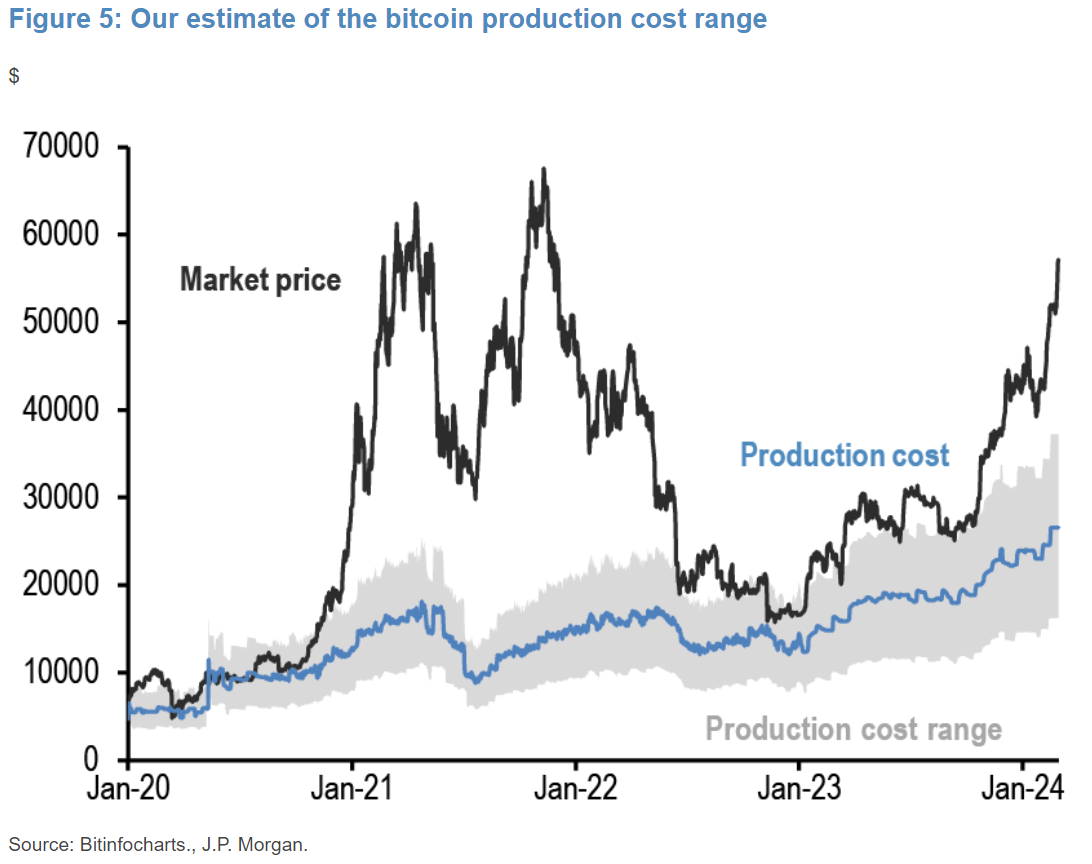
从历史上看,比特币的价格在“减半”之后会上涨,是因为所谓的矿工生产成本是该资产价格的下限。摩根大通的策略师表示,比特币的平均生产成本目前为26500美元,简单来算,“减半”后这一成本将翻番,至53000美元

然而,随着挖矿难度的增加,一些小型矿工被将迫退出,挖矿难度可能比最初估计的低20%,从而降低了生产成本。摩根大通策略师们周四写道,由于比特币的这一下限支撑下降,投资者可能会在4月后看到比特币价格回落至4.2万美元

摩根大通预计比特币的“生产成本”不会随着“减半”而翻倍

摩根大通策略师的预测基于两个关键假设。

首先,“减半”后,矿工的电力成本估计平均为每千瓦时5美分,这可能因地点和规模而异。

其次,随着比特币挖矿在4月份之后变得更加能源密集型,一些挖矿效率低且难以获得资金的生产商将退出市场,因为他们的生产成本超过了盈利能力,这将使哈希率(衡量该行业总挖矿能力的指标)下降约20%。

注:哈希率是挖矿的关键指标,指计算机进行哈希运算的速度。哈希率提高则会增加矿工成功挖掘交易区块并获得区块奖励的机会。

摩根大通策略师们写道:

“这20%的下降将使哈希率更接近历史趋势,将有效地将我们估计的生产成本范围的中值削减到4.2万美元。这也是我们设想的,一旦比特币减半引发的乐观情绪在4月后消退,比特币价格会走向的水平。”

不过,摩根大通策略师也指出,如果比特币的价格保持在高位,哈希值的下降可能不会成为现实。在上市矿商在2022年获得了更多的市场份额之后,第二年比特币价格的上涨吸引了较小的矿商重返该行业,因为效率较低的矿商也能有利可图。

随着越来越多的人通过新的比特币现货ETF投资比特币,继续吸引新的投资者,比特币价格的上涨可能会让规模较小的矿商即使在4月份供应减少后仍能保持盈利。

比特币闪烁多重看跌信号

一些交易员已经开始警告,称比特币现在这种惊人的增长速度是不可持续的

Galaxy Digital创始人Michael Novogratz在接受采访时表示,比特币最近的价格上涨已经使价格达到了“非常泡沫的水平”。他预计,在价格恢复攀升之前,会出现一次“回调”。

周四,比特币一度上涨5.12%,至63649美元,之后几乎没有变化。

此前的回调是在前一天动荡的交易时段之后发生的。比特币在周三飙升至63968美元的高位,之后在暴跌中回吐了大部分涨幅,跌至59000美元以下。

市场上的担忧是,比特币现货ETF的大幅资金流入是否导致公开市场上可供购买的比特币供应不足?根据Glassnode的数据,超过一半的流通比特币在两年多的时间里没有变化。

数字资产平台FRNT Financial首席执行官Stephane Ouellette等人表示,这种担忧可能被夸大了因为短期投资者已经开始抛售头寸。他表示,“加密货币从现在到全面牛市还有很长一段路要走,但对市场因流动性危机而崩溃的担忧似乎并不一定是真的。”

但可以肯定的是,比特币的上涨势头确实可能会停滞,甚至回调。根据CryptoQuant的数据,短期比特币持有者(指那些可能经常交易比特币的人,而不是长期投资者)的未实现利润率在最近的大幅拉升后处于极端水平。

这家研究公司在周四发布的消息中说,目前短期投资者的利润率在45%左右,任何高于40%的利润率都表明价格可能出现回调。

与此同时,在比特币永续期货中开设新的多头头寸的成本已十分高昂,这是比特币可能即将放缓的另一个迹象。

根据CryptoQuant的数据,比特币永续期货的融资利率处于2021年4月以来的最高水平。“从历史上看,当开设新多头头寸的成本过高时,比特币价格往往会暂停或经历一次调整,”该研究公司表示。

İlgili Okumalar

Uniswap v4 Hook Analysis: Architecture Design, Common Vulnerabilities, and Protection Practices

Uniswap v4's Hook mechanism is a major innovation, enabling custom logic injection into liquidity pool lifecycle events like swaps and liquidity provisioning. This transforms the AMM into programmable infrastructure, shifting the security model from protocol-level to pool-level, as each pool's safety now depends on its bound Hook contract. The core architecture revolves around the singleton PoolManager contract, which manages all pools via a flash accounting system. State changes are tracked in transient storage and must be settled by the end of a transaction. Hook contracts are permanently bound to pools via a PoolKey, with their permissions encoded directly into their address via specific low-order bits. This design introduces unique security considerations and challenges for future upgrades. Key vulnerabilities and best practices identified include: - **Access Control Gaps:** Early versions of the BaseHook abstract contract only protect `unlockCallback()`, leaving other lifecycle functions (`beforeSwap`, `afterSwap`, etc.) exposed unless explicitly secured by developers. - **Unrestricted Pool Binding:** The `initialize()` function does not validate if a Hook "consents" to a new pool. Hooks must implement their own whitelisting in `beforeInitialize` to prevent unauthorized pool creation. - **Async/Custom Curve Hooks:** These high-risk Hooks can completely replace Uniswap's swap logic. Their security depends entirely on their own implementation, as they operate outside the native protocol's pricing safeguards. - **Delta Accounting Risks:** The system ensures final balance (NonzeroDeltaCount == 0) but cannot guarantee the *correctness* of intermediate delta states, which attackers could manipulate. - **Token Confusion:** Protocols must implement semantic validation for tokens in user-created markets, not just interface checks, to prevent cross-market confusion attacks. The article emphasizes that Hook auditing requires a "sub-protocol" approach due to extended interaction chains, highlighting a significant shift in security methodology for the v4 ecosystem.

marsbit33 dk önce

Uniswap v4 Hook Analysis: Architecture Design, Common Vulnerabilities, and Protection Practices

marsbit33 dk önce

Chips, Open-Source Models, and $50 Trillion: Joe Tsai Reassesses Alibaba Once Again

Alibaba Executive Chairman Joe Tsai recently outlined the company's comprehensive AI strategy in a public discussion. He believes AI represents a massive opportunity, estimating its potential economic impact at up to $50 trillion, stemming from the automation of human intelligence and productivity. Tsai detailed Alibaba's four-layer investment approach across the AI stack: starting from the chip level, moving to cloud infrastructure (Alibaba Cloud), then the model layer with its open-source Qwen model, and finally applications within its vast digital ecosystem (e-commerce, logistics, etc.). The company avoids the energy layer due to China's efficient infrastructure. This broad strategy is designed to ensure Alibaba captures value regardless of where it ultimately concentrates in the AI value chain. He dismissed concerns about an AI investment bubble, pointing to the enormous $50 trillion opportunity. While acknowledging U.S. cloud giants' higher capital expenditure, he argued Chinese firms, including Alibaba (funded by its cash-generative e-commerce core), need to invest more in AI infrastructure. A key theme was technological sovereignty. Tsai positioned open-source models like Qwen as a solution for companies, especially in Europe, seeking independence from proprietary U.S. models and greater data privacy control. He contrasted this with the trend of U.S. giants keeping their models closed-source. Tsai highlighted Alibaba's collaborations with European manufacturers like Bosch and Siemens, using AI for design and quality control. He concluded with an optimistic vision of AI agents enhancing productivity, ultimately freeing up human time for leisure, family, and experiences like live entertainment.

marsbit47 dk önce

Chips, Open-Source Models, and $50 Trillion: Joe Tsai Reassesses Alibaba Once Again

marsbit47 dk önce

İşlemler

Spot
Futures
活动图片