20% of Americans Are on the Fence: The Next Wave of Crypto Market Lies Here

marsbit2026-03-05 tarihinde yayınlandı2026-03-05 tarihinde güncellendi

Özet

A study reveals that 20% of U.S. adults are considering cryptocurrency adoption, representing a critical intermediate group between outright rejecters and current holders. The research frames crypto acceptance as a three-stage process: rejection, consideration, and ownership. Key findings show that factors influencing the "consideration" phase (e.g., conservative ideology, support for tech innovation) differ from those driving "actual ownership" (e.g., existing stock ownership, higher risk tolerance). This intermediate group is essential for market growth, regulatory policy, and public opinion, as they represent the tipping point for broader adoption. The study emphasizes that understanding this gradual behavioral process—rather than a binary holder/non-holder view—is crucial for accurately predicting market and political trends.

Written by: Kyle Saunders

Compiled by: Chopper, Foresight News

Most research revolves around a simple question: Who holds it? Who doesn't?

Admittedly, this is a reasonable starting point for research. Holding behavior is observable, quantifiable, and actual. But for a market with a market cap in the trillions, it might not be the most critical question.

If you are concerned with market development, regulatory policy, political discourse, or the future direction of crypto assets, there is a question that might be more practically significant: Who is considering acquiring cryptocurrency?

Because the acceptance and adoption of an asset is never a binary, either-or choice, but a gradual process.

If you only study the final stage of this process, you miss the entire conversion funnel.

Rejection → Consideration → Holding: The Three Stages of Crypto Acceptance

In a new paper I recently co-authored with Erin Fitz, we did not treat crypto acceptance as a black-and-white outcome, but defined it as a gradual process.

From late 2024 to 2025, we conducted three independent representative surveys of US adults. Based on the results, we categorized respondents into three groups:

  • Do not hold and have no intention to hold cryptocurrency
  • Do not hold but are considering holding cryptocurrency
  • Currently hold cryptocurrency

Our first finding was straightforward yet crucial: About one-fifth of Americans do not hold cryptocurrency but are considering it.

This group is by no means an insignificant niche, a statistical error, or a group 'destined to hold.' They are a distinct segment with unique psychological characteristics and behavioral patterns, and this attribute makes them critically important.

Why is the 'Potential Holder' Group So Critical?

If the research perspective is limited to the binary comparison of 'holders' vs. 'non-holders,' it assumes all those not in the market are an undifferentiated whole.

But real-world behavioral choices are never like that.

The classic social psychology Theory of Planned Behavior posits that human behavior evolves through a series of preceding stages: beliefs, attitudes, perceived control, behavioral intention. One first 'considers' before forming a 'behavioral intention'; a 'behavioral intention' precedes taking actual action. And each stage does not necessarily transition to the next.
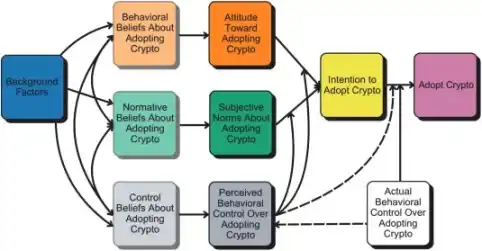
In other words, all holders were once potential holders; but not all potential holders will ultimately become actual holders.

When we view people's engagement with cryptocurrency as an ordered, gradual process rather than a binary characteristic, an interesting conclusion emerges: The factors influencing 'consideration to hold' are not entirely the same as those driving 'actual holding.'

There is a filtering mechanism at work in this conversion funnel.

Which Factors Influence 'Consideration'? Which Drive 'Actual Holding'?

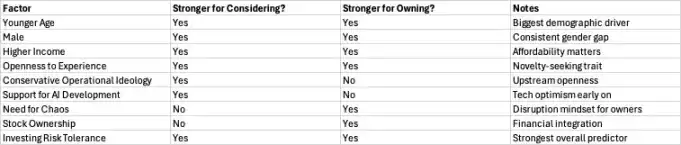
Some common influencing factors aligned with expectations: Younger individuals, men, those more open to new experiences, and those with a higher tolerance for financial risk were more likely to cross both the 'rejection→consideration' and 'consideration→holding' thresholds.

But two sets of significantly different patterns are worth highlighting.

Factors more strongly associated with 'Consideration to Hold':

  • More conservative operational ideology
  • Support for AI technology development

These factors play a role in the early stages of the crypto acceptance process, explaining why people might be open to cryptocurrency, but not necessarily pushing them to take the final step to 'actually hold.'

Factors more strongly associated with 'Actual Holding':

  • Already hold stocks
  • Need for chaos

Risk tolerance was the most influential factor overall: From the lowest to the highest levels, the probability of behavioral choice changed dramatically, with the probability of rejecting crypto decreasing by 32 percentage points and the probability of actually holding crypto increasing by 27 percentage points.

Here is a brief summary of the core differences:
Our survey data also aligns closely with the actual crypto market landscape: Bitcoin dominates overwhelmingly among both 'potential' and 'actual' holders (with Ethereum second), and many are open to multiple cryptocurrencies. The market itself corroborates this finding.
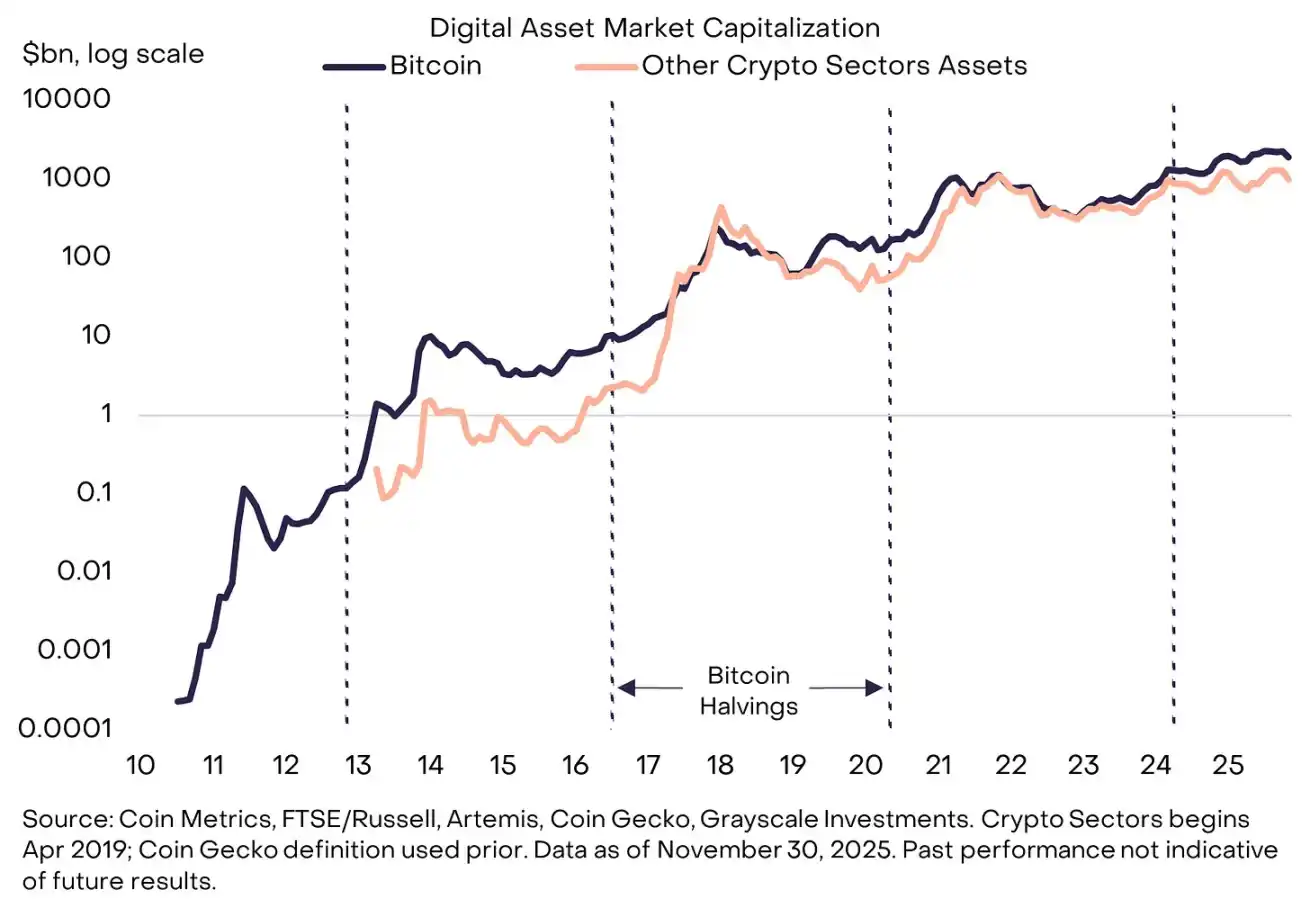
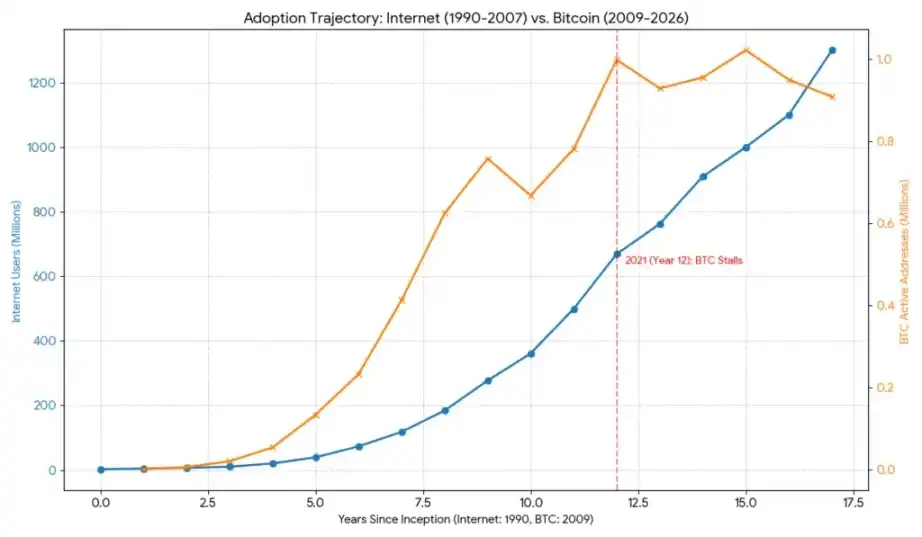
To understand how this landscape fits the broader technology diffusion curve (and why the 'potential holder' stage will determine whether crypto development stalls or scales), one can compare Bitcoin's adoption trajectory with that of the early internet. Survey data shows AI technology acceptance in the US reached about 55% in 2026.
Furthermore, this chart from the paper shows how crypto acceptance fits the Rogers Diffusion of Innovations curve:
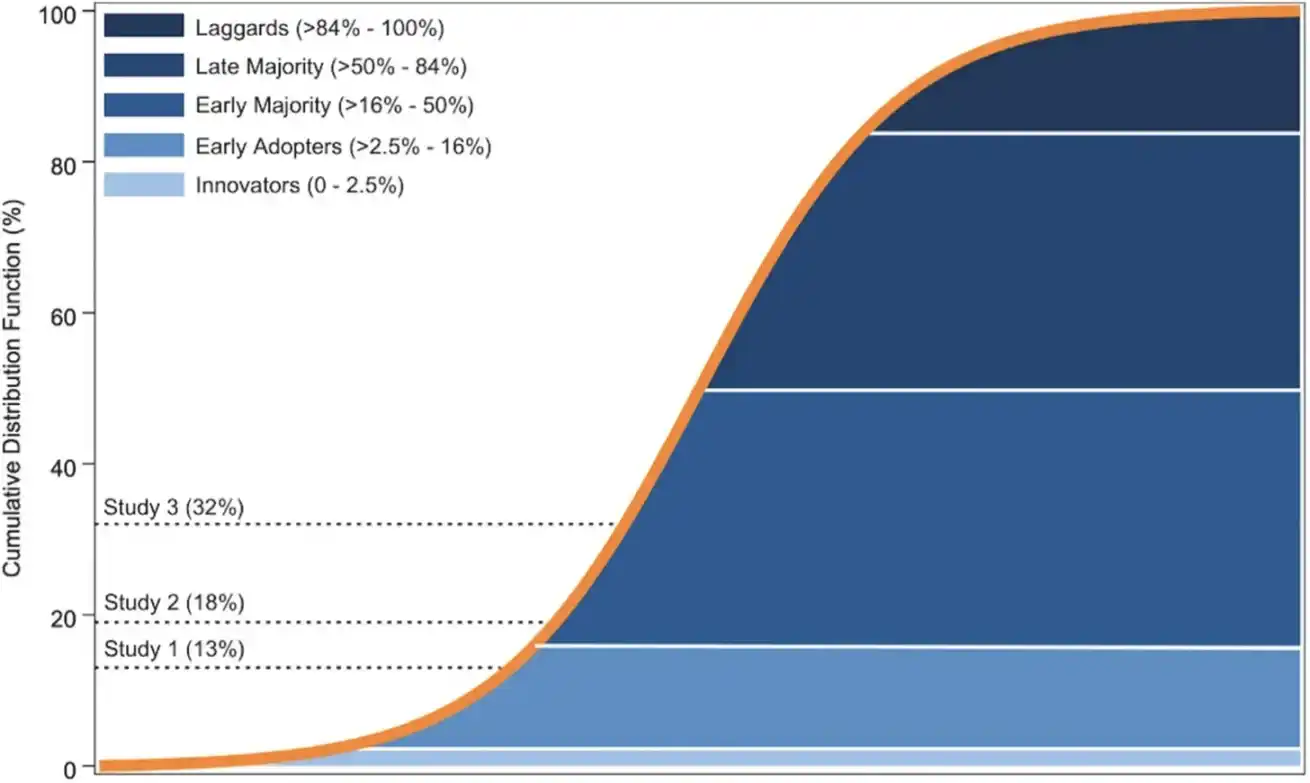
This is an adapted version of Rogers' 2003 Diffusion of Innovations curve. The solid orange line is the S-curve (the cumulative distribution function, with the scale on the left vertical axis). The blue area under the curve represents the probability distribution of the five adopter categories in Rogers' model, divided based on standard deviations from the mean in a normal distribution. In a normal distribution, these areas represent the probability proportion of each category in the whole population: Innovators (2.5%, 0 to mean minus 2 SD), Early Adopters (13.5%, mean minus 2 SD to mean minus 1 SD), Early Majority (34%, mean minus 1 SD to mean), Late Majority (34%, mean to mean plus 1 SD), Laggards (16%, mean plus 1 SD to 100%). The black dashed lines represent the self-reported cryptocurrency holding rates from our three studies (Study 1: 13%, Study 2: 18%, Study 3: 32%).

The Implications of These Findings Extend Beyond Crypto

You could interpret these results narrowly as consumer segmentation, but they have broader significance.

For Market Growth

The expansion potential of the crypto market lies not in converting staunch 'rejecters' into holders, but in figuring out what prevents potential holders from becoming actual holders. This barrier might not be ideological, but rather people's perception of their behavioral control, concerns about market volatility, or issues with asset liquidity.

For Regulatory Policy

If policymakers view only current cryptocurrency holders as the group with political influence, they misjudge the market's current state. The policy direction in the digital asset space will likely be determined by these open-minded yet undecided potential holders. Their preferences, risk profiles, and trust in institutions are critically important, especially as the crypto regulatory framework takes shape in 2026.

For Public Discourse

Online discussions often fall into polarization: either pro-crypto or anti-crypto. But our survey data shows a large, psychologically distinct middle group exists in reality. Historical experience suggests that it is this middle group, not the early adopters, that ultimately determines whether an innovation achieves widespread adoption, stalls, or triggers a backlash.

Acceptance and adoption are inherently gradual processes.

The core insight of this research is not just specific to the crypto space, but also a shift in research methodology and perspective.

When we simplify complex behaviors into binary, either-or choices, we risk conflating the behavioral rules of different stages. The factors that make people open to a new thing are not necessarily the same ones that drive them to take actual action.

This applies not only to cryptocurrency but also to the acceptance of AI technology, political participation, trust in institutions, and many other behavioral choices I've explored in this column.

The overlooked middle stage often holds the most intriguing behavioral patterns.

The acceptance and adoption of cryptocurrency is never simply a personality trait or an ideological signal, but a step-by-step behavioral process.

If you ignore this intermediate 'potential holding' stage, you will misjudge both the true direction of the market and the underlying political and social logic.


İlgili Sorular

QAccording to the research, what percentage of Americans are considered 'potential adopters' of cryptocurrency?

AApproximately one-fifth (20%) of Americans are potential adopters, meaning they do not currently hold cryptocurrency but are considering it.

QWhat is the key difference between the factors that influence 'considering adoption' and those that drive 'actual adoption' of crypto?

AFactors like a more conservative operational ideology and support for AI development are more strongly associated with the 'considering adoption' phase. In contrast, factors like already holding stocks and a 'need for chaos' are more strongly linked to taking the final step into 'actual adoption'.

QWhy is the 'potential adopter' group so crucial for understanding the crypto market's future?

AThis group is crucial because market growth depends on converting them into actual holders, not on convincing those who firmly reject crypto. Their preferences and perceived barriers (like concerns about volatility or liquidity) will determine if the market expands or stagnates.

QHow does the acceptance of cryptocurrency fit into Rogers' Diffusion of Innovations curve?

AThe research data shows that crypto adoption follows the S-curve of the Diffusion of Innovations model. The 'potential adopters' represent the large middle groups (early and late majority) whose adoption is critical for moving the technology from early adopters to mainstream普及.

QBeyond market growth, what other significant implications does the 'potential adopter' group have?

AThe group has major implications for regulatory policy, as their trust in institutions and risk profile will influence the shaping of crypto regulation. It also impacts social discourse, as this large middle group, not the polarized extremes, often determines whether an innovation is widely accepted or faces a backlash.

İlgili Okumalar

Ethereum Q1 2026 Report: Fees Decline, Users and Transaction Volume Hit New Highs

Ethereum Q1 2026 Report: Fees Down, Users & Transactions Hit New Highs Token Terminal's Q1 2026 report on Ethereum presents a pivotal development: the network achieved record highs in monthly active users (13.2M, +85.9% YoY), total transactions (200.4M, +81.5% YoY), and throughput (25.78 TPS), while transaction fees on the mainnet plummeted by 47.9% quarter-over-quarter. This shift is attributed to the network's strategic move into a "low fees for scale" phase, exemplified by the Fusaka upgrade which increased data capacity and lowered block space costs, releasing pent-up demand (a manifestation of Jevons's Paradox). The report highlights a core narrative shift for Ethereum: from a DeFi-centric blockchain to a global financial settlement layer. It maintains a dominant position in tokenized assets, holding majority market shares among top chains in stablecoins (61.8%), tokenized funds (73.0%), and tokenized commodities (84.0%). Growth in tokenized funds (+73.1% YoY) and commodities (+325.9% YoY) was particularly strong, driven by institutions like BlackRock and JPMorgan entering the space. Contrasting these usage gains, several USD-denominated value metrics declined in Q1: fully diluted market cap fell 30.3% QoQ, total value locked (TVL) dropped 11.0%, and ecosystem transaction volume decreased 24.0%. The report interprets this as Ethereum prioritizing long-term network expansion and cementing its role as the default settlement layer for finance over short-term fee capture. The commentary from Etherealize argues that, much like the early internet, Ethereum's open, permissionless model is poised to win over closed alternatives as institutional tokenization accelerates.

marsbit1 saat önce

Ethereum Q1 2026 Report: Fees Decline, Users and Transaction Volume Hit New Highs

marsbit1 saat önce

He Just Raised 2.7 Billion, and Li Fei-Fei Also Invested

Pete Florence, a former senior research scientist at Google DeepMind and a key contributor to the Vision-Language-Action (VLA) model architecture, is deliberately distancing his startup, Generalist AI, from the trendy "world model" label. He argues that the industry should prioritize concrete goals over buzzwords. His goal is to create robots that can perform a vast range of unseen tasks with high speed and success rates, without needing task-specific training data. Recently, his company raised $400 million (¥2.7 billion) at a $2 billion valuation. Notable investors include NVIDIA's NVentures, Bezos Expeditions, NFDG, as well as Xiaomi co-founder Lin Bin, Zoom founder Eric Yuan, and renowned AI scientist Fei-Fei Li. Florence's approach stems from his academic background at MIT under Professor Russ Tedrake, focusing on understanding the physical world. After joining DeepMind, he developed models like Transporter Network and co-created the VLA framework. He left in 2025 to found Generalist AI. The company has launched two models: GEN-0, which demonstrated that scaling laws apply to physical motion, and GEN-1. GEN-1 was trained on over 500,000 hours of physical interaction data collected via a specialized wearable device. It achieves a 99% success rate on precise mechanical tasks like folding boxes and maintains performance three times faster than its predecessor. Florence believes GEN-1 is reaching a commercial utility threshold similar to the GPT-3 inflection point. The substantial funding round, following GEN-1's release, signifies strong investor confidence in Generalist AI's practical, goal-driven path to creating versatile, useful robots, regardless of the "world model" terminology.

marsbit1 saat önce

He Just Raised 2.7 Billion, and Li Fei-Fei Also Invested

marsbit1 saat önce

Two Legends Lost in Three Days: Is Google's AI Talent Dam Cracking?

In three days, Google lost two AI legends. On June 18, Noam Shazeer, co-author of the seminal "Attention is All You Need" paper and Gemini co-lead, left for OpenAI. Just 48 hours later, John Jumper, 2024 Nobel laureate and AlphaFold lead, departed DeepMind for Anthropic. This follows Andrej Karpathy joining Anthropic in May. These moves highlight a structural trend: top AI talent is concentrating at mission-driven, pre-IPO firms like OpenAI and Anthropic, while Google becomes a primary source. The exodus stems from a core mission mismatch. Google's ad-centric model often subordinates AI research to product and revenue goals, creating friction for pioneers like Shazeer, who returned in 2024 only to leave again. In contrast, OpenAI and Anthropic offer singular focus on pushing AI boundaries, whether towards AGI or safety-aligned models, which deeply appeals to top researchers like Jumper. Financial incentives amplify the pull. With both OpenAI and Anthropic nearing IPO, employees stand to gain immensely from equity, an upside Google's mature stock cannot match. Furthermore, the 2023 merger of Google Brain and DeepMind, intended to consolidate strength, has instead created cultural tension and slowed the path from research to product, as evidenced by Gemini's pace. This talent redistribution is reshaping the AI landscape. While Google retains vast data and compute resources, its true crisis is the quiet, continuous loss of the people who define the field's future. The real moat in AI is not infrastructure, but the concentration of brilliant minds—a battle Google is currently losing.

marsbit3 saat önce

Two Legends Lost in Three Days: Is Google's AI Talent Dam Cracking?

marsbit3 saat önce

Behind the AI Report Card, Lies a Chinese 'Exam Setter'

Beyond the familiar performance charts like MMLU-Pro and MMMU, which major AI models strive to ace, stands a key "examiner": Chinese-Canadian researcher Wenhu Chen. An assistant professor at the University of Waterloo and founder of TIGERLab, Chen addresses the crucial need for more rigorous AI evaluation. As models like GPT-4 began scoring near-perfect results on older benchmarks like MMLU, it became difficult to distinguish their true capabilities. In response, Chen introduced MMLU-Pro in 2024, featuring harder, more reasoning-focused questions with more answer choices, successfully reintroducing meaningful performance gaps. His work extends to multi-modal evaluation with MMMU and its enhanced version, MMMU-Pro. These benchmarks test a model's ability to understand and reason with complex information from images, charts, and text across diverse academic subjects, exposing the significant challenges even top models face in genuine comprehension. Chen's background in complex QA, table reasoning, and his experience at Google DeepMind on projects like Gemini inform his approach. He understands that effective benchmarks must anticipate how models might "cheat" by memorizing data or avoiding visual analysis. His lab also actively researches video understanding and generation models (e.g., UniVideo, Vamba), ensuring his evaluation work is grounded in practical model-building challenges. Now at Meta's Super Intelligence Lab, Chen continues his focus on multi-modal data and evaluation, representing the deep yet often unseen contributions of Chinese talent in shaping the fundamental tools of the AI industry.

marsbit3 saat önce

Behind the AI Report Card, Lies a Chinese 'Exam Setter'

marsbit3 saat önce

İşlemler

Spot
Futures
活动图片