Coinbase Made an Arbitration Case to the U.S. Supreme Court – Again

CoinDeskPolicy2024-02-27 tarihinde yayınlandı2024-02-28 tarihinde güncellendi

Özet

In a second case involving a legal argument over arbitration, the U.S. crypto exchange again appeared in the high court to argue about these agreements that affect everybody.

  • Coinbase has again asked the U.S. Supreme Court to reinforce its position in a dispute over arbitration – marking a second time the crypto exchange has appeared before the high court to argue how customer disputes should be handled.
  • Wednesday's arguments weren't about crypto, but arbitration is a topic that affects anybody who has any interaction with modern commerce.

Crypto exchange Coinbase (COIN) again led a legal charge on the ins and outs of arbitration in the U.S. Supreme Court on Wednesday. The latest case isn't about digital assets, directly, but it may be important for every modern consumer who buys, registers or contracts for a product or service – and for the businesses trying to stay out of court.

14.4K

Lawyers for Coinbase, who had previously won a case about whether a lawsuit can move forward if there's an ongoing appeal about whether it should be in arbitration, appeared again in another case stemming from the legal agreements that control how disputes between companies and their clients are handled. This one is about who should make the decision about a dispute going into arbitration in the event that multiple contracts affect the parties.

These highly technical legal matters have nothing to do with crypto, except for the fact that the industry is as reliant on arbitration agreements as any other corner of the tech sector. These agreements often require that unhappy customers take disputes to a third-party arbitrator rather than pressing lawsuits in the courts.

Advertisement
Advertisement

Coinbase, which contends that an arbitrator should decide where such a conflict should be handled, lost in the lower courts and asked the justices to reject those rulings and remand the case back to the earlier court.

"Lower courts cannot collapse the who-decides questions," Coinbase's chief attorney in the case, Jessica Ellsworth of Hogan Lovells, said to the justices on Wednesday. "We think the court should reverse and remand."

Eventually, the Supreme Court is likely to weigh questions that are central to the nature and survival of crypto in the U.S. – namely, what makes a digital asset a security or a commodity, and what are the government's powers to oversee the markets where such assets change hands. But those cases are still winding through lower courts and may not rise to the high court's consideration for many months or even years.

Edited by Nikhilesh De.

İlgili Okumalar

Why do people like Luke still want to fork Bitcoin despite having no support? BIP-100 has already been declared a failure!

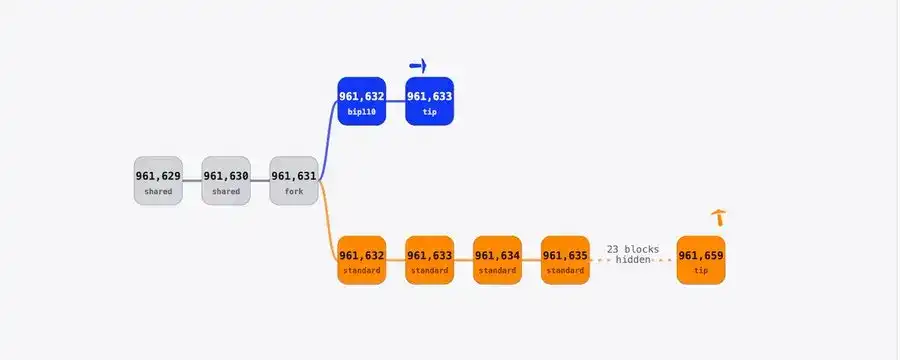
On August 8th, the Bitcoin network experienced a contentious fork triggered by BIP-110, despite the proposal having only 2.53% miner signaling support in the prior period. Led primarily by developer Luke Dashjr and based on his Bitcoin Knots implementation (not merged into Bitcoin Core), this User-Activated Soft Fork (UASF) aimed to impose strict new limits on non-financial data (like Ordinals inscriptions) within blocks to reduce long-term node costs. The fork activated at block height 961632, with BIP-110 nodes rejecting blocks without the required signaling. This created two chains: the dominant original chain continuing normally, and a low-hashrate BIP-110 chain which quickly fell behind. The core conflict is between those viewing block space as a fee market open to all data and those prioritizing Bitcoin as a monetary network, seeking to ban what they see as blockchain "spam." BIP-110's strategy relied on economic nodes (exchanges, wallets) adopting the new rules first, hoping to force miners to follow. However, this has not materialized. The BIP-110 chain now faces severe challenges: extremely slow block times potentially stretching over 1.9 years before its rules would even activate, a lack of broad economic support, and no automatic replay protection. For most users, Bitcoin's main chain operates unchanged. The immediate technical impact is limited to services running BIP-110 software, which now see a different blockchain. The event highlights ongoing ideological disputes within Bitcoin but, given its minimal support, is unlikely to alter the main network's trajectory.

marsbit7 dk önce

Why do people like Luke still want to fork Bitcoin despite having no support? BIP-100 has already been declared a failure!

marsbit7 dk önce

Hardcore Research Report: After a Stunning Debut, A Frame-by-Frame Breakdown of Robinhood Chain's Revenue Potential

**Summary: The Revenue Potential of Robinhood Chain vs. Its Declining Core Crypto Business** A detailed analysis of Robinhood's crypto trajectory reveals a stark contrast: while the company's overall revenue hit a record high of $1.31B in Q2 2026, its crypto-specific business is in sharp decline. Crypto revenue fell 38% year-over-year to $100M, now constituting only 8% of total revenue. Retail crypto trading volume and the share of crypto in customer assets also dropped to multi-year lows. In this context, Robinhood Chain, the company's newly launched Layer 2 blockchain, represents a major strategic bet. Its launch was notably strong, generating $3.6M in Real Economic Value (REV) in July 2026, or 38% of all tracked L2 revenue that month—surpassing established networks like Polygon and Base. However, this early activity was heavily driven by meme coins (51% of spot volume), not the chain's stated focus on Real World Assets (RWAs), which accounted for only 5%. The report argues that Robinhood Chain's infrastructure-layer revenue alone is insufficient to meaningfully revive the crypto division. The entire L2 revenue market is structurally shrinking and too small. Robinhood's clearest monetization path lies at the application layer: 1. **USDG Stablecoin:** Robinhood's native stablecoin could generate significant interest income. At a current $333M supply (assuming a 3.5% yield), it represents ~$10.5M in annualized revenue. Scaling USDG to $1B+ would create a substantial, durable income stream. 2. **Application Distribution:** Robinhood's main app holds immense distribution value. Evidence suggests protocols like Morpho pay for integration, driving significant user deposits. In contrast, distribution via the standalone Robinhood Wallet has shown limited value so far. The known, quantifiable revenue streams from Robinhood Chain (chain REV, USDG interest, shared Lighter fees) total ~$54.8M annualized—only about 14% of Robinhood's annualized crypto revenue. The conclusion is that for Robinhood Chain to become a meaningful growth driver, Robinhood must successfully commercialize its application-layer advantages—primarily by scaling USDG and monetizing its main app's user reach—or use the chain as a funnel into its higher-value traditional products. Based on current data, the chain is not yet a significant contributor to company profits.

marsbit21 dk önce

Hardcore Research Report: After a Stunning Debut, A Frame-by-Frame Breakdown of Robinhood Chain's Revenue Potential

marsbit21 dk önce

Hardcore Research Report: After an Impressive Start, Analyzing Robinhood Chain's Revenue Potential Frame by Frame

Robinhood's crypto business is in steep decline, contributing only 8% of total revenue in Q2 2026 despite the company's overall record performance. Its new Layer 2 blockchain, Robinhood Chain, launched strongly in July, generating $3.6M in Real Economic Value (REV) and capturing 38% of all L2 network revenue that month. However, this early activity is heavily driven by speculative Meme coin trading (51% of spot volume), not the intended Real-World Asset (RWA) use case. While successful as a blockchain, the network's revenue alone is too small to meaningfully impact Robinhood's profits, with known revenue streams annualizing to about $54.8M—just 14% of the crypto segment's annualized revenue. For Robinhood Chain to revitalize the crypto business, Robinhood must monetize beyond infrastructure. The clearest path is scaling its native stablecoin, USDG, to generate interest income from its reserves. Another opportunity lies in commercializing its massive user distribution, particularly through its main app, as evidenced by the successful integration of Morpho. In contrast, distribution via the standalone Robinhood Wallet appears limited. Ultimately, Robinhood Chain may serve more as a user acquisition funnel for higher-value products rather than a major direct revenue line. To become a significant growth driver, Robinhood must successfully expand USDG or effectively monetize its main app's distribution power.

Odaily星球日报27 dk önce

Hardcore Research Report: After an Impressive Start, Analyzing Robinhood Chain's Revenue Potential Frame by Frame

Odaily星球日报27 dk önce

İşlemler

Spot
活动图片