如何实现惠普空投,全面解析STRK Provisions Program

Odaily星球日报2024-02-16 tarihinde yayınlandı2024-02-16 tarihinde güncellendi

Özet

Starknet如何分配空投?如何筛查女巫?

作者: Trust Labs

2024 年 2 月 14 日情人节,中国农历初五迎财神的时候,Starknet Foundation (SNF)宣布了期待已久的 STRK 代币空投计划,即“Starknet Provisions Program”。Starknet 原生代币 STRK 自 2 月 20 日开始,通过该计划进行空投分发,领取期持续四个月直至 6 月 20 日【 1 】。

普惠空投新尝试
如何实现惠普空投,全面解析STRK Provisions Program

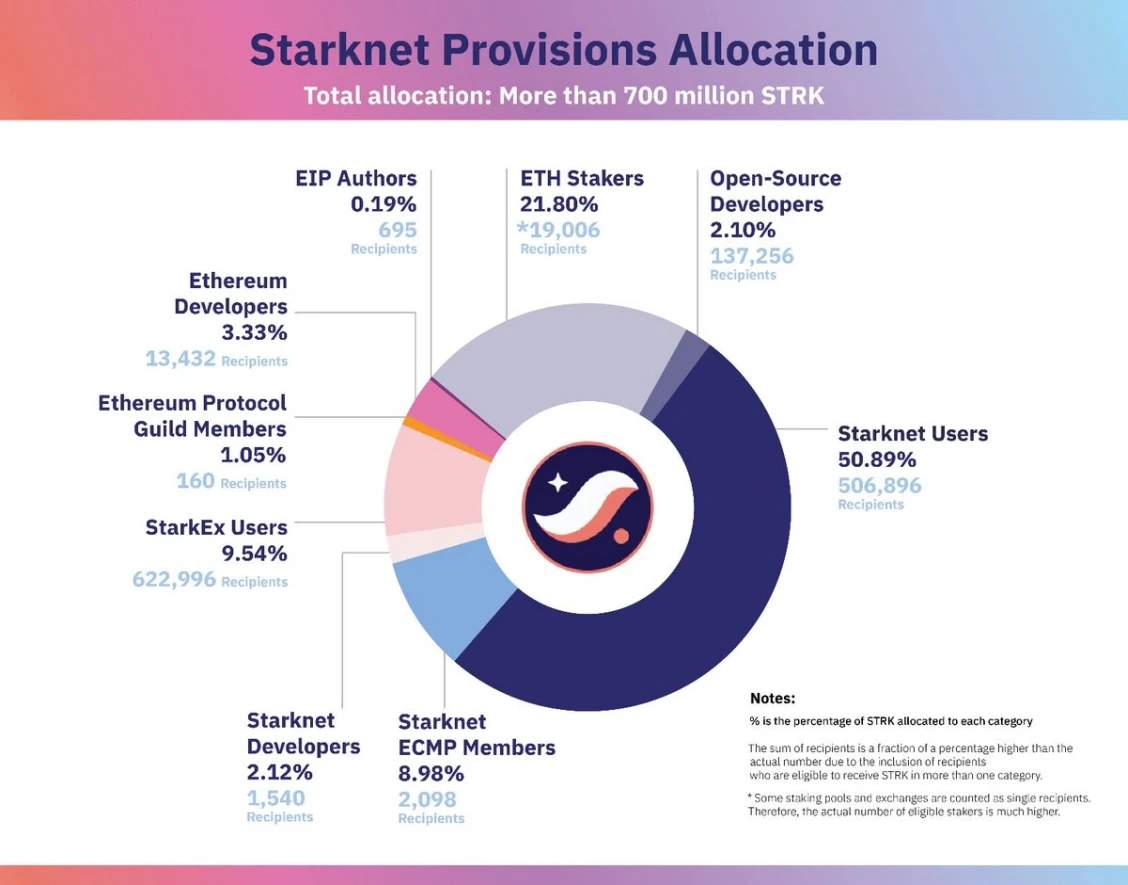
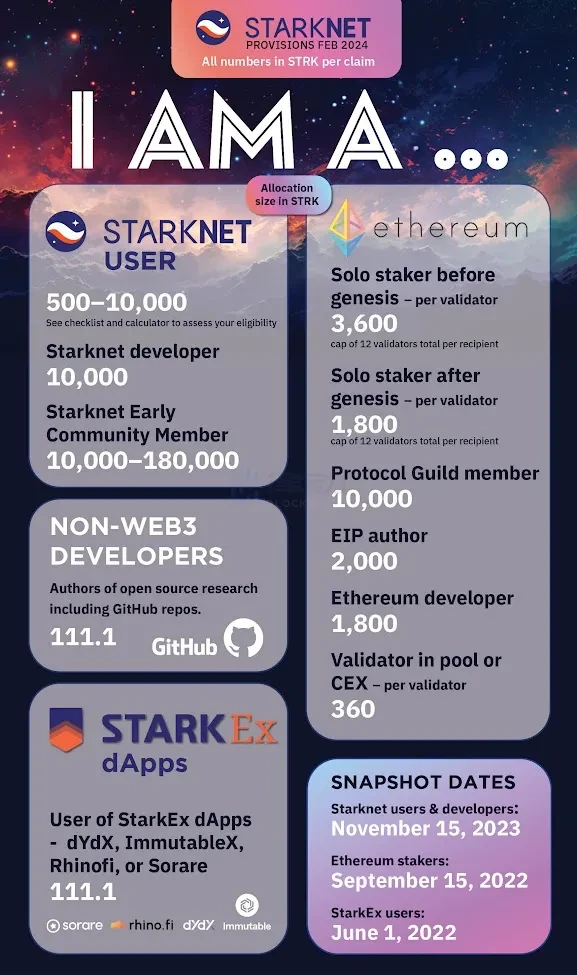
从“Starknet Provisions Program”的分配图可以看出,超过 7 亿的 STRK 会被分配到将近 130 万的地址。相比得到 Optimism 首轮空投的近 25 万地址,Arbitrum 空投的近 62 万地址,和 Celestia 空投的近 20 万地址,这次空投希望广泛激励,雨露均沾的意图非常明显。

1. 超过 50% 的代币被奖励给超过 50 万的 Starknet 个人用户;

2. StarkEx 上超过 60 万的 dApp 使用者,例如 dYdX,ImmutableX,Rhinofi 和 Sorare 等,将获得近 10% 的代币分配;

3. Starknet 是首个将空投的 21.8% 的代币奖励给以太坊独立质押者、以太坊 LSD 持有者的L2项目;

4. 奖励 Ethereum 和 Starknet 的研发人员:EIP 作者,以太坊开发人员,以太坊协议 Guild 成员和 Starknet 开发者;

5. 根据 GitHub 贡献,奖励了非Web3的开源开发人员。在包容性方面树立了新的标杆。

可以看出,无论从激励人数、覆盖生态还是对于非Web3开发人员的覆盖,Starknet 基金会都在致力于 Provisions Program 尽量覆盖多的普通用户。同时吸引尽可能多的的用户和开发者,其最终目的是为了让项目迈入更加去中心化的时代。正像 StarkWare CEO Ben-Sasson 所说,“Provision 计划标志着 Starknet 迈入了更加去中心化的新阶段,它激发了人们对 Starknet 的好奇心,促进了对 Cairo 的学习和使用,使得社区规模大幅增长。越来越多的开发人员正在采用 Cairo,他们认识到,可扩展性的新时代意味着需要一种新的语言来实现。”

Trusta Labs,Starknet 空投计划的独立第三方数据服务商

如何基于数据驱动,公平地奖励到真实、有价值的项目用户。这是 2023 年 8 月摆在 Starknet 基金会和 Trusta Labs 面前的挑战。在近半年的时间内,Trusta Labs 作为独立第三方数据服务商,类比 Arbitrum 空投方案中的 Nansen,在以下方面为 Starknet Provisions Program 提供服务:

1. 空投咨询:Trusta Labs 成功地帮助 Celestia 完成了 TIA Genesis Drop。基于此经验,Trusta Labs 提供了以数据作为驱动的专业咨询服务。

2. 基于 MEDIA 的代币分配:为了普惠空投,需要对用户地址进行定量、科学的价值评估。Trusta Labs 发明了基于 M.E.D.I.A 的链上声誉评价体系,为 Starknet 计算出全量地址的细分维度因子。基于此,Starknet 挑选出重要变量,制定了代币资格规则和代币分配评分。

3. 抗女巫服务:整合 Trusta Labs 和 Starknet 的抗女巫方法,实现了一套 AI-First 和 User-First 的女巫识别方案,经过多轮数据模拟后,应用到本次 Provisions 计划中。

MEDIA 变量选择和应用的考虑

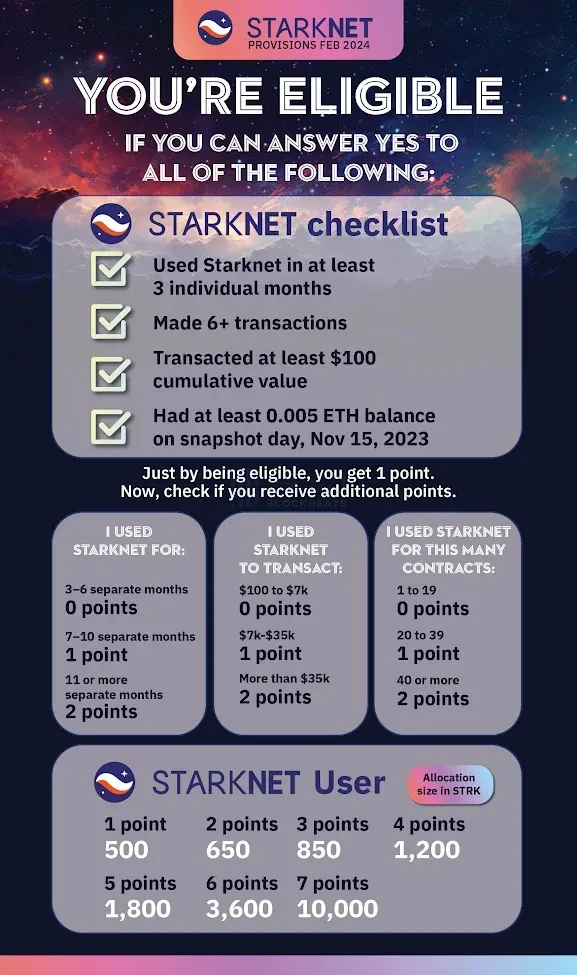
在资格筛选和代币分配模型设计中,Starknet 使用了 Trusta Labs MEDIA 评分体系作为参考【 2 】。MEDIA 体系包含了 Monetary, Engagement, Diversity, Identity 和 Age 5 个维度,综合评估地址的声誉价值评分。Starknet 最终选用了如下五个变量:

1. Engagement - Active Months: 在至少三个不同的月份和 Starknet 交互;

2. Engagement - Interactions:至少完成过 6 笔以上的 Starknet 交易;

3. Monetary - Volumn:交易总金额不低于 100 U;

4. Monetary - Balance: 快照日(2023 年 11 月 15 日)至少持有 0.005 ETH

5. Diversity - Unique Contracts Interacted:交互的不同智能合约的总个数;
如何实现惠普空投,全面解析STRK Provisions Program

如何实现惠普空投,全面解析STRK Provisions Program

在整个 MEDIA 变量选择中,Starknet 贯彻了其普惠空投的思路,整个设计简单、宽泛(可对比 Arbitrum 的空投资格定义【 3 】)。比如,

• Starknet 并没有采用 MEDIA 中的 Identity 变量,因为这会让拥有某类身份(比如 stark id 的拥有者)的地址在空投中更加特殊,得到偏爱;

• Starknet 并没有采用 MEDIA 中的 Age 变量,这直接导致了在社交媒体上有抱怨早期用户并没有得到照顾。其实,更关注用户和项目的交互,而不以交互时间先后来评判,也是一种对普惠空投的坚持。

• Starknet 选择了交易笔数、月份、金额和快照日余额这几个简单变量来定义用户资格,这些维度的门槛也都非常基础。用户需要在 3 个不同的月份,交易过 6 笔以上,并且总交易金额不低于 100 U,就很可能拿到基础空投。

值得一提,MEDIA 体系中对于账户余额的计算包含了 Eth 和多种稳定币。然而,出于对以太坊的重视,Starknet 提出了计算并使用 ETH 余额的需求,USDT 等资金不被计算在余额内。同时,在快照时如果资金存放于 DEX 的 LP,或者借贷协议中的,也不被纳入快照的资格范围内。Trusta Labs 观察到有用户抱怨,出于对于资金的极致利用,并没有在快照日(2023 年 11 月 15 日)保留 0.005 ETH 于账户中,影响了空投资格。这种对于币种、金额、时间窗口的参数设定反映了项目方的空投偏好,Trusta Labs 也会坚持对之后的项目方提出建议,考虑使用更全方位的资金余额形式以及更加多元的梯度奖励标准。

Starknet 空投中的抗女巫服务

抗女巫是一件非常有挑战的工作,这个挑战的根源来自于对女巫的定义。Trusta Labs 从不认为个人多账号在链上活动是一种女巫行为,哪怕交互的目的都是获得空投奖励。但是,利用工具脚本批量地交互,与真实用户不平等地竞争空投资源,哪怕是做到所谓的精品号,也是违背了 Starknet 的普惠空投原则。 

【 4 】中,Starknet 的同事简单阐述了 Trusta Labs 和 Starknet 合作的抗女巫方案。这是一个两阶段的聚类方案,

• 阶段一通过多类方法从资金网络聚集,首次行为聚集,代币 Approve 行为聚集,批量跨链操作等方面对地址进行聚类。阶段一本质上是对类似 Arbitrum 空投中女巫识别方案的改进。Arbitrum 只考虑对于地址资金网络进行 Community detection 挖掘,Starknet 空投中考虑了更多的地址聚集维度。不过,与大家猜测的不同,Trusta Labs 并不会单独分析比如某次奥德赛活动的相似行为。同样,Trusta Labs 也没有能力从任何地方拿到用户 ip,设备指纹等Web2信息。

• 相比于 Arbitrum 方案,新增的阶段二通过基于空间距离的 K-Nearest-Neighbor 和基于序列距离的 Longest Common Sequence 方法对聚类进行提纯,最大程度的降低误入聚类的好人误杀。

对于女巫识别的方案涉及比较专业的机器学习和 AI 知识,我们另文解读。

 一个获得 STRK 的样例地址

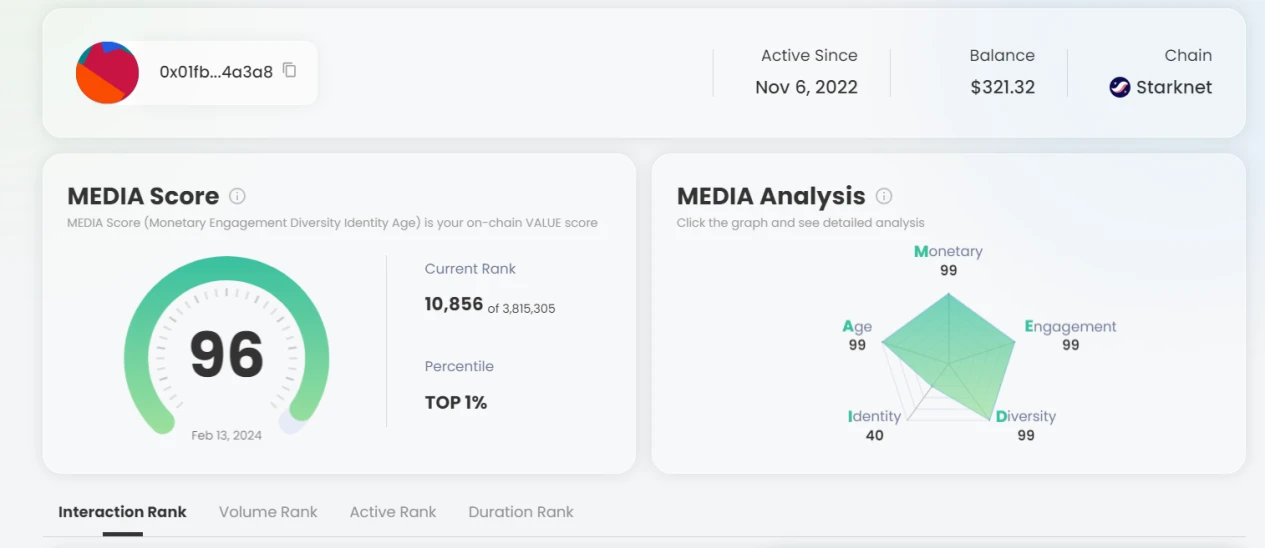
我们以地址0x01fbfdc792c9d169f3672e7389c4f406dbbb917cd8a58994cac8bb4ddbc4a3a8为例,首先看下他在 Trusta Labs 的 Trustgo 产品上的 MEDIA 评分,高达 96 分。
如何实现惠普空投,全面解析STRK Provisions Program

这个地址的 Monetary,Engagement 和 Diversity 的分数更是高达 99 分,这说明该地址在这几个 Starknet 选定维度的相关变量上都表现的很好。有兴趣的读者可以移步【 5 】 亲自看下这个地址的 Starknet 表现。

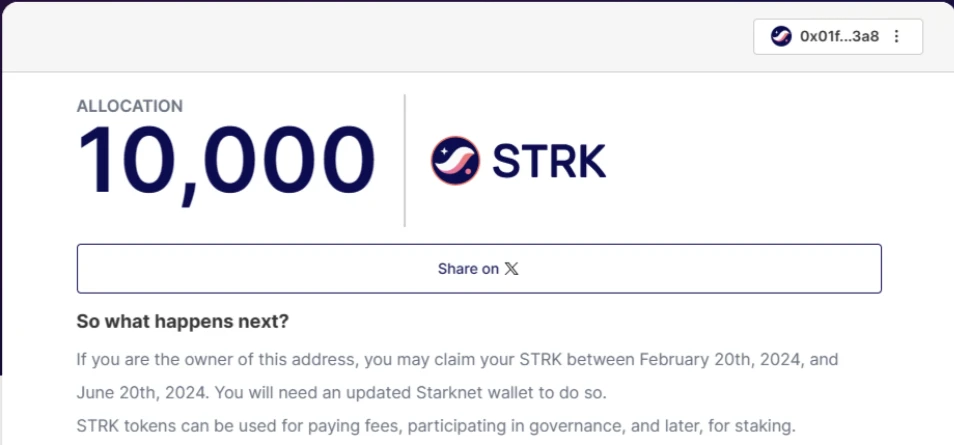
 最终该地址获得了单地址最高所能获得的 10, 000 个 STRK。
如何实现惠普空投,全面解析STRK Provisions Program

结语

让所有人满意的空投方案,也许是一个无限靠近的梦想。在早期用户和持续投入用户之间,在所谓的低保账号和精品账号之间,在真实个体用户和群控批量用户之间,项目方必须有所取舍,无法兼顾。Starknet 的普惠空投思路,可能正在开创空投激励的新范式。在这条路上,Trusta Labs 会帮助所有真实交互,付出正确努力的用户享受激励的成果。

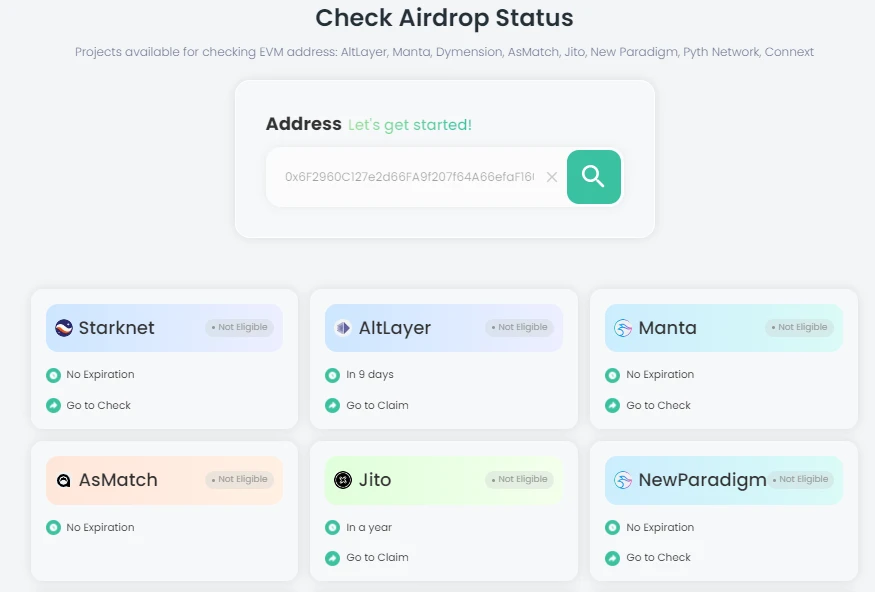
针对 STRK 空投资格查询,不仅可以在官方网站查询你的空投资格【 6 】。Trustgo 的 Airdrop Checker 产品【 7 】也已一站式支持包括 STRK 在内的近期各种空投资格查询。
如何实现惠普空投,全面解析STRK Provisions Program

除了本次 STRK provisions program, Trusta Labs 也是 Celestia Genesis Drop 的方案合作方。通过 AI+Web3的技术积淀,Trusta Labs 正在成为客观、科学的链上声誉评分和 Proof of Humanity 验证的提供者。为项目方提供一套公正评价用户,有效筛选用户,高效激励用户的解决方案。

【 1 】Starknet Provisions Program:https://www.starknet.io/en/content/starknet-provisions-program

【 2 】Trusta Labs 的 MEDIA 评分体系:https://medium.com/@trustalabs.ai/media-score-as-the-infrastructure-for-on-chain-user-value-assessment-c37f68eeb198

【 3 】Arbitrum 空投分配:https://docs.arbitrum.foundation/airdrop-eligibility-distribution

【 4 】Starknet 抗女巫简述:https://github.com/starknet-io/provisions-data/blob/main/sybil_report.md

【 5 】一个获得 STRK 的样例地址:https://trustgo.trustalabs.ai/dashboard/0x01fbfdc792c9d169f3672e7389c4f406dbbb917cd8a58994cac8bb4ddbc4a3a8? chainId= 23448594291968336 

【 6 】Starknet 空投查询:https://provisions.starknet.io

【 7 】Trustgo 的 Airdrop Checker:https://trustgo.trustalabs.ai/booster/0x085ed975a8b6b860de3c2b871da60a3f9f48a5b8? chainId= 324 
İlgili Okumalar

Vitalik's Algorithmic Stablecoin Vision: Interpreting the Mechanism and Challenges from an Options Perspective

Vitalik Buterin's recent algorithmic stablecoin proposal envisions using an option-like mechanism to create a stablecoin without the liquidation risks inherent in traditional collateralized debt position (CDP) models. The design splits one unit of ETH into two components: a 'stable' leg (P) that maintains value up to a certain strike price, and an 'upside' leg (N) that captures any appreciation above that price. Together, they always sum to one ETH, eliminating the need for debt or liquidation mechanisms. From an options perspective, the stable leg essentially functions as a synthetic, covered call position. However, significant challenges exist. For the stable asset to maintain its peg, it must continuously roll deep in-the-money call options, leading to potential rollover slippage, predictable trading paths vulnerable to front-running, and liquidity issues. Crucially, the system's scalability depends on a constant demand for the upside leg—a form of leveraged ETH long position without funding rates or liquidation risk. It's unclear if such persistent, specific demand will materialize from speculators or market makers who have simpler alternatives like perpetual swaps. The author, drawing from experience with Rysk, argues that DeFi options have struggled as standalone trading products due to complexity and fragmented liquidity. Their potential lies instead as foundational infrastructure underpinning more complex financial primitives like stablecoins, structured yields, or index products—transforming from a direct product into a core pricing and risk distribution engine for the next generation of on-chain finance.

marsbit1 saat önce

Vitalik's Algorithmic Stablecoin Vision: Interpreting the Mechanism and Challenges from an Options Perspective

marsbit1 saat önce

GPT-5.6 Countdown: Abandon the Illusion of a Single API, Computational Iteration Can't Outpace a Single Page of Compliance

In mid-June, three seemingly independent industry events—the compliance-driven throttling of Fable 5, the open-sourcing of GLM-5.2, and the leaked release timeline for GPT-5.6—are pushing the global AI industry toward a watershed moment. These shifts signal a fundamental restructuring of the industry's underlying logic. First, **"usability" has substantially overtaken "advanced capabilities"** as the primary weight, pushing the global large language model (LLM) supply chain into a "dual-track" phase of controlled closed-source and local open-source coexistence. Second, **the competitive moats of closed-source giants are shifting**. Their technical focus is moving from "language intelligence" toward "spatial intelligence (world models)"—a domain heavily reliant on computing power. Third, faced with常态化 transnational compliance risks, **a "model-agnostic" decoupled design has become a survival necessity for application-layer developers to maintain business continuity.** The article details how Anthropic's Fable 5, despite its advanced engineering feats, was restricted for non-U.S. citizens within 72 hours of launch, highlighting how geopolitical compliance can instantly limit even the most advanced models. In response, the open-source camp, exemplified by Zhipu AI's MIT-licensed GLM-5.2, is gaining market share by offering stable performance improvements and significant cost advantages (up to 70% savings for enterprises), while achieving full adaptation with domestic semiconductor platforms. Meanwhile, closed-source leaders like OpenAI are pivoting. The anticipated GPT-5.6 reportedly shifts focus from language to spatial intelligence and world models, aiming to rebuild a generational gap in areas like 3D understanding, simulation, and industrial design that demand immense compute. The core conclusion is that the LLM supply chain's logic has changed. Enterprises must now evaluate infrastructure based on a composite of technical performance and policy compliance. For developers, complete reliance on a single closed-source API poses unacceptable risk. Implementing a truly model-agnostic architecture—enabling swift switches to compliant, locally deployable open-source alternatives—is no longer just good practice but a fundamental baseline for business continuity.

marsbit3 saat önce

GPT-5.6 Countdown: Abandon the Illusion of a Single API, Computational Iteration Can't Outpace a Single Page of Compliance

marsbit3 saat önce

Is the 'Token Subsidy War' Among AI Giants Almost Over?

The article discusses the ongoing "token subsidy war" among AI giants like OpenAI and Anthropic, questioning whether it's nearing its end. It reveals that current AI subscription prices are heavily subsidized, with some plans offering tokens at up to 70 times the actual cost to attract and retain heavy users, especially developers and enterprises. This strategy mirrors past internet-era subsidy battles, but with a key difference: AI tokens lack "lock-in" effects. Unlike ride-hailing or food delivery apps, users can easily switch between AI providers as APIs become standardized, making it difficult for companies to raise prices post-subsidy. The piece highlights a structural asymmetry in the competition. Giants like Google, with massive advertising revenue, can afford to subsidize tokens indefinitely, akin to using "tokens as a weapon." In contrast, venture-backed companies like OpenAI and Anthropic face pressure to become profitable, especially as they approach IPO. The article cites Google Ventures founder Bill Maris, who suggests Google could slash token prices by 80%, putting immense pressure on competitors. Two potential endgames are presented: the "internet service" model (subsidize, monopolize, then raise prices) and the "utility" model (tokens become a standardized, low-margin commodity like electricity). Given the low switching costs, the latter seems more likely. The competition may not have a single winner but could instead accelerate AI's evolution into a foundational, infrastructure-level technology, akin to a public utility. For now, users continue to benefit from heavily subsidized token costs.

marsbit4 saat önce

Is the 'Token Subsidy War' Among AI Giants Almost Over?

marsbit4 saat önce

İşlemler

Spot
Futures
活动图片