[focus on web3.0] Bear market ENS opens Web3.0 hundredfold investment opportunities

Huobi Research2022-05-07 tarihinde yayınlandı2022-05-08 tarihinde güncellendi

Özet

Highlights the investment value of ENS.

Some analysts say that Web3 0 will subvert Web2.0 from the perspectives of openness, privacy and co construction 0 Internet, create a decentralized world dominated by user communities, and reconstruct the value paradigm of Internet traffic.

Web3. The openness of 0 is reflected in the full freedom and low threshold of users' access in a certain "field" of Internet applications. For example, users can log in to the application on the chain with one account address, without secondary registration license, and the operation is convenient.

This topic will take ens, mask network, polkdot and GRT as examples to explain the significance of openness.

ENS

DNS (domain name system) is a traditional web2 An important part of 0. When the user accesses the Internet, the server will parse the user's URL request into an IP address and return it to the user. This more readable domain name system reduces the difficulty for users to visit the website, which is web2 0 has made important contributions to the construction of. DNS solves web2 0, but it also brings the problem that users need a large number of website accounts to visit different websites. In response to this problem,

Web3. 0, login can rely on decentralized identity, did (decentralized identity).

In the domain name system built on Ethereum, ENS (Ethereum name service) connects the wallet address with the domain name to log in to various dapps.

Recently, vitalik buterin said in an interview: "Ethereum domain name service ENS is by far the most successful non-financial Ethereum application, which can basically be compared to a decentralized phone book".

On October 9, 2021, an unknown wallet purchased the Ethereum domain name param. With 420 eth Eth, this is the largest ENS domain name transaction so far.
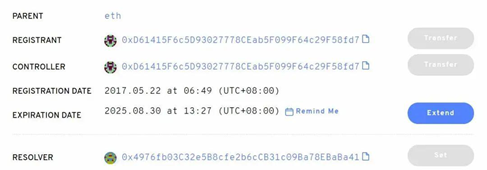
Spending so much money on a domain name shows the significance of HTC.

The full name of ENS is Ethereum name service. It is a distributed domain name service based on Ethereum. It provides a safe and decentralized way to resolve simple human readable domain names into address resources on and off the chain.
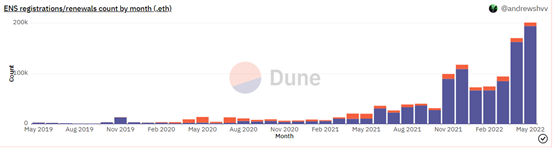
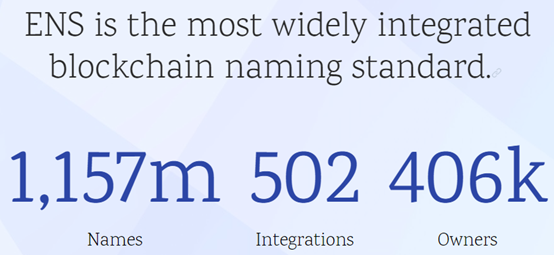
Since the launch of ENS, the number of users has increased rapidly, and the maximum number of registrations per month is only 3066 and 3052 in May 2019 and 2020. By may 2021 and April 2022, the number increased to 10959 and 162978. The year-on-year growth rate can reach 259% and 1387% respectively. In May 2022, it continued to grow to 194562, with a total of 1.157 billion registered user names and 406000 address owners.
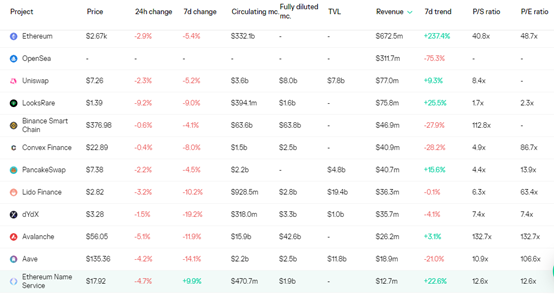
From the data of income and valuation, among the top 12 projects, the cumulative income scale of ENS is not high, but the valuation is reasonable and the growth potential is predictable.

In terms of income, the top four projects have a large income space, which are respectively US $672 million, US $311 million, US $77 million and US $75.8 million of eth, opensea, uniswap and looksrare. ESN earned $12.7 million. In terms of valuation, the PE valuation of ENS reached 12.6 times. Among the top 12 items, the characteristics of undervalued value are obvious, ranking the third in undervalued value items. Only lower than dydx and looksrare.
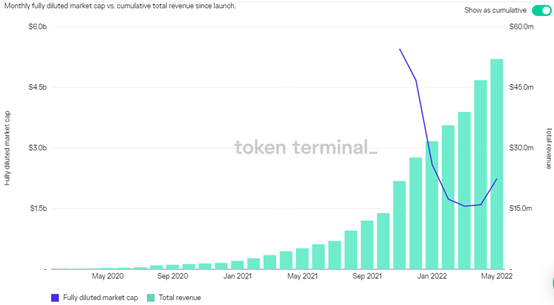
Since its release, the revenue growth of ENS has maintained a very clear growth trend, while the market value fluctuates greatly. Affected by the overall market adjustment, the decline of market value further suggests the opportunity of low absorption.

In terms of revenue, the monthly revenue of ENS increased by 93 times from US $550000 in February 2020 to US $52.1 million in May 2022.

In terms of market value, the monthly market value performance of ENS decreased from US $5.5 billion in November 2021 to US $1.6 billion in March 2022, and then reversed. At present, it is around us $2.2 billion.

The rare ENS domain name has become a new favorite of investment, Web3 Is the positive of 0 released in advance?
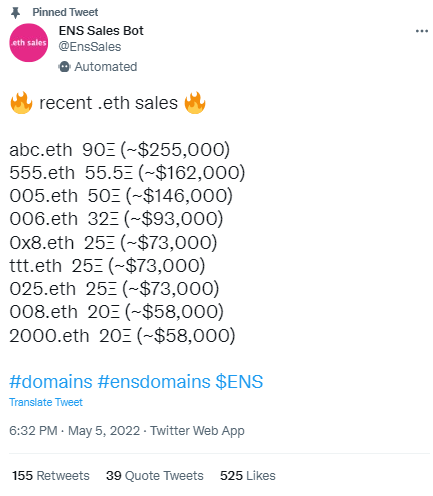
Similar to the early Internet domain name boom, ENS domain names with fewer letters are easier to read, spell and search.

The minimum number of digits of ENS domain name is 3, and the sales of 3-digit and 4-digit domain names have suddenly increased sharply. In the early stage, it was reported that Alisha, head of ENS community Eth suggested that the secondary sales of ENS NFT on opensea reached a staggering 446 Ethereum (about $1.3 million).

But this domain name boom is different from that in the 1990s. Nowadays, many users are interested in the ENS name of digital class, such as 123 eth。 Many three digit ENS domain names sell for more than 6 eth each.

Some people buy at the corresponding amount according to the number contained in the ENS domain name itself, such as 555.5 eth Eth, worth nearly $149000. Ens sales BOT shows that 25eth can purchase 025 Eth, 20eth can buy 2000 eth。

It is worth noting that the ENS domain name is created through the ENS registrar contract, and users need to pay the fees of registration (creating domain name) and renewal (retaining domain name). Ens charging is an anti encroachment mechanism designed to ensure that no one will hold domain names forever.

Therefore, the price of the ENS domain name will vary according to the length of the domain name:

• Domain name with length of 5 + characters: 5 dollars per year;

• 4-character domain name: 160 dollars per year;

• 3-character domain name: $640 per year.

The ENS agreement earns revenue through both domain name registration and domain name renewal. It should be pointed out here that the number of short domain names is limited, which is more attractive to users or investors. In the future, whether it is investment or use, its value is immeasurable.


İlgili Okumalar

Agents Take Over Traffic Distribution Power: What Are Tencent, ByteDance, and Alibaba Competing For?

In the race to dominate the AI era's entry point, China's tech giants—Tencent, ByteDance, and Alibaba—are aggressively deploying AI Agents to control the future of traffic distribution. Alibaba is pursuing a dual-track "closed loop + openness" strategy. Its Qianwen app is evolving into a super-Agent integrated across its ecosystem (Taobao, Alipay, etc.) to handle complex tasks like travel planning. Concurrently, it is opening its platform to external brands (Luckin Coffee, KFC) and has launched a B2B Agent platform, "Wukong," targeting enterprise automation. Its other flagship, Quark, aims to be an "AI super search box" for information and tasks. ByteDance is executing an omnipresent "sprawl strategy." Its Doubao app boasts over 300 million monthly active users and is evolving into a default AI entry point for daily life, with plans for paid versions and e-commerce integration. Its core weapon is the Kouzi platform, a visual "AI assembly factory" for developers to build custom Agents. ByteDance is also pushing hardware integration, collaborating on AI phones and developing smart glasses to embed Doubao everywhere. Tencent is playing its long-held "ultimate card" by quietly embedding an AI Agent directly into WeChat. This Agent, accessible via a swipe, can understand user commands and automatically execute tasks by calling upon WeChat's millions of mini-programs (e.g., finding and ordering coffee). This leverages WeChat's unparalleled 1.4-billion-user ecosystem to position the app as an AI-powered "service operating system," a move that could dramatically reshape the competitive landscape. The core battleground is shifting from competing for "user screen time" to competing to be the "default execution layer" for user intent. The business model is evolving from an "attention economy" to an "intent economy," where the Agent that can most efficiently fulfill a user's need gains control over service access and token flow. This represents a fundamental change in how users connect with digital services, making the fight for the Agent入口 (entry point) a pivotal moment for redefining industry leadership in the AI age.

marsbit7 dk önce

Agents Take Over Traffic Distribution Power: What Are Tencent, ByteDance, and Alibaba Competing For?

marsbit7 dk önce

From Banning Doubao to Embracing Honor: Why Did WeChat Suddenly 'Change Its Face'?

The article explores the sudden shift in WeChat's strategy towards AI assistants from mobile phone manufacturers, transitioning from strict opposition to active collaboration. For over a year, WeChat fiercely resisted attempts by phone AI assistants (like ByteDance's Doubao in late 2025) to control its features via GUI automation ("simulated clicking"), citing security and data control concerns. This stance created a significant barrier for system-level AI integration. Now, Tencent has initiated A2A (Agent-to-Agent) partnerships with major phone brands like Honor, Xiaomi, OPPO, and vivo. This model allows a phone's system AI (e.g., Honor's YOYO) to parse a user's voice command and send a structured request directly to WeChat's own internal AI agent via secure APIs. WeChat then executes the action (e.g., sending a message) and returns the result. The article attributes Tencent's "change of face" to strategic pressure. While leading in social app usage, Tencent trails rivals like ByteDance and Alibaba in standalone AI app popularity. WeChat, with its vast mini-program ecosystem, is Tencent's key asset for an AI comeback. The upcoming WeChat AI agent aims to handle tasks like booking and payments within the app. However, phone system assistants remain the primary AI entry point for most users. The A2A collaboration allows Tencent to extend WeChat's AI reach to this crucial system layer while maintaining control over its core functions and data. For phone manufacturers, embracing A2A is a pragmatic move. The GUI route proved unviable due to WeChat's blocks. A2A offers a compliant path to integrate a vital service, enhancing their AI assistants' usefulness. It allows them to focus on developing their own AI ecosystems for other services while cooperating on WeChat access. The collaboration is framed as a mutual, strategic necessity: Tencent gains a distribution channel, and manufacturers gain a key functionality. The partnership relies on a "dual authorization" mechanism for security, requiring both user and app consent for each action. While questions about long-term data privacy practices remain, experts note A2A is more secure and compliant than GUI automation. Ultimately, this cooperation is seen as a tentative, calculated truce. Tencent's long-term goal is to make WeChat an AI-powered "service OS." Phone manufacturers aim to make their system AI the central user interface. Their paths may converge or clash in the future, but for now, the A2A deal represents the opening chapter in the battle for the AI-era user入口, driven by necessity and strategic calculus on both sides.

marsbit1 saat önce

From Banning Doubao to Embracing Honor: Why Did WeChat Suddenly 'Change Its Face'?

marsbit1 saat önce

On-Chain Figures on the Eve of Kickoff: 1.6 Billion Traded Before the World Cup Even Begins

"On-Chain Numbers on the Eve of the World Cup: $1.6 Billion Traded Before Kick-off" Analysis of on-chain markets before the 2026 FIFA World Cup reveals significant crypto integration into football. The most striking figure is the approximately **$1.6 billion** in total trading volume on the single "World Cup Winner" contract on the Polymarket prediction market platform, accumulated before a single match was played. This represents explosive growth for a sector whose annual volume surged from ~$16B in 2024 to ~$64B in 2025. The ecosystem is maturing beyond speculation. Key developments include: 1) **Infrastructure upgrades** like Polymarket's migration to native, regulated USDC stablecoin for settlements; 2) **Reliable data oracles**, such as Chainlink, being used to resolve real-world match outcomes on-chain; and 3) **Official recognition**, with FIFA appointing its first-ever "Prediction Markets" partner. Over 100 contracts now cover everything from the outright winner to individual match results and even non-sporting risks like venue relocation. This evolution marks a fundamental shift. While crypto firms are absent from FIFA's top-tier sponsor list, the technology has deeply penetrated the tournament's financial and predictive infrastructure through regulated stablecoin settlements, decentralized oracles, and new official partnership categories. The regulatory landscape remains complex and varies by jurisdiction, but on-chain markets for the World Cup are already a multi-billion-dollar reality.

marsbit2 saat önce

On-Chain Figures on the Eve of Kickoff: 1.6 Billion Traded Before the World Cup Even Begins

marsbit2 saat önce

İşlemler

Spot
Futures
活动图片



