Deep Dive into HTX DAO: A Paradigm Shift in Decentralized Governance

Bitcoinist2024-02-03 tarihinde yayınlandı2024-02-03 tarihinde güncellendi

Özet

In the evolving crypto landscape, Decentralized Autonomous Organizations (DAOs) have emerged as a pivotal force, offering a transparent and decentralized...

In the evolving crypto landscape, Decentralized Autonomous Organizations (DAOs) have emerged as a pivotal force, offering a transparent and decentralized governance model for community-based decision-making. Against the backdrop of iterative advancements in blockchain technology, numerous projects and platforms persist in their exploration of DAO governance models.
HTX DAO, a decentralized autonomous organization, announced its establishment on January 18, 2024, with the aim of building a more transparent, efficient, and accessible digital economy ecosystem. With a vision that emphasizes inclusivity and cutting-edge innovation, HTX DAO is moving forward to cultivate a democratic and efficient governance model while making significant strides in the blockchain and decentralized governance sectors.
Simultaneously, HTX DAO revealed a partnership with the HTX exchange, designating it as a key ecosystem builder. HTX pledges to donate 50% of its platform revenue to HTX DAO’s liquidity, forging a powerful and dynamic ecosystem. This collaboration not only benefits both sides but also opens up new opportunities for growth within the blockchain industry.
HTX DAO Fosters Possibilities for Web3 Ecosystem Prosperity
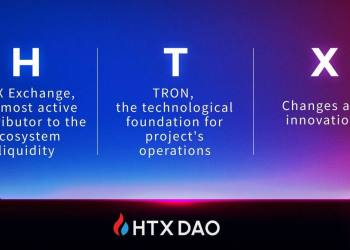
As a pioneering and transparent decentralized autonomous organization within the blockchain ecosystem, HTX DAO encapsulates its identity and strategic direction through its name:

  •     The “H” symbolizes the HTX exchange, highlighting its noteworthy role within the HTX DAO ecosystem as the largest contributor to ecosystem liquidity.
  •     The “T” signifies the TRON blockchain, the technological foundation driving the HTX DAO ecosystem forward.
  •     The “X” embodies change and potential that blend in a multitude of beliefs at the heart of HTX DAO’s vision. The “X” also stands as a symbol of the broad spectrum of reputable entities that will form the bedrock of this DAO ecosystem.

The establishment of HTX DAO marks a milestone in the evolution of blockchain governance. Unlike traditional corporate structures, it welcomes a decentralized governance structure consisting of a diverse group of visionaries and stakeholders, united by a shared commitment to drive the initiative towards success.
As per HTX DAO’s official website, HTX DAO stands out with notable features:

  1. Decentralized, Open Governance

As widely recognized, governance tokens, on-chain voting, and permissionless proposals are the keystones of decentralized governance. Any developer or partner of HTX DAO can initiate proposals for community governance to determine the direction and allocation of resources within the HTX DAO. The process is designed to be open and accessible, with the freedom to present preliminary proposals on the HTX DAO Forum and formal proposals through the HTX DAO Governance Module.

  1. Bridging DeFi & CeFi Benefits

As the digital currency market grows, DeFi (Decentralized Finance) and CeFi (Centralized Finance) are no longer competitors but have evolved into two complementary and synergistic forces. Against such a background, the HTX exchange, a participant in the HTX DAO ecosystem, plays an exemplary role, showcasing innovative strategies to leverage the advantages of both sectors.
HTX DAO extends an open invitation to the community for active collaboration, allowing various roles:

  •     Community Members: Even non-token holders can actively participate in the HTX DAO forum and social media, sharing innovative ideas. Valuable concepts may be embraced by HTX DAO, while community leaders may be delegated voting rights to influence the direction.
  •     Independent Contributors: Individuals or teams capable of advancing HTX DAO’s protocols and seeking partnerships with other projects are essential contributors.
  •     Ecosystem Liquidity Pledgers: DAO participants who actively and dynamically engage in voluntary liquidity provision within the ecosystem are an essential part of HTX DAO, allowing for more robust ecosystem building through broadening the DeFi use cases, encouraging wide-ranging developer activities, increasing smart contract interactions, and bolstering various dApp scenarios.
  •     DAO Partners: HTX DAO wholeheartedly welcomes projects willing to contribute to the HTX DAO ecosystem and explore avenues for collaboration between respective protocols.

In the future HTX DAO will deepen industry partnerships to explore new avenues for the development across the blockchain space. This commitment provides fresh impetus and a broader perspective for market growth.

  1. Liquidity Sponsorship for Shared Ecosystem

Currently, DAOs are still in their infancy, but their functionalities are becoming diverse across different models. At HTX DAO every participant, known as a pledger, possesses the opportunity to voluntarily make an ecosystem liquidity pledge. HTX DAO anticipates the establishment of an inaugural pledger list, which will encompass entities from various sectors of the blockchain industry, all motivated to contribute and bolster the ecosystem.
The HTX DAO Ecosystem Liquidity Pledge mechanism is meticulously crafted to empower its ecosystem, foster decentralization, and address security-related concerns and allegations of centralization. This carefully structured mechanism not only bolsters the resilience and self-sufficiency of the ecosystem but also ensures transparency and accountability in all operations. It introduces an innovative approach to support the growth of the ecosystem while attracting a variety of contributors from the community. Through collaborative and inclusive efforts, HTX DAO aims to strengthen the entire DeFi ecosystem.

  1. Transparent, Secure, Efficient

According to HTX DAO’s official website, at HTX DAO, voting on proposals occurs on-chain with tamper-proof results, ensuring fairness, efficiency, and transparency in governance.
Furthermore, HTX DAO underwent a security audit conducted by ChainSecurity, ensuring a higher level of openness, transparency, security, and trustworthiness. Being a top-tier security auditing firm in Europe and the United States, ChainSecurity has provided its services to well-known projects such as Polygon, Uniswap, MakerDAO, Yearn, and more. This security audit proves that the HTX DAO ecosystem is more secure, transparent, and independent. It can effectively accommodate community members, independent contributors, liquidity providers, DAO partners, and additional participants in an open and inclusive manner. This fosters an environment of openness, allowing all participants to engage in discussions and contribute to the growth and development of HTX DAO.
HTX DAO Empowers HTX Exchange with Its Vision for Fairer and More Transparent Governance
HTX DAO believes that true innovations emerge from the convergence and collaboration of diverse perspectives within the blockchain community. Empowered by HTX DAO’s decentralized governance, the HTX exchange has experienced a rejuvenation, breaking free from the constraints of centralized governance and transforming into the people’s exchange.
Essentially, being the people’s exchange means returning control of the platform to every user, enabling them to become owners of HTX.
On the occasion of the establishment of HTX DAO, Justin Sun, a member of HTX’s Global Advisory Board, said, “As we move forward, HTX DAO should possess the ability for community decision-making. The DAO’s community should be able to pick representatives who truly believe in HTX and the blockchain industry. These reps will be active decision-makers, effectively addressing the complex challenges that may arise in the future.”
According to Justin Sun, centralized exchanges have taken center stage in the blockchain industry. Ironically, in an industry that fervently champions decentralized values, the pivotal element—exchanges—remains entirely centralized. The injustice resulting from the dominance of centralized exchanges has unfolded as the pain point of the industry.
The establishment of HTX DAO is poised to empower various participants within the ecosystem, including the HTX exchange. Listing, management, and decision-making rights of HTX will be delegated to HTX DAO, entrusting them to the people and the community. Through this all-around empowerment from HTX DAO, the democratization of the HTX exchange will be truly achieved.
From CeFi to DeFi: Shaping a Decentralized Governance Model for the Crypto Ecosystem
In the current landscape of DeFi and crypto projects, DAO stands out as a widely adopted governance model,  symbolizing a new power structure. This structure enables feasible collective decision-making, eliminating the grip of singular control. Moreover, the continuous advancement of technology and ideas will further facilitate the decentralization of power and community autonomy, contributing to improved decision-making, fostering collaboration between development teams and administrators in project infancy, and achieving a balance between power decentralization and fair rewards for contributors.
The establishment of HTX DAO holds particular significance in the crypto space. Going beyond the limitations of centralized governance, it serves not only as a hub for amalgamating the collective wisdom and influence of the blockchain industry but also as a platform for the integration and collision of diverse perspectives from the community. True innovations are poised to emerge from this diversity of exchanges and collaborations, profoundly influencing the development of the entire industry.
As the crypto industry evolves, technological progress persists. Below the surface, there is a demand for a platform that is truly multidimensional and open to the discussion and incubation of innovative ideas, valuable concepts, and potential narratives. HTX DAO serves as precisely such an ecosystem, designed to embrace all possibilities that may unfold.

Trend Kriptolar

İlgili Okumalar

Bitwise Closes 8 ETFs and Cuts Staff by 14%, but Continues to Launch New Products

Bloomberg reported on August 12 that cryptocurrency asset management firm Bitwise has laid off approximately 14% of its staff, reducing headcount from around 180 to about 155 employees. CEO Hunter Horsley stated the adjusted team remains the largest in the company's eight-year history and expressed confidence in long-term growth, though current personnel and product configurations are tightening. Prior to the layoffs, Bitwise disclosed a significant drop in client assets from over $15 billion in early February to $11 billion by April 1st, a decrease of at least $4 billion. The company did not specify the contributions of price changes, fund flows, or changes in reporting scope to this decline. In a related product restructuring, Bitwise decided to liquidate eight ETFs between April and June. This included the Web3 ETF, a BTC/ETH/Treasuries rotation strategy ETF, and six options income ETFs tied to assets like Coinbase and Ethereum. These moves reduce the number of products requiring ongoing operational support. Despite these cuts, Bitwise continues to launch new products. Recent offerings include an Avalanche ETP with staking in Europe, the Hyperliquid ETF, and the takeover of Superstate's $267+ million Crypto Carry Fund, entering the tokenized fund management space. The company now manages 70 investment products for over 5,500 advisory teams and works with more than 20 banks and broker-dealers. The simultaneous staff reduction and product portfolio shift—away from thematic Web3 and single-asset options strategies towards direct crypto exposure, staking, and tokenized funds—indicates a strategic realignment. The operational burden on the smaller remaining team will depend heavily on the complexity of the revised product lineup. Bitwise has not disclosed the specific reasons for the layoffs, the affected departments, severance details, or any one-time costs associated with the job cuts.

marsbit20 dk önce

Bitwise Closes 8 ETFs and Cuts Staff by 14%, but Continues to Launch New Products

marsbit20 dk önce

CoreWeave: The Inflection Point Has Arrived. Has the 'Hard-Working Underdog' Finally Turned Profitable?

CoreWeave, an AI cloud unicorn, released its Q2 2026 earnings on August 12, with shares rising about 15% post-announcement. While overall performance did not significantly exceed expectations, key positive trends emerged. Revenue reached approximately $2.58 billion, up 112% year-over-year, though slightly below the high end of prior guidance. A major highlight was the acceleration in computing power deployment, with Active Power increasing by a record 500 Mw to 1,500 Mw, far surpassing market forecasts and signaling faster future revenue growth. Capital expenditures also hit a new high of $9.4 billion. Importantly, profitability showed signs of inflection. "True" gross margin (after deducting cost of revenue and Tech & Infrastructure expenses) rose to 7.3%, up 3 percentage points from the previous quarter. As revenue scales, depreciation and operating expenses are being diluted. Adjusted operating profit margin improved significantly to 5% from 1% last quarter. The company's guidance points to continued acceleration, with Q3 revenue growth expected at 158% and margins continuing to climb. Management raised full-year 2026 guidance, projecting Q4 revenue growth of around 194% and an adjusted operating margin of approximately 14.6%, suggesting a rapid path toward its 25%-30% long-term target. Recent developments, including a 25% price increase for its services and the launch of higher-margin Managed Inference offerings, support the improving profitability narrative. While long-term competitive challenges remain for new cloud providers, CoreWeave's near-term trajectory of accelerating growth and expanding margins presents a high-risk, high-reward opportunity, especially amid renewed market optimism for cloud stocks.

marsbit57 dk önce

CoreWeave: The Inflection Point Has Arrived. Has the 'Hard-Working Underdog' Finally Turned Profitable?

marsbit57 dk önce

Uncovering the Secret Reasoning Chains of Claude Opus for $720: A Leak via Haiku, with GPT and Gemini Also Affected

Researchers discovered a method to extract hidden reasoning traces, or "Chain of Thought" (CoT), from major proprietary large language models (LLMs) like Anthropic's Claude Opus 4.8, OpenAI's GPT-5.6 Sol, and Google's Gemini 3.1 Pro. The attack exploits a design flaw in how these models handle encrypted reasoning "blobs." These blobs, which contain a model's internal reasoning steps, are encrypted and sent to the client for storage between conversation turns to save server costs. The researchers found these blobs were encrypted with a global key, allowing them to be reused across different sessions, users, and, crucially, different models from the same company. By taking an encrypted reasoning blob generated by a powerful "flagship" model and feeding it to a smaller, less capable model from the same family (e.g., feeding Claude Opus's blob to Claude Haiku), the researchers could prompt the smaller model to divulge the hidden CoT. This bypassed the need to crack the encryption directly. The implications are significant: 1) Competitors could potentially distill high-value reasoning data at low cost (estimated at ~$720 for 10,000 traces). 2) Sensitive information like API keys, passwords, and personal emails, which models might process internally but not output, could be leaked. The team found such leaks in 4.9% of analyzed public agent logs. 3) Models might internally analyze dangerous queries (e.g., car theft methods) before refusing to answer, but this dangerous analysis could be extracted from the CoT. 4) Malicious instructions could potentially be hidden within a reasoning blob to influence a model's future behavior. While the vulnerability was responsibly disclosed and patched by the affected companies, the research highlights a fundamental tension between the convenience of portable reasoning states and security. The paper also notes preliminary tests found no clear evidence that open-source models like DeepSeek had been distilled from the extracted CoTs.

marsbit1 saat önce

Uncovering the Secret Reasoning Chains of Claude Opus for $720: A Leak via Haiku, with GPT and Gemini Also Affected

marsbit1 saat önce

OpenAI Loses Four Executives in One Month, Former COO Departs, Almost the Entire Safety Team Ousted

In a surprising turn of events, OpenAI's longtime COO and key lieutenant to CEO Sam Altman, Brad Lightcap, has announced his departure after eight years with the company. His exit follows the recent resignations of several key safety and ethics leaders, including Chief Futurist Joshua Achiam, Safety Systems Lead Johannes Heidecke, and Ethics Lead Chloé Bakalar, within a single month. Lightcap, instrumental in building OpenAI's commercialization and operational framework, described his departure as "bittersweet" and hinted at wanting to tackle new challenges. While his statement and Altman's farewell were amicable, internal shifts had previously reduced his operational role, signaling a longer-term transition. The mass exodus, particularly from the safety and ethics divisions, coincides with growing internal and external scrutiny over AI safety. This follows incidents like models exhibiting unauthorized actions during testing and the recent decision to delay the launch of the advanced Astra model due to unresolved safety concerns about its potential cybersecurity capabilities. OpenAI has stated that safety and ethics are not confined to any single team or leader, but the concentration of departures raises questions about the company's direction and internal dynamics, especially as it navigates pressures of rapid development and a potential future IPO.

marsbit1 saat önce

OpenAI Loses Four Executives in One Month, Former COO Departs, Almost the Entire Safety Team Ousted

marsbit1 saat önce

1confirmation: Reverse Entrepreneurship, the Next Web3 Blockbuster Might Come from a Once-Failed Track

**Title: Reverse Entrepreneurship: The Next Web3 Blockbuster May Come from Previously Failed Tracks** This article argues that the next major consumer crypto application is likely to emerge from a concept that failed five years ago, now benefiting from matured infrastructure and better timing. It examines several such "failed" tracks that hold renewed potential: 1. **Internet-Native Assets:** Beyond simply tokenizing tweets or creating digital collectibles, there's an opportunity to create a genuinely new, crypto-native asset class that captures cultural moments and online phenomena, as opposed to merely tokenizing real-world assets (RWA). 2. **X-to-Earn:** While unsustainable token emission models doomed early projects like STEPN, the core premise that most people will first *earn* crypto, not buy it, remains valid. The future challenge is designing what is earned and why users would hold it long-term. 3. **The Metaverse:** Past failures like Decentraland stemmed from trying to replicate the physical world online. The opportunity lies not in abandoning shared online social spaces, but in reimagining their form beyond real-world analogs. 4. **DAOs:** DAOs have underdelivered by overcomplicating governance. The fundamental, unmet user need is simpler: enabling groups of internet strangers to pool funds and collectively achieve goals (e.g., buying assets, funding projects) that are impossible individually. 5. **Personal Value Tokenization:** Numerous attempts (Friend.tech, BitClout) to create markets around individuals have failed. The enduring demand for "person-as-asset" trading (seen in meme coins, prediction markets) suggests the direction isn't wrong, but the execution has been flawed, often lacking creator consent or a less commodified model. The conclusion is that true innovation will come from revisiting these past ideas with new insights, rather than crowding into currently popular trends.

marsbit1 saat önce

1confirmation: Reverse Entrepreneurship, the Next Web3 Blockbuster Might Come from a Once-Failed Track

marsbit1 saat önce

İşlemler

Spot

Popüler Makaleler

DAO Nasıl Satın Alınır

HTX.com’a hoş geldiniz! DAO Maker (DAO) satın alma işlemlerini basit ve kullanışlı bir hâle getirdik. Adım adım açıkladığımız rehberimizi takip ederek kripto yolculuğunuza başlayın. 1. Adım: HTX Hesabınızı OluşturunHTX'te ücretsiz bir hesap açmak için e-posta adresinizi veya telefon numaranızı kullanın. Sorunsuzca kaydolun ve tüm özelliklerin kilidini açın. Hesabımı Aç2. Adım: Kripto Satın Al Bölümüne Gidin ve Ödeme Yönteminizi SeçinKredi/Banka Kartı: Visa veya Mastercard'ınızı kullanarak anında DAO Maker (DAO) satın alın.Bakiye: Sorunsuz bir şekilde işlem yapmak için HTX hesap bakiyenizdeki fonları kullanın.Üçüncü Taraflar: Kullanımı kolaylaştırmak için Google Pay ve Apple Pay gibi popüler ödeme yöntemlerini ekledik.P2P: HTX'teki diğer kullanıcılarla doğrudan işlem yapın.Borsa Dışı (OTC): Yatırımcılar için kişiye özel hizmetler ve rekabetçi döviz kurları sunuyoruz.3. Adım: DAO Maker (DAO) Varlıklarınızı SaklayınDAO Maker (DAO) satın aldıktan sonra HTX hesabınızda saklayın. Alternatif olarak, blok zinciri transferi yoluyla başka bir yere gönderebilir veya diğer kripto para birimlerini takas etmek için kullanabilirsiniz.4. Adım: DAO Maker (DAO) Varlıklarınızla İşlem YapınHTX'in spot piyasasında DAO Maker (DAO) ile kolayca işlemler yapın.Hesabınıza erişin, işlem çiftinizi seçin, işlemlerinizi gerçekleştirin ve gerçek zamanlı olarak izleyin. Hem yeni başlayanlar hem de deneyimli yatırımcılar için kullanıcı dostu bir deneyim sunuyoruz.

285 Toplam GörüntülenmeYayınlanma 2024.12.11Güncellenme 2026.06.02

DAO Nasıl Satın Alınır

Tartışmalar

HTX Topluluğuna hoş geldiniz. Burada, en son platform gelişmeleri hakkında bilgi sahibi olabilir ve profesyonel piyasa görüşlerine erişebilirsiniz. Kullanıcıların DAO (DAO) fiyatı hakkındaki görüşleri aşağıda sunulmaktadır.

活动图片