18 Years Later, Cashtag on X Is Finally "Usable"

marsbit2026-04-15 tarihinde yayınlandı2026-04-15 tarihinde güncellendi

Özet

On April 14, X launched the Cashtag feature for iPhone users in the U.S. and Canada, allowing users to click on symbols like $AAPL to view real-time stock charts, historical price trends, and related discussions. In Canada, users can also jump directly to Wealthsimple to execute trades. The feature supports cryptocurrencies like $BTC and $ETH, and even tokens via Solana contract addresses. X positions itself as a "data and discovery layer," not a broker, avoiding direct regulatory scrutiny while streamlining the path from discussion to transaction. The term "Cashtag" was originally coined by Howard Lindzon on StockTwits in 2008, but was adopted by Twitter (now X) in 2012 without attribution. Wealthsimple, chosen as the initial Canadian partner, is the country’s largest online broker with experience in both traditional securities and crypto, despite past controversies like a data breach and a class-action settlement over fee disclosures. The rollout is part of X’s broader financial strategy, building on partnerships with Visa, the announcement of X Money, and a clear regulatory stance. This move integrates social discussion, data, trading, and payment layers, advancing Elon Musk’s vision of an "everything app." Cashtag’s journey from concept to functional tool took 18 years.

On April 14, the X platform launched the Cashtag feature on the iPhone in the United States and Canada. The usage is very simple: type $AAPL in a tweet, and this string of characters becomes a blue clickable link. Click on it, and you will see Apple's real-time stock price chart, price trends over a period of time, and all discussions on X with $AAPL. If you are in Canada, you will also see a button that directly jumps to Wealthsimple to complete the transaction.
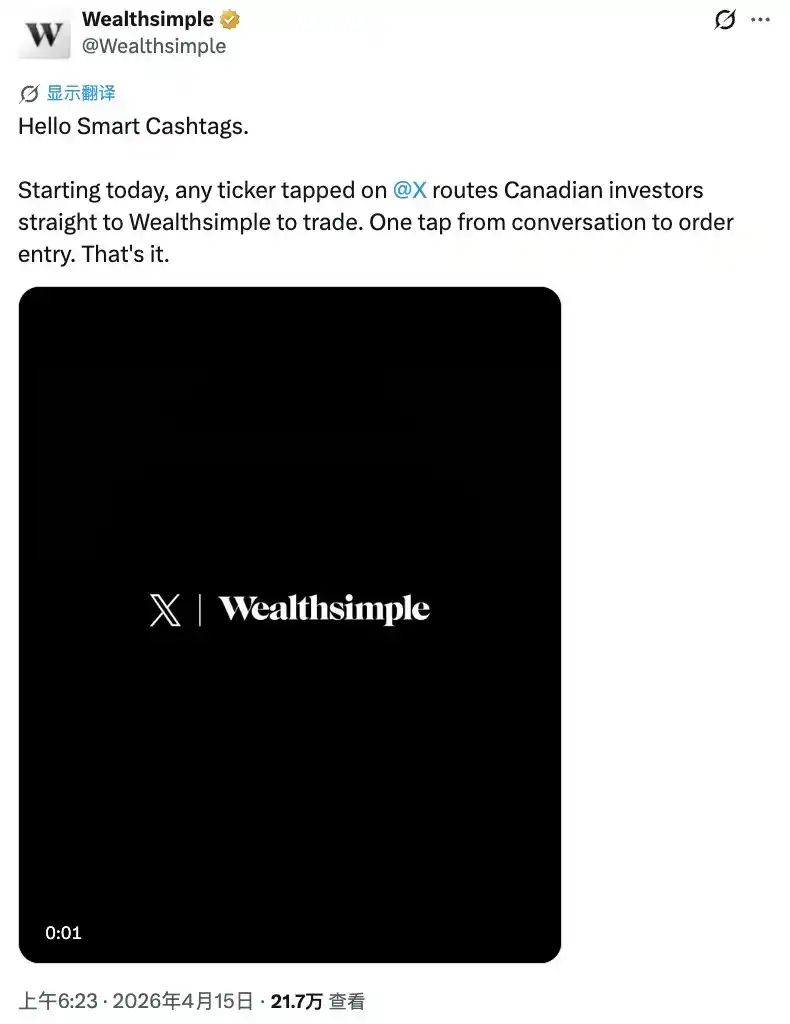
What Can Cashtag Do?

It's not just stocks. X's Cashtag also supports cryptocurrencies. You can search for $BTC, $ETH, or directly input the contract address of a token on the Solana chain to find its on-chain data. In other words, this system aims to cover everything from mainstream blue-chip stocks to long-tail meme coins.

X's product lead, Nikita Bier, specifically emphasized at the feature launch: X will not act as a broker and will not directly execute trades. X's positioning is the "data and discovery layer"; it is responsible for presenting information, aggregating discussions, and guiding users. The actual order placement is handed over to third-party brokers to complete.
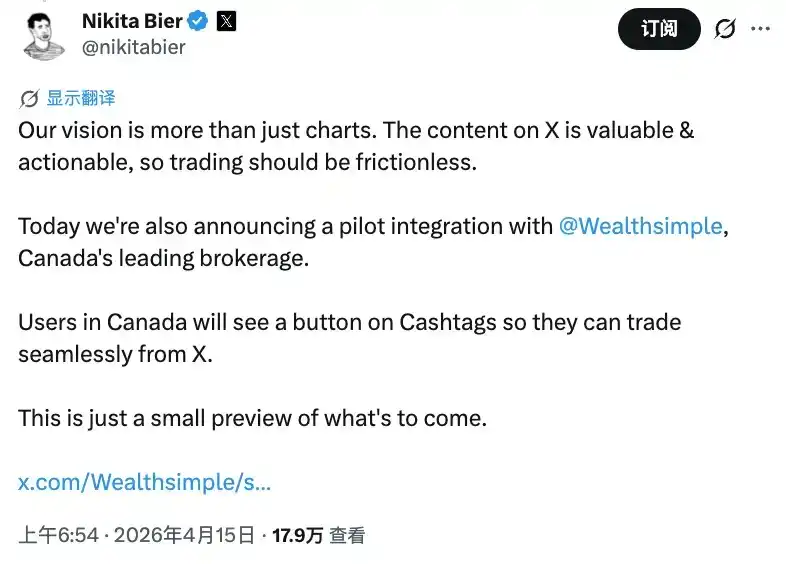
This positioning is crucial. If X were to directly act as a broker, it would need to face the SEC's broker license review, FINRA's compliance requirements, and a series of complex regulatory procedures. By defining itself as a "data layer," X only provides information display, while trade execution happens elsewhere, making the regulatory boundaries much blurrier.

But in terms of user experience, the entire path from seeing a tweet to completing a transaction has been compressed to just a few clicks. This is the first time on the X platform that there is no friction between discussion and action.

Its Origin Is Somewhat Ironic

The term "Cashtag" was not invented by X.

In 2008, a financial analyst and angel investor named Howard Lindzon created StockTwits, a social platform specifically for investors. He introduced symbols like $AAPL on it, using the $ prefix to turn stock tickers into clickable hashtags, allowing retail investors to discuss specific assets and track market sentiment. He named this design: cashtag.
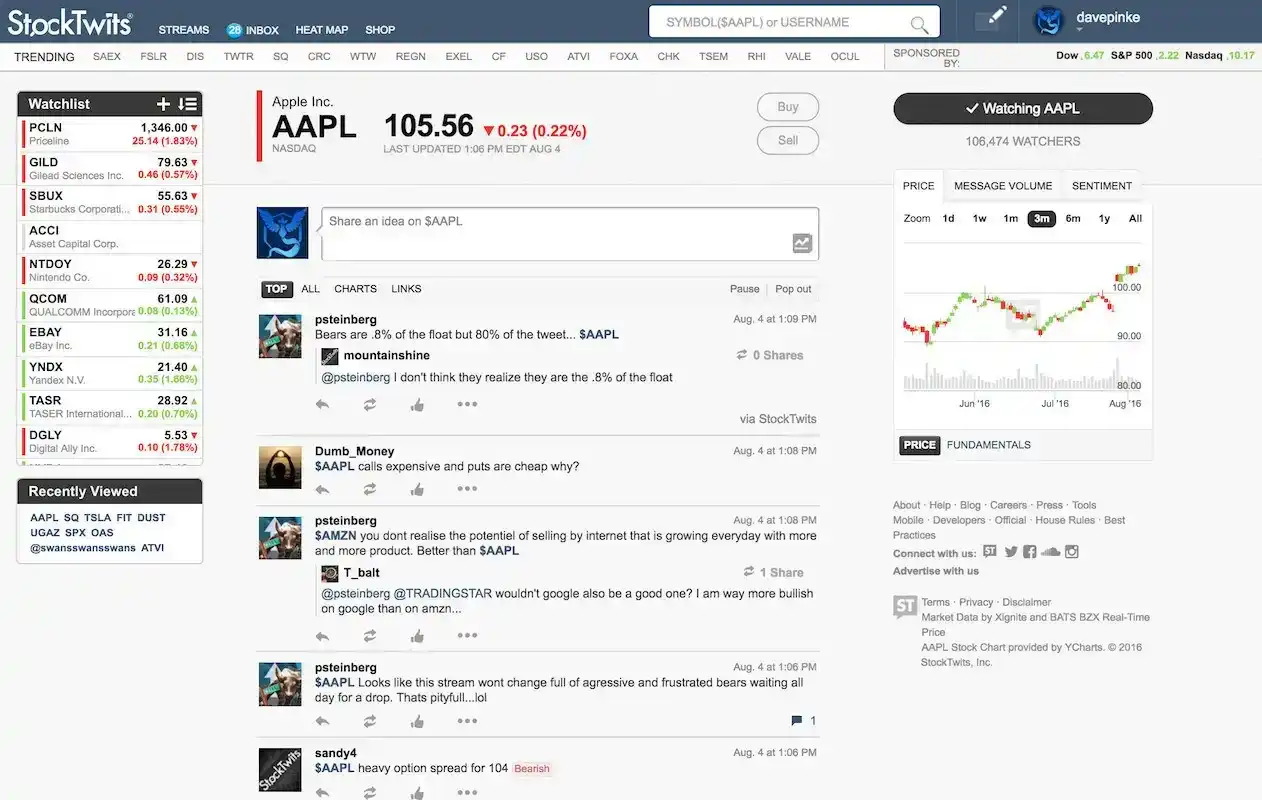
This idea circulated in small circles for four years.

In July 2012, Twitter announced official support for cashtag; $AAPL on Twitter became a blue clickable link. Lindzon publicly expressed "disappointment," saying Twitter had "hijacked" his idea. But he was powerless; cashtag had no copyright, the $ symbol belongs to everyone, and Twitter owed him no explanation.

Over the next dozen years, the two reached a strange balance: StockTwits lived off cashtag, but its traffic was far less than Twitter's. Twitter had the cashtag feature, but on Twitter, it was more like a hashtag than a real financial tool. Clicking on it only led to a topic page—no data, no prices, nothing actionable.

On April 14, 2026, Lindzon posted a tweet on his X homepage advertising the 2026 Cashtag Awards that StockTwits was about to host at the New York Stock Exchange.
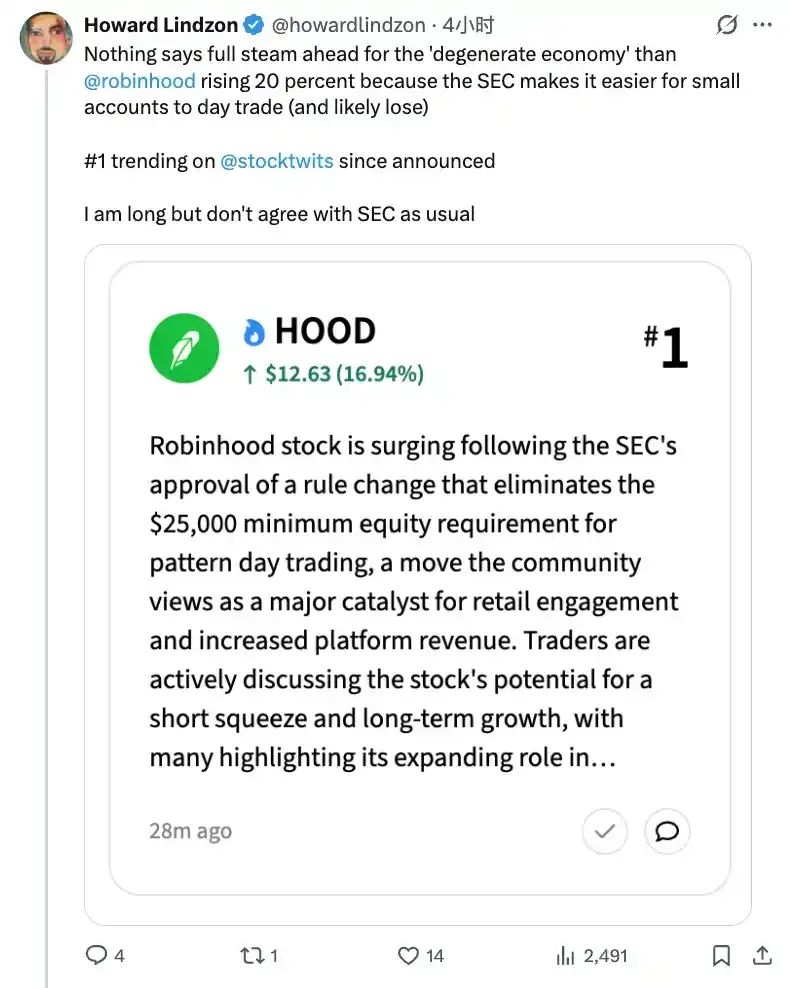
On the same day, the X platform made cashtag truly usable for the first time. Cashtag was invented, appropriated, shelved for over a decade, and then weaponized right under the nose of its inventor, who was still advertising on the opponent's platform.

Why Wealthsimple?

The Cashtag feature was first launched in the US and Canada, but only Canadian users can click on a Cashtag to directly jump to a broker to place an order. The reason is simple: Wealthsimple is a Canadian company, so it's available in Canada. The trading partner for the US market has not yet been announced. But the interesting question is: Why Wealthsimple, and not other Canadian financial institutions?

Wealthsimple is Canada's largest online broker—this is its most direct identity. Founded in 2014, it now manages over CAD 50 billion in assets and has extremely high penetration among young investor demographic in Canada. It holds both traditional securities licenses and digital asset trading permits (Wealthsimple Digital Assets), allowing it to handle both stocks and cryptocurrencies—a condition that X's Cashtag needs to support. This is not something just any institution in Canada can meet.

At the same time, Wealthsimple is also a partner with "a history."

In March 2026, just one month before the partnership with X was announced, the Quebec Superior Court approved a class-action lawsuit settlement against Wealthsimple's crypto business. The cause was its promotion of "zero-commission" trading without clearly explaining to users that it profits from the bid-ask spread. The final settlement was CAD 750,000, averaging about CAD 3.34 per investor. Wealthsimple did not admit any wrongdoing, but the information disclosure issue was already publicly disputed.

Earlier, in 2025, Wealthsimple experienced a data breach. A software package from a trusted third-party supplier was attacked, leading to unauthorized access to some customers' Social Insurance Numbers and account information. Wealthsimple controlled the situation within hours, completing full notification and emergency response. From a crisis management perspective, it did not collapse.

To summarize Wealthsimple's status in one sentence: It has stumbled, but it has gotten back up. It knows where the regulatory boundaries are and has real crisis management experience. For X's new feature, which aims to connect social discussion with trading entry, such a partner, compared to one that hasn't been tested, actually presents more predictable risks.

The real suspense lies in the US market. Robinhood is testing its own social trading feature (Robinhood Social); Coinbase has deeper crypto compliance experience but also more friction with the SEC. Whom X chooses in the US will be the real test of whether this model can succeed.

X's Financial Ambitions, A Timeline Explained in One Chart

The launch of the Cashtag feature marks the assembly of a layered architecture. Looking back at X's actions over the past 16 months, each step falls into a precise position:

January 2025: Partnered with Visa, obtaining the infrastructure for fiat peer-to-peer transfers;

January 2026: Nikita Bier previewed Smart Cashtags, the outline of the financial data layer began to emerge;

February: Proactively clarified "X is not a broker," completing the regulatory separation;

March: X Money officially announced public beta plans, the payment layer surfaced;

April 14: Cashtags launched, simultaneously announcing the Wealthsimple partnership—the data layer and trading layer connected for the first time.
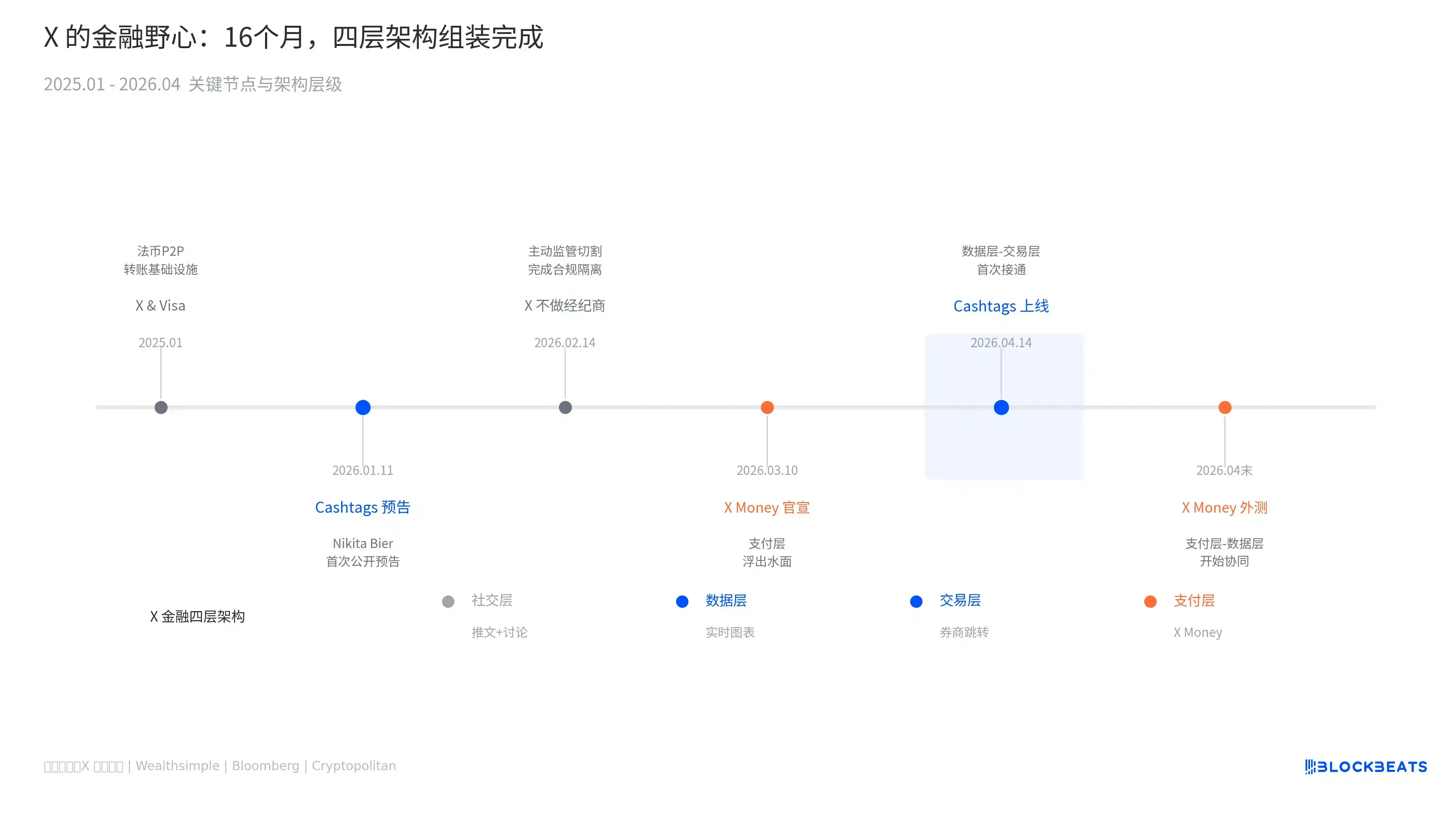
Stack the four layers together: Social layer (tweets + discussions), Data layer (real-time charts), Trading layer (broker jump), Payment layer (X Money P2P transfers + 6% APY yield account). Each layer individually has mature competitors, but combined, no platform has done this before.

This is the most concrete landing of the "everything app" that Elon Musk has been talking about. Starting from attention, it first captures all discussions about money, then step by step transforms these discussions into real capital flows. From Howard Lindzon typing the first $AAPL on StockTwits in 2008 to the X platform today allowing hundreds of millions of users to click this symbol and directly buy stocks, cashtag took 18 years to fulfill its destiny.


İlgili Sorular

QWhat is the Cashtag feature recently launched on X, and how does it work?

AThe Cashtag feature on X allows users to type a dollar sign followed by a stock ticker (e.g., $AAPL) in a post, turning it into a clickable blue link. Clicking the link displays real-time stock price charts, historical price trends, and all related discussions on X. In Canada, it also includes a button to jump directly to Wealthsimple to execute trades.

QWhy did X position itself as a 'data and discovery layer' instead of a broker for the Cashtag feature?

AX positioned itself as a 'data and discovery layer' to avoid the complex compliance requirements and regulatory scrutiny from entities like the SEC and FINRA that come with being a broker. By only providing information and redirecting users to third-party brokers for transactions, X maintains a模糊 regulatory boundary.

QWho originally invented the concept of 'cashtag', and how was it adopted by Twitter (now X)?

AThe concept of 'cashtag' was invented by Howard Lindzon, a financial analyst and angel investor, who created StockTwits in 2008. He used the $ symbol followed by stock tickers to create clickable topic tags for discussions. Twitter (now X) adopted this idea in 2012 without compensation or acknowledgment, as the term 'cashtag' and the $ symbol are not copyrighted.

QWhy did X choose Wealthsimple as its initial trading partner for Cashtag in Canada?

AX chose Wealthsimple because it is Canada's largest online broker, managing over CAD 50 billion in assets, with high penetration among young investors. It holds licenses for both traditional securities and digital asset trading, aligning with X's support for stocks and cryptocurrencies. Additionally, Wealthsimple has experience handling regulatory issues and data breaches, making it a tested partner.

QWhat are the four layers of X's financial ecosystem as outlined in the article, and how do they integrate?

AThe four layers are: 1) Social layer (posts and discussions), 2) Data layer (real-time charts and information), 3) Trading layer (broker redirects for transactions), and 4) Payment layer (X Money P2P transfers and 6% APY yield accounts). Together, they form a comprehensive system that captures financial discussions and converts them into actionable financial activities, unique to X's 'super app' vision.

İlgili Okumalar

Breaking: Google Earth Urgently Pulls Back Nano Banana 2 Image Generation Feature!

Google Earth's newly launched "Create image" feature, powered by the Nano Banana 2 AI image generation model, was abruptly withdrawn shortly after its release due to being "played" by users. The feature allowed users to generate and overlay AI-created visuals directly onto real-world satellite and 3D maps in Google Earth. The tool enabled creative applications like historical recreations (e.g., visualizing ancient Pompeii), generating informational graphics for landmarks, and envisioning architectural projects or futuristic cityscapes on real terrain. It operated under "geospatial grounding," meaning the AI respected the underlying geography, topography, and perspective of the chosen map view. The model also integrated with Gemini to retrieve relevant factual information. However, upon release, users quickly tested its limits. A prominent example involved reimagining Philadelphia's historic Independence Hall as a post-apocalyptic ruin overrun by "happy" zombies, evil clowns, and giant alien mechs. This highlighted both the feature's playful potential and its risks regarding the generation of inappropriate or misleading content on realistic maps, leading to its swift temporary removal. Google stated it would re-release the feature after implementing "enhanced guardrails." Analysts note this move strategically leverages Google's vast proprietary geospatial data, positioning its AI not just for artistic generation but for spatially accurate world visualization—a unique advantage in the competitive AI image generation landscape.

marsbit13 dk önce

Breaking: Google Earth Urgently Pulls Back Nano Banana 2 Image Generation Feature!

marsbit13 dk önce

Altman Admits: Overestimated AI Snatching Jobs! Huang Renxun: The Unemployment Narrative Is Completely Backwards

Sam Altman has revised his earlier predictions about AI rapidly replacing jobs, admitting he overestimated the speed at which AI would eliminate entry-level white-collar roles. Speaking on the "Invest Like the Best" podcast, he stated that people do not truly want an AI CEO, as accountability and human connection remain critical. He found that individuals prefer interacting with people who can be held responsible for decisions. Similarly, NVIDIA's Jensen Huang argued that the narrative of AI destroying jobs is misguided. He distinguishes between tasks and jobs, noting that while AI can automate specific tasks, entire jobs—encompassing communication, judgment, coordination, and accountability—are not eliminated. He cited examples like radiologists and software engineers, where demand for these roles has increased as AI handles repetitive tasks, allowing for business expansion and the creation of more positions. Data from a University of Maryland and LinkUp study supports this, showing that U.S. job postings for new graduates have actually risen, countering the fear of vanishing entry-level roles. However, a significant shift is occurring: the traditional entry-level tasks that help newcomers gain experience are being automated, making initial career access more challenging. The key insight is that as AI takes over standardized tasks, the enduring value of human work shifts toward areas of responsibility, trust-building, and final decision-making—aspects that AI cannot replicate. The real "moat" for professionals lies in these irreplaceable human elements.

marsbit18 dk önce

Altman Admits: Overestimated AI Snatching Jobs! Huang Renxun: The Unemployment Narrative Is Completely Backwards

marsbit18 dk önce

Weekly Editor's Picks (0725-0731)

Weekly Editor's Picks (0725-0731) provides a curated selection of deep analysis, filtering out market noise. Key themes from this week include: **Macro & Policy:** The Federal Reserve's upcoming meeting is marked by high uncertainty, balancing cooling inflation data against persistent price pressures. Meanwhile, the U.S. crypto regulatory Clarity Act faces critical political hurdles, with its 2026 passage probability seen as low. **Investing & Crypto:** Analysis suggests long-term crypto success depends on conviction through volatile cycles, focusing on assets like Bitcoin and core smart contract platforms. A trend noted is the increasing similarity between global equity markets (especially tech) and crypto, driven by narrative and leverage. Several major crypto protocols show strong revenue growth, but this isn't always translating to token price appreciation due to sell pressure and structural factors. **AI & Semiconductors:** Nvidia's rising credit default swap rates signal market concern over AI infrastructure financing risks. The storage sector experienced volatility as markets began pricing in potential 2027 oversupply. Despite a record profitable quarter, SK Hynix's results were deemed "below expectations," reflecting heightened investor demands for future growth visibility. **Markets & DeFi:** TradeXYZ demonstrated remarkable accuracy in pre-market pricing for a major A股 listing. The token ONDO saw gains, linked to its growing role in the on-chain tokenized stock ecosystem. **Ethereum:** Post-Pectra upgrade, a major structural shift is underway as Lido begins migrating millions of ETH to new validator architectures designed for capital efficiency. **Also Highlighted:** Butian's bullish stock market move; OpenAI's Altman promising major advances; Samsung and SK Hynix securing large AI chip deals; Apple reaching a $5T market cap; and ongoing discussions around exchange security following Poolin's bankruptcy case.

marsbit53 dk önce

Weekly Editor's Picks (0725-0731)

marsbit53 dk önce

Low Investment Isn't Apple's Immunity Pass

While Meta and Google face investor scrutiny over ballooning AI capital expenditures, Apple's minimal AI investment has paradoxically become a strength. Its market cap recently reclaimed the global top spot, surpassing $5 trillion. The irony is deep: Apple's own AI efforts have lagged, with "Apple Intelligence" delayed and core talent lost, forcing reliance on partners like Google Gemini and Alibaba's Qianwen. Its Q3 FY2026 (Q2 CY) earnings initially seemed stellar. Revenue hit $109.4B (up 16% YoY), with iPhone and Mac sales, growing 22% and 29% respectively, driving most of the growth. However, the stock fell over 8% post-earnings. The primary concern was a weaker Q4 revenue growth forecast of 9-11%, below expectations, due to looming supply chain constraints. Apple is feeling the indirect cost of the AI boom. Soaring memory and chip prices, fueled by massive data center investments from Microsoft, Amazon, and others, are forcing Apple to raise Mac and iPad prices significantly. The upcoming iPhone launch is also expected to see substantial price hikes. Despite avoiding heavy AI infrastructure spending—its capital expenditures are actually down 28%—Apple cannot escape the industry-wide supply and cost pressures. While Apple's operating cash flow remains robust, its substantial R&D spending (up 32% YoY) has yet to yield major AI breakthroughs. As Tim Cook prepares to step down as CEO, Apple faces a challenging transition: balancing its premium hardware success against the strategic and cost pressures of the AI era it has so far cautiously navigated.

marsbit1 saat önce

Low Investment Isn't Apple's Immunity Pass

marsbit1 saat önce

İşlemler

Spot
活动图片