18-Year-Old Hacker's Boastful Discord Display Leads to Uncovering of $19 Million Theft Case

Odaily星球日报2026-05-13 tarihinde yayınlandı2026-05-13 tarihinde güncellendi

Özet

An 18-year-old hacker from the U.S., Dritan Kapllani Jr., has been exposed by on-chain investigator ZachXBT for his alleged involvement in multiple cryptocurrency social engineering attacks, with total funds stolen estimated at $19 million. The case gained attention after Dritan inadvertently revealed his involvement during a Discord voice call in April 2026, where he screen-shared his Exodus wallet containing approximately $3.68 million to show off his wealth during a "Band 4 Band" argument. Tracing this wallet address led investigators to uncover its connection to a major theft from March 14, 2026, where 185 Bitcoin (worth around $13 million at the time) was stolen. Approximately $5.3 million from that heist was funneled into Dritan’s wallet. Further analysis linked the same wallet to over $5.85 million from other social engineering attacks dating back to 2025. While Dritan has not yet been formally charged, he is identified as "Co-Conspirator 1" in recently unsealed court documents related to the 185 Bitcoin theft case. Another individual, Meme coin KOL yelotree, is also implicated for allegedly assisting with money laundering through a car rental business. Dritan, who had been living a lavish lifestyle and was previously seen as untouchable within hacking circles, turned 18 recently, making him legally accountable. His previous "immunity" has ended as law enforcement closes in.

Original | Odaily Planet Daily(@OdailyChina)

Author | Asher(@Asher_ 0210)

Last night, on-chain investigator ZachXBT exposed an 18-year-old hacker from the United States named Dritan Kapllani Jr. According to the disclosed information, this young man named Dritan Kapllani Jr. is suspected of involvement in multiple social engineering attacks targeting cryptocurrency users, with an estimated total amount involved of approximately $19 million. Although he has not been formally charged yet, he has already been included as a 'co-conspirator' in U.S. judicial documents.

This case quickly attracted attention, not only because of the massive amount involved but also because its starting point was highly dramatic—a voice call meant for showing off wealth became the breakthrough for the entire investigation.

Just Showing Off Wealth Once on Discord

On April 23, 2026, a dispute that occurred in a Discord voice channel kicked off the incident.

It was a voice call known as 'Band 4 Band,' where participants compared their 'strength' in the most direct way—by showcasing their respective assets. The atmosphere soon shifted from teasing to rivalry. Driven by this sentiment, Dritan, to prove he was richer, directly started screen sharing and displayed his Exodus wallet interface, showing a balance of about $3.68 million.
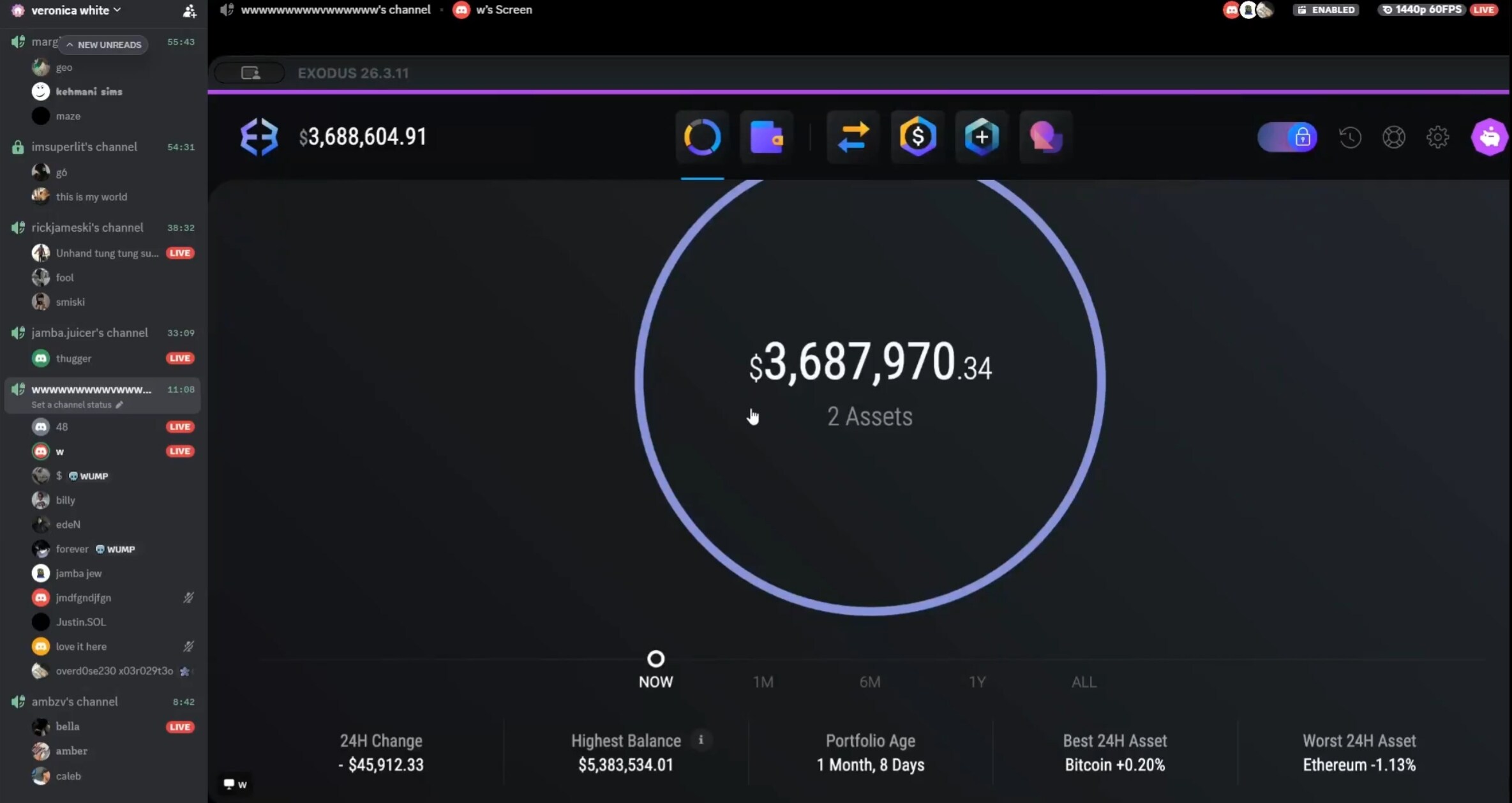
A few weeks later, this scene was revisited. On-chain investigator ZachXBT used this address as a starting point, linking together what were originally scattered transactions one by one, gradually revealing a longer funding trail.

A Cache of 185 Bitcoin Theft Funds Surfaces

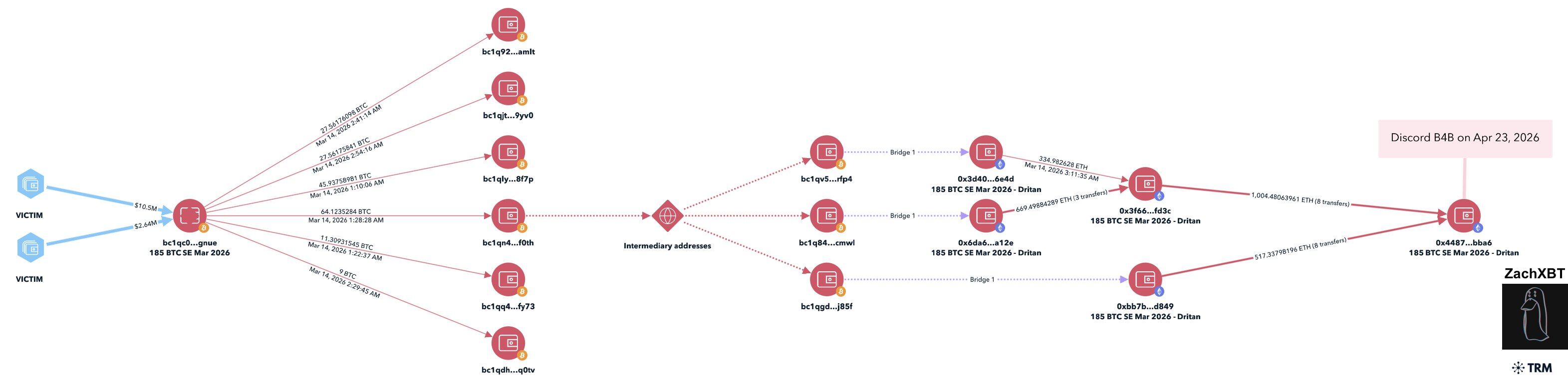
Going back to March 14, 2026, a social engineering theft involving 185 Bitcoins occurred, valued at around $13 million at the time. The funds were quickly transferred out of the original address and swiftly entered an on-chain distribution system.

As early as the next day, about $5.3 million of it was transferred into the wallet Dritan displayed during the Discord voice call (address: 0x4487db847db2fc99372a985743a26f46e0b2bba6). Over the next few weeks, this approximately $5.3 million was continuously split, transferred through multiple addresses, and sent to various destinations. By the time of that April 23 voice conversation, about $1.6 million had already been further moved.
Not the First Time Involved in Crypto Theft

Tracing back from the wallet address Dritan displayed, it quickly became apparent that the funds in it didn't only come from that 185 Bitcoin theft.

According to on-chain analysis, the funding sources for this wallet can be traced back to multiple social engineering thefts in 2025, totaling over $5.85 million. Different victims, different times, but after the funds were transferred away, they would be rapidly split and then moved on through a string of addresses, following a very similar pattern. By matching these funds one by one, it was found that many transfers eventually landed in this wallet address Dritan displayed.

It's worth noting that Dritan once had a 'Band 4 Band' dispute with hacker John Daghita (Lick). Lick was later arrested for allegedly stealing about $46 million in U.S. government funds, and in a later-deleted Telegram post, he had publicly shared Dritan's old address (address: 0x97da0685dbba50b4cbabb0ca9e8336f4fbe41122). Currently, this move appears more like an act of retaliation.

Judging from on-chain behavior, this old address showed a highly consistent pattern with the funds flow of the wallet Dritan displayed in terms of fund splitting methods, transfer paths, and subsequent destinations, and is therefore believed to be used by the same controlling party.

Judicial Documents 'Name' Him for the First Time

It wasn't until May 11, 2026, that this on-chain funding trail was officially confirmed for the first time in judicial documents. That day, the criminal indictment against Trenton Johnson was unsealed. He was charged for his involvement in that 185 Bitcoin theft case and faces up to 40 years in prison.

In the indictment, a key co-conspirator is labeled as 'Co-Conspirator 1 (CC-1),' and the on-chain analysis community has already pointed this identity towards Dritan Kapllani Jr. Although Dritan has not been formally charged yet, he has transitioned from a 'linked address' in on-chain inference to a 'co-conspirator structure' in the judicial narrative.

Additionally, the same document mentions another individual involved—Meme coin KOL yelotree, who is accused of assisting in money laundering through his car rental business in Miami and faces up to 30 years in prison.

Turning 18, The Dissolute Life Comes to an End

Previously, Dritan had been living a life of extravagance for a long time, frequently posting related content on Instagram and interacting with other hackers via Telegram. In hacker circles, he was once considered to have a kind of 'protagonist aura'—several groups associated with him (like ACG, 41 / RM Boyz, etc.) were successively dealt with by law enforcement, yet he himself remained untouched.

But as he turned 18, this 'aura' ended, and his past actions began to be pursued legally.

İlgili Sorular

QWho exposed the 18-year-old hacker Dritan Kapllani Jr., and what was the initial trigger for the investigation?

AThe hacker was exposed by blockchain investigator ZachXBT. The investigation was triggered by Dritan showing off his Exodus wallet (with a balance of about $3.68 million) during a 'Band 4 Band' Discord voice call on April 23, 2026.

QWhat is the total estimated value linked to the social engineering attacks involving Dritan Kapllani Jr.?

AThe cumulative amount linked to the social engineering attacks involving Dritan Kapllani Jr. is approximately $19 million.

QHow did a specific 185 Bitcoin theft connect to Dritan's wallet, and what happened to the funds?

AIn the 185 Bitcoin theft on March 14, 2026 (worth about $13 million at the time), approximately $5.3 million was transferred into the Exodus wallet Dritan later showed off. This money was then split and moved through multiple addresses, with about $1.6 million transferred out before the Discord call.

QWhat is Dritan Kapllani Jr.'s status in the US legal case (Trenton Johnson) related to the 185 Bitcoin theft?

AIn the unsealed criminal complaint against Trenton Johnson, Dritan Kapllani Jr. is referenced as 'Co-Conspirator 1 (CC-1).' While he has not been formally charged yet, his role has moved from a blockchain-inferred association to being officially identified as a co-conspirator in the judicial narrative.

QAccording to the article, why did Dritan's perceived 'main character halo' in the hacker community end?

ADritan's perceived 'main character halo' in the hacker community ended because he turned 18 years old. Upon reaching legal adulthood, his past actions became subject to legal consequences and prosecution.

İlgili Okumalar

War Trade Unwinding | TradeXYZ Weekend Observations

Weekend markets saw a clear return of risk appetite. Major indices rose broadly, with significant gains in tech and precious metals, while energy sectors fell sharply on the "end of war" narrative. On June 14, oil prices initially rose on reports Iran had not yet finalized a memorandum of understanding. Later, YNET reported Trump might immediately lift the maritime blockade on Iran and the Strait of Hormuz. At 21:30, Trump confirmed on Truth Terminal that a deal with Iran was done, authorizing an immediate end to the US blockade and toll-free opening of the Strait. Iran's deputy foreign minister simultaneously announced an immediate and permanent halt to military actions on multiple fronts. Oil prices had already fallen to weekend boundaries, pre-pricing the news. The S&P 500 subsequently touched 7530. Markets will likely remain in a waiting period until the formal peace deal signing on June 19. At the moment of the deal announcement, gold jumped from ~4,221 to a high of 4,337, and silver from ~67.85 to 70.83, before stabilizing at higher levels. Individual stocks and ETFs like NBIS, RKLB, and LITE performed strongly. NBIS, added to the Nasdaq index, saw a target price increase due to strong AI cloud growth. RKLB, also added to the index, benefited from positive SpaceX valuation sentiment. LITE received a $1,130 target from JPMorgan. SPCX rose quickly after Musk tweeted SpaceX could potentially reach ~$1 trillion in revenue by 2030. In summary, the market shock from the multi-month war is beginning to dissipate. Israel's actions remain the key variable before the June 19 signing. Upcoming events like Fed Chair Warsh's debut and BoJ rate hike expectations will also significantly impact markets this week.

marsbit3 dk önce

War Trade Unwinding | TradeXYZ Weekend Observations

marsbit3 dk önce

Will the Next Crypto Bull Run Start with On-Chain Trading of SpaceX?

This article presents a scenario-based forecast for the crypto industry from 2026 to 2029, arguing that the next major cycle will be driven not by technological narratives but by legal access to real-world assets. The author predicts that by mid-2026, pre-IPO perpetual contracts for top private companies like SpaceX, OpenAI, and Anthropic on platforms like Hyperliquid will become the primary gateway for accessing quality assets, as most crypto-native tokens fail to capture real value. The much-hyped AI x Crypto intersection largely fails except for prediction markets, which thrive on betting on AI model supremacy. By 2027, public blockchain foundations are forced to choose between catering to retail speculation or building compliant infrastructure for institutions, with many opting for the latter. Growth in stablecoins and tokenized private credit/equity hits a "triple ceiling" due to regulatory and political uncertainty rather than market demand. The pivotal shift is forecast for 2028. A major liquidation event in pre-IPO perpetuals exposes the structural flaw of synthetic markets lacking a real underlying asset anchor. In response, regulatory changes finally allow the public solicitation of private securities resales to verified accredited investors. This creates a legitimate secondary market for real company equity, which then becomes the core asset class of the new bull market, relegating synthetic perps to a niche role. By 2029, the industry becomes "boring" but foundational. Tokens without claims on real cash flows or assets cease trading. Stablecoin growth is steady but politically capped. Crypto infrastructure fades from view as it gets absorbed into traditional finance backends. The article's central thesis is that the key bottleneck for crypto's next phase is legal and regulatory channels for real asset ownership, not technology.

marsbit1 saat önce

Will the Next Crypto Bull Run Start with On-Chain Trading of SpaceX?

marsbit1 saat önce

The Value Distribution of Stablecoins

**Summary: The Value Distribution of Stablecoins** The article argues that stablecoins are evolving from mere trading tools into broader channels for dollar access. It divides the stablecoin ecosystem into four layers to analyze how value is distributed: 1. **Issuance Layer:** Mints stablecoins, holds reserve assets, and captures the spread between reserve yield and user costs (e.g., Tether, Circle). This layer currently earns the largest profit margin. 2. **Infrastructure Layer:** Connects stablecoins to the traditional financial system, handling fiat on/off-ramps, banking integration, compliance (KYC/AML), and asset management (e.g., Bridge, BVNK). This is the "unglamorous" but critical work, building the essential bridges between crypto and real-world finance. 3. **Acquiring/Distribution Layer:** Integrates stablecoins into merchant systems, manages payment flows, and provides enterprise financial software (e.g., Stripe, Coinbase). They act as the access point for businesses. 4. **Application Layer:** The end-users and businesses that ultimately use stablecoins for payments, settlements, or as a store of value. They benefit from convenience but have little pricing power. The core thesis is that while the issuance layer currently dominates profits, the often-overlooked **infrastructure layer holds significant long-term potential**. The real challenge and barrier to mass adoption is not the on-chain transfer of stablecoins (which is simple), but the complex "last mile" integration into existing business workflows, banking systems, and regulatory frameworks across different countries. Companies in this layer are currently in a "land grab" phase, investing heavily to build networks, secure bank partnerships, and establish compliance pathways. While their position is currently pressured by the profitable issuers above and distribution platforms below, the article suggests that if stablecoins become a default financial rail for businesses, the infrastructure providers who have done the hard work of integration will ultimately gain strong pricing power and become entrenched, essential players.

marsbit8 saat önce

The Value Distribution of Stablecoins

marsbit8 saat önce

The Value Distribution of Stablecoins

The Value Distribution of Stablecoins The article argues that stablecoins are evolving from a mere trading tool into a broad "dollar channel." It analyzes the industry's value chain through four layers: 1. **Issuance Layer (e.g., Tether, Circle):** The top layer that mints stablecoins, holds reserve assets, and captures the thickest interest rate spread. 2. **Infrastructure Layer (e.g., Bridge, BVNK):** Connects stablecoins to the traditional financial system, handling critical but complex "dirty work" like fiat on/off-ramps, banking integration, compliance (KYC/AML), and cross-border settlement. 3. **Acquiring/Distribution Layer (e.g., Stripe, Coinbase):** Embeds stablecoins into merchant systems, manages payment flows, and integrates with enterprise software. 4. **Application Layer:** End-users and businesses that ultimately use stablecoins for payments, settlement, or storing value. The author posits that while the issuance layer currently captures the most profit, the most overlooked and potentially critical layer is infrastructure. The core challenge for stablecoin adoption isn't the on-chain transfer (which is simple), but bridging the gap between blockchain and the real-world financial system. This involves solving practical problems for businesses: fiat conversion, reconciliation, tax handling, and user onboarding. Infrastructure companies are currently in a difficult "land-grab" phase—building networks, securing banking relationships, and achieving compliance country-by-country. They face pressure from both the profitable issuance layer above and distribution platforms below. However, the author suggests this layer is building a crucial moat. Once stablecoins become a default business rail, the infrastructure players who have done the hard work of integration may gain significant, durable value and pricing power.

链捕手8 saat önce

The Value Distribution of Stablecoins

链捕手8 saat önce

İşlemler

Spot
Futures
活动图片