1600 Lines of Code Create an Underwater Manhattan, Fable 5 Leaves Karpathy Stunned

marsbit2026-07-06 tarihinde yayınlandı2026-07-06 tarihinde güncellendi

Özet

Title: Fable 5 Stuns Karpathy with 3D Worlds Built from 1600 Lines of Code An AI model, Fable 5, has demonstrated a remarkable leap in generating complex, interactive 3D worlds with minimal code. Showcased by Peter Gostev of Arena.ai, the model created 63 diverse 3D environments across themes like immersive cityscapes, explorable famous paintings, natural wonders, and cosmic phenomena. Many were generated in a single attempt. A standout creation is a detailed, submerged Manhattan built with only 1600 lines of Three.js code. Other highlights include traversable versions of Van Gogh's "Starry Night," a bear catching a salmon with realistic physics, and a split Red Sea. The model's ability to cohesively manage vast numbers of elements within a scene represents a significant technical advancement. Andrej Karpathy, who recently joined Anthropic's pre-training team, expressed amazement, particularly at how the model intuitively understood and rendered complex real-world interactions like a fish struggling when caught. He coined the term "fablemaxxing" to describe this qualitative leap. While Fable 5 excels at world-building, Gostev notes current limitations in creating engaging, long-form gameplay. The model also sometimes requires prompting to fully utilize its capabilities. Having topped the Agent Arena benchmark for real-world task completion, Fable 5 signals that the boundaries of AI-generated content are rapidly expanding, with its full potential yet to be discovered.

[Introduction] Fable 5 is back online. In a video, Gostev from Arena.ai unleashed 63 3D worlds, nearly all generated in one go. After watching the video, even Karpathy, who just joined Anthropic's pre-training team, exclaimed he never expected this.

A bear stands by a river, snapping up a leaping salmon.

The fish struggles desperately in its mouth.
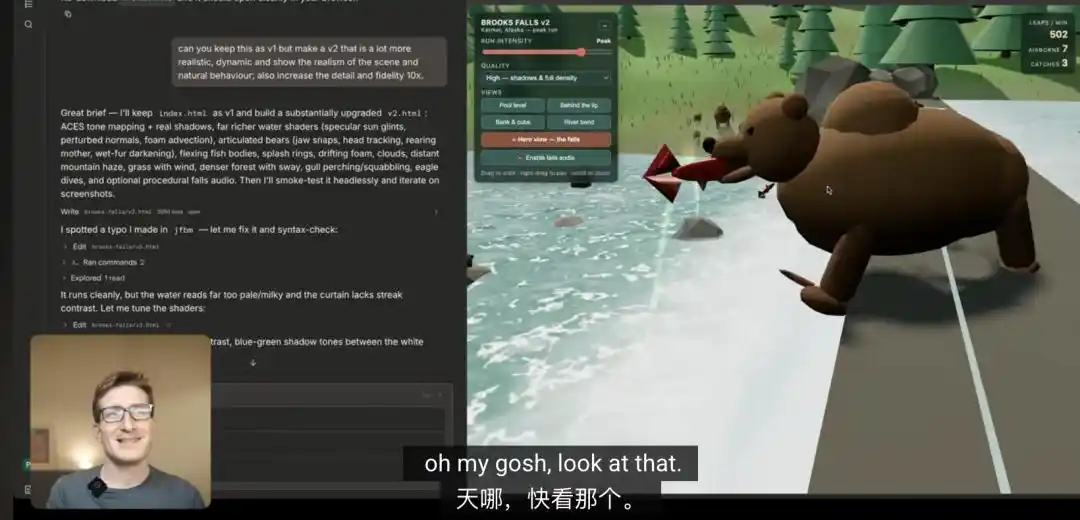
This scene completely stunned Andrej Karpathy.

After viewing this set of 3D videos, he wrote in a post:

It's absolutely incredible. I hadn't realized before that models could create such incredible, rich, and playable worlds.
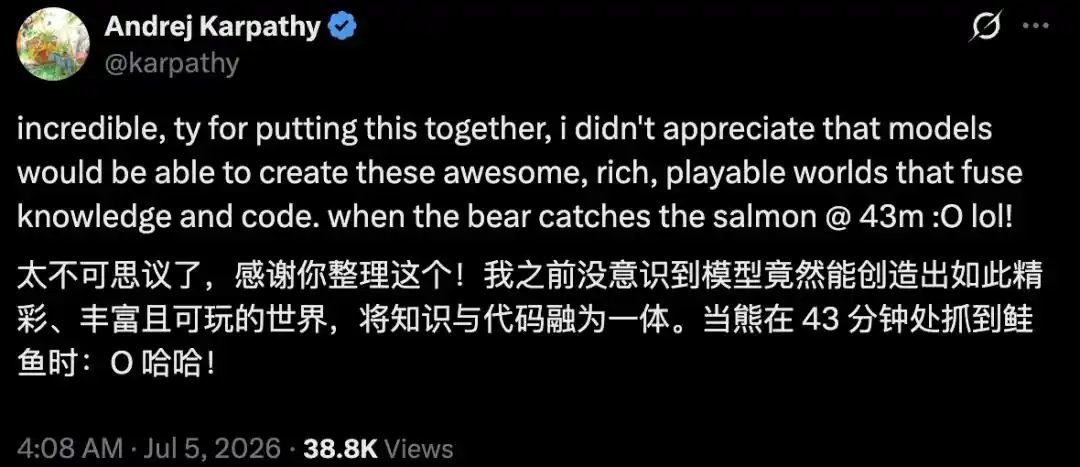
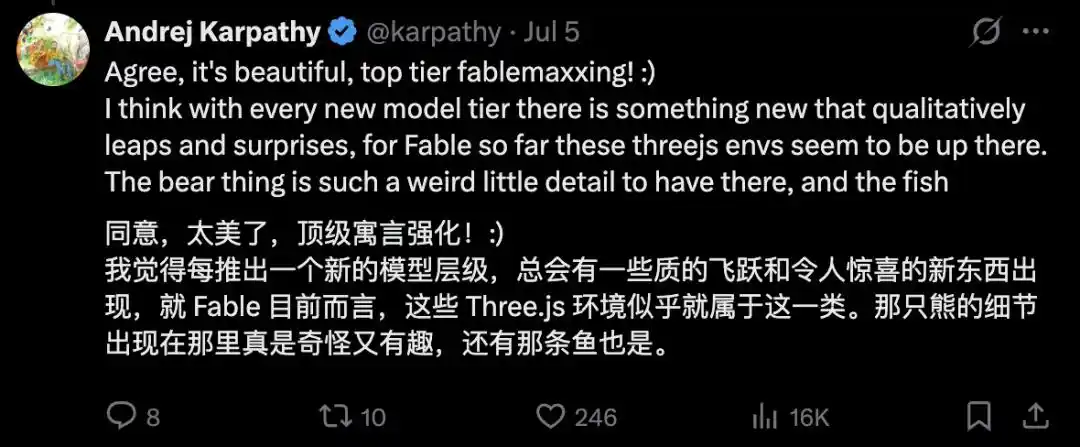
He also coined a new term: fablemaxxing.

This is so beautiful, it's peak fablemaxxing! Every new model scale, there's always something qualitatively new that leaps forward and surprises.
Karpathy just joined Anthropic in May, specifically their pre-training team.

In June, Fable 5 debuted, was shut down by US export controls three days later, and was just reinstated on July 1st. The video's creator is Peter Gostev from the AI evaluation platform Arena.ai.

Using Fable 5, he ran 63 high-difficulty 3D generations in one go, almost all in Three.js, with the majority succeeding on the first try.

Just over a month ago, getting AI to create a playable 3D world you could walk into in one attempt was nearly a pipe dream. Now, Fable 5 can churn out 63 at once.

Thus, Gostev couldn't help but marvel in the video: even the people in the labs haven't fully grasped what it can do yet.

1600 Lines of Code, a Living Underwater Manhattan

Let's start with the most impressive one in the video.

The entire Manhattan is submerged underwater. Central Park, skyscrapers, street textures — the details are unbelievably rich.

Gostev looked at the code: 1600 lines. These 1600 lines support a living underwater city.
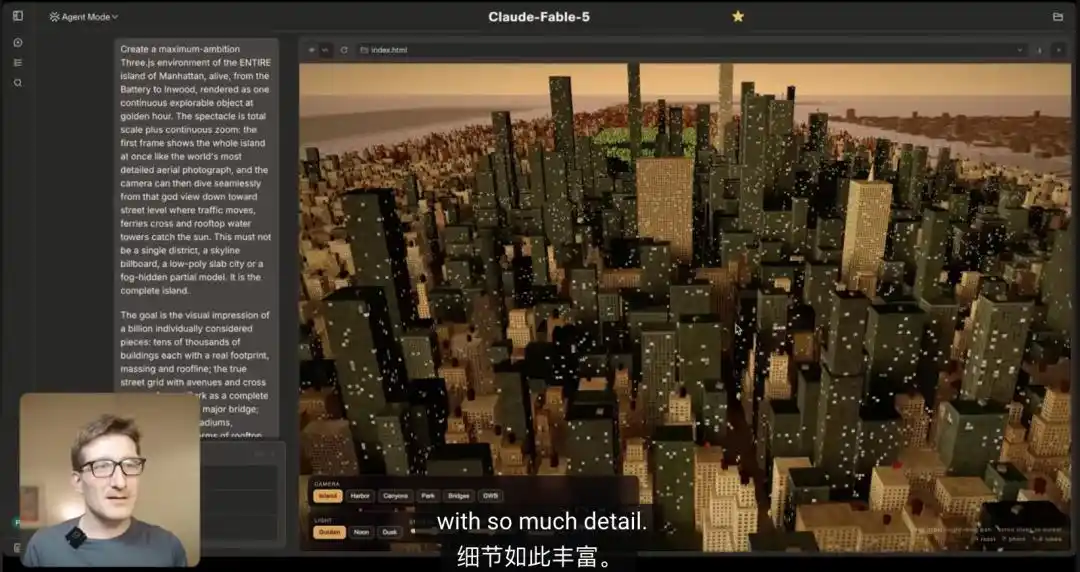
Fable 5 generated Manhattan, showing the entire island from Battery to Inwood, with thousands of buildings each with distinct outlines, all powered by 1600 lines of code. (Source: Peter Gostev video)

In total, Gostev created 63 such worlds, categorized into 6 major themes.
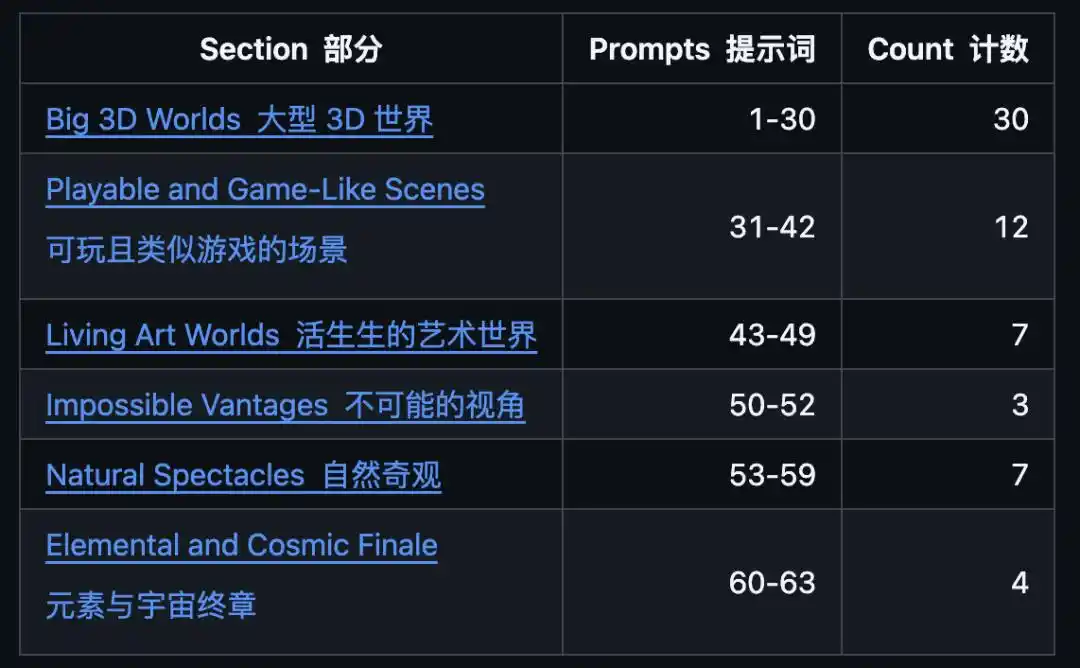
Among the giant 3D worlds, Istanbul spanning the European and Asian shores, London over 2000 years, magnificent pyramids, the eruption of Pompeii, and the Golden Gate Bridge with flowing traffic were all constructed.
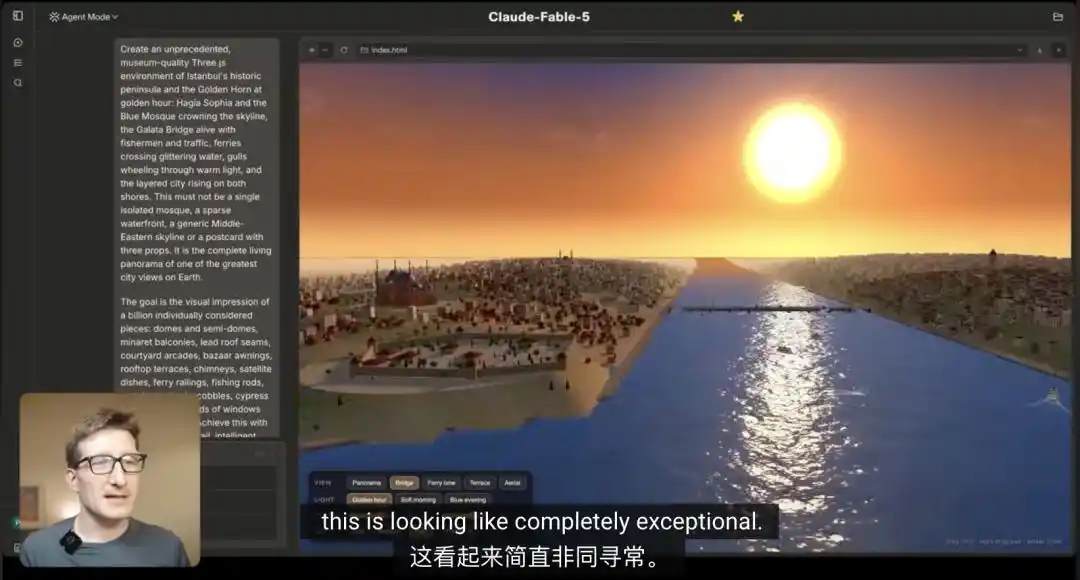
Istanbul generated by Fable 5 in one go, spanning Europe and Asia, layered into the sea. (Source: Peter Gostev video)
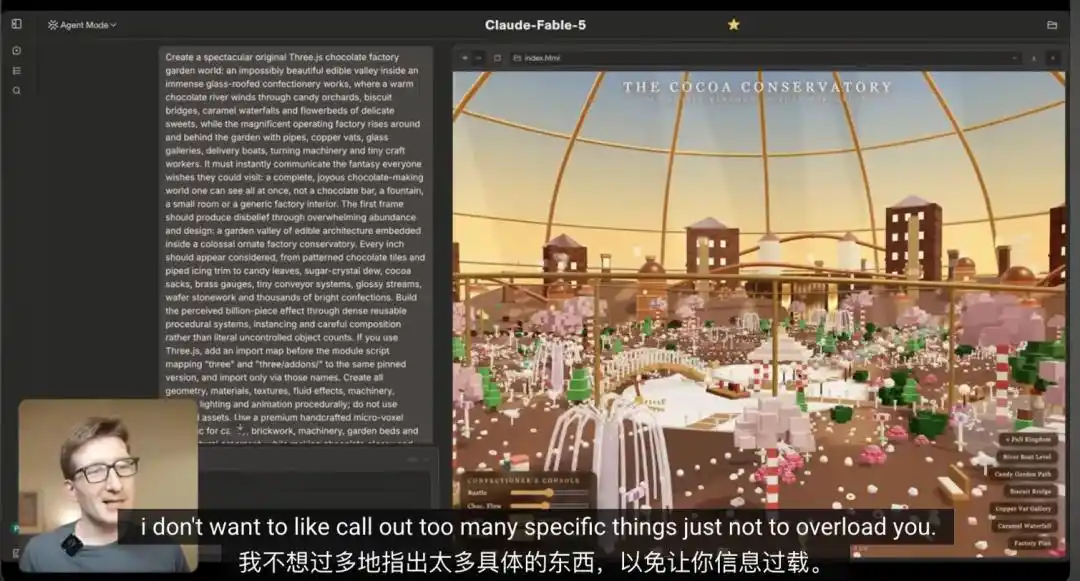
The Edible Kingdom generated by Fable 5, a chocolate factory made of candy. (Source: Peter Gostev video)

For playable scenarios, there's parkour on New York rooftops, a physics playground where you can tear down an entire city, and a flight simulator with a fully equipped dashboard.

The most unbelievable category is stepping into world-famous paintings. Van Gogh's Starry Night, Monet's Water Lilies—each spread out into a traversable 3D world.

Another category is impossible perspectives: a one-millimeter-tall ant observing a garden in the rain, opening its eyes to a mountain of gold.
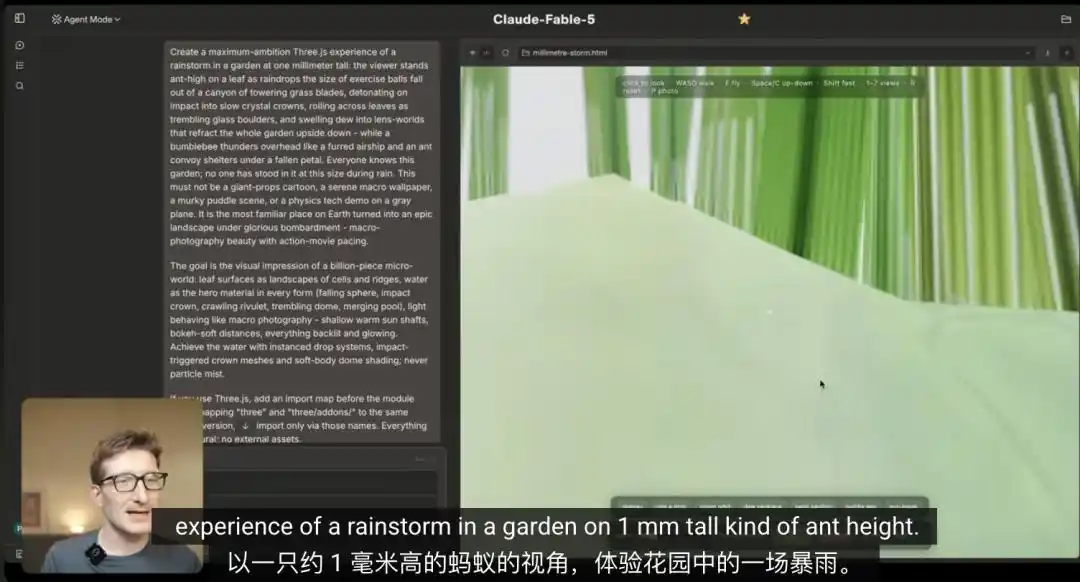
Fable 5 compresses the perspective to one millimeter high, with blades of grass towering like majestic peaks. (Source: Peter Gostev video)

Among natural wonders, Niagara Falls, a forest where fireflies synchronize their flashes, and the bear catching a salmon that stunned Karpathy are in this category.

Finally, there are elements and the universe: the Red Sea parting, a volcanic island being born, a space elevator piercing the clouds.
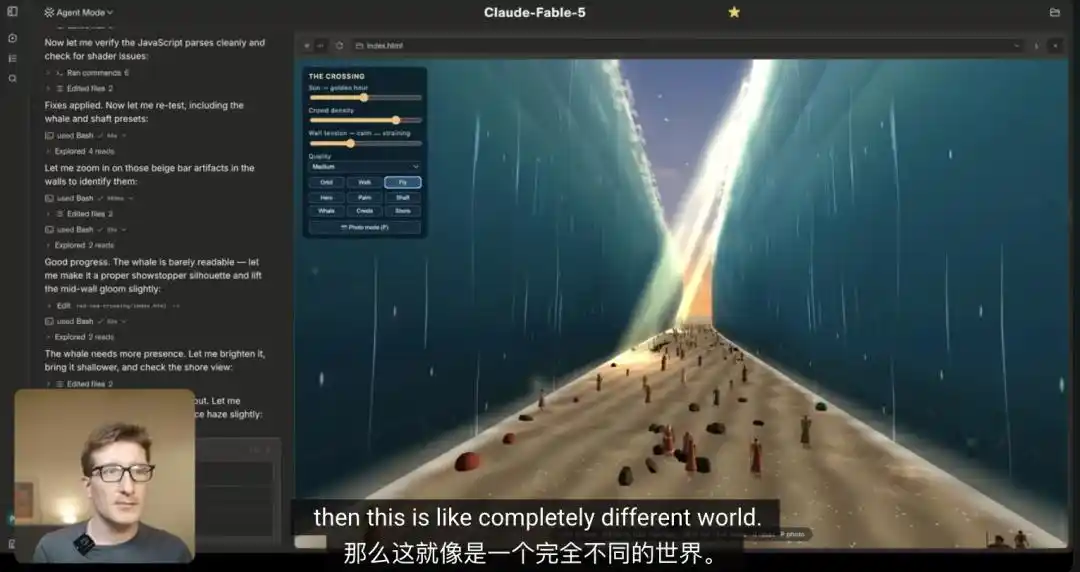
Fable 5 generates the Red Sea parting, with people walking between the two walls of water. (Source: Peter Gostev video)

In Gostev's view, whether a single scene looks good has never been the hard part. The difficulty lies in whether the model can manage vast numbers of elements simultaneously and make them coordinate with each other.

Weaker models often do the first 80% decently, then completely collapse in the final 20%, leaving even longer debugging time.

You Can't Simply Copy a Painting; It Has to Understand First

If building cities still follows some logic, then the next batch of paintings is what made Gostev say "unbelievable" several times.

Van Gogh's The Starry Night.

You can't simply copy such a painting, with thick paint smeared all over the canvas, brushstrokes swirling into vortices.

Fable 5's approach is to use individual lines to reassemble that starry sky in three-dimensional space, then let you fly into it, navigating between the swirls.
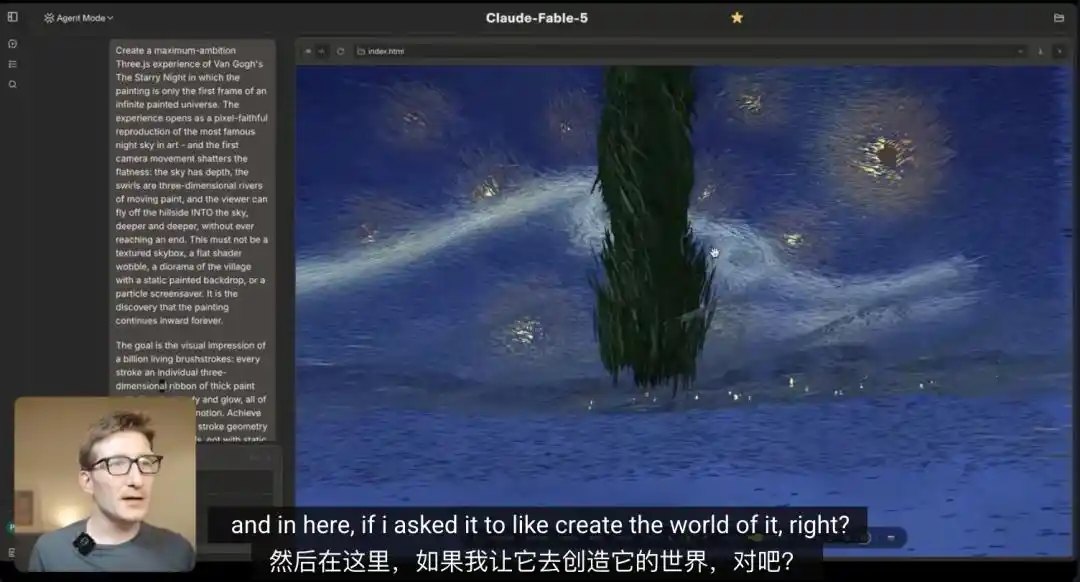
Fable 5 deconstructs Van Gogh's The Starry Night into individual 3D lines, reassembling them in space, allowing you to fly amidst the swirling stars and vortices. (Source: Peter Gostev video)

Monet's Water Lilies and Hokusai's Great Wave were similarly "opened up" into worlds you can roam.

In Gostev's opinion, Fable this time is particularly good at explaining things clearly, able to demonstrate while clarifying how things work. This explanatory power is something he didn't anticipate before.

Of course, these worlds weren't conjured with just "one sentence".

Gostev fed the model long, detailed specification documents. Most cases succeeded on the first try, with some requiring one or two rounds of fine-tuning.

The real watershed moment is this: things that used to take dozens of rounds to polish out can now mostly be generated in one go, with a single HTML file.

Behind the Magic, There Are Also Shortcomings

Gostev admits his showcased cases were curated. He generated about 20% more than he displayed, filtering out those with obvious bugs, leaving these 63.

Games are its weak spot.

He admits those few playable scenarios "get boring after 30 seconds." There was a Roman Empire version he thought looked too cartoonish.

More subtly, he feels the model sometimes seems lazy, holding back its capabilities, and you have to repeatedly push it to be more ambitious before it shows its true prowess.

When Fable 5 launched, it topped the Agent Arena leaderboard on Arena.ai's own platform with the largest lead in history.
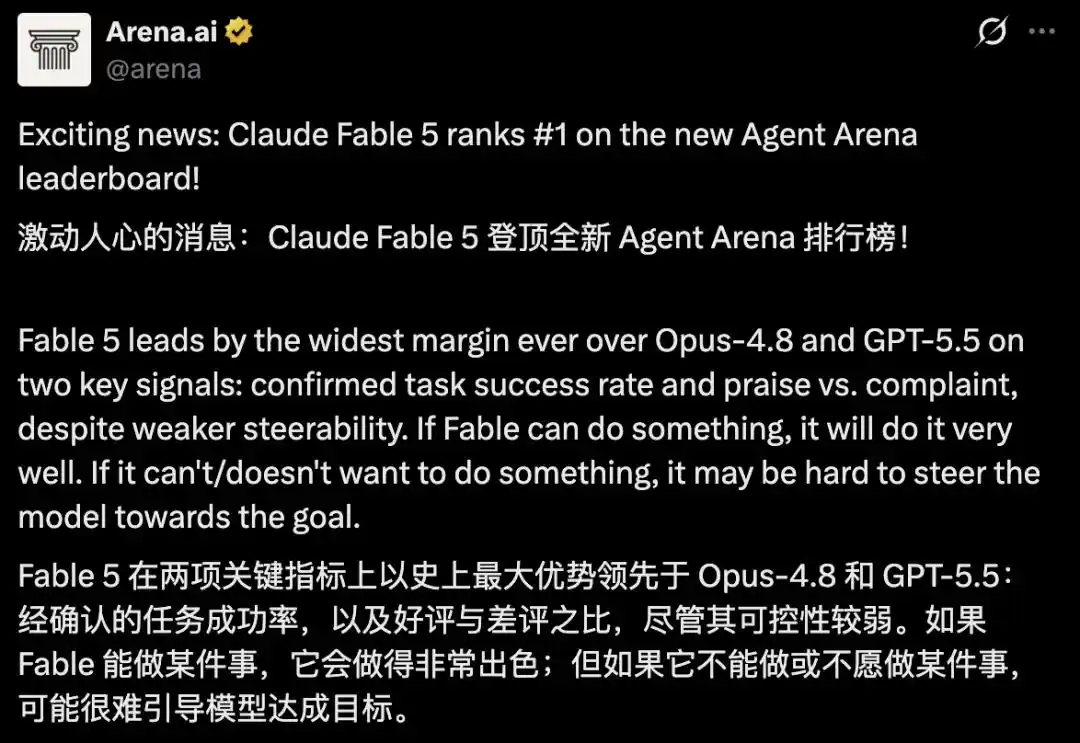
Arena.ai states that this leaderboard measures a model's ability to genuinely accomplish tasks across millions of real-world assignments.

This Exploration Has Only Just Begun

Returning to the scene in the video of the bear catching the salmon.

What struck Karpathy as strange is that the fish struggles when caught—a detail no one requested. How does a large model, trained only from the internet, know this?

And knowing it, how does it translate that understanding into xyz coordinates, meshes, transformations, animations, effects, interactions, even micro-narratives?

This question moves beyond "whether the AI draws well" to "how much does it actually understand."

Karpathy also mused: adding one to three more model scales on top of this, what could be created is truly unimaginable.

Gostev is equally amazed by the rapid AI progress, "Don't be constrained by models from six months ago. You must have something that past models couldn't do, but today's model can. Go try it."

Even the creators of the models haven't yet found its limits.

This exploration has only just begun.

References:

https://github.com/petergpt/3d-prompt-collection#prompt-01

https://x.com/karpathy/status/2073505440479293773

https://www.youtube.com/watch?v=rTc2_-1KuRE&t=14s

This article is from the WeChat public account "Xinzhiyuan" (新智元), author: ASI启示录; edited by: 元宇

İlgili Sorular

QWhat is the key feature of Fable 5 demonstrated in the article that impressed Andrej Karpathy?

AThe key feature demonstrated is Fable 5's ability to generate rich, playable 3D worlds from detailed specification documents, often in a single attempt, as shown by the creation of 63 diverse 3D environments including a living underwater Manhattan.

QAccording to the article, what was the specific technical method used by Peter Gostev to generate most of the 3D worlds with Fable 5?

AMost of the 3D worlds were generated using the Three.js 3D graphics library, often achieving successful results in a single attempt (one-shot).

QWhat example from the article illustrates Fable 5's capability to interpret and transform 2D art into an explorable 3D space?

AThe article cites the example of Vincent van Gogh's painting 'The Starry Night.' Fable 5 deconstructed the painting into individual lines and reconstructed them in three-dimensional space, creating a navigable world where one can fly among the swirling stars and vortices.

QWhat limitation of Fable 5's generative capabilities does Peter Gostev mention regarding game creation?

APeter Gostev mentions that the playable game scenes generated by Fable 5 are a weakness, describing them as something you get bored with after about 30 seconds. He also found a Roman Empire version too cartoonish.

QWhat broader philosophical question about AI understanding does Karpathy raise based on the 'bear catching a salmon' scene generated by Fable 5?

AKarpathy questions how a large model trained only on the internet understands and knows to depict specific physical details, like a salmon struggling when caught, and how it translates that understanding into the technical components (coordinates, meshes, animations, etc.) to create a coherent micro-narrative within the 3D world.

İlgili Okumalar

AI Folding: Fable 5 and GPT-5.6 Are Becoming the Privilege of a Few

【AI Accessibility Gap Widens: Elite Tools Like Fable 5 and GPT-5.6 Are Becoming Privileged】 We are witnessing a growing "AI divide." A stark reality is emerging: a tiny fraction of elites, primarily in tech, are using powerful next-generation models like Fable 5 or the upcoming GPT-5.6, while the vast majority of the public only has access to "toys" - free, limited models equivalent to ChatGPT's basic versions (8B to 30B parameters). This creates a massive experiential chasm and cognitive dissonance. Industry outsiders see AI as overhyped and ineffective, unable to grasp its transformative potential, while insiders leverage these advanced models for a decisive competitive edge. The gap isn't just about model quality but product functionality. Free users get a simple chatbot. Paying elites get integrated workflow systems—capable of creating specialized agents, processing complex data, and handling real-world tasks like management, coding, and planning. Demos showcasing AI planning weddings or building apps feel disconnected from everyday needs like managing bills, groceries, or health. The cost barrier is immense, with reports of engineers spending $1000 daily on Fable 5 inference. Elite users employ sophisticated multi-model workflows, combining different AIs for ideation, architecture, execution, and review, completing complex projects in minutes instead of weeks. This divide extends to critical areas like healthcare, where free models are dangerously unreliable for medical queries. However, some argue that for 90% of common business tasks, mid-tier models like GPT-5.5 are sufficient; the perceived limitation often stems from poor integration and lack of context, not model intelligence. Ultimately, unequal access to cutting-edge AI is creating a new form of social stratification, where the most powerful tools are becoming the exclusive privilege of a few.

marsbit28 dk önce

AI Folding: Fable 5 and GPT-5.6 Are Becoming the Privilege of a Few

marsbit28 dk önce

Cathie Wood's June $77M Investment: Are Crypto Stocks a True 'Substitute' for Bitcoin?

In June, Cathie Wood's ARK Invest purchased $77 million worth of publicly traded crypto-related stocks, including Coinbase, Circle, and Bullish, during Bitcoin's worst monthly performance in four years. This aligns with the investment thesis that such stocks offer a compliant way to gain exposure to the crypto cycle without directly holding Bitcoin. However, data analysis reveals significant drawbacks. A group of nine U.S.-listed crypto companies showed 30-day annualized realized volatility between 68% and 90%, nearly double Bitcoin's 37.6%. Over 90 days, Circle's volatility reached 103.6% versus Bitcoin's 37.8%. Drawdowns were also more severe for stocks like Circle (-51.4%) and MicroStrategy (-48.6%) compared to Bitcoin's -36.4% from its January high. Correlation analysis shows most stocks share only a moderate link to Bitcoin. For example, Circle, Robinhood, and Bullish have a 90-day correlation coefficient of just 0.55–0.58 with BTC, meaning only about one-third of their price movement is explained by Bitcoin's action. The rest stems from company-specific risks: earnings, competition, fundraising, and equity dilution. MicroStrategy (MSTR) is the notable exception, acting as a leveraged Bitcoin proxy with a beta of 1.59 and 0.85 correlation. Coinbase offers relatively balanced exposure. Circle exemplifies "crypto-wrapped" corporate risk, with its recent crash tied to stablecoin competition, not Bitcoin. Robinhood's diversified business insulates it from crypto downturns but also limits upside. Bitcoin miners like RIOT and MARA have posted significant gains year-to-date, driven primarily by their pivot to AI compute services, not Bitcoin's price. The article highlights that investing in crypto stocks often means accepting amplified volatility or layering on business-specific risks absent from direct Bitcoin ownership. For instance, MicroStrategy's recent challenges—its market value falling below its Bitcoin holdings (mNAV <1) and facing potential Bitcoin sales for liquidity—demonstrate equity-specific hazards like dilution and financing pressures not faced by a direct Bitcoin holder. ARK's buying spree represents a bet on a basket of different business models with varying crypto exposure, not a simple, lower-risk substitute for holding Bitcoin.

marsbit28 dk önce

Cathie Wood's June $77M Investment: Are Crypto Stocks a True 'Substitute' for Bitcoin?

marsbit28 dk önce

Crypto Welcomes the 'July Rebound'? On-Chain Bottom Signals Align, Reversal Still Requires Breakthrough Above $70k

The cryptocurrency market is showing signs of a potential "July rebound," with Bitcoin leading a recovery above $63,000 and total market cap rising. This bounce is attributed to improved macro expectations (weaker US jobs data easing Fed hike fears), a short squeeze in derivatives, and signs of whale accumulation. Key on-chain metrics signal a potential bottom, including the Sharpe Ratio hitting extreme lows, the AHR999 index nearing historic buy zones, and miner pressure reaching significant levels. However, analysts caution this is likely a corrective rebound rather than a confirmed trend reversal. Persistent challenges include weak spot demand, negative Coinbase Premium indicating institutional caution, and ongoing selling pressure in the altcoin market. Market sentiment remains in "extreme fear" territory, and the AVIV ratio suggests the average active Bitcoin investor is still at a loss. For a true bullish reversal, Bitcoin needs to convincingly break above the key $70,000 level (aligned with the Short-Term Holder Realized Price). The path to a new parabolic bull market is seen as dependent on attracting substantially more capital, as capital efficiency has declined. While prices may be approaching a cyclical bottom zone (with estimates between $37k-$60k), the market requires more sustained positive signals for a definitive uptrend.

marsbit59 dk önce

Crypto Welcomes the 'July Rebound'? On-Chain Bottom Signals Align, Reversal Still Requires Breakthrough Above $70k

marsbit59 dk önce

İşlemler

Spot
活动图片





