Ethereum: Dencun Upgrade Likely Delayed To Early Next Year

Bitcoinist2023-12-11 tarihinde yayınlandı2023-12-11 tarihinde güncellendi

Özet

The anticipated Ethereum upgrade, dubbed Dencun, amalgamating the consensus layer (Deneb) and the execution layer (Cancun), is poised for a...

The anticipated Ethereum upgrade, dubbed Dencun, amalgamating the consensus layer (Deneb) and the execution layer (Cancun), is poised for a likely delay to early next year. The discussions during the Ethereum All Core Developers Consensus Call (ACDC) #118, chaired by Danny Ryan from the Ethereum Foundation, signposted this potential delay amid discussions surrounding the pivotal Ethereum Improvement Proposals (EIPs) such as EIP-4844. In a recent blog post, Galaxy Digital Vice President of Research, Christine Kim, highlighted the developments.
Delay Concerns And Strategic Discussions
Tim Beiko of the Ethereum Foundation, during the ACDC call, raised the prospect of Dencun not launching on the mainnet before the close of 2023, considering its absence on public testnets and the approaching Devconnect conference in November 2023. “If we don’t launch a [public] testnet before DevConnect, it’s probably unlikely we can go live on the mainnet before the Christmas holidays,” Beiko stated, hinting at a plausible deployment in 2024.
Core developers have centered their deliberations on the strategic deployment of Dencun, scrutinizing the sequence of its launch on the testnets like Goerli and Holesky. The focus has been on utilizing the deprecated testnet Goerli, permitting developers to assiduously experiment with Dencun specifications before transiting to Holesky. The consensus during the call leaned towards prioritizing the launch on Goerli to preclude any adverse ramifications on the long-lived network like Holesky.
Developments On Devnet-9
Devnet-9, serving as a precursor for Dencun, is slated to instigate the test phase next week, featuring the full suite of the Dencun upgrade and acting as the first testing ground for the activation of EIP 7514 and 7516. Parithosh Jayanthi, a DevOps Engineer at Ethereum Foundation, conveyed the team’s readiness for this impending launch, with several Execution Layer (EL) and Consensus Layer (CL) clients such as Lodestar, EthereumJS, Lighthouse, and Geth confirming their preparedness.
However, developers acknowledged the necessity for flexibility, allowing for the launch of Devnet-9 even if all clients are not ready, with Jayanthi affirming, “We can still start the devnet as long as we have at least a couple of clients ready and we can add the rest post [launch].”
Implementation Of EIP-4844
EIP-4844, or proto-danksharding, forms the cornerstone of the Dencun upgrade, poised to enhance Ethereum’s scalability and augmenting the capabilities of Layer 2 solutions. The upgrade addresses both the temporary storage and retrieval of off-chain data and aims to alleviate transaction costs on Layer 2 rollup solutions, such as Optimism and Arbitrum.
This proposal necessitated a meticulous verification process dependent on a secret value generated through a multi-party ceremony that spanned from January to August 2023. The deployment strategy for this EIP is currently under rigorous testing on Devnet-9, with developers mulling over the incorporation of a trusted setup derived from the multi-party ceremony results.
Carl Beek from the Ethereum Foundation is spearheading the conversion of these results into a standardized format, although he communicated that the timing for this conversion is “very tight” for the upcoming Devnet-9.
In conclusion, the Dencun upgrade, combining Deneb and Cancun, marks a significant step in Ethereum’s evolution, integrating vital improvements and focusing on scalability. However, the intricate processes, strategic decisions on deployment, and extensive testing phases underscore the complexity of this upgrade.
The likelihood of Dencun seeing the light of day this year appears dim, with early 2024 emerging as a probable timeframe for its deployment.
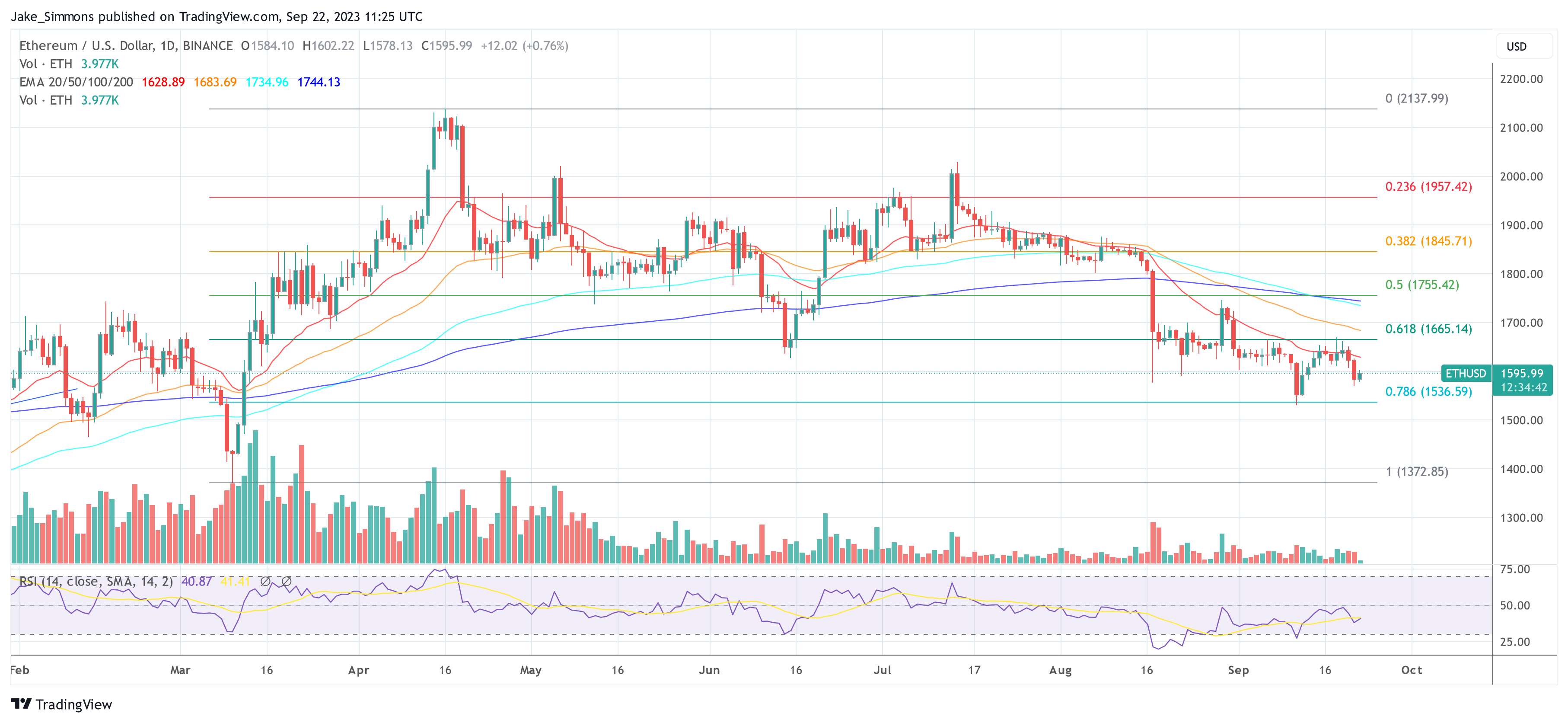
At press time, ETH traded at roughly $1,596.
Ethereum price

ETH price rejected at 61.8% Fib, 1-day chart | Source: ETHUSD on TradingView.com Featured image from Shutterstock, chart from TradingView.com

İlgili Okumalar

Where Is the AI Infrastructure Industry Chain Stuck?

The AI infrastructure (AI Infra) industry chain is facing unprecedented systemic bottlenecks, despite the rapid emergence of applications like DeepSeek and Seedance 2.0. The surge in global computing demand has exposed critical constraints across multiple layers of the supply chain—from core manufacturing equipment and data center cabling to specialty materials and cleanroom facilities. Key challenges include four major "walls": - **Memory Wall**: High-bandwidth memory (HBM) and DRAM face structural shortages as AI inference demand outpaces training, with new capacity not expected until 2027. - **Bandwidth Wall**: Data transfer speeds lag behind computing power, causing multi-level bottlenecks in-chip, between chips, and across data centers. - **Compute Wall**: Advanced chip manufacturing, reliant on EUV lithography and monopolized by ASML, remains the fundamental constraint, with supply chain fragility affecting production. - **Power Wall**: While energy demand from data centers is rising, power supply is a solvable near-term challenge through diversified energy infrastructure. Expansion is further hindered by shortages in testing equipment, IC substrates (critical for GPUs and seeing price hikes over 30%), specialty materials like low-CTE glass fiber, and high-end cleanroom facilities. Connection technologies are evolving, with copper cables resurging for short-range links due to cost and latency advantages, while optical solutions dominate long-range scenarios. Innovations like hollow-core fiber and advanced PCB technologies (e.g., glass substrates, mSAP) are emerging to meet bandwidth needs. In summary, AI Infra bottlenecks are multidimensional, spanning compute, memory, bandwidth, power, and supply chain logistics. Advanced chip manufacturing remains the core constraint, while substrate, material, and equipment shortages present immediate challenges. The industry is moving toward hybrid copper-optical solutions and accelerated domestic supply chain development.

marsbit37 dk önce

Where Is the AI Infrastructure Industry Chain Stuck?

marsbit37 dk önce

Autonomy or Compatibility: The Choice Facing China's AI Ecosystem Behind the Delay of DeepSeek V4

DeepSeek V4's repeated delay in early 2026 has sparked global discussions on "de-CUDA-ization" in AI. The highly anticipated trillion-parameter open-source model is undergoing deep adaptation to Huawei’s Ascend chips using the CANN framework, representing China’s first systematic attempt to run a core AI model outside the CUDA ecosystem. This shift, however, comes with significant engineering challenges. While the model uses a MoE architecture to reduce computational load, it places extreme demands on memory bandwidth, chip interconnects, and system scheduling—areas where NVIDIA’s mature CUDA ecosystem currently excels. Migrating to Ascend introduces complexities in hardware topology, communication latency, and software optimization due to CANN’s relative immaturity compared to CUDA. The move highlights a broader strategic dilemma: short-term compatibility with CUDA offers practical benefits and faster adoption, as seen in CANN’s efforts to emulate CUDA interfaces. Yet, long-term over-reliance on compatibility risks inheriting CUDA’s limitations and stifling native innovation. If global AI shifts away from transformer-based architectures, strict compatibility could lead to technological obsolescence. Despite these challenges, DeepSeek V4’s eventual release could demonstrate the viability of a full domestic AI stack and accelerate CANN’s ecosystem growth. However, true technological independence will require building an original software-hardware paradigm beyond compatibility—a critical task for China’s AI ambitions in the next 3-5 years.

marsbit55 dk önce

Autonomy or Compatibility: The Choice Facing China's AI Ecosystem Behind the Delay of DeepSeek V4

marsbit55 dk önce

İşlemler

Spot
Futures

Popüler Makaleler

OP Nasıl Satın Alınır

HTX.com’a hoş geldiniz! Optimism (OP) satın alma işlemlerini basit ve kullanışlı bir hâle getirdik. Adım adım açıkladığımız rehberimizi takip ederek kripto yolculuğunuza başlayın. 1. Adım: HTX Hesabınızı OluşturunHTX'te ücretsiz bir hesap açmak için e-posta adresinizi veya telefon numaranızı kullanın. Sorunsuzca kaydolun ve tüm özelliklerin kilidini açın. Hesabımı Aç2. Adım: Kripto Satın Al Bölümüne Gidin ve Ödeme Yönteminizi SeçinKredi/Banka Kartı: Visa veya Mastercard'ınızı kullanarak anında Optimism (OP) satın alın.Bakiye: Sorunsuz bir şekilde işlem yapmak için HTX hesap bakiyenizdeki fonları kullanın.Üçüncü Taraflar: Kullanımı kolaylaştırmak için Google Pay ve Apple Pay gibi popüler ödeme yöntemlerini ekledik.P2P: HTX'teki diğer kullanıcılarla doğrudan işlem yapın.Borsa Dışı (OTC): Yatırımcılar için kişiye özel hizmetler ve rekabetçi döviz kurları sunuyoruz.3. Adım: Optimism (OP) Varlıklarınızı SaklayınOptimism (OP) satın aldıktan sonra HTX hesabınızda saklayın. Alternatif olarak, blok zinciri transferi yoluyla başka bir yere gönderebilir veya diğer kripto para birimlerini takas etmek için kullanabilirsiniz.4. Adım: Optimism (OP) Varlıklarınızla İşlem YapınHTX'in spot piyasasında Optimism (OP) ile kolayca işlemler yapın.Hesabınıza erişin, işlem çiftinizi seçin, işlemlerinizi gerçekleştirin ve gerçek zamanlı olarak izleyin. Hem yeni başlayanlar hem de deneyimli yatırımcılar için kullanıcı dostu bir deneyim sunuyoruz.

321 Toplam GörüntülenmeYayınlanma 2024.12.12Güncellenme 2025.03.21

OP Nasıl Satın Alınır

Tartışmalar

HTX Topluluğuna hoş geldiniz. Burada, en son platform gelişmeleri hakkında bilgi sahibi olabilir ve profesyonel piyasa görüşlerine erişebilirsiniz. Kullanıcıların OP (OP) fiyatı hakkındaki görüşleri aşağıda sunulmaktadır.

活动图片