Shibarium By Numbers: How The Shiba Inu L2 Fares Up So Far

Bitcoinist2023-09-19 tarihinde yayınlandı2023-09-20 tarihinde güncellendi

Özet

Since its anticipated launch on August 16, the Shiba Inu Layer 2 solution, Shibarium, has been under the spotlight, facing...

Since its anticipated launch on August 16, the Shiba Inu Layer 2 solution, Shibarium, has been under the spotlight, facing a mix of challenges and milestones. The platform, shortly after its launch, encountered an unexpected halt in block production owing to an immense surge in traffic.
The lead developer, Shytoshi Kusama, elucidated on this setback, mentioning a “massive influx of transactions and users” that immediately ensued upon the network going live, pushing it offline. Highlighting the extent of the traffic deluge, Kusama referred to data from the Web3 development platform Alchemy.
The data revealed that while Shibarium had a monthly allocation of 400 million compute units, a whopping 160+ million units were used up in just under half an hour. Nevertheless, the technical glitches were addressed, and Shibarium was successfully revived by August 23. But how does Shibarium fare up almost one month after the launch?
Shibarium By The Numbers
Based on the most recent data from Shibariumscan, the network’s average block time stands at 195.48 seconds with 2.64 million completed transactions. On the contract side, 11 have been deployed today, with 5 of those verified. The overall account number has reached 25.706, with a total of 1.247 million addresses registered.
In terms of blocks, there have been 710.485 processed, with 9.896 contracts in total. Native coin transfers have reached 127.086K, and there are 7.509K tokens with a cumulative transaction count of 2.84 million. Furthermore, 416 contracts have been verified in total.
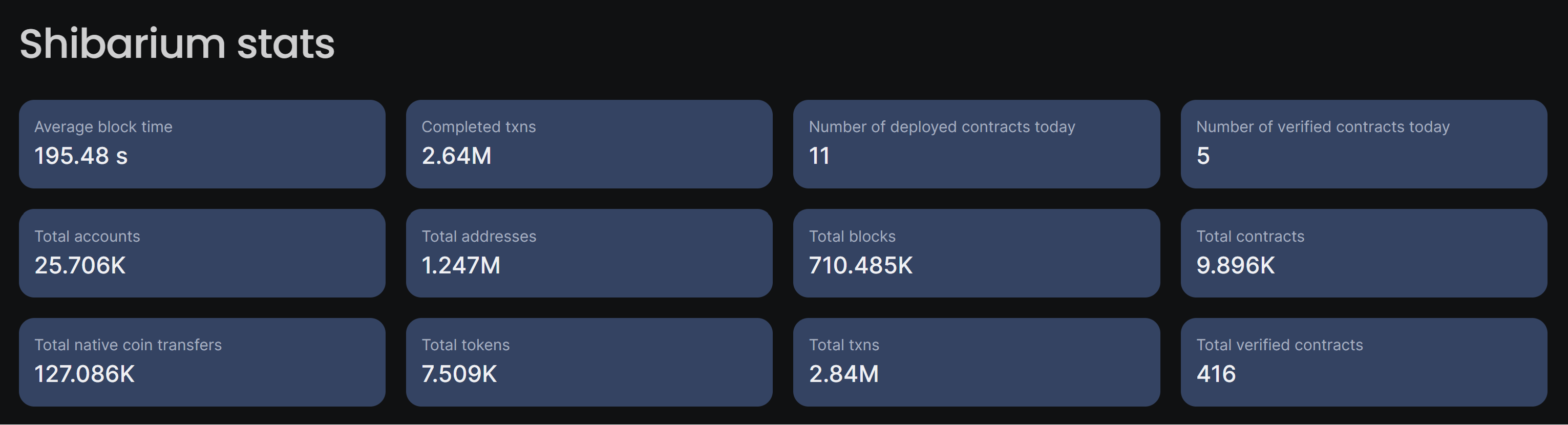
Shibarium stats

Shibarium stats | Source: https://www.shibariumscan Activity on Shibarium has been subject to wide fluctuations over the past month, with generally declining usage. Active accounts per day reached their zenith on August 26 with a count of 7,729. However, in the past week, this figure has declined to below 1,000, recording its lowest figure at 520 on Monday.
The surge in new account creation was at its pinnacle on August 24 with 5,552 accounts. Afterwards, the growth of new accounts slowed massively. This number then dropped significantly to 33 on Sunday, with 65 new accounts created yesterday.
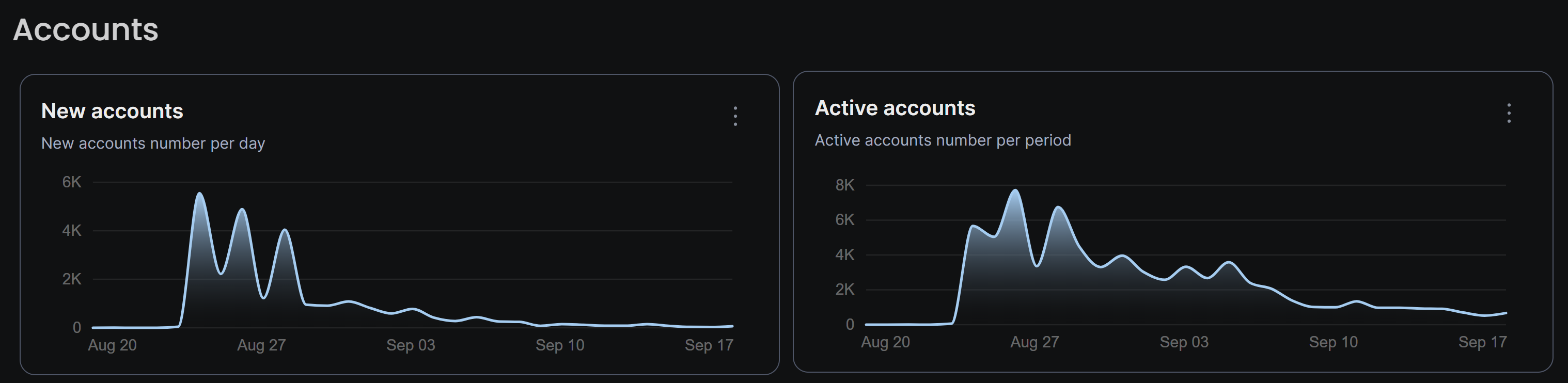
Shibarium accounts

Shibarium accounts | Source: https://www.shibariumscan Transaction numbers soared to their highest on September 11 with 202,906 but took a plunge in recent days, ranging between 40,000 and 42,000 in the past two days. The average block size in bytes reached its peak on September 14 with 75,611 bytes, which dropped to below 16,500 bytes in recent days.
Moreover, the peak of new contract creations was on August 24 with 2,766 contracts. This momentum seems to have slowed down, with the number last exceeding 100 on September 6, registering 174. Yesterday, only 51 new contracts were generated.
Most Popular Shiba Inu Based Tokens
Delving into the most popular tokens on Shibarium, Wrapped BONES (WBONES) leads with 2,360 holders, followed by Ryoshi’s Coin (RYOSHI) with 1,407 holders. Brick by Brick (BRICK) comes in third place with 625 holders, followed by Shibarium Wrapped BONE (WBONE) with 369. Shiboshi (SHIBOSHI) rounds up the top five with 318 holders.
Adding to the discourse, renowned Shiba Inu influencer @LucieSHIB recently posed a compelling question to the community, urging them to transition from exchanges and embrace Shibarium. In her tweet, she emphasized the community’s role in driving SHIB adoption, pointing out that the community needs to become more active on Shibarium. Addressing the topic of SHIB burns, she stated:
It’s adorable to see people hyping burns and never use Shibarium , but the fact remains that $SHIB burns are a community effort, not a call to the devs saying, “Do something.” To initiate burns, you need to actively use Shibarium. The more you utilize it, the more you contribute to the burns. This is fact.
At press time, Shiba Inu traded at $0.00000739.
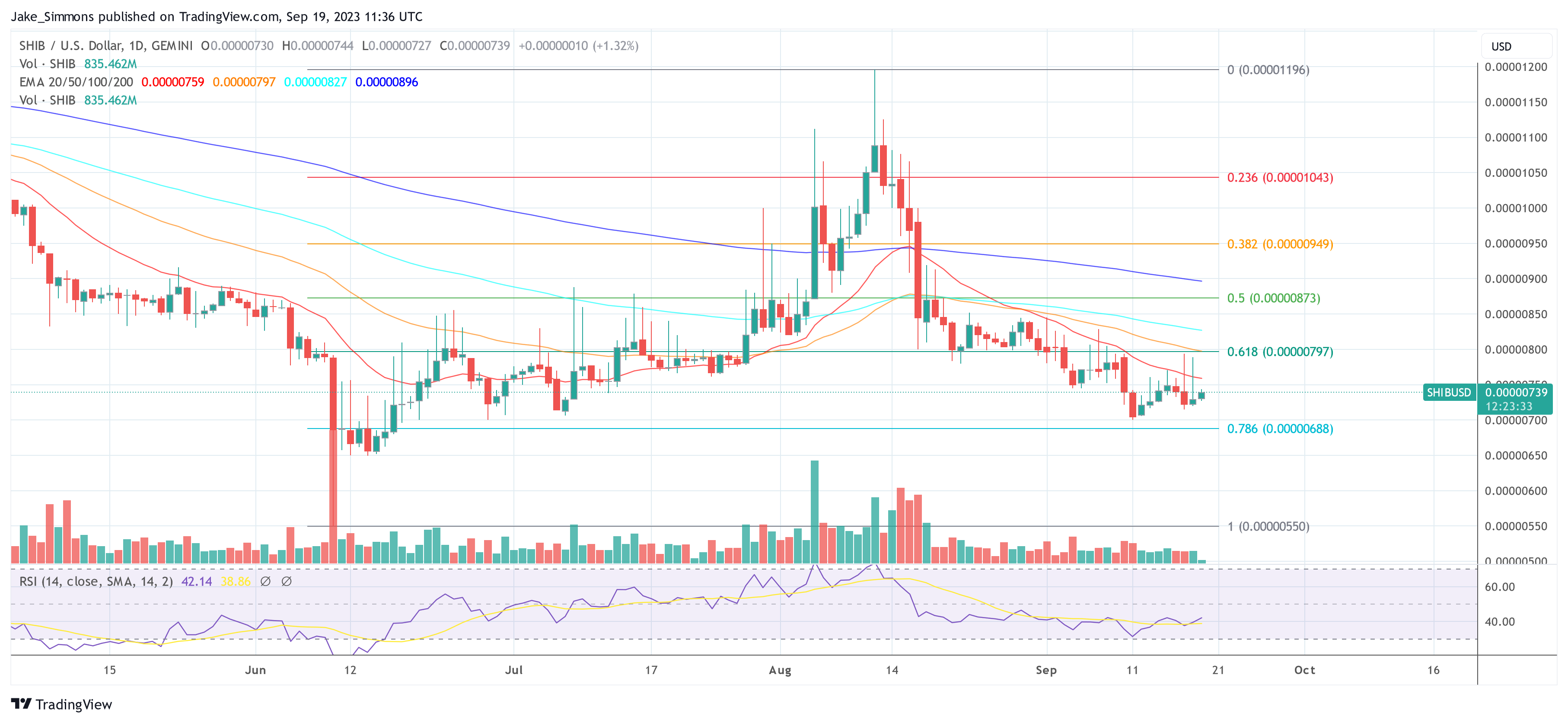
Shiba Inu price

Shiba Inu price, 1-day chart | Source: SHIBUSD on TradingView.com Featured image from Metaverse Post, chart from TradingView.com


İlgili Okumalar

Three Years Later: Looking Back at My Predictions About ChatGPT in 2023

Three Years Later: Revisiting My 2023 Predictions on ChatGPT In March 2023, shortly after ChatGPT's launch, I made 20 predictions about its future. Now, in mid-2026, I've used AI agents to fact-check each one against the latest data. Overall, most major directional forecasts were correct, with only one outright error (incorrectly stating GPT-4 had 100 trillion parameters). Key successes included predicting that RAG and retrieval architectures would become the standard for handling knowledge and hallucinations, that natural language interfaces (LUI) would create a massive new industry layer beyond the models themselves, and that China would develop viable large language models, significantly closing the performance gap with Western counterparts within about three years. Predictions about the absence of mass unemployment, the rise of a new "robot network" for agent communication, and ChatGPT not possessing consciousness also held true in their core arguments. However, the "devil was in the details." Errors frequently involved specific numbers, timelines, or overlooking distributional effects. I tended to overestimate the speed of adoption (e.g., for agent networks) while underestimating the ultimate scale of capabilities or costs (e.g., AI winning IMO gold without tools, or the extreme capital required for frontier models). Other misjudgments included: underestimating how AI would reinforce, not dissolve, information filter bubbles; incorrectly assuming AI-generated content would easily circumvent copyright (it has instead triggered record-breaking settlements); and misidentifying where value would be captured (it accrued overwhelmingly to the compute layer, like Nvidia, not just the application or model layers). Key lessons from reviewing these predictions are: 1) Directional and mechanistic insights are far more reliable than precise numbers or absolute statements. 2) There's a consistent bias to overestimate short-term speed but underestimate long-term magnitude. 3) Errors often lie in missing distributional impacts within a generally correct aggregate trend. 4) Predictions phrased with nuance and caveats aged the best. 5) Some fundamental debates (e.g., on machine consciousness or the ultimate value chain) remain unresolved even after three years. This exercise is less about scoring the past and more about establishing rules for clearer thinking about the next three years of AI.

marsbit56 dk önce

Three Years Later: Looking Back at My Predictions About ChatGPT in 2023

marsbit56 dk önce

Three Years Later: Looking Back on My 2023 Predictions for ChatGPT

Looking Back After Three Years: Revisiting My 2023 Predictions on ChatGPT In March 2023, shortly after ChatGPT's debut and before GPT-4's release, I made over twenty predictions about AI's future based on limited information and intuition. Now, in May 2026, I revisited those forecasts using an AI-driven analysis with 41 Opus 4.8 agents to cross-reference them with the latest data. The assessment used symbols: ✅ Correct, 🟢 Mostly Correct, 🟡 Partially Correct, ❌ Incorrect. Overall, the directional judgments held up well, with only one major factual error regarding GPT-4's rumored parameter size (incorrectly cited as 100T). However, nuances and degrees of accuracy revealed more. **What Was Largely Correct:** Predictions about mechanisms and directions proved accurate. The rise of RAG (Retrieval-Augmented Generation) as the standard architecture for combating AI hallucination was confirmed, as was the transformative potential of LUI (Language User Interface) in creating a new industry layer atop GUIs. The emergence of "robot networks" (agent-to-agent communication protocols) and China's rapid catch-up in developing capable large models (closing the performance gap with top models to ~2.7%) were also on point. The analysis affirmed that LLMs lack consciousness and that the Turing Test merely measures perceived intelligence. **What Was Off Target:** Errors often involved specific numbers, over-optimistic timelines, or misjudged distributions. The prediction that value would primarily accrue to the application layer was half-right but missed NVIDIA's dominance as the profitable infrastructure layer. Forecasts about AI circumventing copyright issues and fostering a "global common ground" by averaging human viewpoints were incorrect; instead, major copyright settlements occurred and AI personalization is increasing. Estimates for model training costs ("$5-10 billion cap") were significantly off, underestimating frontier costs and overestimating replication costs. The notion that LLMs could never do complex math without tools was disproven by later models winning IMO gold. **Key Patterns from the Review:** 1. **Direction over precision:** Judgments about mechanisms and trends were more reliable than specific numbers or definitive statements. 2. **Timing bias:** There was a tendency to overestimate short-term speed but underestimate long-term magnitude and transformation. 3. **The distribution blind spot:** Aggregate-level correctness often masked uneven impacts (e.g., on young professionals' employment). 4. **The value of qualifiers:** Predictions framed with caution (e.g., "reportedly," "for now," "prototype in 2-3 years") aged better. 5. **Some debates continue:** Issues like the nature of "emergent abilities" or machine consciousness remain unresolved. This three-year review highlights that while seeing the big picture is crucial, humility regarding specifics, timelines, and disparate impacts is essential for future forecasting.

链捕手3 saat önce

Three Years Later: Looking Back on My 2023 Predictions for ChatGPT

链捕手3 saat önce

AI Bubble Warning: AI Investments Are Negative Returns for Most Tech Giants

The article issues a stark warning about a potential AI investment bubble. It notes that while the AI boom shares similarities with the TMT bubble of the late 1990s, its scale is vastly larger, currently driving 93% of U.S. GDP growth. Major hyperscale cloud providers like Microsoft, Alphabet, Amazon, Meta, and Oracle are planning to invest trillions in AI data centers over the coming years. However, calculations based on analyst projections for 2025-2030 reveal a concerning math problem: expected capital expenditure growth far outpaces projected revenue growth. Even under an extremely optimistic scenario of zero costs, the implied return on investment for most of these tech giants (except Amazon) is deeply negative. This suggests that the current trajectory could lead to one of history's largest shareholder value destruction events. The piece outlines two potential escapes: AI generating vastly more revenue than currently anticipated—a near-impossible task—or a significant cutback in the planned investment splurge. The latter scenario could trigger a domino effect, severely impacting the entire tech supply chain (from Nvidia to TSMC), potentially pushing the U.S. economy into recession, and causing a major stock market downturn. The author suggests upcoming high-profile IPOs by companies like OpenAI and Anthropic might represent a transfer of risk from early investors to public market participants. While the peak of the hype cycle might sustain investment through 2026, the fundamental financial dilemma remains unresolved, setting the stage for a potential market correction in 2027 or 2028, similar to the years following Alan Greenspan's "irrational exuberance" warning.

marsbit4 saat önce

AI Bubble Warning: AI Investments Are Negative Returns for Most Tech Giants

marsbit4 saat önce

From Tokens to Machine Labor: AI is Shifting from Tool to "Worker"

The article "From Token to Machine Labor: AI is Evolving from Tool to 'Worker'" argues that the business model for AI is shifting beyond simply selling computational resources (tokens, GPU hours) or model access. Instead, a new "machine labor market" is emerging, where the core economic transaction is the purchase of economically useful work directly performed by software. The central thesis is that AI pricing will evolve through four stages: 1) raw tokens, 2) standardized LLM capabilities (e.g., text generation), 3) industry-specific labor markets (e.g., legal review, radiology), and finally 4) a programmable results market where tasks like resolving a support ticket are bid on and priced based on outcome. In this future, buyers will care less about *which* model or GPU completes a task and more about whether the work meets specified standards for accuracy, latency, and cost. This transition reframes the impact of AI on human labor. Rather than simple replacement, it suggests a re-coordination where machines handle standardized, verifiable work, freeing humans for roles involving oversight, context management, responsibility, and final judgment. In some cases, this "last 1%" of human input becomes more valuable as it enables the other 99% to be automated. Furthermore, as AI reduces the cost of work, demand may expand, creating larger markets (e.g., 24/7 customer service) rather than just cheaper versions of existing ones. The article concludes that while infrastructure (GPUs, models, tokens) remains crucial upstream, the market is converging on a simpler, tradeable unit: machine labor that can be defined, measured, priced, and procured based on contractible specifications.

marsbit4 saat önce

From Tokens to Machine Labor: AI is Shifting from Tool to "Worker"

marsbit4 saat önce

Xiaomi MiMo's 99% Price Cut is Not Marketing! Luo Fuli Posts on X to Refute Critics

The price of Xiaomi's MiMo-V2.5 series API has been permanently reduced by up to 99%, specifically for the "Input (Cache Hit)" cost, which covers users re-reading historical context in long conversations. MiMo's head, Luo Fuli, published a detailed technical blog to clarify that this drastic price cut stems from genuine engineering breakthroughs, not a marketing stunt or a simple price war. The core of the achievement lies in six key engineering optimizations. First, the model architecture adopts a Hybrid Sliding Window Attention (SWA), reducing the memory footprint (KVCache) to 1/7th of a traditional model. Second, a dual-pool memory management system actually utilizes these savings, allowing a single GPU to handle over 5 times more concurrent users. Third, an upgraded prefix caching mechanism achieves a cache hit rate of 93-95% for repeated reads, meaning most such requests bypass GPU computation entirely. Fourth, a self-developed distributed cache (GCache) utilizes idle SSD space on existing GPU servers, eliminating additional storage costs. Fifth, an intelligent scheduling system (LLM-Router) efficiently routes requests to maximize cache reuse and performance. Sixth, Multi-Token Prediction (MTP) accelerates the model's text generation ("output") side. Together, these systemic optimizations dramatically lower the real computational cost per request, enabling the 99% price reduction for cached inputs while reportedly maintaining positive gross margins. Luo Fuli's disclosure aims to shift the narrative from "price war" to a demonstration of substantive AI engineering progress.

marsbit6 saat önce

Xiaomi MiMo's 99% Price Cut is Not Marketing! Luo Fuli Posts on X to Refute Critics

marsbit6 saat önce

İşlemler

Spot
Futures

Popüler Makaleler

KSM Nasıl Satın Alınır

HTX.com’a hoş geldiniz! Kusama (KSM) satın alma işlemlerini basit ve kullanışlı bir hâle getirdik. Adım adım açıkladığımız rehberimizi takip ederek kripto yolculuğunuza başlayın. 1. Adım: HTX Hesabınızı OluşturunHTX'te ücretsiz bir hesap açmak için e-posta adresinizi veya telefon numaranızı kullanın. Sorunsuzca kaydolun ve tüm özelliklerin kilidini açın. Hesabımı Aç2. Adım: Kripto Satın Al Bölümüne Gidin ve Ödeme Yönteminizi SeçinKredi/Banka Kartı: Visa veya Mastercard'ınızı kullanarak anında Kusama (KSM) satın alın.Bakiye: Sorunsuz bir şekilde işlem yapmak için HTX hesap bakiyenizdeki fonları kullanın.Üçüncü Taraflar: Kullanımı kolaylaştırmak için Google Pay ve Apple Pay gibi popüler ödeme yöntemlerini ekledik.P2P: HTX'teki diğer kullanıcılarla doğrudan işlem yapın.Borsa Dışı (OTC): Yatırımcılar için kişiye özel hizmetler ve rekabetçi döviz kurları sunuyoruz.3. Adım: Kusama (KSM) Varlıklarınızı SaklayınKusama (KSM) satın aldıktan sonra HTX hesabınızda saklayın. Alternatif olarak, blok zinciri transferi yoluyla başka bir yere gönderebilir veya diğer kripto para birimlerini takas etmek için kullanabilirsiniz.4. Adım: Kusama (KSM) Varlıklarınızla İşlem YapınHTX'in spot piyasasında Kusama (KSM) ile kolayca işlemler yapın.Hesabınıza erişin, işlem çiftinizi seçin, işlemlerinizi gerçekleştirin ve gerçek zamanlı olarak izleyin. Hem yeni başlayanlar hem de deneyimli yatırımcılar için kullanıcı dostu bir deneyim sunuyoruz.

172 Toplam GörüntülenmeYayınlanma 2024.12.10Güncellenme 2025.03.21

KSM Nasıl Satın Alınır

Tartışmalar

HTX Topluluğuna hoş geldiniz. Burada, en son platform gelişmeleri hakkında bilgi sahibi olabilir ve profesyonel piyasa görüşlerine erişebilirsiniz. Kullanıcıların KSM (KSM) fiyatı hakkındaki görüşleri aşağıda sunulmaktadır.

活动图片