
Bitcoin Cash: What’s the best entry point for buyers as BCH goes on a rally

Ambcrypto2023-07-05 tarihinde yayınlandı2023-07-05 tarihinde güncellendi

Özet

Even though waiting for a significant drop before buying sounds like a good plan, the majority of the market expects the same- Will the price action follow what the majority expects?

Disclaimer: The information presented does not constitute financial, investment, trading, or other types of advice and is solely the writer’s opinion.

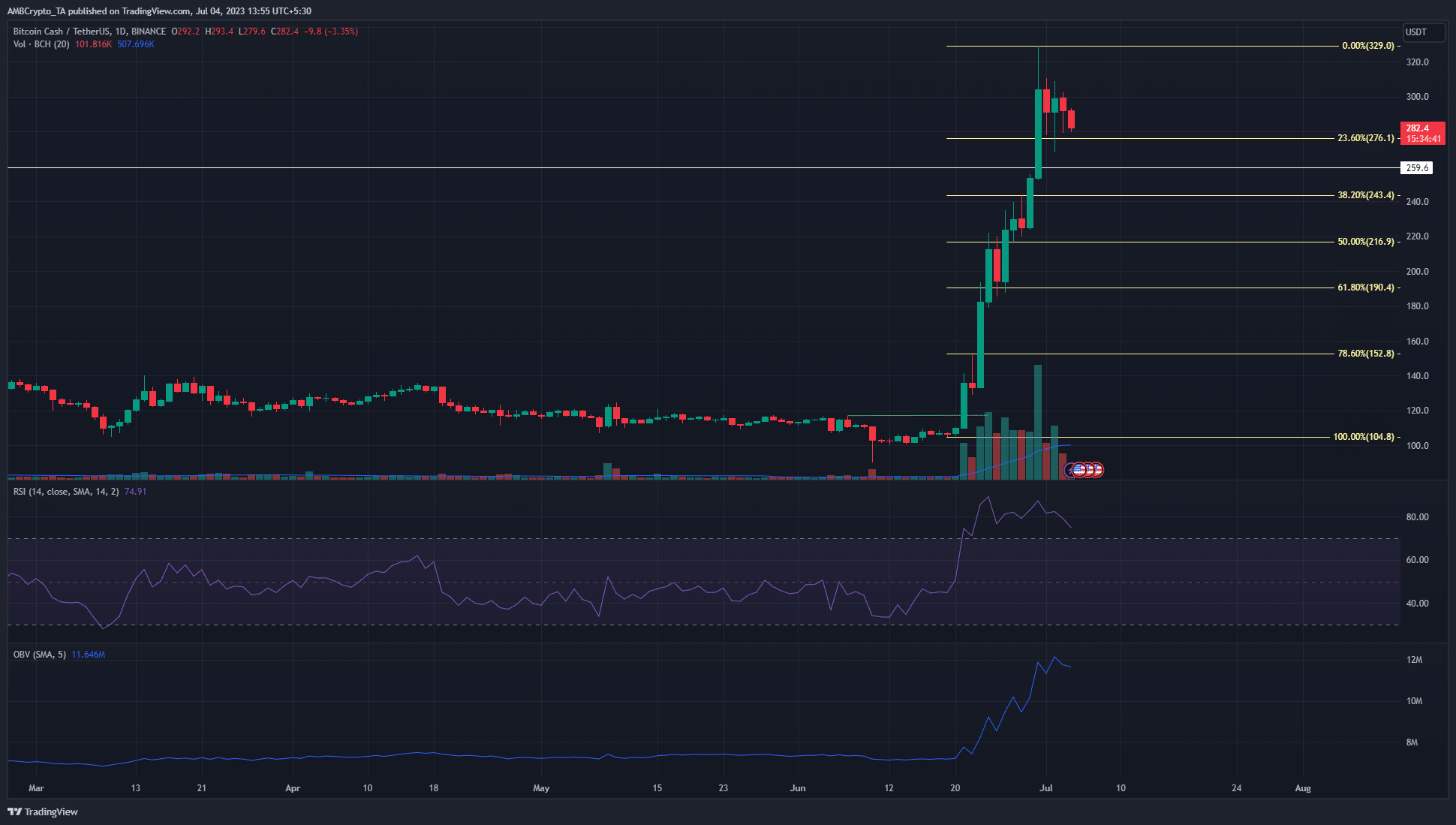
The price action of BCH and retracement levels lined up pretty well near the $200 mark.

Yet this could be precisely why such a retracement could be risky for the buyers.

Bitcoin Cash [BCH] embarked on a rally that measured 214% in magnitude. The bulls accomplished this feat in under two weeks. While the price action and indicators showed strong bullishness, this was not a time for FOMO.

Traders can instead look to capitalize on a retracement if the market gives one. But Fib retracement levels are a popular tool, and if the entire market is looking at certain levels for a bullish reaction, it could become easy to trap the bulls before the real move.

Will Bitcoin Cash retrace some of its vast gains?
Source: BCH/USDT on TradingView

It was very likely that BCH would retrace at least a portion of its recent gains. But how much would that be? Will the bears begin to shed all the gains from the vertical upward move? This was possible. But with Bitcoin having a bullish bias on the higher timeframes, there could be another bullish move left for BCH in the coming weeks or months.

The RSI began to form a bearish divergence while BCH fell close to 15% from the high at $329. However, the price action remained strongly bullish. The Fibonacci retracement levels were drawn after BCH flipped its structure to bullish on the 1-day timeframe.

The 50% and 61.8% retracement levels lie at $190.4 and $216.9. Interestingly, a large red candle was present in this zone as well. Formed on 25 June, this area represented a region where some lower timeframe consolidation occurred before the explosive surge past $300.

Therefore, a revisit to this area could offer a buying opportunity. Bulls can look for a positive reaction from the $190-$220 region and another bullish structure break before looking to buy BCH- but must beware of becoming liquidity before a deeper retracement.

The rapid fall in the mean coin age could mean trouble
Source: Santiment

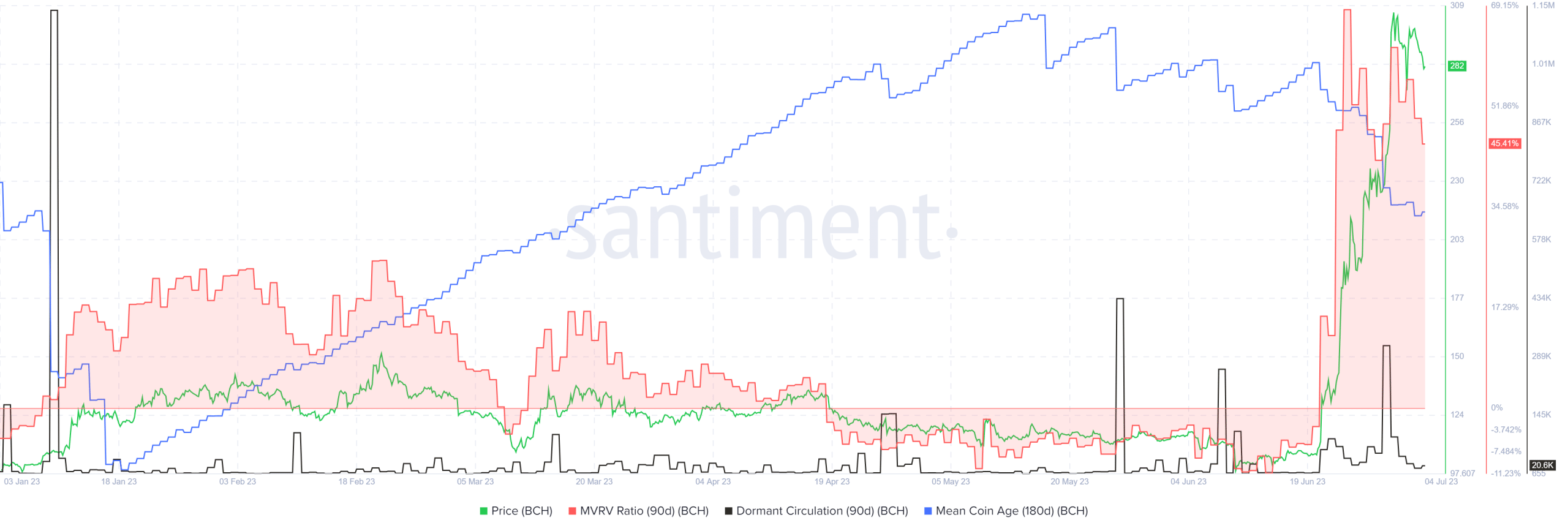
While the OBV shot upward to show strong buying pressure, the mean coin age was not as bullish. The metric began to decline even as Bitcoin Cash rocketed higher on the chart. The mean coin age was already in a downtrend in May and fell sharply as the asset embarked on its rally.

This showed a heightened movement of BCH between addresses, a sign that likely points toward increased selling. The MVRV ratio was also at a nearly two-year high. Taken together they suggested that sellers could force Bitcoin Cash lower once more.

A spike in the dormant circulation coincided with the surge to $329, which suggested a flurry of selling activity could have taken place then.


İlgili Okumalar

When Real Estate Ownership Goes Digital: What Happens to Your Rights, Risks, and Liquidity?

"Tokenizing Real Estate: Rights, Risks, and the Path to Liquidity" While tokenizing real-world assets (RWA) gains traction, real estate presents unique complexities. Beyond technical token issuance, critical challenges remain: enforcing legal rights, managing the underlying physical asset, and creating genuine secondary market liquidity. This article explores these issues through OneAsset, a Dubai-based commercial real estate (CRE) tokenization platform. OneAsset moves away from simply offering asset fragmentation. Instead, it focuses on institutional-grade infrastructure, prioritizing asset quality, legal enforceability, and operational fundamentals. Each property is held in an independent, single-asset vault, backed by a legally separate Special Purpose Vehicle (SPV) for bankruptcy remoteness. Investors acquire tokens representing the economic rights to a specific property, with precise legal claims defined by the underlying SPV structure. OneAsset emphasizes that tokenization cannot transform a poor-quality asset. Its initial focus is on institutional investors and quality Dubai-based CRE, selected for stable tenant cash flows and a clear regulatory environment. The platform integrates compliance by design, aiming to embed investor qualification and transfer rules directly into the token architecture. A core insight is that asset fragmentation does not automatically create liquidity. True liquidity depends on the asset's inherent quality—its location, cash flow, and valuation—as well as sufficient buyer demand. The goal is not just tradability, but making real estate rights more easily priced, verified, and reallocated. Looking ahead, the article discusses the potential for "AiFi" (AI-powered finance). For AI agents to autonomously allocate capital, investment assets like real estate tokens must become truly "machine-readable." This requires a high degree of standardization in legal rights, valuations, cash flows, and compliance data—a direction OneAsset is pursuing through its structured data reporting. In conclusion, real estate tokenization is shifting from a technology narrative to a focus on asset fundamentals. Blockchain can enhance efficiency and programmability, but it cannot replace sound underwriting, property management, or legal execution. The real work begins after the asset is on-chain.

marsbit22 dk önce

When Real Estate Ownership Goes Digital: What Happens to Your Rights, Risks, and Liquidity?

marsbit22 dk önce

After Affecting Two Generations, Meta Ordered to Pay $18 Billion in Damages

After more than two decades, a legal parallel has emerged. In 1998, major U.S. tobacco companies settled for $206 billion, leading to strict advertising bans and warning labels that significantly reduced smoking rates. On August 26, 2026, Meta reached a landmark settlement with U.S. attorneys general, agreeing to pay up to approximately $18 billion and implement mandatory changes to Facebook and Instagram. This historic settlement, one of the largest against a tech company, stems from allegations that Meta deliberately designed addictive features like infinite scroll and push notifications, harming youth mental health and violating child privacy laws. Facing a potential $1.4 trillion lawsuit and a series of unfavorable jury verdicts, Meta chose to settle on the eighth day of trial to avoid a catastrophic ruling. The core of the agreement is not just the financial penalty, which Meta will pay over 10 years, but a series of strict, 10-year product mandates for young users. These include a hard two-hour daily time limit (combined across apps), a default "nighttime block" from midnight to 6 AM, restricted notifications during school hours, hidden "like" counts, an optional non-algorithmic feed, and stronger age verification. An independent auditor will monitor compliance. Crucially, roughly 30% ($5.3 billion) of Meta's payment is contingent on YouTube and TikTok adopting similar measures and paying around $5 billion each. This move aims to create an industry-wide standard and prevent Meta from being competitively disadvantaged. The settlement is being likened to Big Tobacco's "tobacco moment." By legally framing addictive algorithm design as a "public nuisance," it sets a powerful precedent. Nearly 3,000 similar cases are pending against other social media giants, signaling a fundamental shift in regulatory pressure. The era where platforms could deny the addictive impact of their designs on children is effectively over.

marsbit28 dk önce

After Affecting Two Generations, Meta Ordered to Pay $18 Billion in Damages

marsbit28 dk önce

İşlemler

Spot
活动图片