Metaverse Will Be Most Popular Place to Buy, Trade, Store Cryptocurrency, Survey Shows

newsbtc2022-04-08 tarihinde yayınlandı2022-04-08 tarihinde güncellendi

Özet

Nasdaq-listed Agora (NASDAQ: API), a video, voice, and live interactive streaming platform, conducted a survey on the metaverse and published the results Tuesday.

Metaverse Will Be Most Popular Place to Buy, Store, Trade Cryptocurrency, Survey Shows

The metaverse will become the most popular place to buy, sell, and trade cryptocurrency, according to a recent survey. In addition, 70% of respondents agreed that “cryptocurrency and blockchain technology advancements will be critical to shaping the future of the metaverse.”

Survey: Metaverse Will Be the Most Popular Place for Crypto

Nasdaq-listed Agora (NASDAQ: API), a video, voice, and live interactive streaming platform, conducted a survey on the metaverse and published the results Tuesday.

The company asked 300 U.S.-based developers a set of questions “to learn more about what they thought about the metaverse and what we will see in the coming years,” Agora detailed. Developers were surveyed because for them, “the growth of the metaverse allows the development of new communities and allows them to better connect with users,” the company explained.

According to the results:

57% of respondents think that the metaverse will become the most popular place to buy, store and trade cryptocurrency, while 18% disagree and 25% feel neutral.
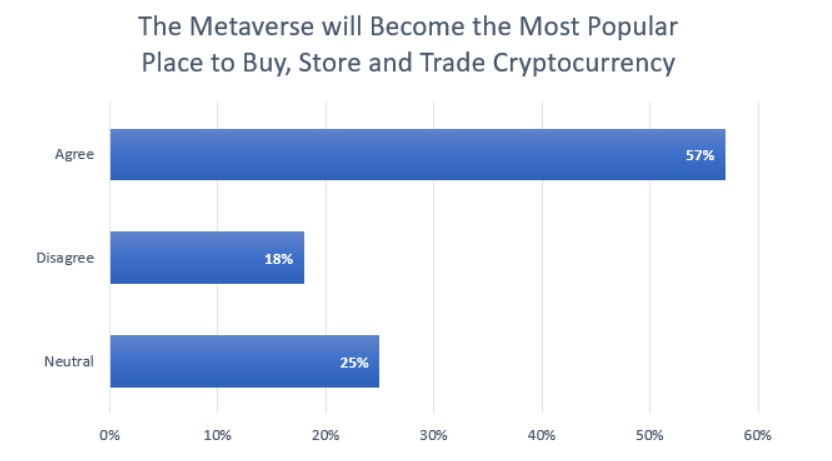
Source: Agora

In addition, 70% agreed that “cryptocurrency and blockchain technology advancements will be critical to shaping the future of the metaverse,” while 9% disagreed.

Regarding non-fungible tokens (NFTs), “The majority of developers are bullish on NFTs and believe they will become the biggest [currency] in the near team,” the survey results note.
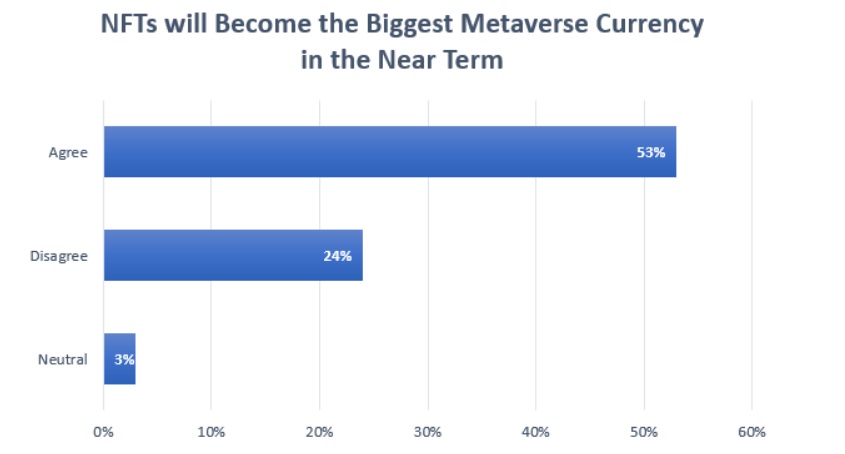
Source: Agora

Survey participants were also asked who they think will own the metaverse. 55% of respondents said Meta (formerly Facebook), 9% said Google, 7% said Microsoft, 6% said Apple, and 5% said Amazon.

Meta recently filed eight trademark applications covering the metaverse and a wide range of crypto services.

A number of analysts have estimated the size of the metaverse. Last month, Citi predicted that the metaverse could be a $13 trillion opportunity with five billion users by the year 2030. Meanwhile, investment banks Goldman Sachs and Morgan Stanley both said the metaverse could be an $8 trillion opportunity.

In February, JPMorgan opened a lounge in Decentraland after stating that “The metaverse will likely infiltrate every sector in some way in the coming years, with the market opportunity estimated at over $1 trillion in yearly revenues.”

İlgili Okumalar

Probability in the Price: How World Cup Odds Are Calculated

**The Probability in the Price: How World Cup Odds Are Calculated** Two major systems released their "championship probabilities" before the 2026 World Cup, and they disagreed on the favorite. Prediction market aggregators listed France at around **17%**, while the Opta supercomputer gave European champion Spain **16.1%**. These numbers look similar, but their production methods are fundamentally different. The market's **17%** is the **price** that clears after hundreds of millions of dollars in trading across platforms like Polymarket and Kalshi, where contracts trade between 0 and 100 cents, directly representing implied probability. This liquidity is provided by crypto-native market makers like Wintermute, though the market still has "the liquidity profile of an early-stage" asset class. In contrast, Opta's **16.1%** is a **simulated frequency**. Its model uses team data (including betting market odds as an input) to estimate match probabilities, then runs **10,000 full tournament simulations**, counting how often each team wins. Which is more accurate? There is **no rigorous, cross-tournament academic study** directly comparing their track records. However, a persistent **longshot bias**—where low-probability outcomes are systematically overvalued—observed in traditional betting for nearly a century, has also been found in modern crypto prediction markets. Research shows low-price contracts on Kalshi/Polymer less likely to pay out than their implied odds suggest. Unlike traditional bookmakers, prediction markets operate on **public blockchain ledgers**, making every transaction auditable and enabling such research. However, price formation is also influenced by **regulatory uncertainty**, as seen in recent US state-level bans and legal battles over jurisdiction. In summary, the "probability" you see is either a **market-clearing price** subject to behavioral biases and liquidity constraints, or a **model-simulated frequency** that partially incorporates market data. The question of which method is more reliable remains open, highlighting the importance of asking: **How was this number produced?**

marsbit26 dk önce

Probability in the Price: How World Cup Odds Are Calculated

marsbit26 dk önce

İşlemler

Spot
Futures
活动图片