Bitcoin slightly recovered to around $26,400 on May 25, following a sharp drop below $26,000.
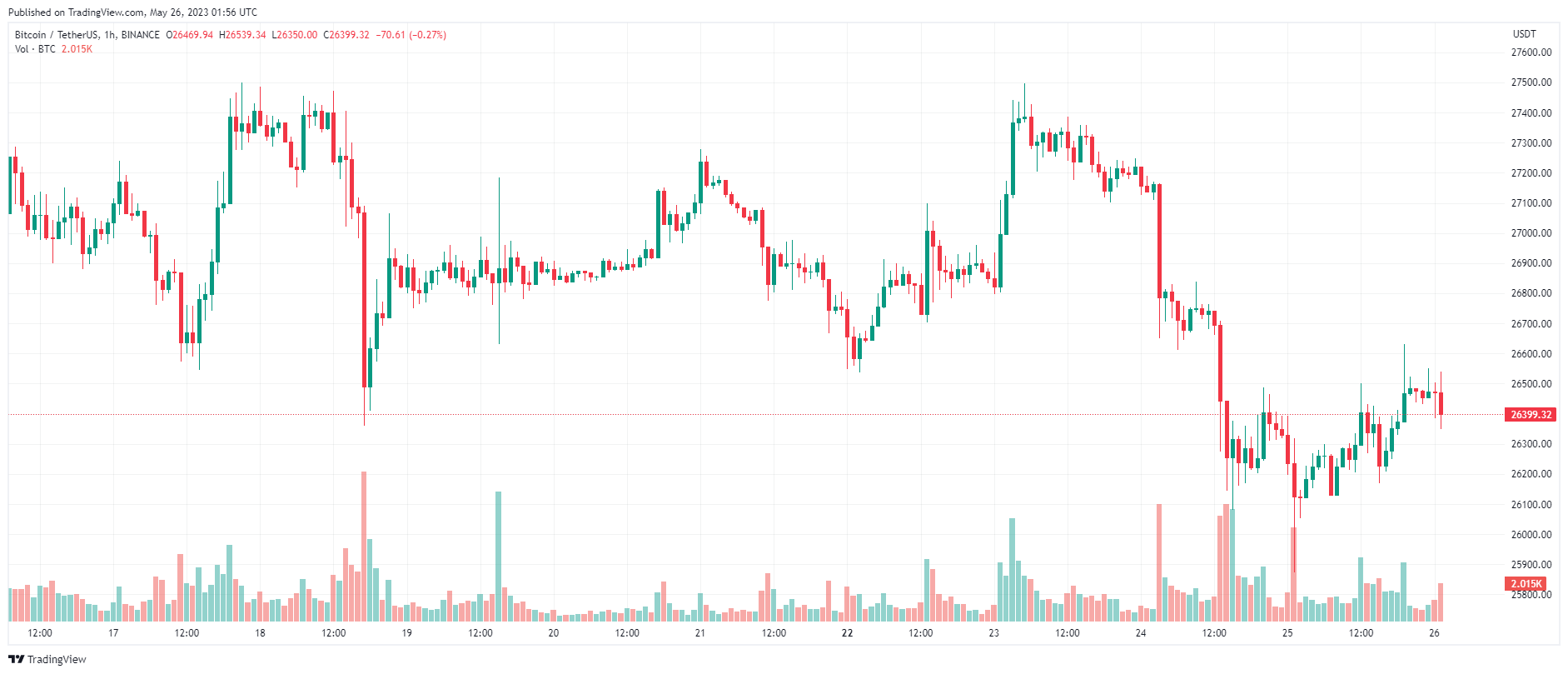
BTC Price Chart – 1 hour | Source: TradingView
The S&P 500 and Nasdaq Composite Index rallied on Thursday (May 25), as investors cheered Nvidia's latest quarterly results, boosting tech stocks' gains.
Closing the session, the Nasdaq Composite index rose 1.71% to 12,698.1 points, the S&P 500 added 0.88% to 4,151.3 points; while Dow Jones lost 35.3 points (or 0.11%) to 32,764.65 points and closed below the 200-day moving average.
Nvidia shares jumped 24.4%, a day after the company released a stronger-than-expected revenue outlook and reported positive revenue-earnings for the recent quarter. Booming demand for Nvidia chips used in artificial intelligence underpinned the quarterly growth rate.
Some analysts have raised their price targets for Nvidia stock following strong results. The strong rally in Nvidia stock has brought the chipmaker close to a $1 trillion market cap.
Other semiconductor stocks and some artificial intelligence stocks rallied after Nvidia's rally. Advanced Micro Devices and Taiwan Semiconductor shares jumped 11.1% and 12%, respectively. The VanEck Semiconductor ETF added 8.6% to a 2023 high, hitting a new 52-week high early in the session. Alphabet and Microsoft shares rose 2.1% and 3.9%, respectively.
Despite Thursday's rally, market breadth concerns persist. Keith Lerner, Co-Chief Investment Officer at Truist, said certain companies and sectors are driving the bull market, covering some of the cracks below the surface.
In addition, negotiations on the US debt ceiling continue, with the default deadline approaching. Negotiations between the leaders of the US Congress and US President, Joe Biden, made progress on Thursday. According to a report from Reuters, the two sides now only need to agree on a spending amount of $70 billion.
Uncertainty around the talks has weighed on US stocks this week, with the Dow Jones and S&P 500 down 2% and 1% respectively so far this week, while the Nasdaq Composite is up 0.3%. .
Oil prices fell sharply on Thursday (May 25) after Russian Deputy Prime Minister Alexander Novak downplayed the prospect of additional OPEC+ production cuts at next week's meeting.
Ending the session, the Brent oil contract fell 3.6% to 75.55 USD/barrel. WTI oil contract lost 3.95% to 71.41 USD/barrel.
Data from TradingView shows that BTC/USD has recovered slightly from a flash drop below $26,000.
With little excitement present in the spot market, traders and analysts are looking for potential volatility catalysts.
Macroeconomic reports from the US, including gross domestic product estimates for the second quarter and the number of jobless claims, have failed to change the status quo.
Prominent trader, Jelle, summed it up : “The bulls cannot push the price lower as the market retests the support zone.”
He added that a reclaim of $26,600 would be the “ideal scenario,” acting as a springboard for BTC/USD to regain the previous range.
Crypto trader Tony has repeated a popular bearish target of around $25,000 if Bitcoin continues to form a lower low.
Analyzing BTC briefly falling below the $26,000 mark, trader Skew said: “It was the usual pump and pull of Liquidity for Binance.”
Then, he explained, the price rebounded as limit buy orders filled and order book Liquidity sanitize.
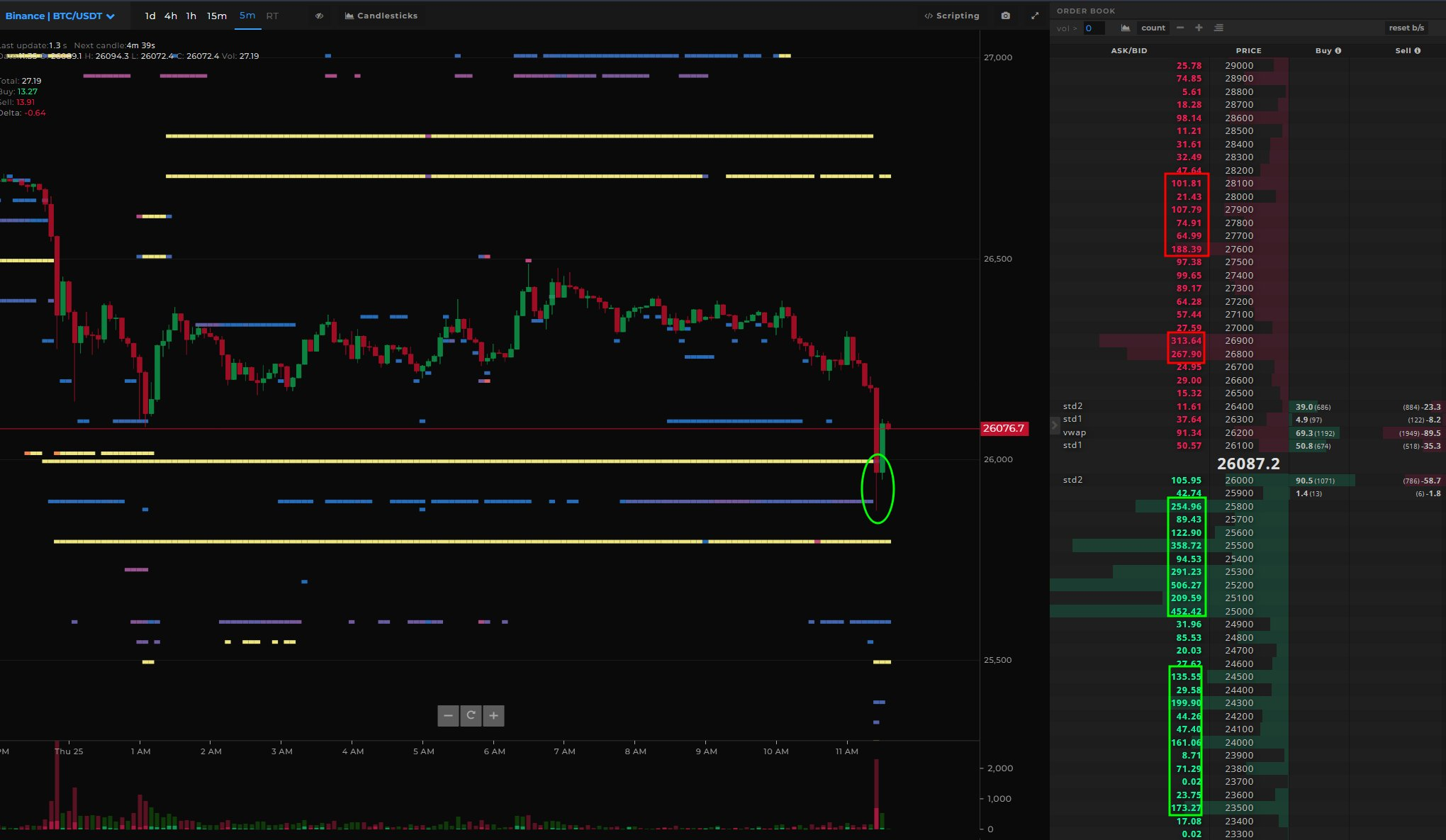
Overview of Binance order book data | Source: Skew
Meanwhile, on the weekly timeframe, analyst Rekt Capital has emphasized the importance of current spot prices.
He noted that just above the $26,000 level is the 200-week moving average and flipping it back into resistance will pose long-term difficulties for the bulls.
Further analysis has warned that Bitcoin's multi-month high at $31,000 is rapidly turning in favor of the bears, completing a head and shoulders pattern.
“So far, BTC has broken down a head and shoulders pattern. BTC also recently turned the Neckline of this pattern into new resistance (red). This bearish pattern is being validated, which could lead to a deeper drop to the bottom of $20,000.”
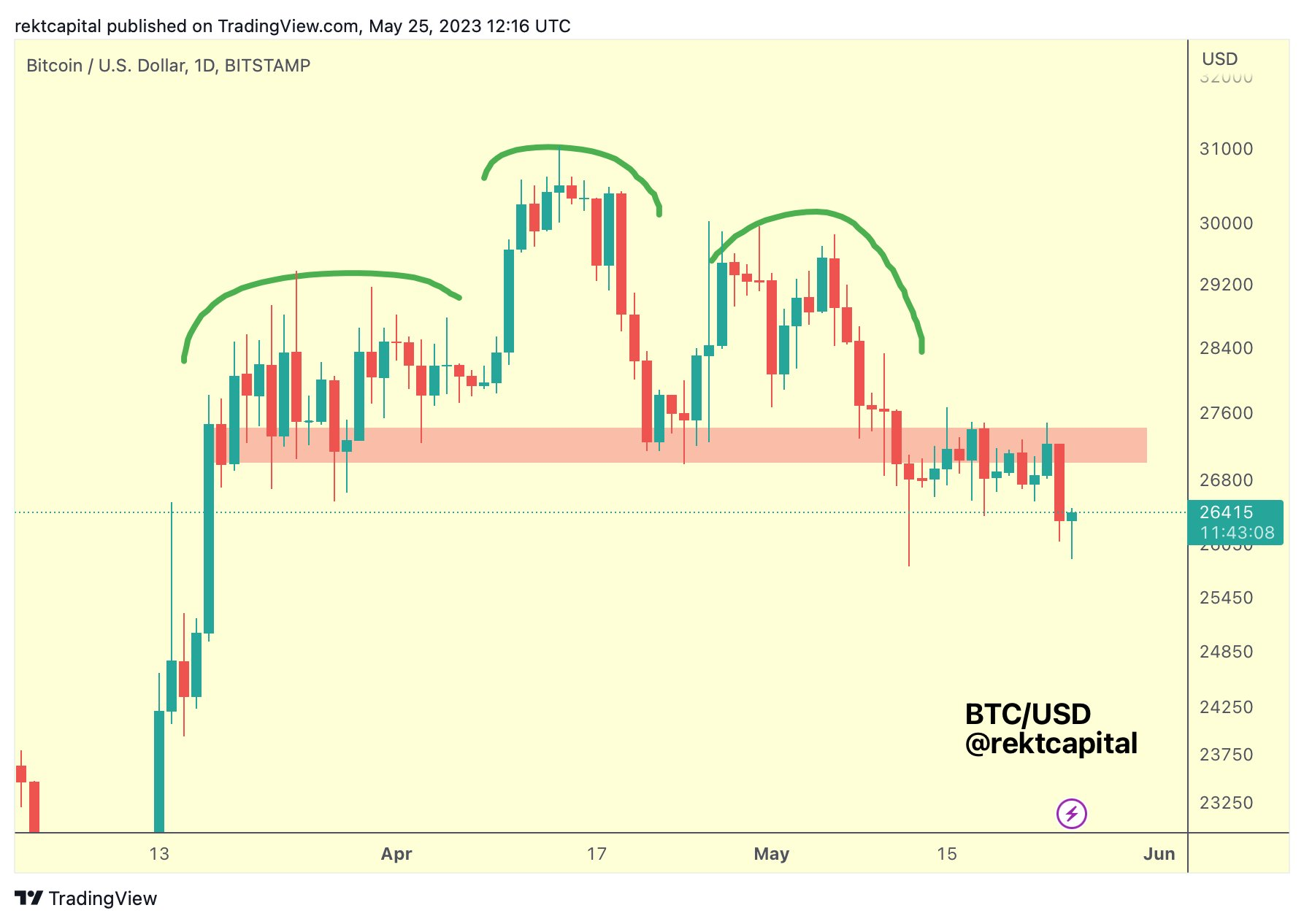
BTC/USD chart with caption | Source: Rekt Capital
The Altcoin market rebounded slightly as BTC bounced back around $26,400 following yesterday's plunge.
SingularityNET (AGIX) is the project that recorded the best growth of the day, when it bounced more than 10%, erasing all losses in the past 7 days.
Other Altcoin like Casper (CSPR), Pepe (PEPE), Enjin Coin (ENJ), Render Token (RNDR), Litecoin (LTC), THORChain (RUNE), Polygon (Matic), OKB (OKB), Huobi Token (HT))… increased slightly from 3-5%.
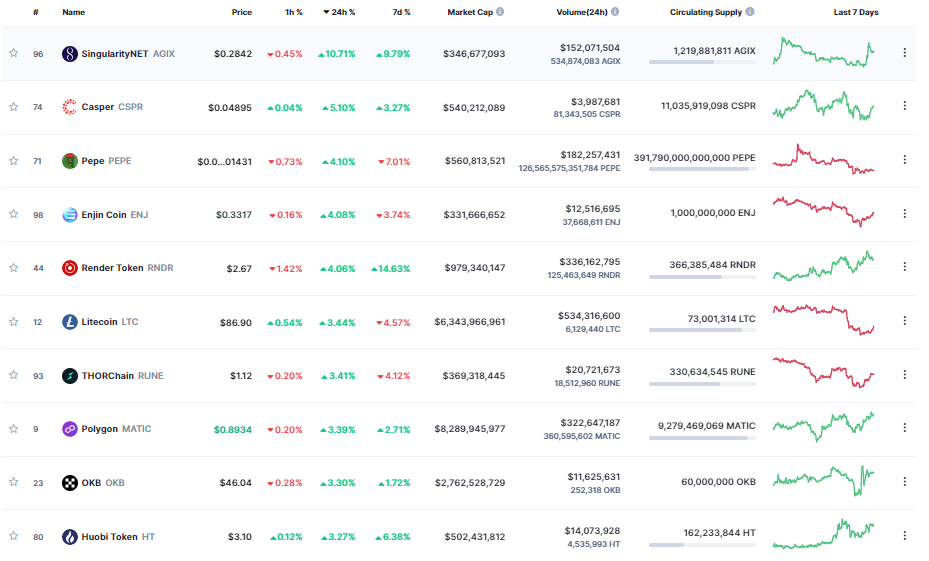
Source: Coinmarketcap
After yesterday's plunge, establishing a local bottom at $1,761, Ethereum (ETH) managed to regain the $1,800 area with slight gains of nearly 1.5% on the day.
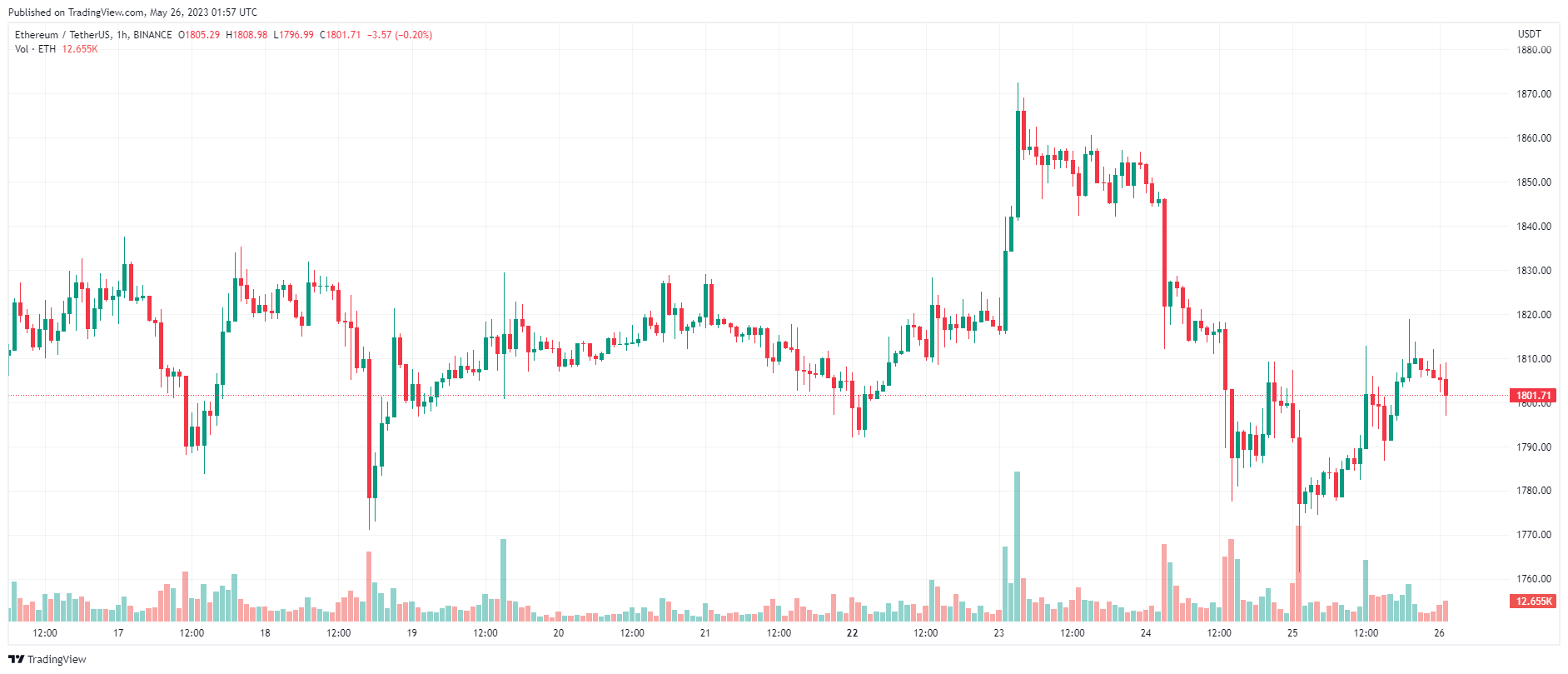
ETH price chart – 1 hour | Source: TradingView