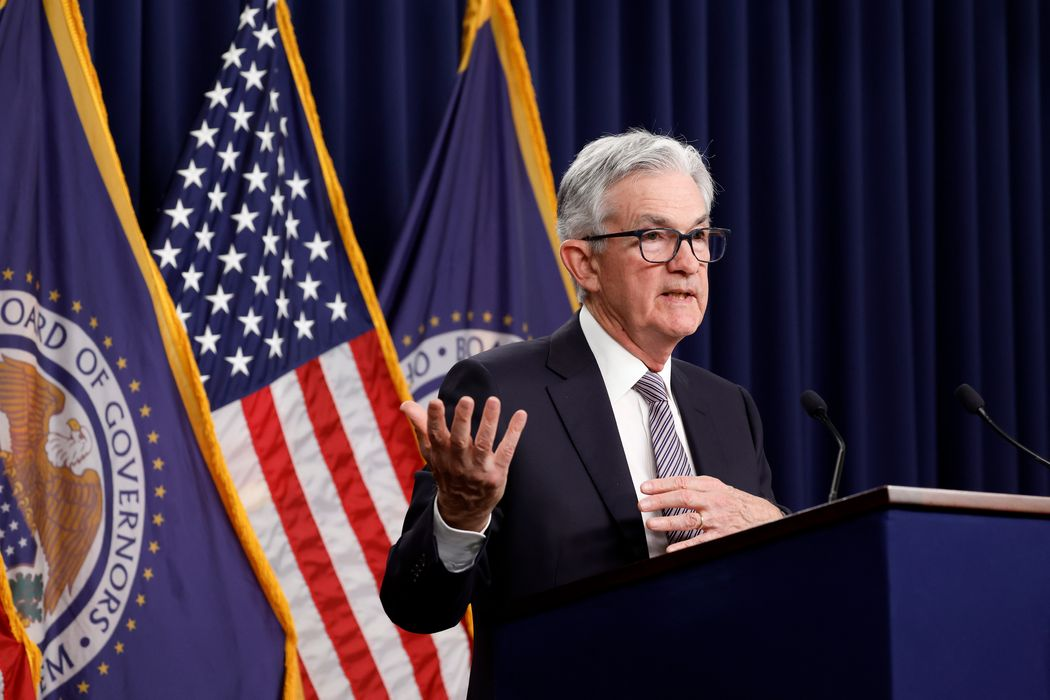
Fed Uncertain About More Rate Hikes, Minutes Show

Barrons2023-05-25 tarihinde yayınlandı2023-05-25 tarihinde güncellendi

Özet

Fed officials continue to debate whether to raise interest rates or hold them steady when the policy committee next meets in mid-June.

Federal Reserve officials appear increasingly divided over the appropriate path forward for monetary policy, with participants acknowledging significant uncertainty at their May meeting and emphasizing a need to keep their options open as they debate whether to continue raising interest rates or holding them steady in the coming months.

Minutes from the central bank’s May 2-3 meeting show that while officials remain focused on reining in “unacceptably high” inflation, they are balancing the need to rein in price growth with the growing likelihood that fallout from recent banking failures will have a dampening impact on economic growth.

“Participants generally expressed uncertainty about how much more policy tightening may be appropriate,” the minutes say.

Several officials felt the impact of stricter financial conditions and the lag with which monetary policy operates could mean their tightening campaign was nearly finished if the economy continued to evolve in line with the current outlook, the minutes say. Some others, however, felt the progress in bringing inflation back in line with the Fed’s 2% target would continue to be “unacceptably slow” and further rate hikes would be necessary.

Officials were able to agree in general on the need to keep a close eye on incoming economic data and to keep their options open ahead of the next policy meeting, scheduled for June 13-14.

The fresh insight, released Wednesday afternoon, underscores how seriously Fed officials considered changing course and holding interest rates steady when they met earlier this month. Officials voted unanimously in May to raise interest rates by a quarter-point to a range of 5-5.25%. The minutes suggest there was significant discussion over what the Fed should do after that and whether it would be time to pause the tightening campaign and hold rates steady.

“In short, the hawks were still in charge in early May,” wrote Ian Shepherdson, chief economist with Pantheon Macroeconomics, after the minutes were released. “But the next round of CPI, PPI, and labor market data likely will strengthen the case for a June pause.”

After the minutes were released on Wednesday, traders put the probability that the Fed holds rates steady at the June meeting at 72%, according to the CME FedWatch Tool.

Fed Chairman Jerome Powell laid the groundwork at his postmeeting press conference in May for the central bank to hold rates steady at its next meeting, and officials deleted a line from their policy statement that said “ongoing increases” in the policy rate would be appropriate.

But Powell was careful not to suggest that officials had made a decision about what was coming next, and the minutes show other participants were focused on making sure the shift in their stance wasn’t misinterpreted. Some officials emphasized during the meeting the need to make clear that the changes to the statement didn’t mean the central bank had ruled out further rate hikes this year, or that it was leaning toward cutting rates, the minutes show.

Fed officials have said for months that they don’t anticipate lowering the federal-funds rate this year but will instead be holding it steady once they determine that they have reached a sufficiently restrictive level. That view stands at odds with the consensus forecast among investors, who continue to price in a significant likelihood of at least one quarter-point rate cut by the end of this year.

The Fed’s May rate hike came despite a view from committee staff economists that tightening in the pipeline so far, alongside the expected further tightening in bank credit conditions, would lead to a mild recession beginning later this year, the minutes show. Staff first released their recession forecast during the March meeting, which was held in the immediate aftermath of the failures of Silicon Valley and Signature Banks. The May meetings show committee staff see the downturn being followed by a “moderately paced” recovery.

Fed officials appeared to take a somewhat less dour view of the economic outlook, however, noting that while tightening credit conditions were likely to weigh on economic activity, “the extent of these effects remained uncertain.”

Ultimately, though, their decision on how to move forward in the coming meetings will depend largely on what forthcoming economic data show. April’s personal-consumption expenditures price index—the Fed’s preferred inflation gauge—will be released Friday, while May jobs numbers arrive next week and May consumer-price-index data will come the week after.

İlgili Okumalar

Ethereum Foundation Interim Executive Director Speaks Out: What Is Our Mission?

The Ethereum Foundation's core mission is to ensure Ethereum remains a truly permissionless, censorship-resistant, private, and open infrastructure for large-scale, sovereign coordination. The article clarifies the EF's focus and dismisses irrelevant objectives, such as pursuing institutional popularity or short-term speculation. Its core work centers on eliminating systemic weaknesses. This involves fortifying Ethereum across multiple layers—protocol, access, user, and institutional—against exploitation, control, or surveillance. Key initiatives include minimizing harmful MEV and preventing privileged control over transaction flow, making unconditional privacy a foundational default, ensuring staking remains permissionless and decentralized, and strengthening user-facing access points to uphold autonomy. Concurrently, the EF aims to seize strategic opportunities. These include leading the transition to post-quantum cryptography, achieving a fully verifiable protocol stack, establishing Ethereum as private digital cash, integrating user-owned AI agents with personal wallets, and demonstrating that trusted-neutral infrastructure can competitively handle disintermediated coordination at an institutional scale. The article also addresses recent organizational changes, stating that personnel departures were due to strategic realignment, role fit, or natural evolution. It clarifies the approach to spin-outs, emphasizing that external funding will be provided only for work critical to the EF's mission that reduces Ethereum's dependency without creating new risks or mission drift. Ultimately, the EF is committed to building an enduring, neutral system that reshapes global coordination, focusing relentlessly on the principles of censorship resistance, openness, privacy, and sovereignty (CROP).

链捕手22 dk önce

Ethereum Foundation Interim Executive Director Speaks Out: What Is Our Mission?

链捕手22 dk önce

STRC 跌破面值,比特币财库实验进入下半场

The price of STRC, Strategy's dividend-paying preferred stock, has fallen below its $100 face value, triggering a re-evaluation of the "bitcoin treasury" corporate model. This highlights a critical tension: the company's asset base consists of high-volatility, non-cash-flow-generating Bitcoin, while its capital structure requires continuous cash payouts for dividends and interest. The decline of STRC signals that market pressure is shifting from asset price volatility to the pricing of the company's financing tools. Strategy's core model involves a three-step conversion: turning equity into Bitcoin exposure, converting Bitcoin holdings into capital market credit, and packaging non-yielding BTC into cash-paying securities like STRC. While Strategy holds a massive 847,363 BTC, the focus is now on cash flow mismatches. The company faces annual preferred stock dividend obligations of approximately $1.7 billion, far exceeding the cash flow from its legacy software business. Its ability to meet these obligations relies on continued access to capital markets. The market is now scrutinizing which of three potential costs becomes untenable first: rising dividend costs to attract investors, dilution costs from issuing more common stock, or the reputational cost of selling BTC—a move contrary to its "hodl" narrative. For the broader crypto market, a constrained Strategy means the potential loss of a predictable, narrative-driven marginal buyer for Bitcoin. The STRC discount serves as a reminder that the longevity of such models depends not just on Bitcoin's price, but also on financing windows, cash reserves, and investor willingness to pay a "trust premium" for the structure.

marsbit57 dk önce

STRC 跌破面值,比特币财库实验进入下半场

marsbit57 dk önce

Standard Chartered Bank’s 50-Fold Fantasy: Predicting AAVE to Reach $3,500

Standard Chartered Bank has issued an optimistic research report predicting that the AAVE token could surge 50-fold to $3,500 by 2030. This forecast is based on the projection that the total value locked (TVL) in DeFi will grow 37x to approximately $2.7 trillion, driven by stablecoin expansion and the tokenization of real-world assets (RWA). The bank's model links Aave's potential valuation directly to its protocol revenue, which is primarily driven by net interest margins. The report highlights Aave's current dominant position, noting it captures over 80% of the net earnings ("protocol retained earnings") in the lending sector while holding only about half of its TVL. It also points to the recent launch of the Aave V4 architecture and a healthy revenue stream of $142 million in 2025 as positive fundamentals. Grayscale's separate analysis, applying traditional valuation metrics like DCF, concluded AAVE is currently undervalued. However, the article notes significant challenges. Aave's peer-to-pool lending model suffers from inherent capital inefficiency, with an estimated $52 million annual "deadweight loss" due to idle funds needed for liquidity buffers. This structural flaw was exposed during the April KelpDAO exploit, which locked a WETH pool at 100% utilization for days. Emerging protocols like Morpho, with more efficient point-to-point models, are cited as growing competitive threats. In summary, while institutional forecasts paint a macro picture of massive growth fueled by RWA adoption, Aave's path forward hinges on addressing its core structural limitations and competitive pressures within the evolving DeFi lending landscape.

链捕手2 saat önce

Standard Chartered Bank’s 50-Fold Fantasy: Predicting AAVE to Reach $3,500

链捕手2 saat önce

İşlemler

Spot
Futures
活动图片