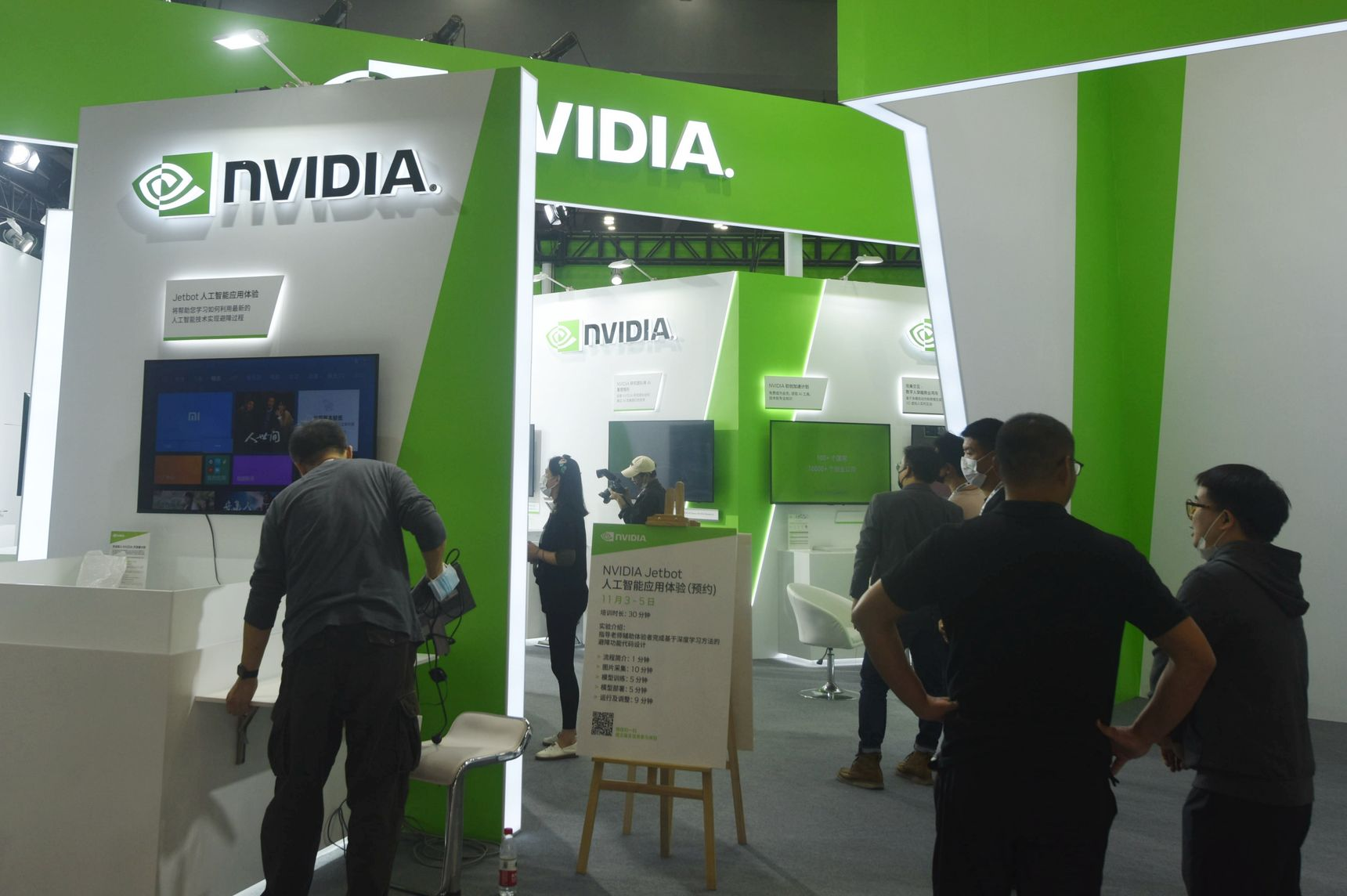
Nvidia Poised for Record Sales as AI Demand Kicks In

WSJ2023-05-25 tarihinde yayınlandı2023-05-25 tarihinde güncellendi

Özet

The graphics-chip giant gives a strong outlook, driven by growing appetite for generative AI technology

Chip giant Nvidia is starting to capitalize on the craze for language-generating artificial intelligence, projecting a more than 64% jump in sales as the company rushes to get more processors in customer hands to satisfy booming interest in the technology.

A new generation of advanced Nvidia chips for AI calculations in data centers is in production, Nvidia CEO Jensen Huang said, and “we are significantly increasing our supply to meet surging demand for them.”

The company forecast a record $11 billion in sales for the current quarter, far above the $7.2 billion Wall Street was expecting and what would be the highest quarterly total ever for the company.

“This demand has extended our data center visibility out a few quarters and we have procured substantially higher supply for the second-half of the year,” Chief Financial Officer Colette Kress said on an earnings call.

Nvidia’s shares, which have more than doubled in value this year, surged more than 28% in after-market trading to reach an all-time high. The rise puts Nvidia, the U.S.’s largest chip-supplier by market value, close to becoming the world’s first $1 trillion chip company.

Demand for computing power that drives language-generating tools such as OpenAI’s ChatGPT is opening a huge new revenue opportunity for the company and others. It has spurred an arms race between tech giants to offer advanced AI features to their customers. Microsoft, which has invested in OpenAI, has been adding the technology to its Bing search engine and business software products. Google has introduced its own advanced AI tools. Facebook parent Meta Platforms also has been working on the technology. Nvidia’s chips are essential in creating these kinds of tools, analysts say, and building just one such AI system can require thousands of Nvidia’s computing engines.

Huang said the company was well-prepared to benefit from the AI opportunity because it was starting to produce a new wave of advanced equipment for data centers when the explosion of interest began last year. “I call it the iPhone moment,” he said, referring to the shift toward smartphones that Apple capitalized on by releasing its advanced handset about 16 years ago. “All the technology came together and helped everybody realize what an amazing product that can be and what capabilities it can have.”

Nvidia doesn’t manufacture its own chips, but farms out production to contract chip-makers including the world’s largest, Taiwan Semiconductor Manufacturing Co. TSMC’s shares, which trade in New York and Taiwan, rose by 7% after-hours in the wake of Nvidia’s results.

Nvidia may be the leading provider of AI chips, but Huang said the battle to supply chips to satisfy demand is fierce. “We have competition from every direction,” he said, from established semiconductor companies to startups.

Nvidia on Wednesday said revenue fell 13% to $7.2 billion in its last fiscal quarter, topping forecasts from analysts surveyed by FactSet. Net profit rose 26% to $2 billion. The sales retreat was driven by a sharp decline in the graphics chips business for videogamers, who pulled back after the pandemic eased and are only beginning to resume buying.

Huang said operators of big data centers are retooling their computing infrastructure to better address the opportunities offered by AI, creating surging demand for its chips.

“A trillion dollars of installed global data center infrastructure will transition from general purpose to accelerated computing as companies race to apply generative AI into every product, service and business process,” he said.

Nvidia’s data center revenue rose to $4.28 billion in its latest quarter, a record, which Kress said reflected strong demand from consumer internet companies and cloud-computing companies.

Nvidia has said it is working on generative AI with Amazon.com, Microsoft and Alphabet’s Google unit, and is partnering with cloud-computing companies to help make generative AI available to smaller businesses. The company on Tuesday said it was adding its AI software to Microsoft’s Azure cloud-computing service, allowing corporate customers to tap in to its chips and software to speed up large generative AI systems.

Nvidia has its roots in graphics-processing chips for videogamers, but has diversified its customer base rapidly in recent years. Engineers found the chips to be well-suited to AI tasks and cryptocurrency mining, which led to an explosion of new sources of demand.

The company has tried to capitalize on that shift by making specialized chips for those markets. Its AI chips have helped its data center division surpass its gaming division in revenues over the past few quarters, a major break from the past. The company has recently begun to roll out a new generation of AI chips for data centers that promise a substantial performance upgrade, and many customers have had to wait for them amid red-hot demand.

The company’s gaming division fell by 38% to $2.2 billion in the latest quarter, which Kress attributed to the macroeconomic slowdown and Nvidia limiting shipments so customers run through existing inventories of chips.

Amid the growth in AI-related sales, new U.S. regulations seeking to hamstring China’s AI industry limited the sale of Nvidia chips there. Nvidia has developed versions of its chips that don’t exceed performance thresholds, but the company said last year that the curbs could cost it up to $400 million in quarterly sales.

İlgili Okumalar

Ethereum Foundation Interim Executive Director Speaks Out: What Is Our Mission?

The Ethereum Foundation's core mission is to ensure Ethereum remains a truly permissionless, censorship-resistant, private, and open infrastructure for large-scale, sovereign coordination. The article clarifies the EF's focus and dismisses irrelevant objectives, such as pursuing institutional popularity or short-term speculation. Its core work centers on eliminating systemic weaknesses. This involves fortifying Ethereum across multiple layers—protocol, access, user, and institutional—against exploitation, control, or surveillance. Key initiatives include minimizing harmful MEV and preventing privileged control over transaction flow, making unconditional privacy a foundational default, ensuring staking remains permissionless and decentralized, and strengthening user-facing access points to uphold autonomy. Concurrently, the EF aims to seize strategic opportunities. These include leading the transition to post-quantum cryptography, achieving a fully verifiable protocol stack, establishing Ethereum as private digital cash, integrating user-owned AI agents with personal wallets, and demonstrating that trusted-neutral infrastructure can competitively handle disintermediated coordination at an institutional scale. The article also addresses recent organizational changes, stating that personnel departures were due to strategic realignment, role fit, or natural evolution. It clarifies the approach to spin-outs, emphasizing that external funding will be provided only for work critical to the EF's mission that reduces Ethereum's dependency without creating new risks or mission drift. Ultimately, the EF is committed to building an enduring, neutral system that reshapes global coordination, focusing relentlessly on the principles of censorship resistance, openness, privacy, and sovereignty (CROP).

链捕手24 dk önce

Ethereum Foundation Interim Executive Director Speaks Out: What Is Our Mission?

链捕手24 dk önce

STRC 跌破面值,比特币财库实验进入下半场

The price of STRC, Strategy's dividend-paying preferred stock, has fallen below its $100 face value, triggering a re-evaluation of the "bitcoin treasury" corporate model. This highlights a critical tension: the company's asset base consists of high-volatility, non-cash-flow-generating Bitcoin, while its capital structure requires continuous cash payouts for dividends and interest. The decline of STRC signals that market pressure is shifting from asset price volatility to the pricing of the company's financing tools. Strategy's core model involves a three-step conversion: turning equity into Bitcoin exposure, converting Bitcoin holdings into capital market credit, and packaging non-yielding BTC into cash-paying securities like STRC. While Strategy holds a massive 847,363 BTC, the focus is now on cash flow mismatches. The company faces annual preferred stock dividend obligations of approximately $1.7 billion, far exceeding the cash flow from its legacy software business. Its ability to meet these obligations relies on continued access to capital markets. The market is now scrutinizing which of three potential costs becomes untenable first: rising dividend costs to attract investors, dilution costs from issuing more common stock, or the reputational cost of selling BTC—a move contrary to its "hodl" narrative. For the broader crypto market, a constrained Strategy means the potential loss of a predictable, narrative-driven marginal buyer for Bitcoin. The STRC discount serves as a reminder that the longevity of such models depends not just on Bitcoin's price, but also on financing windows, cash reserves, and investor willingness to pay a "trust premium" for the structure.

marsbit59 dk önce

STRC 跌破面值,比特币财库实验进入下半场

marsbit59 dk önce

Standard Chartered Bank’s 50-Fold Fantasy: Predicting AAVE to Reach $3,500

Standard Chartered Bank has issued an optimistic research report predicting that the AAVE token could surge 50-fold to $3,500 by 2030. This forecast is based on the projection that the total value locked (TVL) in DeFi will grow 37x to approximately $2.7 trillion, driven by stablecoin expansion and the tokenization of real-world assets (RWA). The bank's model links Aave's potential valuation directly to its protocol revenue, which is primarily driven by net interest margins. The report highlights Aave's current dominant position, noting it captures over 80% of the net earnings ("protocol retained earnings") in the lending sector while holding only about half of its TVL. It also points to the recent launch of the Aave V4 architecture and a healthy revenue stream of $142 million in 2025 as positive fundamentals. Grayscale's separate analysis, applying traditional valuation metrics like DCF, concluded AAVE is currently undervalued. However, the article notes significant challenges. Aave's peer-to-pool lending model suffers from inherent capital inefficiency, with an estimated $52 million annual "deadweight loss" due to idle funds needed for liquidity buffers. This structural flaw was exposed during the April KelpDAO exploit, which locked a WETH pool at 100% utilization for days. Emerging protocols like Morpho, with more efficient point-to-point models, are cited as growing competitive threats. In summary, while institutional forecasts paint a macro picture of massive growth fueled by RWA adoption, Aave's path forward hinges on addressing its core structural limitations and competitive pressures within the evolving DeFi lending landscape.

链捕手2 saat önce

Standard Chartered Bank’s 50-Fold Fantasy: Predicting AAVE to Reach $3,500

链捕手2 saat önce

İşlemler

Spot
Futures
活动图片