随着香港为散户投资者开放加密货币交易,比特币跃升至关键价格阻力位

Coindesk2023-05-24 tarihinde yayınlandı2023-05-24 tarihinde güncellendi

Özet

由于香港表示散户投资者可以从 6 月 1 日起交易数字资产,比特币 ( BTC ) 周二早盘升至关键价格阻力位。

由于香港表示散户投资者可以从 6 月 1 日起交易数字资产,比特币 ( BTC ) 周二早盘升至关键价格阻力位。

香港证券及期货事务监察委员会 (SFC) 宣布将从 6 月 1 日起接受交易所向散户投资者提供加密货币交易的申请,并补充说获批的代币需要有 12 个月的业绩记录和可观的市值。证监会表示,注册交易所将被禁止提供稳定币和生息工具。

该公告符合长期以来的预期,即亚洲的发展将促进下一次加密货币牛市,并与西方,尤其是美国缺乏规律性形成鲜明对比

比特币在亚洲时段上涨超过 2% 至 27,500 美元,试探了连接头肩 (H&S) 形态第一和第二波谷的水平趋势线的前支撑转阻力位。本月初,该加密货币跌破趋势线,证实了 H&S 的崩溃,并为进一步下滑至 25,000 美元打开了大门。

“这看起来像是一个与宏观无关的基于现货的举动,而且时间恰逢香港将从 6 月 1 日起允许在许可数字资产平台上进行BTC和ETH零售交易的消息,”Noelle Acheson,作者Crypto Is Macro Now 通讯,在周二的版本中说。 “这并不完全出人意料——裁决和时间安排在很大程度上是意料之中的。但在一个低迷的市场中,由于来自其他方面的不利因素, 确认更为重要,”艾奇逊补充道。

Per Acheson 表示,香港为散户投资者开绿灯加密货币交易的决定并不意味着对加密货币的需求会大量涌现,因为本地交易商可能已经通过离岸场所进入市场。尽管如此,艾奇逊指出,该公告是“一个受欢迎的提醒,即加密货币采用池在明年及以后可能会大幅增长”。
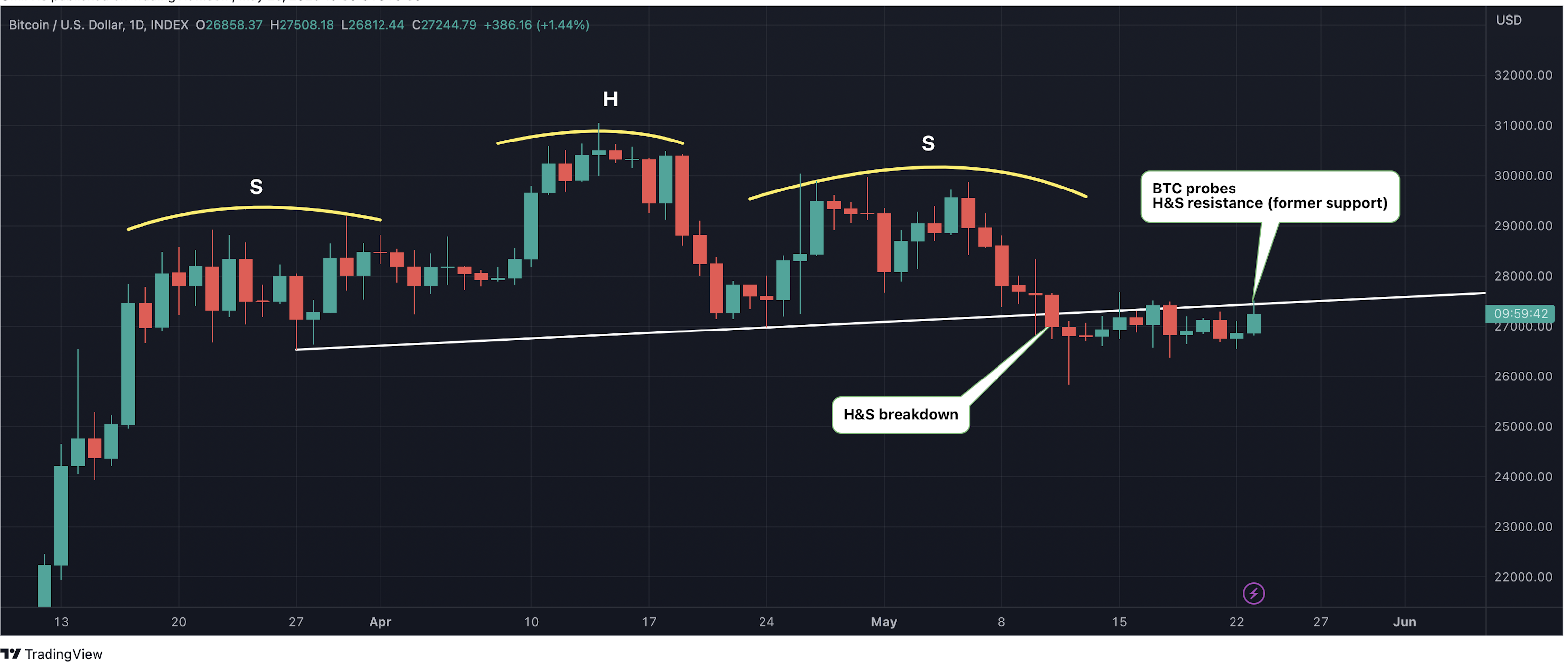
比特币周二早些时候升至 H&S 阻力位。 (TradingView)(TradingView)

据总部位于加拿大的数字资产流动性提供者Secure Digital Markets 称,比特币需要清除 H&S 趋势线阻力位和 27,500 美元的 20 天简单移动平均线才能确认牛市复苏。

“只要价格保持在这种 [H&S] 形态的颈线 [水平趋势线] 以及 20 日移动平均线下方,我们就应该预期会进一步下跌至 25,250 美元,可能跌至 24,000 美元,”那里的分析师写道。

比特币的短期前景还取决于正在进行的美国债务上限戏剧和美元指数的轨迹。财政部长珍妮特耶伦警告说,如果不能达成债务协议,政府将在 6 月初耗尽资金,为许多人所说的灾难性违约敞开大门。 一些分析师表示,成功解决债务上限问题可能会让财政部从市场吸走流动性,并对比特币施加下行压力。

最后,债券收益率正在上升,这表明投资者正在重新评估美联储继续其加息行动并在更长时间内保持较高借贷成本的可能性。

截至发稿时,美国 10 年期国债收益率升至 3.75% 的两个多月高位,而两年期国债收益率则跳升至 4.4%,为 3 月 13 日以来的最高水平。收益率上升削弱了科技股等风险资产的吸引力,加密货币和黄金等零收益资产。


İlgili Okumalar

Analyzing the Impact of AI on Economic Growth and Productivity

**Title: Analyzing AI's Impact on Economic Growth and Productivity** This article examines three contrasting views on AI's influence on economic growth and productivity. **The Optimistic View** posits that AI, especially through automating R&D ("recursive self-improvement"), could dramatically accelerate growth, even triggering a technological "singularity" with explosive, potentially infinite, economic expansion. **The Moderate/Mainstream View** acknowledges AI's productivity benefits but emphasizes significant real-world constraints that could limit its impact. These include: limited cost savings per task, structural ceilings on which jobs and industries are "exposed" to AI, adoption bottlenecks (e.g., compute, energy, regulatory hurdles), and the "weak link" effect where non-automatable tasks cap overall gains. Consequently, the realized AI dividend may be far lower than optimistic projections, with estimates typically ranging from 0.1% to 1.3% annual productivity growth. **The Pessimistic View** stems from two strands. The first aligns with the moderate view but applies extremely conservative assumptions about task exposure and efficiency gains, yielding minimal projected impact. The second introduces a demand-side critique: if AI primarily replaces rather than augments labor, it could depress labor's share of income, weaken consumer demand, and create a "demand trap" that ultimately stifles growth, unless offset by redistribution policies. **The authors' assessment** is nuanced: * **Short-term (1-2 years):** AI will support growth primarily through investment spending, not significant productivity gains. * **Medium-term (3-5 years):** Three potential paths emerge based on AI demand and bottleneck severity: 1. **"Optimistic Path":** High demand, few bottlenecks. Rapid productivity gains but risk of major job displacement and social conflict without redistribution. 2. **"Moderate Path" (most likely):** High demand but significant, surmountable bottlenecks. Leads to moderate productivity gains, financial market volatility (K-shaped returns), and sectoral job losses. 3. **"Pessimistic Path":** Low demand or severe bottlenecks. Minimal productivity and growth impact, triggering financial market corrections but allowing a smoother societal transition with less labor disruption. * **Long-term:** AI holds potential for a major productivity revolution and prosperity. The conclusion stresses that no path is smooth. Technologically "optimistic" outcomes could be socially detrimental, while "pessimistic" technological diffusion might be more socially stable. Policymakers must monitor developments and prepare balanced responses to manage economic, financial, and social sustainability.

marsbit12 dk önce

Analyzing the Impact of AI on Economic Growth and Productivity

marsbit12 dk önce

The New Cold War is a Tech Stock War

The New Cold War is a Tech Stock War The article argues that the contemporary geopolitical and economic rivalry between the US and China represents a "New Cold War," but one fundamentally fought through technology and financial markets, not physical barriers or conventional trade. Historically, US dominance was secured through financial systems. The Soviet Union, reliant on the rigid "Transferable Ruble," was ultimately undermined by its dependency on the US dollar for oil trade. Later, Japan's semiconductor challenge was countered not just by tariffs (e.g., Plaza Accord, 301 investigations) but by binding it to US Treasury bonds. China presents a more complex, "embedded" challenger. While it holds vast dollar reserves and US debt like Japan, its industrial base is stronger and more diversified than the Soviet Union's. Surviving the initial 2018 trade war phase, the conflict has evolved into a "tech-financial war." The core battlefield is now the stock market. US tech stocks (AI, semiconductors) are treated as sovereign assets, buoyed by bipartisan national will. China is pushing to strengthen its own financial markets to convert industrial strength into financial power and fund its tech ambitions. Companies like ChangXin (semiconductors), Moonshot AI, and DJI compete not just for market share but as financial proxies for their respective systems. The new paradigm is moving from globally efficient monopolies (Apple, Google) towards companies that achieve monopolistic profits within their respective geopolitical spheres. This competition over "pricing power" and financial valuation in segmented markets defines the current era, making the stock market the primary arena for this tech-centric struggle.

marsbit22 dk önce

The New Cold War is a Tech Stock War

marsbit22 dk önce

RWA Weekly: Ten European Financial Institutions Establish Tokenized Asset Cooperative; Ondo Launches New Execution Network Ondo Network

RWA Weekly: European Banks Form Tokenized Asset Cooperative; Ondo Launches New Execution Network Ondo Network Covering July 24-31, 2026, the RWA sector saw a steady on-chain total value locked (TVL) of $36.8 billion, with holder count hitting a record high. However, stablecoin transfer volumes fell sharply (~30%), indicating low on-chain settlement demand. Key regulatory moves include South Korea advancing stablecoin legislation and a push to scrap crypto taxes, Kenya lowering capital requirements for stablecoin issuers, and Zimbabwe approving seven projects for its crypto sandbox. In project developments, BIS-led Project Agorá successfully tested cross-border payments with tokenized funds across six currencies. Ten major European financial institutions formed the RL1 blockchain cooperative to build tokenized asset infrastructure. Other notable updates: Aviva launched a tokenized dollar liquidity fund on XRPL, POSCO International tokenized commercial invoices on Injective, and a Brazilian farmer used tokenized cattle as collateral for a loan. Additional progress includes BNY Mellon migrating its core transfer agent operations to blockchain, Securitize gaining SEC investment advisor registration, and Tether’s compliant stablecoin USA₮ launching on Celo. Ondo Finance introduced Ondo Network, a new execution layer focused on speed and privacy, moving away from its initial chain plans. An analysis highlights that despite the growing scale of on-chain RWAs (~$32B), approximately 90% remain underutilized in DeFi, pointing to a critical challenge in unlocking liquidity and fostering real-world application beyond mere issuance.

marsbit22 dk önce

RWA Weekly: Ten European Financial Institutions Establish Tokenized Asset Cooperative; Ondo Launches New Execution Network Ondo Network

marsbit22 dk önce

South Korean Stock Market Sees Sharp Rebound After Forceful De-leveraging, SK Hynix Rises 30%

On July 31, South Korean stocks staged a historic rebound. The benchmark KOSPI index surged 18.27%, with chipmaker SK Hynix hitting a 30% gain limit. This followed a brutal, near-40% decline in the KOSPI over the previous month, driven largely by a deleveraging spiral involving leveraged ETFs. Analysts attributed the sharp sell-off to structural liquidity issues rather than deteriorating corporate fundamentals. The rally was triggered by a confluence of positive catalysts. Firstly, strong earnings from U.S. cloud giants Microsoft and Amazon alleviated fears of an "AI bubble burst," boosting global tech sentiment. Secondly, SK Group Chairman Chey Tae-won made a rare personal purchase of SK Hynix shares, seen as a strong vote of confidence. Thirdly, the South Korean government announced a 20 trillion won ($139 billion) AI investment fund. In response to the market turmoil, South Korean regulators are tightening controls on leveraged ETFs, admitting oversight shortcomings. Measures include raising minimum cash保证金 requirements for散户 investors and suspending new product launches. While the rebound signals eased liquidity pressure, analysts note deep structural issues remain. The market's future stability is seen as dependent on global tech capital expenditure trends and memory chip price cycles, with some viewing the surge as a technical correction rather than a definitive trend reversal.

marsbit43 dk önce

South Korean Stock Market Sees Sharp Rebound After Forceful De-leveraging, SK Hynix Rises 30%

marsbit43 dk önce

İşlemler

Spot
活动图片