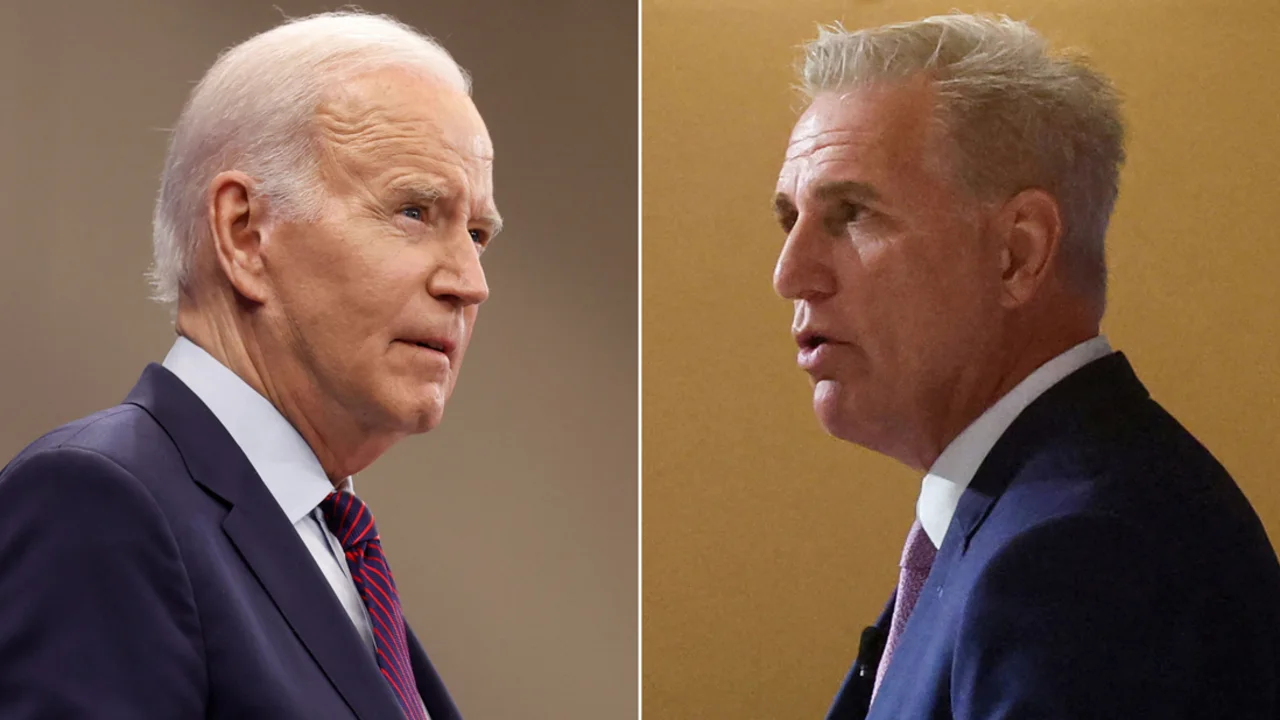
Biden, McCarthy Hold ‘Productive’ Meeting but No Debt-Ceiling Deal Yet

WSJ2023-05-23 tarihinde yayınlandı2023-05-23 tarihinde güncellendi

Özet

Spending levels for next year have become contentious part of negotiations

WASHINGTON—House Speaker Kevin McCarthy and President Biden failed to reach a deal to raise the debt ceiling following a high-stakes meeting at the White House but planned to press ahead with talks, as the U.S. nears a deadline to prevent a first-ever default.

Heading into the meeting, the president said that he was optimistic they could make progress. After the sit-down concluded, Biden termed it a productive meeting and “we reiterated once again that default is off the table and the only way to move forward is in good faith toward a bipartisan agreement.”

McCarthy told reporters that the tone of the roughly 90-minute meeting was “better than any other time we’ve had discussions.” He too said the meeting was productive and offered both leaders an opportunity to dig into the details of their positions.

McCarthy told reporters that the meeting was “productive,” adding, “I think the tone tonight was better than any other time we’ve had discussions.” He said the meeting offered both leaders an opportunity to dig into the details of their positions.

“I believe we can get it done,” he said, adding that negotiators would continue their discussions and he expects to talk to Biden every day.

Central to the talks is setting a top line spending level for the next year and deciding how long to lift the debt ceiling until having to raise it again. The two sides are aiming to reach a deal by June 1, when the Treasury Department estimates the U.S. could run out of money to pay all of its bills, leading to default. Treasury Secretary Janet Yellen repeated that estimate Monday.

Ahead of the meeting, Biden and McCarthy’s negotiating teams huddled on Capitol Hill. The two sides remained at odds on the central issue of spending, but are nearing agreement on secondary matters such as clawing back unused coronavirus-response funding, according to people familiar with the matter.

McCarthy said a deal must be reached this week to have time for the legislation to pass Congress. He added that he would consider canceling a planned House recess next week if there was no deal. “We’re going to stay and do our jobs,” McCarthy said.

Once a deal is reached, it will likely take at least several days for the agreement to wind its way through Congress. McCarthy said he planned to give House lawmakers 72 hours to read the bill, a rule that was put in place at the beginning of this Congress. House lawmakers will likely want to introduce amendments to any agreement as well.

Monday’s meeting comes after several stops and starts in the negotiations and increased tension among White House officials and House Republicans.

Rep. Byron Donalds (R., Fla.) said that in a closed-door briefing with some Republicans, Mr. McCarthy indicated that the talks were dragging on and lawmakers may need to cancel part of a 10-day recess planned to start this weekend.

“We were talking a lot about how to manage the clock and what that was going to look like,” Donalds said.

On Sunday, Biden said House Republicans have taken extreme positions and he called the GOP’s current proposal unacceptable. White House officials have accused Republicans of being unreasonable in the negotiations and pushing partisan proposals that have little chance of winning approval by both chambers of Congress. Meanwhile, Republicans have criticized Biden for waiting until May to engage in the negotiations, and they say the White House isn’t doing enough to cut spending.

Republicans have called for spending cuts as a condition for any debt-ceiling increase and they passed a bill in April to do so, saying that was their starting point on negotiations. They also want to cap spending in future years. Democrats for months declined to negotiate, saying the debt ceiling should be raised with no strings attached, but began engaging seriously in talks earlier this month as the deadline approached.

Biden has said he would like to work to narrow the deficit with some tax increases to wealthy Americans, but McCarthy said tax increases are off the table.

GOP lawmakers also want to attach changes to permitting rules that would speed the process of building energy projects and to tighten work requirements for some government benefit programs, proposals that the White House has signaled some openness to.

McCarthy has said spending in the coming fiscal year must be lower than it was last year. The White House has proposed keeping nondefense and defense discretionary spending flat from fiscal 2023 to fiscal 2024, and a 1% increase in fiscal 2025, according to people familiar with the matter.

Democrats want the debt ceiling increased until after the 2024 election, while Republicans’ original bill pushed the next debt-ceiling deadline to March 2024.

If Congress doesn’t act to raise the debt limit soon and the government is unable to borrow to help pay all of its bills, it might have to suspend certain pension payments, withhold or cut the pay of soldiers and federal workers, or delay interest payments, which would constitute a default.

Given the uncertainty of negotiations, lawmakers are examining emergency solutions that could avoid a default. Nearly all House Democrats have signed a discharge petition, a long-shot parliamentary maneuver that requires 218 signatures to force a vote on debt-ceiling legislation.

Republicans control the House, 222-213, so for their petition to succeed, Democrats would need at least five GOP lawmakers to sign on. Because of timing rules around the maneuver, the petition would also not be ready to implement until after the June 1 deadline.

Progressives in the Senate and House are pushing Biden to use the 14th Amendment of the Constitution to unilaterally act without Congress, a never-before-used process that Republicans have derided, which would almost certainly be challenged in court.

The 14th Amendment states that federal debt authorized by law “shall not be questioned.” Biden has said he was considering invoking the amendment as a way to keep paying the nation’s bills but that it remained a long shot.

Lawmakers could also pursue a short-term increase of the debt ceiling to give negotiators more time to reach a deal. But McCarthy and others in Washington have expressed resistance to that approach.


İlgili Okumalar

PA Graphics Explanation | One Chart to Understand the Major Web3 Events in August 2026

**PANews Crypto Calendar: Key Web3 Events in August 2026** PANews introduces its revamped crypto calendar, featuring comprehensive coverage, flexible filtering, and easy export options. The market in August will be shaped by multiple key events across macroeconomics, regulation, tokenomics, and project developments: * **Macro & Policy:** Key US economic data releases (July Non-Farm Payrolls, CPI), the Federal Reserve meeting minutes, and the Jackson Hole Economic Symposium will be in focus. On the regulatory front, the US Senate plans to release a new draft of the *CLARITY Act*, while the EU's expanded crypto ban against Belarus comes into effect. * **Token Unlocks:** Significant token unlocks are scheduled for assets including ENA, AVAX, CONX, ZRO, and KAITO, which may influence market volatility. * **Project Updates & Shutdowns:** Several services, including Exchange Art, Ctrl Wallet, Zapper, NFTfi, and Summer.fi, are set to cease operations or undergo major adjustments. Users are advised to manage their assets accordingly. * **Corporate Activity:** Q2 earnings reports from companies like SpaceX, Circle, and Nvidia are due. Unitree Robotics will initiate its IPO subscription on the STAR Market, and Moonshot AI plans to begin a Pre-IPO financing round. * **Industry Events:** Major conferences such as Bitcoin Asia 2026 and the 2026 Digital Expo will take place. The overarching market narrative for August will revolve around macroeconomic expectations, regulatory developments, token unlock schedules, and ongoing industry consolidation.

marsbit5 dk önce

PA Graphics Explanation | One Chart to Understand the Major Web3 Events in August 2026

marsbit5 dk önce

Wall Street's Most Famous 'Cassandra' Now Has His Sights Set on Nvidia

Michael Burry, the famed "Big Short" investor, has once again captured Wall Street's attention with a series of short positions against major tech and semiconductor stocks, most notably Nvidia. In late June and July, through his "Cassandra Unchained" newsletter, Burry disclosed short bets against Nvidia, Tesla, Applied Materials, Caterpillar, the SOXX semiconductor ETF, and later, Micron Technology. His core thesis revolves around potential distortions in the AI infrastructure boom, specifically questioning whether extended depreciation schedules (e.g., 6 years vs. a realistic 2-3 years for AI chips) by cloud giants like Microsoft and Google artificially inflate profits. He also raises concerns about possible "off-balance-sheet circular financing," where chip demand might be propped up by vendor-backed funding to clients. Nvidia's stock experienced volatility following these disclosures, briefly dipping but largely holding near Burry's reported entry points, leaving his positions roughly flat or slightly underwater as of late July. This move is part of a pattern for Burry, whose track record since his legendary 2008 bet is mixed. He has faced notable losses, such as on Tesla in 2021, while scoring on broader market turns like the 2020 pandemic crash. His methodology focuses intensely on free cash flow and scrutinizing original financial documents to spot overvaluation and structural risks, but it often struggles with timing the market. The article contrasts Burry's stance with other prominent investors. Steve Eisman, another "Big Short" figure, is not shorting Nvidia, citing strong fundamentals but expressing nervousness about sustainability. Jim Chanos agrees with the broad "accounting mismatch" concern—comparing it to the dot-com bubble—but targets financial leverage in private equity firms rather than the chip stocks themselves. While Nvidia's short interest remains relatively low at 1.3-1.4% of float, the massive stock size means absolute short losses have been significant, exceeding $5 billion earlier this year. The piece concludes that for ordinary investors, the key takeaway is not replicating specific short bets but learning from the critical frameworks these investors use: questioning rosy accounting, identifying structural vulnerabilities, and maintaining skepticism during market euphoria, even if pinpointing the exact catalyst for a downturn remains elusive.

marsbit30 dk önce

Wall Street's Most Famous 'Cassandra' Now Has His Sights Set on Nvidia

marsbit30 dk önce

Weekly Selection丨Epic Stock Market Volatility, Changxin Tech's IPO Reshapes Storage Landscape, Saylor Aims to Re-Anchor STRC Around September 8th

PANews Weekly Digest: Market Turmoil, Tech Breakthroughs, and Crypto Developments. The week saw significant volatility across global markets. South Korea's KOSPI index experienced extreme turbulence, including multiple trading halts, largely driven by sharp declines in AI hardware stocks like SK Hynix. In contrast, China's Changxin Xinqiao (CXC) achieved a landmark IPO with a market cap surpassing 4 trillion yuan, marking a major success for the domestic DRAM industry after a decade of losses. In the crypto and Web3 space, several key narratives emerged. AI is driving demand for new infrastructure, with projects like AI agent wallets and programmable payments gaining traction, attracting interest from firms like Coinbase. The Bitcoin mining sector is pivoting, with companies like MARA focusing on energy management as electricity becomes a core AI-era asset. Meanwhile, the RWA (Real World Assets) sector faces a "utilization puzzle," with hundreds of billions in on-chain assets remaining dormant. Notable market movements included a historic single-day surge of over 17% for the KOSPI index and a significant migration of $16.5 billion in staked ETH within the Lido ecosystem. Michael Saylor announced a target to re-peg the STRC stablecoin around September 8th. Other highlights include discussions on Ethereum's ambitious 2030 roadmap for scaling and privacy, analysis showing high protocol revenues not always translating to token price gains, and warnings from Citi about potential extreme commodity price shocks by late 2026.

marsbit35 dk önce

Weekly Selection丨Epic Stock Market Volatility, Changxin Tech's IPO Reshapes Storage Landscape, Saylor Aims to Re-Anchor STRC Around September 8th

marsbit35 dk önce

When the Market Begins to Question AI Capex: A Full Analysis of Q2 Earnings Reports from Five Tech Giants

In late July 2026, five major US tech giants—Alphabet, Intel, Microsoft, Meta, and Apple—released their Q2 earnings reports. While all companies exceeded revenue and profit expectations, driven by strong AI-related business growth, investor reactions diverged sharply due to concerns over escalating AI capital expenditures (capex) and their impact on free cash flow. Alphabet reported strong revenue growth and a surging cloud business, but its stock fell after announcing a doubled year-on-year capex and negative quarterly free cash flow for the first time. Intel posted its strongest revenue growth in over 15 years, but its stock experienced volatile trading after significantly raising its full-year capex guidance. Microsoft saw its stock surge after beating estimates and, crucially, lowering its capex forecast while projecting positive free cash flow. Meta faced the most severe sell-off as its profits declined despite revenue beats, with free cash flow plunging over 90% and its capex guidance raised. Apple reported record June-quarter results, but its stock plummeted after providing Q4 revenue guidance that fell short of expectations, citing supply chain constraints and forex headwinds. The overall takeaway is that the market's focus has shifted from validating AI demand to scrutinizing the timeline for returns on massive AI investments. Companies demonstrating a clearer path to managing capex and preserving free cash flow, like Microsoft, were rewarded, while those signaling continued aggressive spending faced investor skepticism.

Odaily星球日报44 dk önce

When the Market Begins to Question AI Capex: A Full Analysis of Q2 Earnings Reports from Five Tech Giants

Odaily星球日报44 dk önce

a16z: From Companies to DAOs, DUNA May Become the Next Generation Organizational Form

This article, "From Companies to DAOs: How DUNA Could Become the Next Organizational Form," traces the 500-year evolution of business collaboration. It begins with medieval structures like the *commenda* and Florentine *compagnia*, which exposed partners to personal risk. The modern corporation, exemplified by the Dutch East India Company (VOC), was a revolutionary leap, enabling large-scale, capital-intensive ventures by offering limited liability and reducing coordination costs. However, corporations introduced new challenges like principal-agent problems and bureaucratic overhead. The piece argues that software and internet-native protocols are now reducing these traditional overheads. Decentralized Autonomous Organizations (DAOs) emerged as a new model for coordination without centralized management. Yet, DAOs face a significant legal vacuum: they lack legal recognition, leaving members exposed to unlimited personal liability, and their tokens are vulnerable to being classified as securities under unclear regulations (e.g., the Howey Test). This has forced projects into suboptimal workarounds like offshore foundations. The article identifies the Decentralized Unincorporated Nonprofit Association (DUNA) as a potential solution. Recently legalized in states like Wyoming, the DUNA provides a legal wrapper for decentralized networks. It grants key protections—legal personality, limited liability, and perpetual existence—to a group without imposing a traditional hierarchical management structure. This allows token-holder communities to govern, hold assets, and contract as a single legal entity, aligning with their decentralized nature. While DUNA doesn't solve all governance challenges or magically resolve securities law questions, it represents a crucial step. It fills the legal recognition gap, offering a native legal form for internet-scale, decentralized collaboration and extending the separation of personal risk from organizational venture into a new domain.

marsbit1 saat önce

a16z: From Companies to DAOs, DUNA May Become the Next Generation Organizational Form

marsbit1 saat önce

İşlemler

Spot
活动图片



