【研报精选】从 Meme 到加密货币:探究 PEPE 的奇特历程与风险挑战

投研第一线2023-05-05 tarihinde yayınlandı2023-05-09 tarihinde güncellendi

Özet

PEPE Memecoin 在推出三周后市值超过 4.2 亿美元,在加密市场引起了一定的轰动。许多人将 PEPE 与其他 Memecoin(例如 SHIB、DOGE、FLOKI 等)进行比较,但只有时间才能证明这种源于 Meme 的 Token 是否会继续存在。

Memecoin 似乎是加密行业周期性市场波动的必备产物,时不时地,就有一个全新的 Memecoin 被市场炒作起来。

比如最近大火的 PEPE Memecoin,面世不到几周,就进入了前 100 名,总市值高达 4 亿美元。

在本篇文章中,我们将解读 PEPE Memecoin 是什么?以及相关的背景故事。

什么是 Memecoin?

Meme 已成为互联网上的元老级元素(Meme,中文翻译「迷因」,指一种通过互联网快速传播的思想或文化、风格图片等)。从 Web1 早期就已经存在,并且会在未来很长一段时间内继续存在。

因此 Meme 进入加密行业也就不足为奇了。虽然大多数 Token 倾向于专注于某种实用性,但 Memecoin 专注于通过 Meme 的病毒性传播速度来达到疯传的效果。

具体例子有狗狗币 (DOGE),它是第一个引起大众注的 Memecoin,而且随着时间的发展,在加密资产中的地位越发坚固,其他的有包括像 SHIB、FLOKI 等。

而现在,PEPE Memecoin 的火爆程度,可能是其他 Memecoin 之前从未有过的。

PEPE Memecoin 的发展历史

PEPE Memecoin 于 2023 年 4 月中旬推出,在区块浏览器 Etherscan 上的第一个入口点是 4 月 18 日。

不到三周后,该加密资产的市值超过 4.2 亿美元,总市值跻身前 100 名 Token 之列。

在撰写本文时,PEPE 已经入驻火币、MEXC、OKX 等主要交易平台。除此之外,它还可以在多个 DEX(例如 Uniswap)上使用。

1.什么是 PEPE Memecoin?

根据官方网站,PEPE memecoin 的设计寓意「现存最容易让人记住的 Memecoin」,同时多次提到其他流行的 Token,例如 SHIB、FLOKI、DOGE 等。

按照设计,PEPE 没有内在价值,这在网站上有明确说明:「PEPE 是一种没有内在价值或财务回报预期的 Memecoin。没有正式的团队或路线图,可以说完全没用,仅供娱乐。

不过这在加密领域并不是什么新鲜事,毕竟过去出现的很多种 Memecoins,都没有提出任何声明,也直接警告用户它们没有任何价值。

2.与 Pepe the Frog Meme 的联系

虽然依靠流行的 Meme 进行病毒式传播,但 PEPE 背后的团队声称与 Pepe the Frog 并无任何关联:「PEPE Coin 与 Matt Furie 和他的创作 Pepe the Frog Meme 没有任何关联。」

图源:维基百科

相反——PEPE Coin 的远景是「向我们都喜爱和认可的 Memecoin 致敬」。

关于 Pepe the Frog,简单介绍一下,它是由漫画家 Matt Furie 创作的卡通人物。Pepe 于 2005 年在 Furie 的漫画《Boy’s Club》中首次亮相。2008 年,Pepe 被 4chan 相中,作为表情包在 4chan 上传播开来。

3.PEPE Memecoin 的目的和愿景

在开玩笑说没有任何计划时,该团队以三个不同的路线图阶段的形式提出了三个阶段式发展期望,如下官网截图所示:

该页面显示,在阶段一路线包括:

发布

上线 CoinGecko/Coinmarketcap 市值排名

1 千 + 持有者

用 Meme 力量在推特上获取传播趋势

阶段二路线包括:

实现社区伙伴关系 Pepe 时报 数字通讯

组建持有者 Discord 社群等

CEX 上 1 万 + 持有者

阶段三路线包括:

PEPE 商品

PEPE 学院

PEPE 工具

上市 T1 交易平台

10 万 + 持有者

PEPE 收购

PEPE 总供应量为近 4207 亿(420,690,000,000,000),实际上,这个数字是在向流行的 Meme 数字 4:20 和 69 致敬(特定文化中这几个数字有特定含义)。

目前根据官方网站,93.1% 的 PEPE 供应已被发送到流动资金池,其余 6.9% 存放在一个多重签名钱包中,将用于未来在 CEX、LP 的上市,另外可以使用 ENS 名称「pepecexwallet.eth」跟踪此钱包。

4.PEPE Memecoin 生态系统

PEPE Memecoin 生态系统人数与日俱增。根据 Etherescan 的数据,在 5 月 1 日撰写本文时,也就是首次推出两周后,持有者人数已经拥超过 65,000 。
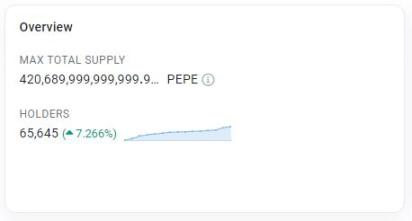
资料来源:Etherscan

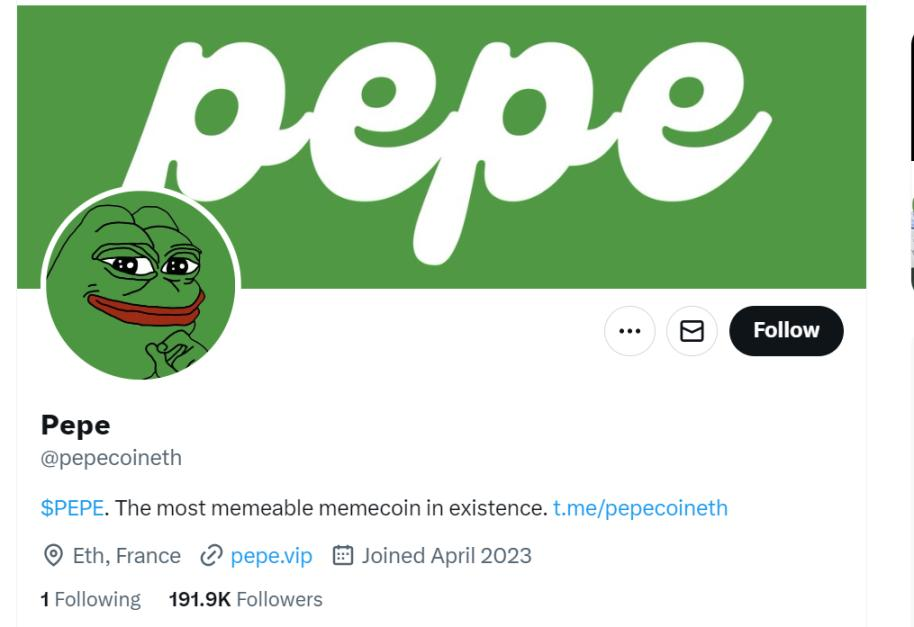
其官方 Telegram 群组拥有超过 25,000 名成员和每天数十万条的消息。它的官方推特虽然是在 4 月份创建的,但截止目前(5 月 3 日)已经拥有超过 19 万名粉丝。
风险与挑战

与大多数倾向于传播病毒的 Memecoin 一样,PEPE 也有一些风险和挑战。

1.市场波动

PEPE 自创建以来一直是最不稳定的加密资产之一,价格波动巨大。例如,5 月 1 日,它的价格翻了一番多,当天涨幅超过 100%。虽然这听起来特别有吸引力,但同样重要的是要注意它会带来一系列风险。

在加密领域有一句流行的说法是这样的:「价格上涨如爬楼梯,下跌如坐电梯。」

这表明,虽然 PEPE 看起来「只会上涨」,但也可能会很快失去所有全部价值。请注意,创作者自己已经说过它没有内在价值,所以它的价值基本上取决于人们愿意为此付出多少。这在圈内并非罕见,而且价值的概念本身就是一种社会建构,但风险尤其会随着新铸造的 Memecoin 而放大。

此外,许多 CEX 还存在缺乏必要的流动性来兑现收益相关的问题。这意味着即使有人能够完成一生中最重要的交易,他们也可能没有足够的流动性来弥补他们的头寸。

举个例子,某人将 27 美元的 PEPE 投资变成了惊人的 100 万美元,但由于各种与流动性相关的问题而无法完全兑现。

当然,如果 PEPE 经受住时间的考验,并在流动性往往更深的更集中的交易平台上市,这种担忧可能会消退。

2.安全风险

Memecoin 越受欢迎,相关骗局就越多。例如,这是来自官方 PEPE Telegram 群的消息:

一些社区成员就我们的部署程序钱包和 CEX 钱包中发生的 dusting/token scams(网络攻击)与我们联系:任何人都可以攻击交易并将这些 Token 发送到我们的钱包。如果真这样做的话,每一枚 Coin 都是骗局。许多黑客正在攻击我们的钱包,使其看起来像我们进行的 airdrop 或 Token 交易,以诱骗人们进行互动。谨记!不要购买任何这些 Token 或与不明合约互动,以免造成财产损失。

一般来说,无论何时与 DeFi 生态系统进行交互,遵循一些基本的加密资产安全都是绝对必要的,这样可以尽可能地避免被骗。

小结

在推出后的短短两周内获得了超过 4 亿美元的总市值,PEPE Memecoin 无疑成功地在加密资产市场引起了轰动。

许多人将 PEPE 与其他 Memecoin(例如 SHIB、DOGE、FLOKI 等)进行比较,但只有时间才能证明这种源于 Meme 的 Token 是否会继续存在。

İlgili Okumalar

After R&D Investment Catches Up with the U.S., Is the Sino-U.S. Chip Competition Still Just About Money?

The article examines the significance of recent data showing China's total R&D expenditure, measured by purchasing power parity (PPP), catching up to or slightly surpassing that of the United States in 2024. It argues that while this milestone reflects China's immense capacity to mobilize research resources, the competition in semiconductors now extends far beyond sheer financial input. The analysis highlights key differences: China's R&D is heavily skewed towards experimental development (over 80%), focusing on product engineering and industrialization, whereas the U.S. allocates a proportionally larger share (about 15%) to basic research. Furthermore, leading U.S. semiconductor firms reinvest a significant portion of their substantial global sales revenue into R&D, creating a sustainable commercial innovation cycle that is difficult to replicate. The article emphasizes that semiconductor progress depends on converting R&D into commercially viable products that pass rigorous customer validation and achieve repeat orders, not just on spending levels. It concludes that as China enters the top tier of R&D spenders, the critical challenges shift to improving resource allocation efficiency, fostering long-term basic research, and building effective mechanisms to bridge the gap between laboratory discoveries and reliable, market-ready industrial capabilities.

marsbit12 dk önce

After R&D Investment Catches Up with the U.S., Is the Sino-U.S. Chip Competition Still Just About Money?

marsbit12 dk önce

Top 10% of American Households Capture 88% of Wealth, How Is the AI Era Cake Divided?

AI Worsens Wealth Inequality as Top 10% of US Families Garner 88% of Stock Gains (2019-2026) A report from the China Finance 40 Forum highlights that the AI boom is significantly widening wealth inequality in the United States. From 2019 to Q1 2026, wealth from directly held stocks by US households nearly doubled from $29 trillion to approximately $55 trillion, with rapid growth concentrated post-2023, coinciding with the AI-driven stock market surge. The distribution of these gains has been starkly uneven. Between 2022 and Q1 2026, the wealth increase of about $21 trillion was captured almost entirely by the wealthiest families: the top 10% secured roughly 88% ($18.5 trillion), while the bottom 50% received only about 1% ($0.2 trillion). This has contributed to a growing disparity in disposable income shares. The report, referencing economic historian Robert Allen, draws parallels to historical technological shifts like the "Engels' Pause" during the First Industrial Revolution, where worker wages stagnated despite productivity gains. It suggests AI could induce a similar period where capital收益 outpace labor income, exacerbating inequality. Huang Yiping of Peking University identifies four mechanisms through which AI impacts income distribution: capital-bias (reducing labor's income share), task polarization (hollowing out middle-skill jobs), skill-based digital divides, and wealth amplification through assets. He warns that if this trend continues, strong supply growth driven by AI could be undermined by persistently weak consumer demand, threatening sustainable economic growth. To address these challenges, the report proposes a three-pronged strategy: 1) Defensive measures like strengthening social safety nets and antitrust enforcement; 2) Empowering workers through education reform and lifelong learning to collaborate with AI; and 3) Rebalancing via policies such as potential taxes on AI超额收益 and mechanisms for broader sharing of technology's benefits, ensuring AI's红利 are more equitably distributed.

marsbit18 dk önce

Top 10% of American Households Capture 88% of Wealth, How Is the AI Era Cake Divided?

marsbit18 dk önce

İşlemler

Spot
活动图片