IMF : Interest Rates to Fall to Pre-Pandemic Levels Once Inflation Is Tamed

newsbtc2023-04-13 tarihinde yayınlandı2023-04-13 tarihinde güncellendi

Özet

When inflation in advanced economies is tamed, real interest rates are likely to drop to pre-pandemic levels, the latest International Monetary Fund (IMF) blog post has said. According to the authors of the blog post, the transition to a “cleaner economy in a budget-neutral way” could result in lower rates in the medium term.

Recent Interest Rate Hikes Temporary

Interest rates in advanced economies are likely to fall to pre-pandemic levels when authorities succeed in bringing inflation back under control, the latest International Monetary Fund (IMF) blog post has suggested. The blog post added that the “recent increases in real interest rates are likely to be temporary.”
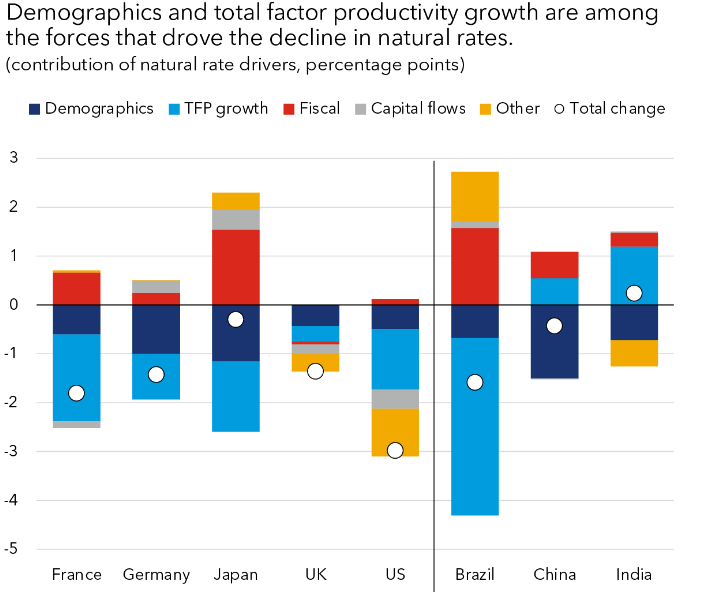
The return of real interest rates to levels seen before the spread of Covid-19 will also coincide with the easing of the respective countries’ monetary policy regimes. As has been reported by Bitcoin.com News, central banks from advanced economies have raised benchmark rates as they seek to tame inflation. The rising interest rates have sparked fears that the global economy may be headed for a recession.

However, in their April 10 blog post, the authors claimed a transition to a green economy may potentially lead to lower real interest rates globally:

Transitioning to a cleaner economy in a budget-neutral way would tend to push global natural rates lower in the medium term, as higher energy prices (reflecting a combination of taxes and regulations) would bring down the marginal productivity of capital. However, deficit-financing of public investment in green infrastructure and subsidies could potentially offset and even reverse this result.

The authors also suggested that so-called deglobalization forces could intensify and this may result in both “trade and financial fragmentation.” According to the authors, this outcome is likely to result in driving up the natural rate in advanced economies and down in emerging markets economies.




İlgili Okumalar

DistributeX Unveils DX Coin Ecosystem Roadmap, Advancing Preparations for Its On-Chain Launch

DistributeX has unveiled the DX Coin Ecosystem Roadmap, detailing its preparations for the upcoming on-chain launch of DX Coin. The roadmap outlines key phases focusing on community governance, technical readiness, blockchain deployment, and ecosystem growth. Current efforts are centered on building community consensus and completing technical groundwork. This includes launching community votes to select the official DX Coin logo and decide on the preferred blockchain network for integration. The platform will also implement features like on-chain wallet binding and contribution tracking to prepare for future data synchronization and rewards. Before the official launch, DistributeX will publish a Tokenomics White Paper detailing the token's issuance, governance, and long-term strategy, and will take a snapshot of eligible community accounts for future asset allocation. The subsequent deployment phase will involve smart contract deployment, security audits, community airdrops, and developing liquidity on decentralized exchanges. Looking further ahead, planned utilities for DX Coin encompass cross-chain interoperability, decentralized governance, digital rights, staking, and other Web3 applications. This roadmap aims to provide the community with clear visibility into the platform's plans, as DistributeX works to establish a solid foundation for DX Coin's on-chain ecosystem and long-term expansion.

TheNewsCrypto37 dk önce

DistributeX Unveils DX Coin Ecosystem Roadmap, Advancing Preparations for Its On-Chain Launch

TheNewsCrypto37 dk önce

AI at a Crossroads: Why Wall Street is Saying "No" to ChatGPT and Claude?

The article "AI at a Crossroads: Why Wall Street Says 'No' to ChatGPT and Claude" explores the growing tension between the adoption of powerful, closed-source AI models and the imperative for data privacy and intellectual property (IP) protection in enterprises, particularly in high-stakes sectors like finance. It details how the fundamental architecture of services like OpenAI and Anthropic involves sending user data in plaintext to the vendors' servers, creating risks of IP leakage ("alpha transfer"). While enterprise contracts with "zero-data-retention" clauses offer some assurance, they rely on trust. A significant problem is "shadow AI," where employees use personal accounts, bypassing corporate policies and leading to data breaches. For consumers, the article highlights that AI conversations lack legal protections like attorney-client privilege and can be subpoenaed in legal cases, a fact many users are unaware of. The core of the piece analyzes the technical spectrum of privacy solutions, contrasting **protocol-level privacy** (contracts, anonymous proxies) with more robust **structural-level privacy**. The latter includes: * **TEEs (Trusted Execution Environments) / Confidential Computing:** Running models in hardware-sealed enclaves with remote attestation. * **End-to-End Encryption (E2EE):** Encrypting prompts so only the target enclave can read them. * **Fully Homomorphic Encryption (FHE):** Performing computations on encrypted data without decryption (currently very slow). * **Local Inference:** Running models entirely on-premise, the most private but costly and limited to less powerful models. The article argues that verifiable privacy (via attestation) is only possible with **open-source models**, as closed-source vendors cannot reveal their serving code without losing competitive advantage. While the performance and cost gap between open and closed models is narrowing, a key dilemma remains: sacrifice some model capability for privacy or risk data exposure for a competitive edge. A case study from Bridgewater and Thinking Machines demonstrates that a finely-tuned open-source model (Qwen) can outperform leading closed models in specific, expert financial tasks, both in accuracy and lower cost. However, the training process itself often isn't private. The discussion extends to the **"harness layer"**—the tools and data sources surrounding an AI agent. Here, privacy becomes even more complex, as each external API call can expose data. Current solutions are mostly at the protocol level (gateways, PII masking), with true encrypted search for open-ended queries still in the research phase. In conclusion, the demand for private AI is growing, with services like Venice AI and Proton gaining users. While privacy-enabling infrastructure (like enclaves) is becoming more affordable and performant, the article posits that the most defensible value lies in solving the remaining hard problems: private training cycles, fully private tool calls, and practical encrypted search. For enterprises, the path forward is to use their proprietary "alpha" (expert knowledge) to fine-tune open-source models within a verifiably private environment, securing their most valuable strategic insights.

链捕手44 dk önce

AI at a Crossroads: Why Wall Street is Saying "No" to ChatGPT and Claude?

链捕手44 dk önce

Let Funds Flow at Internet Speed

Tokenization bridges the distinct worlds of always-on, permissionless DeFi and traditional funds with scheduled, permissioned settlements, unlocking significant value for those who can manage this integration. The tokenized Real World Asset (RWA) market exceeds $33 billion, with U.S. Treasuries comprising nearly half. It offers corporate treasurers options from low-risk, liquid Treasury funds to higher-yield, programmable investments, all benefiting from the same audit standards as traditional bonds. The core advantage is *composability*: tokenized funds can combine yield, liquidity, and transferability simultaneously, unlike traditional finance which forces a trade-off. However, achieving this requires sophisticated coordination. Tokenized funds remain legally bound to daily net asset value (NAV) updates, KYC-verified holder lists, and redemption cut-offs based on traditional settlement infrastructure (e.g., 5 PM ET). Key challenges in this hybrid model are: 1) **Price**: Determining token value between NAV updates to prevent manipulation; 2) **Compliance**: Embedding KYC/whitelisting (e.g., within a vault) to allow free circulation of receipt tokens in DeFi; and 3) **Cross-chain Consistency**: Maintaining a single source of truth for ownership and value across multiple blockchains. Projects like Centrifuge (with its deRWA framework and V3 architecture) and LayerZero address these by using a hub-and-spoke model. A central "hub" chain manages NAV, accounting, and compliance, while a messaging layer (LayerZero) synchronizes this data with "spoke" chains where tokens are used, enabling DeFi composability. This coordination layer, which handles in-transit asset accounting and prevents redemption gateway conflicts, becomes a critical and valuable piece of infrastructure—akin to SWIFT or Visa in traditional finance. For institutions, effective tokenization enables strategies like rehypothecation, where tokenized Treasury funds are used as collateral to borrow stablecoins for reinvestment, amplifying yield. However, failures in price synchronization, redemption limits, or cross-chain messaging pose risks that must be meticulously managed to build institutional trust. Ultimately, the goal is to break the old rules that force a choice between yield, liquidity, and transferability. If tokenization can make capital work simultaneously in multiple ways without compromising security, it will attract the attention of institutions managing billions in idle cash. The entities that successfully orchestrate this coordination between traditional finance timelines and blockchain speed are positioning themselves for a central role in the future capital markets.

链捕手1 saat önce

Let Funds Flow at Internet Speed

链捕手1 saat önce

İşlemler

Spot
活动图片