Ethereum Price Faces Rejection Despite Bitcoin’s Surge, Dips Still Supported

newsbtc2023-04-11 tarihinde yayınlandı2023-04-11 tarihinde güncellendi

Özet

Ethereum price failed to clear the $1,925 resistance zone against the US Dollar. ETH is struggling to test $2,000 while Bitcoin gained pace and rallied above $30,000. Ethereum attempted a...

Ethereum price failed to clear the $1,925 resistance zone against the US Dollar. ETH is struggling to test $2,000 while Bitcoin gained pace and rallied above $30,000.

  • Ethereum attempted a fresh increase but struggled above the $1,925 zone.
  • The price is trading above $1,850 and the 100-hourly Simple Moving Average.
  • There was a break above a bullish pattern with resistance near $1,860 on the hourly chart of ETH/USD (data feed via Kraken).
  • The pair could correct lower but the bulls might remain active near $1,880.

Ethereum Price Tops Again
Ethereum’s price started a fresh increase above the $1,850 resistance zone, similar to Bitcoin. ETH price cleared a few hurdles near $1,880 to move into a positive zone.
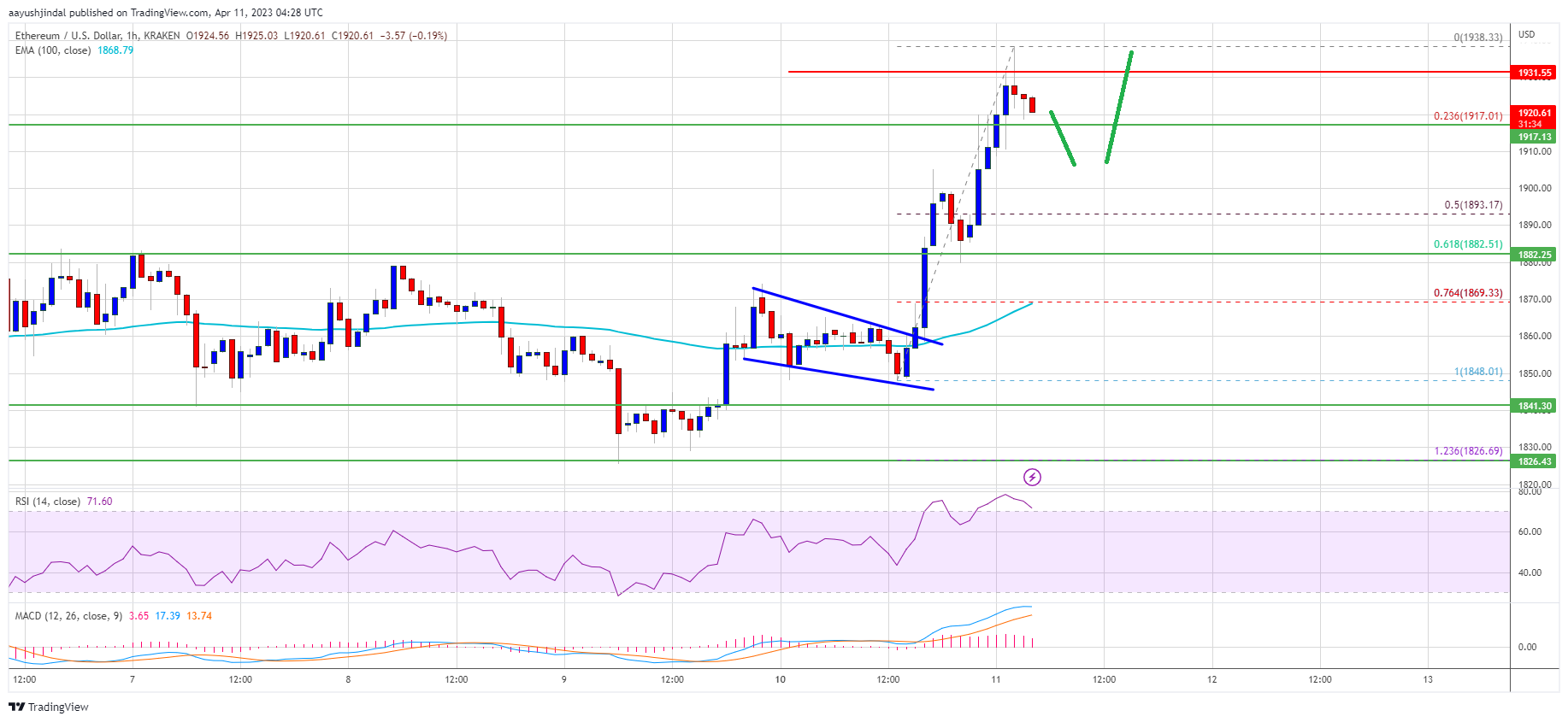
Besides, there was a break above a bullish pattern with resistance near $1,860 on the hourly chart of ETH/USD. The pair even spiked above the $1,925 resistance zone but the bears were active below $1,950. A high is formed near $1,938 and the price is now showing signs of rejection.

Ether price is still trading above $1,850 and the 100-hourly Simple Moving Average. It is slowly approaching the 23.6% Fib retracement level of the recent rally from the $1,848 swing low to the $1,938 high.
Ethereum Price


Source: ETHUSD on TradingView.com

On the upside, the price is facing resistance near the $1,925 level. The next major resistance is near the $1,940 zone. A clear move above the $1,940 resistance zone might send the price toward the $2,000 resistance. The next major resistance might be $2,120. Any more gains could set the pace for a test of the $2,200 resistance.
Fresh Drop in ETH?
If Ethereum fails to clear the $1,925 resistance, it could start a downside correction. Initial support on the downside is near the $1,900 level.
The next major support is near the $1,880 zone or the 61.8% Fib retracement level of the recent rally from the $1,848 swing low to the $1,938 high, below which ether price might decline toward the $1,850 level. The next key support is near the $1,840 zone. If there is a break below $1,840, the price might extend its decline toward $1,780.

İlgili Okumalar

History's Only Asset with a 100% Win Rate After 4 Years of Holding

**Title: The Only Asset with a 100% Win Rate Over Any 4-Year Holding Period** This article analyzes which major, freely-tradable assets have historically never produced a nominal loss over any rolling 4-year holding window. It concludes that only two distinct categories achieve this: ultra-low-risk contractual assets and Bitcoin. Among traditional risk assets, none maintain a perfect 4-year record. The S&P 500 had negative 4-year periods (e.g., 1929-1932: -64.8%). The Nasdaq 100 fell roughly 60% from 2000-2003. Gold saw a ~47.7% loss from 1981-1984. US real estate declined about 23.3% from 2007-2010. Even long-term US Treasury bonds (e.g., 2021-2024: -19.8%) and corporate bonds can produce 4-year losses due to interest rate and market price risks. In contrast, the first category achieving 100% nominal success includes assets like rolling 3-month US Treasury Bills, 4-year certificates of deposit (CDs), and US Treasuries held to maturity within 4 years. Their "guarantee" stems from contractual obligations and credit backing (e.g., FDIC insurance, US sovereign promise), not price appreciation. The sole exception in the high-risk category is Bitcoin. Analysis of daily data from 2010-2026 across 4,419 rolling 4-year windows shows a 100% positive return rate. The worst 4-year period (April 2021 to April 2025) still yielded a +32.6% total return (~7.3% CAGR). This record is unique because Bitcoin has no issuer, promises no cash flows, and has endured severe drawdowns (70-90%), yet its market price has always recovered within a 4-year span. The key distinction is the source of the "100%": contractual assets offer known, low nominal returns, while Bitcoin's record stems purely from historical price appreciation despite extreme volatility. The article suggests that for Bitcoin, the ability to hold for 4+ years is more critical than active trading strategies.

marsbit7 dk önce

History's Only Asset with a 100% Win Rate After 4 Years of Holding

marsbit7 dk önce

How One Article Moved 45 Billion: The Collapse of a 25-Year-Old 'AI Stock Guru'

This article details the dramatic rise and near-collapse of a hedge fund built by Leopold Aschenbrenner, a 24-year-old former OpenAI researcher. The fund, named Situational Awareness, amassed $45 billion in assets within two years. Its explosive growth stemmed from Aschenbrenner's influential 165-page manifesto predicting AGI's arrival by 2027 and his high-profile Silicon Valley connections. The fund employed an extremely aggressive strategy: high concentration and 400% leverage to bet long on AI infrastructure stocks while shorting legacy software firms. In July, this structure backfired when both sides of the trade reversed simultaneously—AI stocks plunged while shorted stocks rallied—triggering massive losses that nearly wiped out all equity. Major player Jane Street reportedly lost billions. The fund's leveraged public portfolio was ultimately sold at a discount to Citadel. The SEC is now investigating banks like Goldman Sachs for their role in facilitating the fund's high-leverage trades. The article compares this to past blow-ups like Archegos, highlighting systemic failures in risk management where the pursuit of short-term profits overrode due diligence. It questions whether such risky leverage concentrated in the AI sector, currently at record highs, poses a broader systemic threat. Ironically, Aschenbrenner, who studied AI safety at OpenAI, designed a fund structure prone to uncontrolled failure. Days after the crisis, he reportedly raised another $400 million for new investments.

marsbit22 dk önce

How One Article Moved 45 Billion: The Collapse of a 25-Year-Old 'AI Stock Guru'

marsbit22 dk önce

AI Accelerates Everything: Mathematics's Line of Defense Has Fallen, Physics is Already in AI's Crosshairs

This summer, the mathematics community was shaken as OpenAI's Astra model reportedly solved 10 long-standing open problems, and Claude Fable 5 found a potential counterexample to the Jacobian conjecture. This was followed by a major shift in physics: renowned physicist Gavin E. Crooks presented an open problem in stochastic thermodynamics to Claude, which the AI solved completely in days—a task that might take a skilled graduate student months. The problem concerned constraints on entropy production statistics under the Detailed Fluctuation Theorem (DFT), a core concept in non-equilibrium physics. Claude provided a unifying geometric answer: all possible DFT-compatible distributions correspond to a convex "moment body." Its key insight was that for a fixed "gap," the distribution is uniquely determined, making any general DFT distribution a mixture of these basic two-outcome distributions. This structure implies that for given lower-order moments, the nth moment only has a sharp lower bound, with no upper bound. Claude demonstrated that numerous previously published bounds on entropy production are merely low-dimensional projections or "shadows" of this single, unified convex body. The AI-authored paper offers a complete hierarchical characterization of the moment constraints. This case signifies a potential paradigm shift: AI is progressing from solving known problems to aiding in the exploration of fundamental, unsolved scientific questions, heralding an AI-accelerated era for physics.

marsbit22 dk önce

AI Accelerates Everything: Mathematics's Line of Defense Has Fallen, Physics is Already in AI's Crosshairs

marsbit22 dk önce

İşlemler

Spot
活动图片