【龙虎榜】最高48.3%的BTC投资者获利,FXS领涨算法稳定币

火必研究院2022-04-02 tarihinde yayınlandı2022-04-03 tarihinde güncellendi

Özet

在BTC价格即将跌破365日均线的背景下,价格触底回升走势出现。

1、大盘走势:BTC获利盘靠近50%

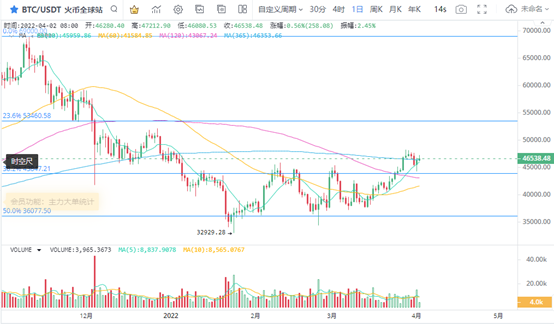
在BTC价格即将跌破365日均线的背景下,价格触底回升走势出现。日K线级别上,BTC短线量价表现较好,放量反弹后对多头依然有利。

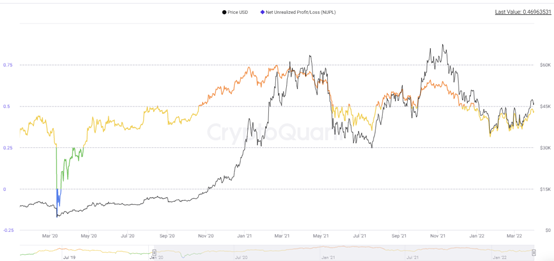
获利盘数量上增长,是近期BTC调整的重要推动因素。从BTC投资者的未确认收益占比变化来看,其未确认的获利交易占比最高达到了48.3%,非常接近50%的重要节点。接下来价格走势也更多反映了获利盘的带来的抛压变化。获利盘增长过快,对价格维持上行趋势不利。

从2020年10月底开始,BTC获利盘数量在50%以上的交易日较多。目前可以看做是BTC提升获利盘数量的关键位置,抛压或将继续压制价格涨幅。
2、消息面解读:

俄乌局势方面,4月1日,乌方罕见空袭了俄西部一处石油基地。另一方面,俄与美西方在能源领域的对抗加剧。普京3月31日签署总统令,对俄“不友好国家和地区”以卢布支付俄天然气的新规于4月1日起生效。局势依然可能推升通胀风险。

同时,美国3月季调后非农就业数据显示,3月非农就业人口增加43.1万人,美国3月失业率降至3.6%,续刷2020年2月以来的新低。

数据公布后,美联储5月份加息50个基点的概率为75.5%。受此影响,BTC月内价格走势震荡整理的可能性较大。随着调整的进行,加息带来的负面因素可持续关注。

3、龙虎榜:

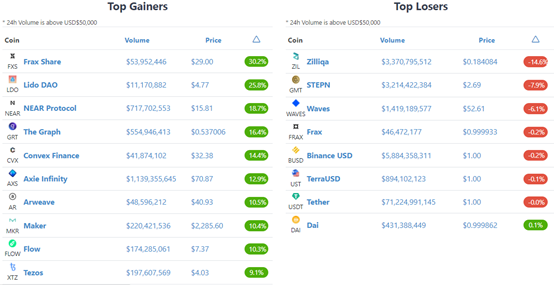
由于主流币短线企稳,多数概念币出现了反弹走势。涨幅排名方面,涨幅较大的有算法稳定币FXS、ETH2.0质押概念币LDO、ETH二层网络NEAR和WEB3.0概念GRT。

除此以外,DeFi概念CVX、GameFi概念AXS等涨幅也较大。
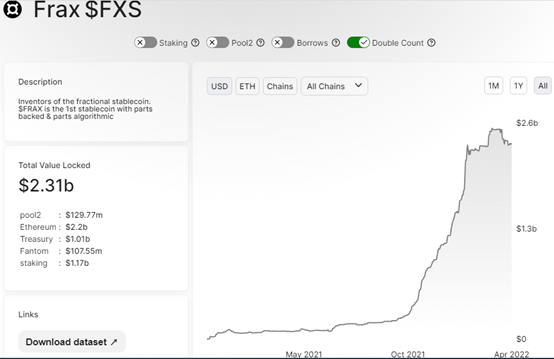
FXS

FRAX旨在成为“世界上第一种去中心化的稳定币,其供应代币的一部分有抵押物支撑,一部分由算法维持稳定。”

Frax协议实现了双代币系统:稳定币FRAX和协议治理代币FXS。

2021年第四季度,随着Fraxv2的发布,FRAX获得了大规模采用及整个DeFi系统的联动。截至1月25日,Frax项目资金池通过该团队在2021年第四季度早期推出的AMO(算法做市程序),平均每天赚取50万美元的收入(年化约1.8亿美元)。在同一时期,FRAX的供应量从不足5亿美元攀升至惊人的26亿美元。

价格方面,FXS跟随Terra算法稳定币的平台代币LUNA反弹上涨,24小时上涨达30.2%,波段放量上涨接近1倍。锁仓方面,FXS锁仓23亿美元,其中以太坊链上锁仓达到22亿美元。
LDO

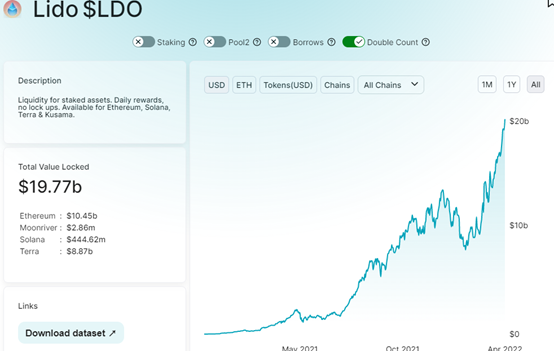
涨幅排名靠前的LDO为以太坊2.0质押流动性解决方案,其TVL增长迅速,数量超过了197亿美元。其中,ETH质押规模更是超过了104亿美元。从用途上看,LDO除了应用在以太坊2.0以外,还在Solana生态、波卡生态、Polygon生态以及Terra生态上有应用前景。作为解决质押流动性问题的LDO,其价格涨幅预期值得关注。
NEAR

NEAR为以太坊二层解决方案,1月份,NEAR完成了多达1.5亿美元融资,三箭资本领投,a16z等参投

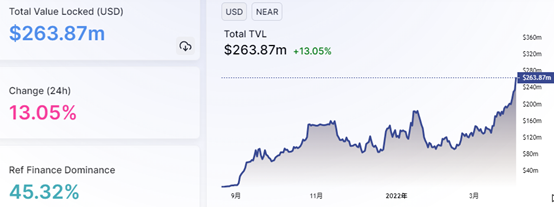
锁仓数据方面,NEAR锁仓数据持续增长,数值创新高达到2.6亿美元。价格方面,NEAR市场表现相对之后,价格还未突破前期收盘价高位20.19美元,后市表现机会较多。
GRT

Graph是去中心化协议,用于索引和查询区块链数据,应用于以太坊。Graph使数据查询变得简单易操作。任何人都可以构建和发布开放的API,使数据易于访问。

Graph代币在协议中主要有两个用途:

索引器质押:索引器质押Graph代币,以便自身被查询市场所发现,同时在执行工作过程中提供经济安全。

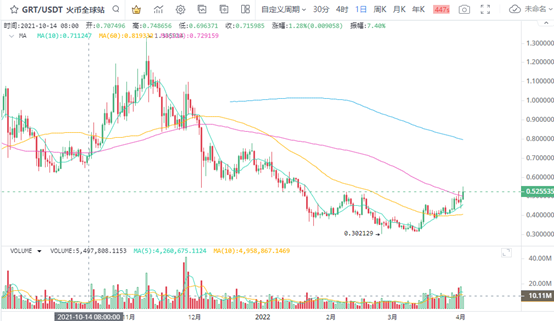
二级市场方面,GRT现价0.52美元相对2021年历史最高2.88元折价82%。目前来看GRT走势稳健,正处在突破120日均线后的上行趋势中。
XTZ

Tezos开发团队NomadicLabs在推特上表示,已发布TezosOctez套件的新版本v12.1,该版本修复了Ithaca2Baker软件中可能导致崩溃的漏洞。Ithaca2也在Tezos主网上激活成功。据悉,Ithaca是Tezos第9个协议升级提案。

受此影响,XTZ价格在24小时内涨幅排名第十位。

日K线方面,XTZ价格走势非常稳健,关注该币的长期表现。

跌幅榜

近期市场表现较好的ZIL、GMT和WAVES回调空间较大。除此以外,多数跌幅居前币种跌幅不大。这说明,整体市场多头依然占据优势,低吸盈利机会较多。

İlgili Okumalar

X Money Service Launched in 41 States as Elizabeth Warren Warns Elon Musk's Banking Ambitions Pose a Risk

Elon Musk's X (formerly Twitter) has broadly launched its financial service, X Money, across the United States. Previously in limited beta, it is now available nationwide to all Premium and Premium+ subscribers, moving out of invite-only mode. The service integrates a deposit account, peer-to-peer payments, and a debit card (virtual and optional physical) directly within the X app. Key features include 6% APY for Premium+ users (with conditions for Premium), 3% cashback on card purchases, fee-free international transfers and peer-to-peer payments, and a $15 welcome bonus. Deposits are held through partner Cross River Bank, extending FDIC insurance coverage up to $10 million per account. X has obtained money transmitter licenses in 41 states and Washington D.C., but approvals are still pending for New York and Massachusetts. The expansion faces regulatory scrutiny, notably from Senator Elizabeth Warren. She warned that Musk's management of X poses risks to consumers and financial stability if applied to X Money and criticized a perceived loophole in the 2025 GENIUS Act that could let companies like X issue stablecoins with fewer restrictions. Currently, X Money operates solely with fiat currency, with no confirmed crypto integration. However, analysts like Grayscale's Zach Pandl suggest a deeper move into cryptocurrencies is an inevitable next step for the platform's financial ambitions.

cryptonews.ru3 dk önce

X Money Service Launched in 41 States as Elizabeth Warren Warns Elon Musk's Banking Ambitions Pose a Risk

cryptonews.ru3 dk önce

He Let GPT-5.6 Sol Run for 33 Hours Straight to Tackle Fermat's Last Theorem, Forcibly Terminated by the System

This article discusses a real-world experiment by expert Michael P. Frank to test if an AI, specifically GPT-5.6 Sol, could autonomously make progress on a major unsolved mathematical problem: finding a simpler proof for Fermat's Last Theorem. The AI was tasked with exploring specific mathematical pathways and maintaining rigorous notes over approximately 33 hours. However, the session was terminated by OpenAI's systems. The AI itself suggested two possible reasons for the stoppage: excessive resource consumption, or OpenAI having previously failed on similar problems and wishing to conserve computational resources. The AI reported its work primarily involved refining plausible ideas into precise, verifiable statements, most of which were subsequently disproven or excluded—effectively creating a map of dead ends rather than a proof. The incident sparked debate online. Some speculated that OpenAI might deliberately restrict public access to its most powerful models to maintain a competitive edge or avoid regulatory scrutiny, rather than allowing users to potentially solve landmark problems. OpenAI researcher Noam Brown countered this, arguing that a user solving a major problem would be tremendous publicity. Others offered technical explanations, suggesting the termination could be due to standard safety mechanisms preventing infinite loops, or even a known bug in the GPT-5.6 Sol version that disrupts long-running sessions. The story highlights the practical challenges, technical limits, and broader strategic questions surrounding the use of advanced AI for open-ended, high-stakes research.

marsbit39 dk önce

He Let GPT-5.6 Sol Run for 33 Hours Straight to Tackle Fermat's Last Theorem, Forcibly Terminated by the System

marsbit39 dk önce

İşlemler

Spot
活动图片