Arbitrum ARB Airdrop Confirmed: Here’s How to Check Eligibility!

Huobi2023-03-20 tarihinde yayınlandı2023-03-20 tarihinde güncellendi

Özet

Arbitrum, the Layer 2 scaling solution for Ethereum, has announced plans to airdrop a new governance token called $ARB to users of its platform.

Arbitrum, the Layer 2 scaling solution for Ethereum, has announced plans to airdrop a new governance token called $ARB to users of its platform. This move comes as part of the platform’s transition to a decentralized autonomous organization (DAO) model. In this article we will cover what is Arbitrum, basic utility of the $ARB token, how to check eligibility to claim the $ARB token, and lastly how to deposit the $ARB token on Huobi.
What is Arbitrum?

“”

Arbitrum is a popular Layer 2 scaling solution for the Ethereum network that uses optimistic rollups to bundle many transactions into a single batch before submitting them to the main Ethereum network. This significantly reduces gas fees and increases transaction speeds. It has quickly gained popularity as a fast and affordable alternative to the main Ethereum network.

“”

Arbitrum product, as well as an entire suite of scaling solutions, is built by a New York-based development firm Offchain Lab. The initiative is spearheaded by Offchain Labs co-founders Ed Felten, Steven Goldfeder and Harry Kalodner. Ed is a professor, Steven received his Ph.D, and Harry is a Ph.D. candidate at Princeton University. All three are blockchain experts with a passion for making cryptocurrencies more capable.

What is the utility of the ARB token?

“”

The ARB token will give power back to the holders by providing voting rights within the Arbitrum DAO. This will allow users to participate in decision-making processes regarding the platform’s development and management. ARB will be distributed to users based on their usage of the platform, with those who have used Arbitrum the most receiving the largest share of tokens.
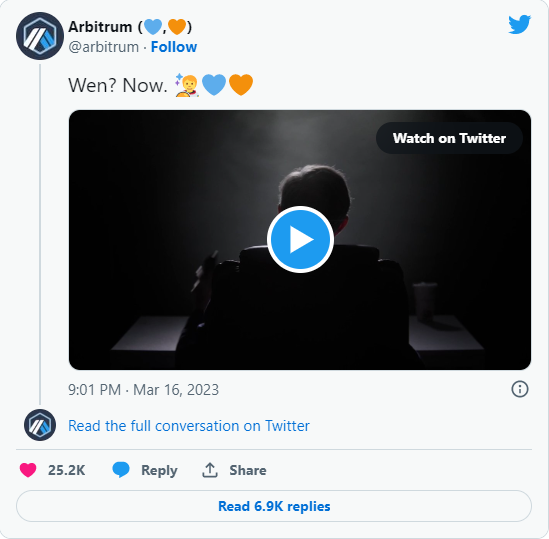
How do you check eligibility for $ARB Token?

“”

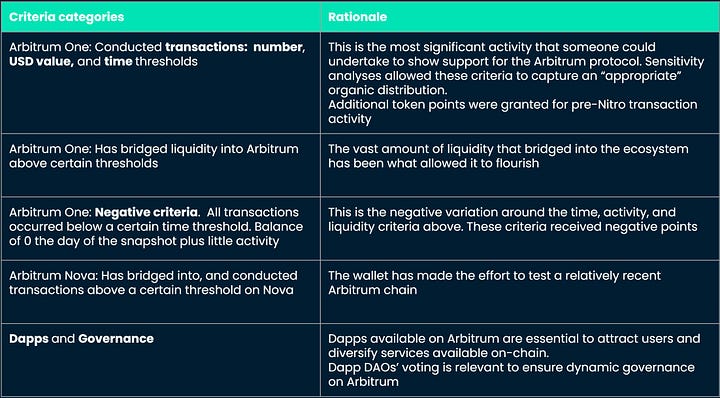
Arbitrum collaborated with Nansen, a crypto analytics firm, to determine ARB token eligibility based on user activity. Eligible users can claim tokens by visiting the Arbitrum Website. To claim the $ARB token airdrop, users need to have used Arbitrum and interacted with blockchain with several specific criteria. The list of eligible wallets represents 625,143 addresses or ~28% of those having bridged to Arbitrum One since inception and as of the late snapshot date of February 6, 2023. The tokens will be airdropped directly to users’ Ethereum wallets, with the amount of ARB received based on their usage of the platform.
How to deposit $ARB to Huobi?

“”

Huobi just announced the $ARB listing , so you can deposit later today by following these simple steps:

“”

Step 1: Download the Huobi APP

“”

Step 2: Follow step by step tutorial to deposit

“”

Thanks for reading, and please let us know in the comments what you think about the $ARB airdrop and token. Lastly, make sure to follow Huobi on our social channels to stay update on all things crypto.

İlgili Okumalar

One Vote Could Make SOL's Daily Burn Rate Soar 14 Times

Solana's first formal on-chain governance vote concluded on August 27th, coinciding with SOL hitting a yearly high. Three key proposals aimed at reshaping the network's tokenomics were decided. Solana's core challenge is a massive usage-to-value capture gap. Despite processing 120x more transactions than Ethereum and leading in DEX volume, its fee revenue is significantly lower due to its fee structure. Currently, most fees (priority fees) go to validators, with only a small base fee partially burned. This results in high net inflation (approx. 6k SOL issued vs. ~650 burned daily). The three proposals seek to address this: **SGP-0001** establishes the formal governance framework. **SGP-0002** (Double Deflation Acceleration) proposes doubling the annual reduction rate of new SOL issuance from 15% to 30%, aiming to reach the terminal inflation rate by 2029 instead of 2032, reducing issuance by an estimated 18.9 million SOL. **SGP-0003** (Resource & Entry Fee Restructuring) would split the base fee into a fixed "entry fee" for block producers and a variable, fully burned "resource fee." This could increase daily SOL burns by ~14x to 7,500-9,000. Major stakeholders like Helius, Jupiter, and Jito support the changes. However, opposition exists, notably from Solana Company (HSDT), whose revenue is 99.4% from staking. They argue rapid changes could disrupt institutional adoption. Critics also highlight a potential conflict where validators can vote against reduced staking yields using delegated SOL without explicit voter consent. The outcome of these votes provides a directional mandate. If passed, they represent a significant step towards aligning Solana's immense network activity with tangible economic value for SOL holders.

marsbit18 dk önce

One Vote Could Make SOL's Daily Burn Rate Soar 14 Times

marsbit18 dk önce

Chinese Venture Capital Is Shifting from 'Selecting People' to 'Selecting Cities'

Chinese Venture Capital: Shifting from "Picking Founders" to "Picking Cities" The article discusses a significant shift in China's venture capital (VC) landscape. Historically, VC investments heavily focused on the individual founder's vision, track record, and capability, as seen in early internet-era successes like Wang Xing (Meituan), Li Bin (Nio), and Li Xiang (Li Auto). The belief was that betting on exceptional people was the key to success. However, the rise of hard tech startups—in fields like semiconductors, robotics, AI, and biotech—has changed this calculus. These industries depend heavily on deep, localized ecosystems: specialized talent pools, established supply chains, manufacturing bases, and application scenarios. A city's industrial "resume" now significantly impacts a startup's chances. Examples include Shenzhen's dominance in robotics, Beijing's concentration of AI firms, Suzhou's biotech cluster, and Hefei's successful bet on semiconductor giant ChangXin. This shift is further driven by changes in funding sources. Government-guided funds and state-owned capital now dominate VC limited partners (LPs). These "patient capital" investors prioritize local economic development, job creation, and industrial chain growth alongside financial returns. Their early bets signal viability to other investors. Ultimately, the VC logic remains about managing risk and increasing the odds of success. In the hard tech era, a supportive city ecosystem provides crucial resources—talent, suppliers, R&D, and policy stability—that a single founder cannot easily assemble. The investment due diligence process has thus expanded from evaluating just the founder to also evaluating the founder's city. Consequently, capital is concentrating in a few regions with strong, focused industrial foundations, challenging other cities to build compelling, credible ecosystems to attract investment.

marsbit1 saat önce

Chinese Venture Capital Is Shifting from 'Selecting People' to 'Selecting Cities'

marsbit1 saat önce

İşlemler

Spot
活动图片