10000 Hours of Human Data, Trains the World's First Whole-Body Mobile Manipulation Implicit World-Action Model

marsbit2026-07-15 tarihinde yayınlandı2026-07-15 tarihinde güncellendi

Özet

"Being-M0.7" is the world's first latent world-action model for whole-body mobile manipulation in humanoid robots, developed by Zhi Zai Wu Jie (Beyond Being). Trained on over 10,000 hours of human-centric multimodal data, it aims to overcome key industry challenges: the high cost and scarcity of real robot demonstration data, the computational inefficiency of pixel-level video prediction models, and the lack of full-body coordination in existing approaches. The model is based on a Vision-Motion Mixture-of-Transformers (MoT) architecture, which allows training on a mixture of paired video-motion data, pure video data, and pure motion sequences. A key design is a unified motion representation that bridges human and robot morphology, enabling knowledge transfer from vast human behavioral data to specific robot control. After pre-training on human data, the model is adapted to a real robot (Unitree G1) using a small amount of teleoperated demonstration data via a lightweight "Action Expert" module. This process decouples low-frequency world planning from high-frequency motion control. The model was tested in four challenging real-world demos: fishing a toy fish from water (liquid interaction), retrieving an object using a mirror (visual reasoning), a multi-step pick-and-place task, and obstacle avoidance while carrying a box. In comparative tests against other models, Being-M0.7 showed stronger performance in tasks requiring indirect reasoning and full-body coordination. This...

Over the past two years, the competitive focus in the humanoid robot sector has been shifting from the hardware of the entire machine further to model capabilities.

Manufacturers have been releasing new products intensively, with videos of backflips, dancing, and marathon running frequently dominating social feeds. Behind the fanfare, however, the industry has gradually reached a consensus: what determines the upper limit of a humanoid robot's ability is no longer just its joints and motors. The capacity to understand the environment, predict changes, and coordinate the entire body to complete tasks is becoming the key to achieving generality.

World models, VLA, and humanoid robot foundation models have thus become some of the most important technical directions in this field over the past two years.

Amidst this excitement, three major challenges have remained.

First, the cost of collecting real-world demonstration data for humanoid robots is high. Collection requires synchronous recording of first-person video, proprioceptive data, and executable whole-body commands. Constrained by teleoperation difficulty, safety risks, hardware availability, and environmental diversity, it is difficult to accumulate large-scale, high-quality data in a short time.

Second, many existing world-action models follow the pixel-level video prediction approach, which is computationally expensive, with significant capacity consumed by image details weakly correlated with control. The robot's own rapid movement and viewpoint jitter further amplify visual prediction noise.

Third, many existing solutions still model upper-limb manipulation and lower-body locomotion separately, resulting in insufficient coordination between the upper and lower body and difficulty in supporting natural, fluid whole-body control.

Against this backdrop, Embodied Intelligence company Zhi Zai Wu Jie has released Being-M0.7. This is the world's first Latent World-Action Model (Latent WAM) for whole-body mobile manipulation of humanoid robots, and it is also the industry's first time extending the capabilities of latent world models from desktop dexterous manipulation to whole-body mobile manipulation.
  • Paper Link: https://research.beingbeyond.com/being-m07/being-m07.pdf
  • Project Page: https://research.beingbeyond.com/being-m07

It was pre-trained on over 10,000 hours of human-centric mixed-modal data, then adapted to a specific embodiment using a small amount of real-world demonstration data, and has successfully completed multiple challenging whole-body mobile manipulation tasks on a physical humanoid robot.

From Being-H to Being-M: A Continually Materializing Technical Path

Behind Being-M0.7 lies a technical path that Zhi Zai Wu Jie has steadfastly pursued for years.

This company is one of the earliest embodied intelligence firms globally to bet on the large-scale human video training path, concurrently developing two main model lines: general dexterous manipulation and general mobile dexterous manipulation. It is also the first team in China to launch a natively embodied implicit world-action model.

The core judgment of this path is that real-world robot demonstration data is expensive and scarce, making it difficult to scale continuously like internet text and video. In contrast, humans interact with the physical world from a first-person perspective daily. This vast amount of human behavioral data contains rich priors about scene evolution, object dynamics, and body coordination. Rather than waiting for robot data to slowly accumulate, it is better to first let models learn how the world works from human experience, and then transfer this knowledge to specific robot embodiments.

Being-H0.7, released in April this year, validated the feasibility of this judgment for dexterous manipulation. The model scaled training data to 200,000 hours of human video, achieved an overall first-place ranking globally in 6 international benchmarks, topping 4 of them, and became the first general embodied world model covering seven key dimensions: cross-embodiment, cross-scenario, continuous dynamics, fluids, deformable objects, physical laws, and contextual reasoning.
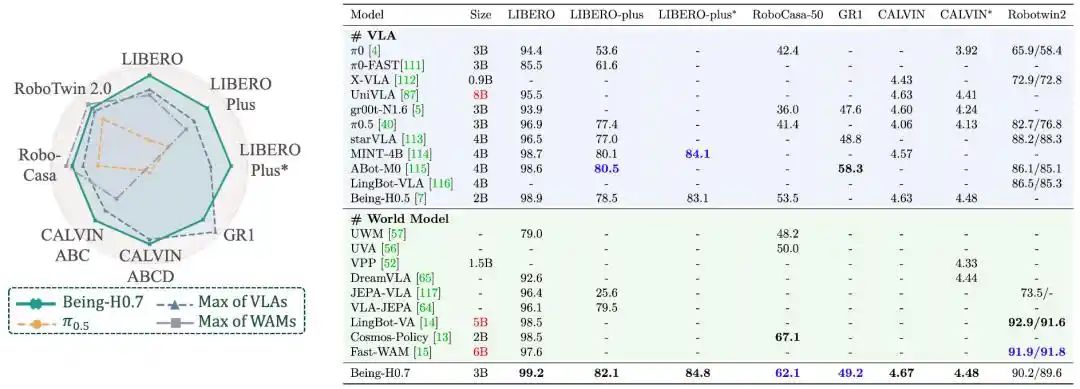
Being-M0.7 is the latest result of this implicit world-action model path.

If the Being-H series answers how hands manipulate the world, Being-M0.7 answers how the entire body coordinates locomotion and task execution in the world. Humanoid robot mobile manipulation (loco-manipulation) requires the model to simultaneously decide where to go, how to orient the body, how to coordinate arms and legs, and how to maintain posture stability. This is a problem highly coupled in both the temporal and body dimensions, and a critical hurdle that general-purpose humanoid robots must overcome.
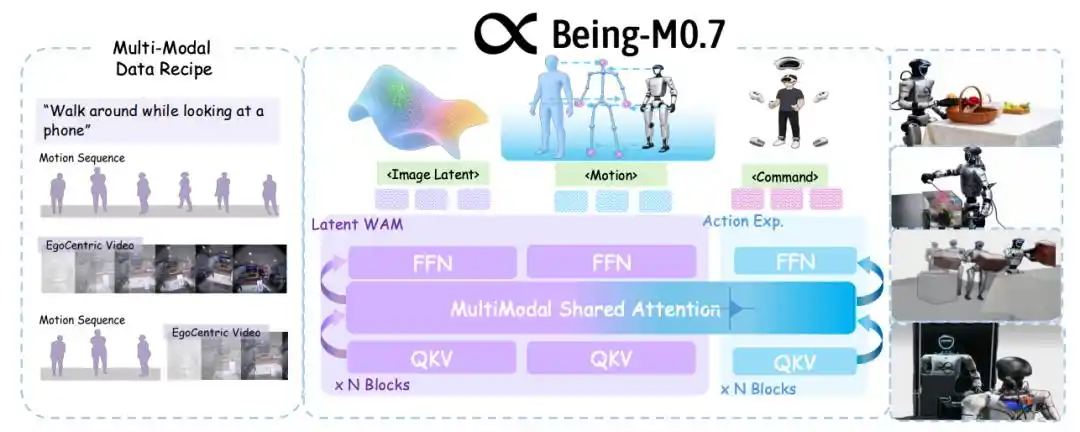
Being-M0.7 is an implicit world-action model. It is first pre-trained on first-person video and human motion data using a Mixture of Transformers (MoT) architecture; then, through action expert post-training, it is adapted for control on robot trajectory data from diverse whole-body manipulation tasks.

Unlike many world models relying on pixel-level video generation, Being-M0.7 predicts future environmental states in a latent space and couples them with a compact whole-body motion representation. Pixel-level prediction is computationally expensive, with much computational power wasted on appearance details weakly related to control. Severe self-motion and viewpoint jitter in the first-person perspective further fill predictions with noise. Latent space prediction focuses modeling capacity on semantic states, object layout, and scene evolution—structural elements truly relevant to control—retaining the essence of a world model anticipating the future while significantly reducing computational overhead.

How Does Physical Understanding Translate into Whole-Body Action?

Whether the model truly possesses whole-body mobile manipulation capabilities ultimately must be tested in real-world scenarios.

Zhi Zai Wu Jie released four real-world demos centered around Being-M0.7, covering four highly challenging scenarios: liquid interaction, mirror reasoning, long-horizon tasks, and obstacle avoidance with occlusion.

These tasks collectively examine one question: Can the robot, based on predictions of the environment and its future changes, continuously generate whole-body actions appropriate to the current scene?.

Fishing in a Fish Tank

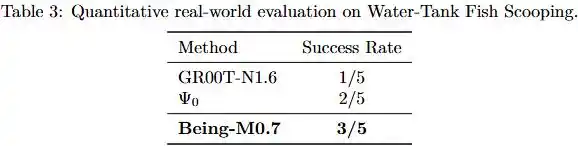
The robot walks to an aquarium and uses a handheld net to scoop a toy fish from the water. Liquids have no fixed shape, flow, exert buoyancy and drag on immersed objects, and water surface refraction causes the visual position of underwater targets to shift. The robot must understand the interaction between water, net, and fish, coordinating its arm to complete a tool-based capture of a dynamic target while visual information is distorted by the water. This task precisely tests future state prediction, tool use, and motion coordination under uncertain object dynamics.

For the fish-scooping segment of the task, Being-M0.7 succeeded in 3 out of 5 tests. In comparison,

was 2/5, while GR00T-N1.6 was 1/5.
Mirror Object Retrieval

A box sits in front of the robot, open only on the back and sides. The item inside is completely invisible from the robot's own perspective; the only clue is the reflection in a mirror ahead. The robot needs to infer the hidden object's position in real 3D space based on the mirrored view, then approach the box and reach in to grab it. This requires the model to understand the spatial relationships and principles of mirror reflection among the mirror, box, and object, converting indirect visual evidence into executable actions under partially observable conditions.

In real-world comparative tests with

and GR00T-N1.6, under two distance settings of 0.5 meters and 1 meter, Being-M0.7 succeeded in 3 out of 5 and 1 out of 5 tests respectively, overall 4/10;

and GR00T both achieved an overall score of 1/10.
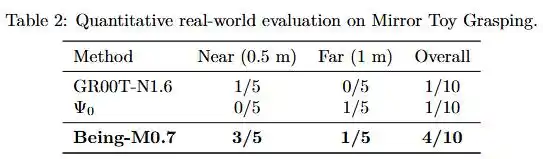
This result indicates that Being-M0.7 demonstrates stronger adaptability in partially observable tasks requiring indirect visual reasoning, whole-body approach, and fine grasping.

Mobile Object Transfer and Retrieval

The robot walks to a table, transfers a baguette from one basket to another, then picks up a bouquet from a basket and turns to leave. The task consists of multiple sub-tasks strung together. The robot needs to continuously switch between walking, grasping, transferring, turning, etc., while maintaining an ongoing understanding of the scene throughout. It tests not just single-grasp success rate, but also state maintenance in long-horizon tasks, object-level spatial reasoning, and whole-body synergy between locomotion and dexterous manipulation.

Box Carrying with Obstacle Avoidance

The robot walks forward carrying a box. When an obstacle appears ahead, it doesn't completely stop to re-plan, but adjusts its body orientation to sidestep through the narrow space between obstacles. Carrying the object partially occludes the first-person view and also alters the robot's load and center of gravity. The model needs to combine prior environmental information with real-time feedback to judge passable areas, adjust walking direction and whole-body posture, while maintaining its own balance and the stability of the carried object. Multi-directional movement, obstacle avoidance, and load-aware manipulation are unified into one closed-loop behavior here.

These demonstrations illustrate that the robot does not execute according to a fixed, open-loop trajectory, but rather continuously generates and corrects whole-body actions by combining current observations, real-time feedback, and predictions of the future.

MoT Architecture and Unified Motion Representation: Solving the Embodiment Data Scarcity Challenge

Supporting the above capabilities is a set of key designs in data and architecture for Being-M0.7.

Humanoid robots need to perform spatial perception via first-person visual information and also output future motion and control commands. High-quality human motion data typically requires motion capture equipment, while first-person paired data where vision and motion are strictly aligned is even scarcer.

If a model can only use data containing both vision and motion, the scale of trainable data would be severely limited. The problem Being-M0.7 solves is precisely how to let paired data, pure video data, and pure motion data all participate in training.

Zhi Zai Wu Jie's choice is the Vision-Motion MoT (Mixture-of-Transformers) architecture. Vision-Motion MoT retains separate modality-specific projection and processing modules for vision and motion, while enabling cross-modal interaction through shared multimodal attention. Visual state changes and continuous motion have different data distributions and need not be forced into identical parameter systems; when both modalities are present, they can exchange information within a shared context.

This allows the model to simultaneously handle three types of data.

For video-motion paired data, the model jointly learns future environmental states and motion trajectories; for pure video data, only the visual branch's training objective is computed; for pure motion data, only the motion branch is trained. Data from different sources jointly constrain the model through the same training objective, without needing to train multiple isolated single-modal systems separately.

From a probabilistic modeling perspective, paired data characterizes the joint relationship between vision and motion, while single-modal data provides marginal constraints for this joint distribution. Even data with incomplete modalities can be incorporated into the same training framework.
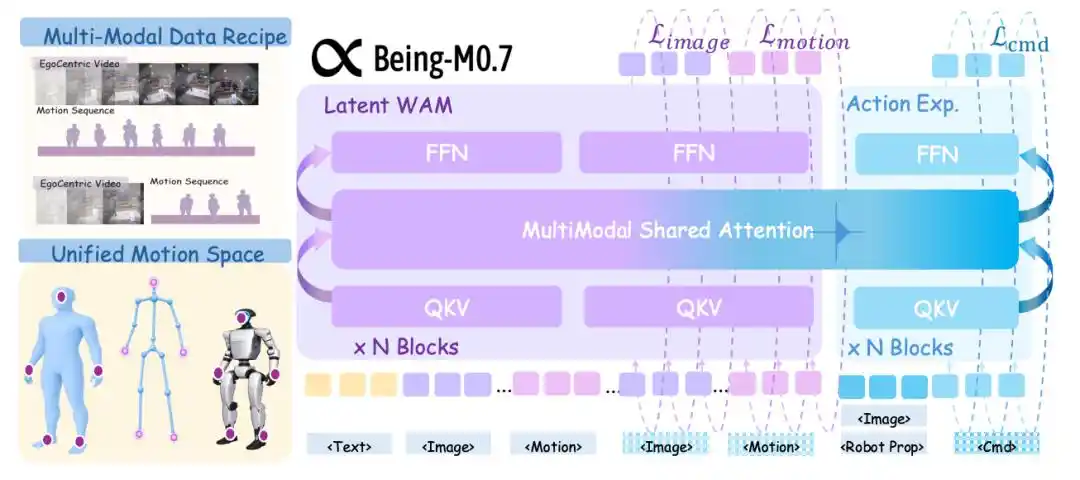
Overview of the Being-M0.7 training framework. Top Left: Pre-training data consists of video-motion paired data, pure video data, and pure motion data. Bottom Left: The research team constructed a unified motion representation shared between humans and humanoid robots, providing richer supervision signals and feedback for training and inference. Right: The overall model architecture of Being-M0.7.

Based on this architecture, the team built a mixed-modal pre-training dataset exceeding 10,000 hours, covering human first-person videos, first-person video-motion paired data, and pure human motion sequences.
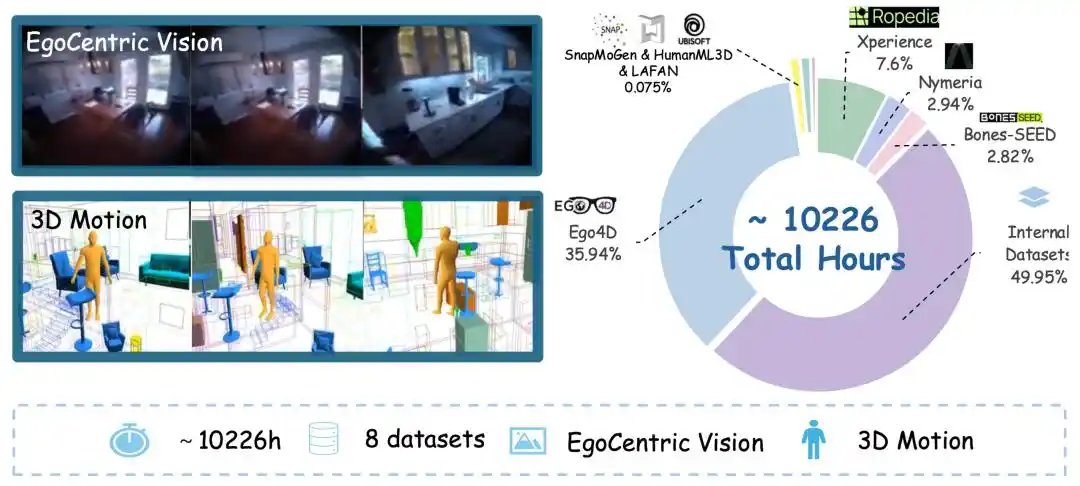
Being-M0.7's Data Recipe. The pre-training corpus is sourced from multiple external public datasets, including Ego4D, Xperience, Nymeria, Bones-SEED, SnapMoGen, HumanML3D, and Lafan1; it also includes internal datasets.

Another key design is the unified motion representation shared between humans and humanoid robots.

Being-M0.7 proposes a unified action representation that transforms human motion data from different sources into a unified representation with the head as the root node, naturally aligning it with first-person vision. Through standardization processes like unifying coordinate systems and removing initial orientation, it reduces distribution differences between datasets and improves cross-source consistency.

Furthermore, Being-M0.7 employs a compact motion representation that retains only the head, both hands, and both feet. While preserving key interaction and contact information, it effectively bridges the morphological gap between humans and robots. This representation not only provides richer supervision signals than action labels for robot post-training but also offers motion-level feedback during inference, supporting whole-body coordinated control.

During pre-training, the model maps images to latent space via a visual encoder and uses the compact unified motion representation. The model is trained with a Flow Matching objective to jointly predict future state changes and motion trajectories based on a short segment of visual-motion history and task instructions.

For real-world robot data collection, the team set up a whole-body teleoperation system based on PICO VR. An operator wears a PICO headset, two ankle trackers, and two handheld controllers. The VR system estimates the human pose in real-time, which is then converted into executable 29-degree-of-freedom whole-body control commands for the Unitree G1 via a whole-body motion controller. While the robot executes actions via teleoperation, it simultaneously records onboard RGB camera first-person view images, proprioception, and motion control commands. This serves as the post-training fine-tuning data for Being-M0.7 on specific tasks.
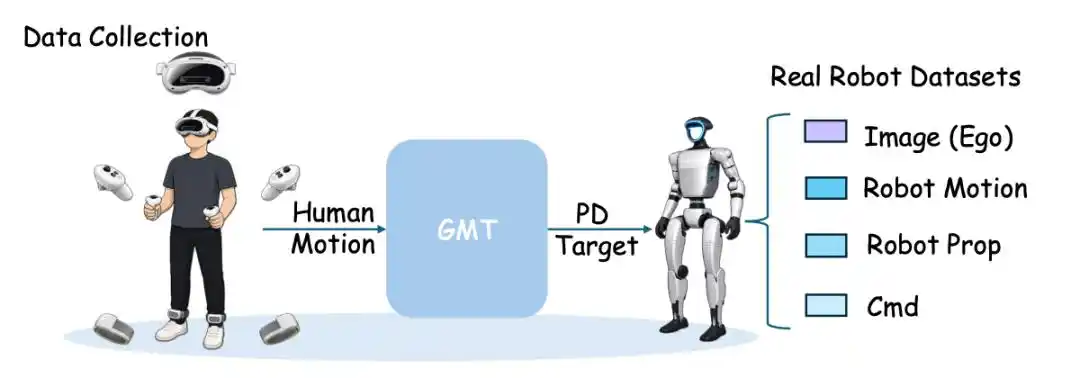
Being-M0.7 real-world robot data collection system. The operator provides whole-body motion commands via VR devices; the system converts human poses into robot control commands and synchronously collects first-person images, proprioception, and motion trajectories.

Since the model has already established visual-motion priors during pre-training, the real-world robot data no longer needs to teach all motion patterns from scratch; it primarily serves two purposes: first, to ground the pre-trained priors into the specific control space of the humanoid robot; second, to learn the low-level control commands and feedback mechanisms required by the real robot. This process is handled by a lightweight Action Expert. The Action Expert reads the intermediate hidden states of the Latent WAM as high-level planning context, then combines them with current visual observations, proprioceptive information, and execution progress to generate action chunks directly executable by the robot.

During inference, the model generates future video-motion plans at a low frequency and converts their intermediate hidden states into reusable policy caches (KV Cache). The unified motion representation not only fuses visual and proprioceptive feedback but also uses the robot's latest motion state to correct the predicted whole-body motion plan, enabling the policy to promptly respond to deviations in body and end-effector motion. The Action Expert then reuses the current KV Cache to continuously generate actions at a high frequency, seamlessly incorporating the latest robot feedback when the cache refreshes. This design decouples low-frequency world planning from high-frequency action control, ensuring real-time performance while keeping the robot consistently guided by both long-term planning and real-time feedback.

A Scalable Fusion Paradigm, Towards More General Embodied Intelligence

The significance of the Vision-Motion MoT architecture extends beyond solving the training problem for Being-M0.7 alone; it establishes a sustainable, extensible multimodal fusion paradigm.

The most direct change from this paradigm occurs at the data level.

Over 10,000 hours of mixed-modal data expand the sources of supervision signals available for training humanoid robot models from expensive, scarce real-world robot demonstrations to vast human behavioral data. Loosening the data bottleneck is a prerequisite for any Scaling Law to hold.

Simultaneously, Being-M0.7 also adjusts the sequence of model learning.

Before being adapted into robot-executable commands, the model first learns visual context, future dynamics, and humanoid kinematic structure from large-scale human-centric data. Subsequently, the Action Expert translates these predictions and motion priors into control commands for the specific robot. In other words, the model first builds the capability to predict future states and body motion, then learns how to act on a specific embodiment. This constitutes a key difference between it and traditional imitation learning schemes that learn action mappings directly from robot demonstrations. The latter often start from "see something, output some action," while Being-M0.7 inserts a layer of joint modeling of future state-motion before action generation.

Moreover, this architecture does not require all newly added data to have complete vision-motion pairing. After cleaning and processing, standalone human video and motion sequences can all be incorporated into the same model. As data scale expands further, this fusion paradigm has the potential to continuously extend the capability frontier.

Placed within the industry's coordinate system, the release of Being-M0.7 perhaps signifies a shift in the competitive logic of humanoid robots.

In recent years, industry attention has focused more on whose robot body is more agile and whose motion demos are more spectacular. As hardware performance continues to improve, whether models can understand scenes, predict changes, and generate coordinated whole-body actions, and whether there exists a scalable data system behind them, will increasingly become the key differentiator.

The development of large language models has already proven that scalable data and a training flywheel often determine how far a technical path can ultimately go. Embodied intelligence stands at a similar critical point: real-world robot data cannot grow rapidly like internet corpora; where else can robots obtain the experience needed for continuous evolution?

From Being-H to Being-M, Zhi Zai Wu Jie's judgment is to let robots first learn about the world from human behavior, then translate this knowledge into actions in the real physical world.

When understanding becomes the prerequisite for action, general-purpose humanoid robots truly step out of the lab narrative and begin their journey towards the physical world of myriad industries.

This article comes from the WeChat public account "Machine Heart" (ID: almosthuman2014), author: Yang Wen


Trend Kriptolar

İlgili Sorular

QWhat is the core technological innovation of Being-M0.7 as presented in the article?

ABeing-M0.7 is presented as the world's first Latent World-Action Model for humanoid robot whole-body mobile manipulation. Its core innovation lies in predicting future environment states in a latent space and coupling them with compact whole-body motion representations, moving away from computationally expensive pixel-level video prediction. This allows the model to focus on semantically relevant structures for control.

QHow does the Being-M0.7 model address the challenge of scarce robot demonstration data for training?

ABeing-M0.7 addresses data scarcity by being pre-trained on over 10,000 hours of human-centric, mixed-modality data (including paired video-motion, pure video, and pure motion data) using a Vision-Motion Mixture of Transformers architecture. This allows it to learn world dynamics from human experience. It then adapts to a specific robot body using a smaller amount of real robot demonstration data via a lightweight Action Expert module.

QAccording to the article, what are the key advantages of using a latent world model over a pixel-level predictive model for humanoid robots?

AThe key advantages are reduced computational overhead and improved robustness. Pixel-level prediction consumes significant capacity on visual details less relevant to control, and the rapid self-motion and viewpoint jitter of humanoid robots amplify visual prediction noise. Latent space prediction focuses modeling power on semantic states, object layouts, and scene evolution, which are more directly related to control decisions.

QWhat specific capabilities did the real-world robot demos (like "Fish Tank Fishing" and "Mirror Fetch") aim to demonstrate?

AThe demos aimed to demonstrate the model's ability to perform complex whole-body mobile manipulation based on its understanding and prediction of the environment. Specifically: "Fish Tank Fishing" tested future state prediction, tool use, and action coordination under the uncertain dynamics of liquid objects. "Mirror Fetch" tested indirect visual reasoning, spatial understanding of reflections, and precise whole-body approach and grasping in partially observable conditions.

QWhat is the strategic significance of Zhizai Wujie's technological route from Being-H to Being-M, as described in the article?

AThe strategic significance is establishing a scalable path for embodied intelligence by leveraging vast, scalable human behavior data instead of waiting for scarce, expensive robot data to accumulate. The route posits that robots should first learn about the world's operation and body coordination from human experience (pre-training), and then transfer this knowledge to specific robot bodies (adaptation). This approach is seen as key to overcoming data bottlenecks and achieving more general-purpose humanoid robots.

İlgili Okumalar

Robinhood Chain Launchpad Chaos: NOXA Shuts Down, Uniswap CCA Steps In?

Robinhood Chain, a blockchain focused on tokenized stocks, has seen unexpected early success driven by meme coin speculation. Two weeks after launch, its weekly DEX volume surpassed $3.1 billion, briefly exceeding Solana in daily meme trading. This frenzy centered on launchpads, tools allowing easy meme token creation. The leading platform, NOXA, generated massive fees ($7.66M in a week) and launched the chain's top meme, CASHCAT. However, on July 11, NOXA abruptly suspended new token launches, citing spam, copycat tokens, and infrastructure strain. It pivoted to a history-only interface, redistributing fees to creators. This move sparked "soft rug pull" fears and caused its launched tokens to drop sharply. NOXA's exit left a leadership vacuum among Robinhood's launchpads. Meanwhile, Uniswap officially launched its Continuous Clearing Auctions (CCA) mechanism on the chain. CCA uses a gradual, block-by-block auction to set a fair initial price and automatically creates a locked liquidity pool. Early CCA-launched memes like UNICORN and TRASH have seen high volatility. The situation highlights the trade-offs: CCA reduces front-running risk but may be less suited for fast-paced meme trading, while instant-launch platforms carry higher sniper risk. For Robinhood Chain, the meme-driven activity has successfully bootstrapped initial usage, testing its "meme-first, RWA-later" strategy as it aims to eventually host tokenized real-world assets.

Foresight News46 dk önce

Robinhood Chain Launchpad Chaos: NOXA Shuts Down, Uniswap CCA Steps In?

Foresight News46 dk önce

İşlemler

Spot

Popüler Makaleler

$S$ Nedir

SPERO'yu Anlamak: Kapsamlı Bir Genel Bakış SPERO'ya Giriş İnovasyonun manzarası gelişmeye devam ederken, web3 teknolojilerinin ve kripto para projelerinin ortaya çıkışı dijital geleceği şekillendirmede önemli bir rol oynamaktadır. Bu dinamik alanda dikkat çeken projelerden biri SPERO, $$s$$ olarak adlandırılmaktadır. Bu makale, SPERO hakkında ayrıntılı bilgi toplamak ve sunmak amacıyla, meraklılar ve yatırımcıların web3 ve kripto alanlarındaki temellerini, hedeflerini ve yeniliklerini anlamalarına yardımcı olmayı amaçlamaktadır. SPERO,$$s$$ Nedir? SPERO,$$s$$, kripto alanında merkeziyetsizlik ve blok zinciri teknolojisi ilkelerini kullanarak etkileşimi, faydayı ve finansal kapsayıcılığı teşvik eden bir ekosistem yaratmayı amaçlayan benzersiz bir projedir. Proje, kullanıcıların yenilikçi finansal çözümler ve hizmetler sunarak eşler arası etkileşimleri yeni yollarla kolaylaştırmayı hedeflemektedir. SPERO,$$s$$'nin temel amacı, bireyleri güçlendirmek ve kripto para alanındaki kullanıcı deneyimini artıran araçlar ve platformlar sağlamaktır. Bu, daha esnek işlem yöntemlerini mümkün kılmayı, topluluk odaklı girişimleri teşvik etmeyi ve merkeziyetsiz uygulamalar (dApp'ler) aracılığıyla finansal fırsatlar yaratmayı içermektedir. SPERO,$$s$$'nin temel vizyonu kapsayıcılık etrafında dönmekte olup, geleneksel finansal sistemlerdeki boşlukları kapatmayı ve blok zinciri teknolojisinin faydalarından yararlanmayı hedeflemektedir. SPERO,$$s$$'nin Yaratıcısı Kimdir? SPERO,$$s$$'nin yaratıcısının kimliği bir miktar belirsizdir, çünkü kurucusu(ları) hakkında ayrıntılı arka plan bilgisi sağlayan sınırlı kamuya açık kaynaklar bulunmaktadır. Bu şeffaflık eksikliği, projenin merkeziyetsizlik taahhüdünden kaynaklanabilir—birçok web3 projesinin paylaştığı bir etik anlayışı, bireysel tanınmanın yerine kolektif katkıları önceliklendirmektedir. Topluluk ve onun kolektif hedefleri etrafında tartışmaları merkezileştirerek, SPERO,$$s$$, belirli bireyleri öne çıkarmadan güçlendirme özünü taşımaktadır. Bu nedenle, SPERO'nun etik anlayışını ve misyonunu anlamak, tek bir yaratıcının kimliğini belirlemekten daha önemlidir. SPERO,$$s$$'nin Yatırımcıları Kimlerdir? SPERO,$$s$$, kripto sektöründe yeniliği teşvik etmeye adanmış girişim sermayedarlarından melek yatırımcılara kadar çeşitli yatırımcılar tarafından desteklenmektedir. Bu yatırımcıların odak noktası genellikle SPERO'nun misyonuyla uyumlu olup, toplumsal teknolojik ilerlemeyi, finansal kapsayıcılığı ve merkeziyetsiz yönetimi vaat eden projeleri önceliklendirmektedir. Bu yatırımcı temelleri, yalnızca yenilikçi ürünler sunan projelere değil, aynı zamanda blok zinciri topluluğuna ve ekosistemlerine olumlu katkılarda bulunan projelere de ilgi duymaktadır. Bu yatırımcıların desteği, SPERO,$$s$$'yi hızla gelişen kripto projeleri alanında dikkate değer bir rakip haline getirmektedir. SPERO,$$s$$ Nasıl Çalışır? SPERO,$$s$$, onu geleneksel kripto para projelerinden ayıran çok yönlü bir çerçeve kullanmaktadır. İşte benzersizliğini ve yeniliğini vurgulayan bazı temel özellikler: Merkeziyetsiz Yönetim: SPERO,$$s$$, kullanıcıların projenin geleceğiyle ilgili karar alma süreçlerine aktif olarak katılmalarını sağlayan merkeziyetsiz yönetim modellerini entegre etmektedir. Bu yaklaşım, topluluk üyeleri arasında sahiplik ve hesap verebilirlik duygusunu teşvik etmektedir. Token Kullanımı: SPERO,$$s$$, ekosistem içinde çeşitli işlevler sunmak üzere tasarlanmış kendi kripto para token'ını kullanmaktadır. Bu token'lar, işlemleri, ödülleri ve platformda sunulan hizmetlerin kolaylaştırılmasını sağlayarak genel etkileşimi ve faydayı artırmaktadır. Katmanlı Mimari: SPERO,$$s$$'nin teknik mimarisi, modülerlik ve ölçeklenebilirliği destekleyerek projenin evrimi sırasında ek özelliklerin ve uygulamaların sorunsuz bir şekilde entegrasyonuna olanak tanımaktadır. Bu uyum sağlama yeteneği, sürekli değişen kripto manzarasında geçerliliği sürdürmek için hayati öneme sahiptir. Topluluk Katılımı: Proje, işbirliği ve geri bildirim teşvik eden mekanizmalar kullanarak topluluk odaklı girişimlere vurgu yapmaktadır. Güçlü bir topluluk oluşturarak, SPERO,$$s$$, kullanıcı ihtiyaçlarını daha iyi karşılayabilir ve piyasa trendlerine uyum sağlayabilir. Kapsayıcılığa Odaklanma: Düşük işlem ücretleri ve kullanıcı dostu arayüzler sunarak, SPERO,$$s$$, daha önce kripto alanında yer almamış bireyler de dahil olmak üzere çeşitli bir kullanıcı tabanını çekmeyi hedeflemektedir. Bu kapsayıcılık taahhüdü, erişilebilirlik yoluyla güçlendirme misyonuyla uyumludur. SPERO,$$s$$ Zaman Çizelgesi Bir projenin tarihini anlamak, gelişim yolculuğu ve kilometre taşları hakkında kritik bilgiler sağlar. Aşağıda, SPERO,$$s$$'nin evriminde önemli olayları haritalayan önerilen bir zaman çizelgesi bulunmaktadır: Kavram Geliştirme ve Fikir Aşaması: SPERO,$$s$$'nin temelini oluşturan ilk fikirler, blok zinciri endüstrisindeki merkeziyetsizlik ve topluluk odaklılık ilkeleriyle yakından uyumlu olarak geliştirildi. Proje Beyaz Kağıdının Yayınlanması: Kavramsal aşamayı takiben, SPERO,$$s$$'nin vizyonunu, hedeflerini ve teknolojik altyapısını ayrıntılı bir şekilde açıklayan kapsamlı bir beyaz kağıt yayımlandı ve topluluk ilgisini ve geri bildirimini toplamak amacıyla sunuldu. Topluluk Oluşturma ve Erken Katılımlar: Projenin hedefleri etrafında tartışmalar yürüterek destek toplamak ve erken benimseyenler ile potansiyel yatırımcılar için bir topluluk oluşturmak amacıyla aktif iletişim çabaları gerçekleştirildi. Token Üretim Etkinliği: SPERO,$$s$$, yerel token'larını erken destekçilere dağıtmak ve ekosistem içinde başlangıç likiditesini sağlamak amacıyla bir token üretim etkinliği (TGE) gerçekleştirdi. İlk dApp'in Yayınlanması: SPERO,$$s$$ ile ilişkili ilk merkeziyetsiz uygulama (dApp) faaliyete geçti ve kullanıcıların platformun temel işlevleriyle etkileşimde bulunmalarını sağladı. Sürekli Gelişim ve Ortaklıklar: Projenin tekliflerine sürekli güncellemeler ve iyileştirmeler yapılmakta olup, blok zinciri alanındaki diğer oyuncularla stratejik ortaklıklar, SPERO,$$s$$'yi rekabetçi ve gelişen bir oyuncu haline getirmiştir. Sonuç SPERO,$$s$$, web3 ve kripto paranın finansal sistemleri devrim niteliğinde dönüştürme ve bireyleri güçlendirme potansiyelinin bir kanıtıdır. Merkeziyetsiz yönetime, topluluk katılımına ve yenilikçi tasarlanmış işlevselliğe olan bağlılığıyla, daha kapsayıcı bir finansal manzaraya doğru bir yol açmaktadır. Hızla gelişen kripto alanındaki herhangi bir yatırımda olduğu gibi, potansiyel yatırımcılar ve kullanıcılar, SPERO,$$s$$ içindeki devam eden gelişmelerle ilgili olarak kapsamlı bir araştırma yapmaları ve düşünceli bir şekilde katılmaları teşvik edilmektedir. Proje, kripto endüstrisinin yenilikçi ruhunu sergileyerek, sayısız olasılığını keşfetmeye davet etmektedir. SPERO,$$s$$'nin yolculuğu hala devam ederken, temel ilkeleri, teknoloji, finans ve birbirimizle etkileşim biçimimizi etkileyebilir.

181 Toplam GörüntülenmeYayınlanma 2024.12.17Güncellenme 2024.12.17

$S$ Nedir

AGENT S Nedir

Agent S: Web3'te Otonom Etkileşimin Geleceği Giriş Web3 ve kripto para dünyasında sürekli gelişen manzarada, yenilikler bireylerin dijital platformlarla etkileşim biçimlerini sürekli olarak yeniden tanımlıyor. Bu tür öncü projelerden biri olan Agent S, açık ajans çerçevesi aracılığıyla insan-bilgisayar etkileşimini devrim niteliğinde değiştirmeyi vaat ediyor. Otonom etkileşimlerin yolunu açarak, Agent S karmaşık görevleri basitleştirmeyi ve yapay zeka (AI) alanında dönüştürücü uygulamalar sunmayı hedefliyor. Bu detaylı inceleme, projenin karmaşıklıklarına, benzersiz özelliklerine ve kripto para alanındaki etkilerine dalacaktır. Agent S Nedir? Agent S, bilgisayar görevlerinin otomasyonunda üç temel zorluğu ele almak üzere özel olarak tasarlanmış çığır açıcı bir açık ajans çerçevesidir: Alan Spesifik Bilgi Edinimi: Çerçeve, çeşitli dış bilgi kaynaklarından ve iç deneyimlerden akıllıca öğrenir. Bu çift yönlü yaklaşım, alan spesifik bilgi açısından zengin bir veri havuzu oluşturmasını sağlar ve görev yürütmedeki performansını artırır. Uzun Görev Ufukları Üzerinde Planlama: Agent S, karmaşık görevlerin verimli bir şekilde parçalanmasını ve yürütülmesini kolaylaştıran deneyim artırımlı hiyerarşik planlama kullanır. Bu özellik, çoklu alt görevleri etkili ve verimli bir şekilde yönetme yeteneğini önemli ölçüde artırır. Dinamik, Homojen Olmayan Arayüzlerle Başlama: Proje, ajanlar ve kullanıcılar arasındaki etkileşimi geliştiren yenilikçi bir çözüm olan Ajan-Bilgisayar Arayüzü'ni (ACI) tanıtmaktadır. Çok Modlu Büyük Dil Modellerini (MLLM'ler) kullanarak, Agent S çeşitli grafik kullanıcı arayüzlerini sorunsuz bir şekilde gezinebilir ve manipüle edebilir. Bu öncü özellikler aracılığıyla, Agent S, makinelerle insan etkileşimini otomatikleştirmede karşılaşılan karmaşıklıkları ele alan sağlam bir çerçeve sunarak, AI ve ötesinde birçok uygulama için zemin hazırlıyor. Agent S'nin Yaratıcısı Kimdir? Agent S'nin kavramı temelde yenilikçi olsa da, yaratıcısı hakkında spesifik bilgiler belirsizliğini koruyor. Yaratıcı şu anda bilinmiyor, bu da projenin yeni aşamasını veya kurucu üyeleri gizli tutma stratejik tercihini vurguluyor. Anonimlikten bağımsız olarak, odak çerçevenin yetenekleri ve potansiyeli üzerinde kalıyor. Agent S'nin Yatırımcıları Kimlerdir? Agent S, kriptografik ekosistemde oldukça yeni olduğundan, yatırımcıları ve finansal destekçileri hakkında ayrıntılı bilgiler açıkça belgelenmemiştir. Projeyi destekleyen yatırım temelleri veya organizasyonları hakkında kamuya açık bilgilerdeki eksiklik, finansman yapısı ve gelişim yol haritası hakkında sorular doğuruyor. Destekleyicilerin anlaşılması, projenin sürdürülebilirliğini ve potansiyel pazar etkisini değerlendirmek için kritik öneme sahiptir. Agent S Nasıl Çalışır? Agent S'nin temelinde, çeşitli ortamlarda etkili bir şekilde çalışmasını sağlayan son teknoloji bir sistem yatmaktadır. İşleyiş modeli birkaç ana özellik etrafında inşa edilmiştir: İnsan Benzeri Bilgisayar Etkileşimi: Çerçeve, bilgisayarlarla etkileşimleri daha sezgisel hale getirmeyi amaçlayan gelişmiş AI planlaması sunar. Görev yürütmedeki insan davranışını taklit ederek, kullanıcı deneyimlerini yükseltmeyi vaat eder. Anlatı Belleği: Yüksek düzeyde deneyimlerden yararlanmak için kullanılan Agent S, görev geçmişlerini takip etmek amacıyla anlatı belleğini kullanarak karar verme süreçlerini geliştirir. Episodik Bellek: Bu özellik, kullanıcılara adım adım rehberlik sağlayarak, çerçevenin görevler gelişirken bağlamsal destek sunmasına olanak tanır. OpenACI Desteği: Yerel olarak çalışabilme yeteneği ile Agent S, kullanıcıların etkileşimleri ve iş akışları üzerinde kontrol sağlamasına olanak tanır ve Web3'ün merkeziyetsiz felsefesiyle uyumlu hale gelir. Dış API'lerle Kolay Entegrasyon: Çeşitli AI platformlarıyla uyumluluğu ve çok yönlülüğü, Agent S'nin mevcut teknolojik ekosistemlere sorunsuz bir şekilde entegre olmasını sağlar ve geliştiriciler ile organizasyonlar için cazip bir seçenek haline getirir. Bu işlevsellikler, Agent S'nin kripto alanındaki benzersiz konumuna katkıda bulunarak, karmaşık, çok aşamalı görevleri minimum insan müdahalesi ile otomatikleştirir. Proje geliştikçe, Web3'teki potansiyel uygulamaları dijital etkileşimlerin nasıl gelişeceğini yeniden tanımlayabilir. Agent S'nin Zaman Çizelgesi Agent S'nin gelişimi ve kilometre taşları, önemli olaylarını vurgulayan bir zaman çizelgesinde özetlenebilir: 27 Eylül 2024: Agent S'nin kavramı, “Bilgisayarları İnsan Gibi Kullanan Açık Bir Ajans Çerçevesi” başlıklı kapsamlı bir araştırma makalesi ile tanıtıldı ve projenin temelini sergiledi. 10 Ekim 2024: Araştırma makalesi arXiv'de kamuya açık olarak yayınlandı ve çerçevenin derinlemesine bir incelemesini ve OSWorld benchmark'ına dayalı performans değerlendirmesini sundu. 12 Ekim 2024: Agent S'nin yetenekleri ve özellikleri hakkında görsel bir içgörü sağlayan bir video sunumu yayımlandı ve potansiyel kullanıcılar ve yatırımcılarla daha fazla etkileşim sağlandı. Bu zaman çizelgesindeki işaretler, sadece Agent S'nin ilerlemesini değil, aynı zamanda şeffaflık ve topluluk katılımına olan bağlılığını da göstermektedir. Agent S Hakkında Ana Noktalar Agent S çerçevesi gelişmeye devam ederken, birkaç ana özellik öne çıkmakta ve yenilikçi doğasını ve potansiyelini vurgulamaktadır: Yenilikçi Çerçeve: İnsan etkileşimine benzer bir bilgisayar kullanımı sağlamak üzere tasarlanan Agent S, görev otomasyonuna yeni bir yaklaşım getiriyor. Otonom Etkileşim: GUI aracılığıyla bilgisayarlarla otonom olarak etkileşim kurabilme yeteneği, daha akıllı ve verimli hesaplama çözümlerine doğru bir sıçrama anlamına geliyor. Karmaşık Görev Otomasyonu: Sağlam metodolojisi ile karmaşık, çok aşamalı görevleri otomatikleştirerek süreçleri daha hızlı ve daha az hata payı ile gerçekleştirebilir. Sürekli İyileştirme: Öğrenme mekanizmaları, Agent S'nin geçmiş deneyimlerden öğrenmesini sağlar ve sürekli olarak performansını ve etkinliğini artırır. Çok Yönlülük: OSWorld ve WindowsAgentArena gibi farklı işletim ortamlarında uyumlu olması, geniş bir uygulama yelpazesine hizmet edebilmesini sağlar. Agent S, Web3 ve kripto alanında kendini konumlandırırken, etkileşim yeteneklerini artırma ve süreçleri otomatikleştirme potansiyeli, AI teknolojilerinde önemli bir ilerlemeyi temsil etmektedir. Yenilikçi çerçevesi aracılığıyla, Agent S dijital etkileşimlerin geleceğini örneklemekte ve çeşitli sektörlerde kullanıcılar için daha sorunsuz ve verimli bir deneyim vaat etmektedir. Sonuç Agent S, AI ve Web3'ün birleşiminde cesur bir sıçramayı temsil ediyor ve teknoloji ile etkileşim biçimimizi yeniden tanımlama kapasitesine sahip. Henüz erken aşamalarında olmasına rağmen, uygulama olanakları geniş ve çekici. Kritik zorlukları ele alan kapsamlı çerçevesi ile Agent S, otonom etkileşimleri dijital deneyimin ön plana çıkmasına taşımayı hedefliyor. Kripto para ve merkeziyetsizlik alanlarına daha derinlemesine girdikçe, Agent S gibi projelerin teknoloji ve insan-bilgisayar işbirliğinin geleceğini şekillendirmede önemli bir rol oynayacağı kesin.

657 Toplam GörüntülenmeYayınlanma 2025.01.14Güncellenme 2025.01.14

AGENT S Nedir

S Nasıl Satın Alınır

HTX.com’a hoş geldiniz! Sonic (S) satın alma işlemlerini basit ve kullanışlı bir hâle getirdik. Adım adım açıkladığımız rehberimizi takip ederek kripto yolculuğunuza başlayın. 1. Adım: HTX Hesabınızı OluşturunHTX'te ücretsiz bir hesap açmak için e-posta adresinizi veya telefon numaranızı kullanın. Sorunsuzca kaydolun ve tüm özelliklerin kilidini açın. Hesabımı Aç2. Adım: Kripto Satın Al Bölümüne Gidin ve Ödeme Yönteminizi SeçinKredi/Banka Kartı: Visa veya Mastercard'ınızı kullanarak anında Sonic (S) satın alın.Bakiye: Sorunsuz bir şekilde işlem yapmak için HTX hesap bakiyenizdeki fonları kullanın.Üçüncü Taraflar: Kullanımı kolaylaştırmak için Google Pay ve Apple Pay gibi popüler ödeme yöntemlerini ekledik.P2P: HTX'teki diğer kullanıcılarla doğrudan işlem yapın.Borsa Dışı (OTC): Yatırımcılar için kişiye özel hizmetler ve rekabetçi döviz kurları sunuyoruz.3. Adım: Sonic (S) Varlıklarınızı SaklayınSonic (S) satın aldıktan sonra HTX hesabınızda saklayın. Alternatif olarak, blok zinciri transferi yoluyla başka bir yere gönderebilir veya diğer kripto para birimlerini takas etmek için kullanabilirsiniz.4. Adım: Sonic (S) Varlıklarınızla İşlem YapınHTX'in spot piyasasında Sonic (S) ile kolayca işlemler yapın.Hesabınıza erişin, işlem çiftinizi seçin, işlemlerinizi gerçekleştirin ve gerçek zamanlı olarak izleyin. Hem yeni başlayanlar hem de deneyimli yatırımcılar için kullanıcı dostu bir deneyim sunuyoruz.

1.7k Toplam GörüntülenmeYayınlanma 2025.01.15Güncellenme 2026.06.02

S Nasıl Satın Alınır

Tartışmalar

HTX Topluluğuna hoş geldiniz. Burada, en son platform gelişmeleri hakkında bilgi sahibi olabilir ve profesyonel piyasa görüşlerine erişebilirsiniz. Kullanıcıların S (S) fiyatı hakkındaki görüşleri aşağıda sunulmaktadır.

活动图片