1-Minute Breakdown of Quantitative Models: High Rollers Hunt Down Trading Bots

marsbit2026-01-21 tarihinde yayınlandı2026-01-21 tarihinde güncellendi

Özet

In the emerging prediction markets, a mysterious trader known as a4385 executed a sophisticated attack against quantitative trading bots, netting $280,000 in 48 hours. These markets allow users to bet on short-term price movements of assets like XRP—for example, predicting whether the price will rise or fall within 15 minutes. Quant algorithms typically profit by exploiting散户情绪 and market inefficiencies with毫秒级 precision. On January 17, 2026, a4385 placed a "rise" bet in an XRP market when the price was below the starting price and the probability of success was only 36%. In the final minute before settlement, a4385 executed large market buy orders, artificially pumping XRP’s price just above the starting threshold at the exact moment of settlement—ensuring his bet paid out. The strategy relied on shallow order book depth (due to weekend trading and XRP’s lower liquidity), allowing a4385 to move the market with relatively modest volume (~$569,000 in the final minute. Each operation cost about $6,200 in fees, but yielded returns as high as $40,218 per round. To hedge against post-settlement price drops, a4385 held short positions of equivalent size, ensuring overall portfolio stability. This required significant capital—over a million dollars—highlighting that this was not luck or a散户 victory, but a calculated exploit of market structure, liquidity conditions, and quantitative model behavior.

In today's stock market, where quantitative trading is all the rage, most people see these cold, algorithmic bots as Wall Street's ruthless harvesting machines, constantly siphoning off the hard-earned money of retail investors through emotional misjudgments or information asymmetry at millisecond speeds.

However, in a nascent market over the past 48 hours, the near-perfect profit curves of several top quantitative bots collectively snapped, while a mysterious account named a4385 raked in $280,000 from the chaos.

This market is called the prediction market, and it is here that a trader known as a4385 showcased a meticulously orchestrated hunt targeting quantitative bots.

Financial "Heads or Tails": The Arbitrage Paradise for Quantitative Models

Everyone understands heads or tails, and prediction markets have a similar game.

For example, if you bet on "up" in "Will the price of gold rise or fall tomorrow?" and the price indeed rises tomorrow, then regardless of the magnitude of the increase, your "up" position will be settled for profit according to the odds at the time of betting, where the odds themselves correspond to the probability of the event occurring. Conversely, if the price falls, no matter how much it drops, your position will be wiped to zero.

"XRP up or down in 15 minutes" is a typical representative of the many markets in prediction markets. Each 15-minute market opens with a starting price; 15 minutes later, if XRP's price is above the starting price, traders who wagered on "up" profit, and vice versa for those who bet on "down".
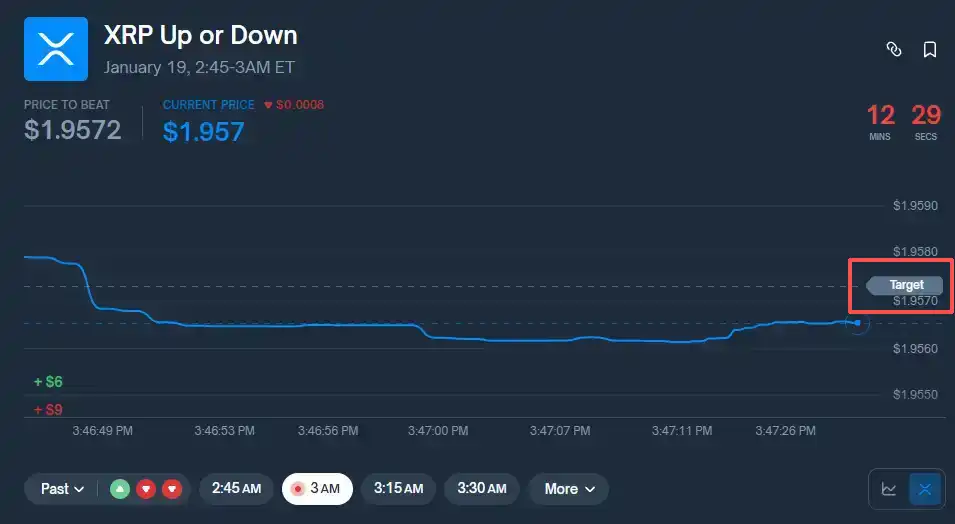
This real-time mechanism makes this particular market a paradise for quantitative bots: algorithms use sophisticated statistical models to capture pricing deviations caused by retail investor emotions, information delays, remaining time, and other factors, perfectly蚕食ing steady profits through automated trading.
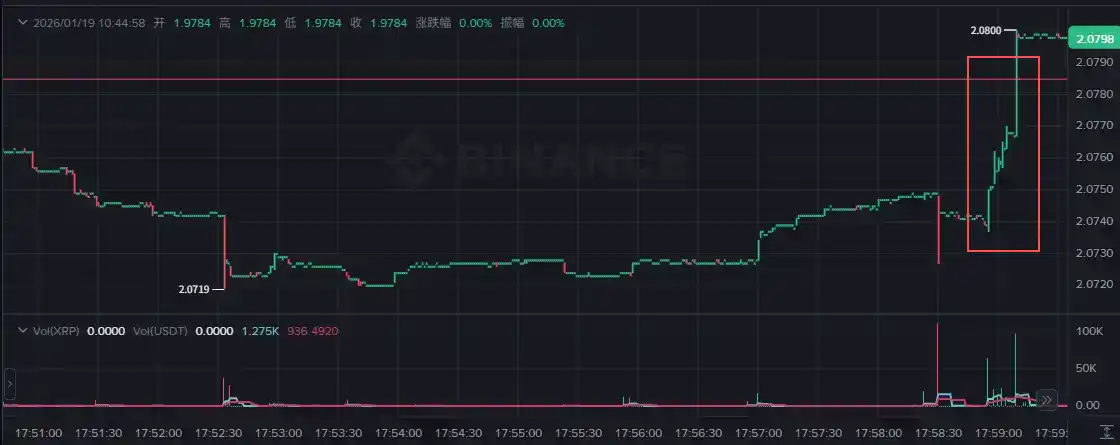
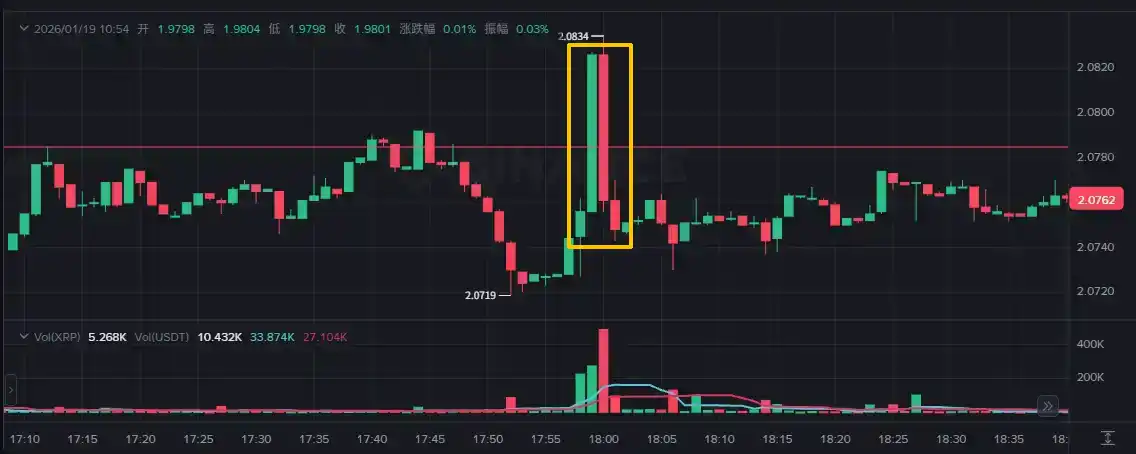
XRP Soars Right at Settlement, "Lucky Big Spender" Doubles Their Money

On the afternoon of January 17, 2026, a4385 bet on "up" in the "XRP up or down in 15 minutes" market.

The starting price for XRP in this market was $2.0784, and as late as 17:58:54 (66 seconds remaining until settlement), XRP's price was still hovering around $2.0737, with a corresponding probability of rising of only 36%—market consensus suggested it would be difficult for XRP to rise above the starting price in the mere minute remaining.

But in the next minute, XRP suddenly began a sustained climb, and the market settlement price was fixed at $2.0817—just clearing the starting price.

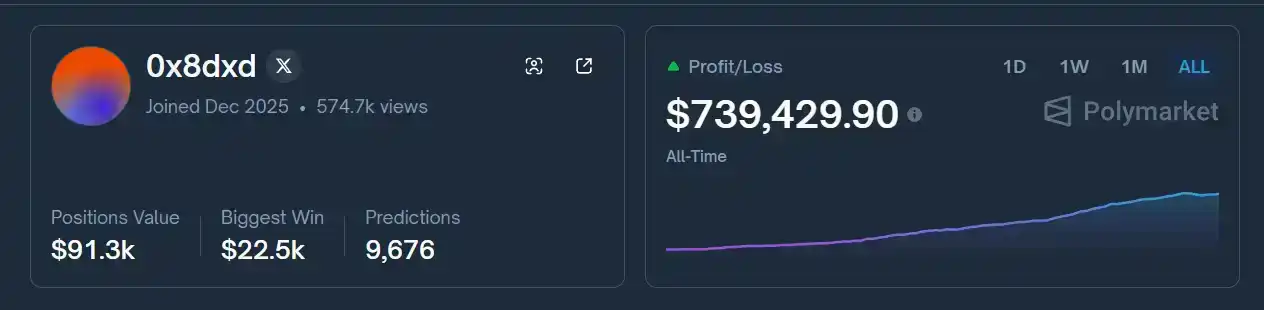
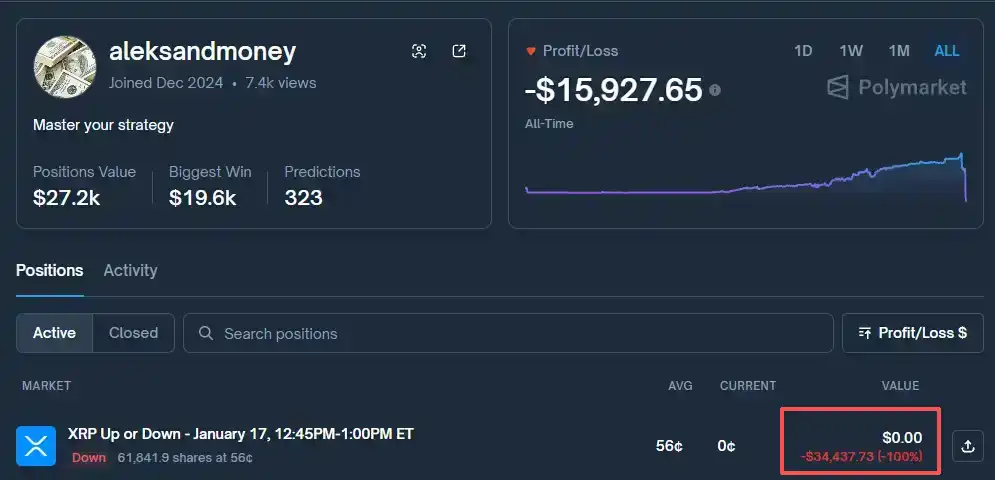
This meant a4385's position, from entry to settlement, realized huge profits, while quantitative bots, like the one in the chart below, spewed out all their historical profits, and even suffered additional losses, just from this single market.
Meticulous Manipulation Behind Repeated "Luck"

After this market settled, people discovered that a4385 subsequently replicated this "incredible luck" several more times: in multiple markets, about one minute before settlement, the XRP price suddenly spiked, only to quickly fall back the very second after settlement.

This led to suspicions that his "luck" might not be coincidental but rather a precise snipe targeting quantitative bots.

In theory, a4385 could first bet on "up" when the real-time XRP price is below the starting price, then, in the minute before settlement, place large market orders to buy XRP, artificially pushing the price up to ensure it exceeds the starting price at settlement, thus locking in profits.

At this point, all previously seemingly insignificant details become crucial: the 17th was a weekend, meaning the order book depth provided by market makers for XRP was insufficient to buffer large, short-term trades.

Choosing XRP, a less popular asset compared to Bitcoin, further ensured shallower order book depth, guaranteeing the manipulator could move the price with less capital in a short time.

This gave a4385 a perfect, brief window for manipulation:
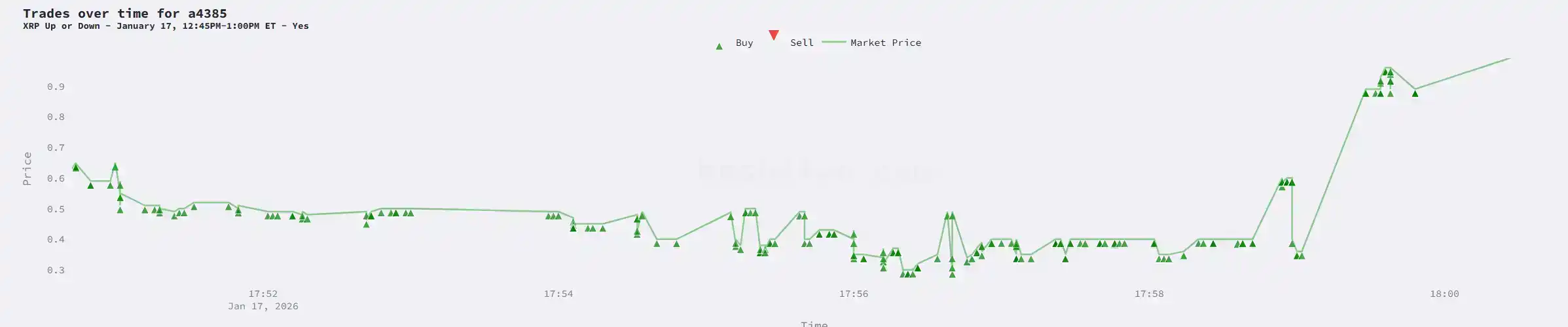
If we assume all market buy orders at 17:59 came from a4385, then based on the trading volume of $569,000 in that one-minute candle, with an exchange fee of 0.32%, the total cost for buying and subsequently selling would be approximately $6,200.

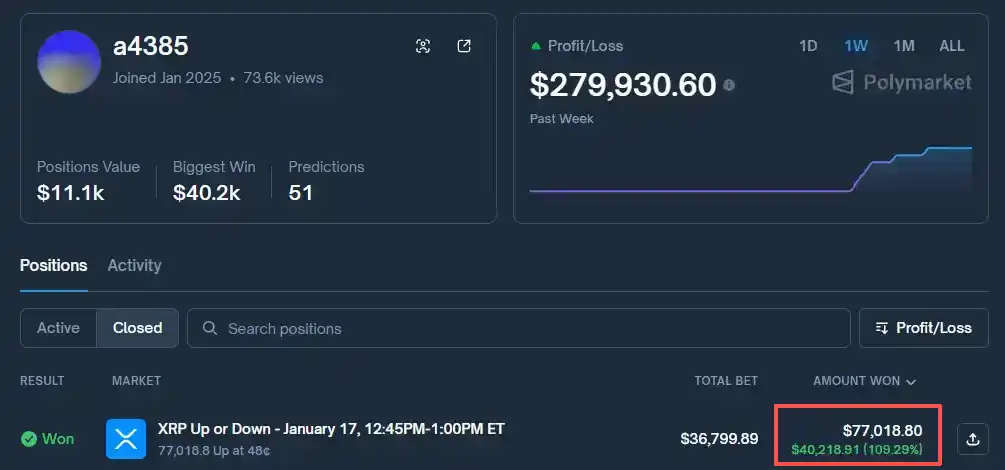
His profit from betting "up" in this market was $40,218. By repeatedly replicating this strategy, he made nearly $300,000 within 48 hours.
While marveling at a4385's seemingly money-printing operation, we must also account for the costs behind this seemingly "retail revenge"热血 story.

Buying to pump the price not only incurs thousands in fee磨损 but also leads to massive losses when selling off after settlement due to the price falling back.

Therefore, while pumping, he also needs to hold an equivalent 1x short position. Only then can his total asset value remain stable, no matter how violently the spot XRP price in his hands fluctuates.

This means, besides bearing the fee磨损, he requires over a million dollars in liquid capital to ensure the feasibility of this strategy.

So, this is not a gambler's game of luck, nor is it a狂欢 for the average retail investor.

Behind the legendary stories of casino-like huge profits, perhaps the one laughing last is never luck itself, but the inevitable outcome of precisely calculated capital, structure, and rules.


İlgili Sorular

QWhat is the core strategy used by the mysterious account a4385 to profit from quantitative trading bots in the prediction market?

AThe account a4385 executed a strategy where they placed a bet on 'up' in the 'XRP 15-minute up or down' market when the real-time price was below the starting price. Then, in the final minute before settlement, they used large market buy orders to artificially pump the price of XRP above the starting price, ensuring their bet would win. They simultaneously held a corresponding short position to hedge against price fluctuations in their purchased XRP, making the outcome a calculated result rather than a gamble.

QWhy was the XRP market specifically chosen for this strategy against quantitative models?

AXRP was chosen because it is a less popular asset compared to Bitcoin, resulting in a shallower order book depth. This meant that a large market order could move its price significantly with less capital, especially on a weekend when market maker liquidity was lower, creating a perfect window for a short-term price manipulation.

QWhat was the estimated cost and profit for a4385 in a single market operation described in the article?

AFor a single market operation, the estimated cost based on the trading volume and a 0.32% exchange fee was approximately $6,200. The profit from the successful 'up' bet in that market was $40,218.

QWhat crucial risk management technique did a4385 employ to protect against losses from the price volatility of the XRP they bought to pump the price?

ATo hedge against the volatility and potential loss from the XRP they purchased, a4385 held an equivalent 1x short position. This ensured that their overall asset value remained stable regardless of the price movement of the spot XRP after the settlement.

QAccording to the article, what does the success of a4385's strategy ultimately depend on, beyond mere chance?

AThe success ultimately depended on precise calculations of market structure and rules, a deep understanding of quantitative model behaviors, and, most importantly, access to over a million dollars in liquid capital to fund the large trades and hedging positions required for the strategy.

İlgili Okumalar

The Gold Buy-on-the-Dip Guide: Watch Interest Rates, Not Just War

"Gold Buying Guide: Focus on Interest Rates, Not Just War" Four months ago, gold buyers likely didn't anticipate buying at a peak that even a war couldn't sustain. After hitting a record high of $5,596 on January 29, gold entered a bear market just 91 days later, its fastest decline since 2008. A key trigger was the Fed's hawkish shift, highlighting that monetary policy, not geopolitics, is the primary driver. The article argues that the traditional "buy gold in turmoil" script has changed. While the US-Iran conflict initially boosted prices, the sustained rally in oil prices heightened inflation fears, forcing central banks to maintain or consider tighter policy. Since gold yields no interest, higher rates increase its opportunity cost, eroding its appeal. This dynamic was evident when gold fell sharply on May 18 despite positive peace talks, as lower oil prices eased inflation and thus rate hike pressures. The recent sell-off is also part of a broader market deleveraging. Correlations between gold, Nasdaq, and Bitcoin spiked as leveraged investors sold liquid assets to cover losses, creating a synchronized downturn. Historically, gold bottoms align with policy shifts, not conflict resolutions. The 2008 and 2022 bear markets ended with shifts to extreme easing and peak inflation expectations, respectively. For potential buyers, the author suggests monitoring three signals: 1) Peak interest rate hike expectations, 2) Reopening of the Strait of Hormuz (to ease oil/inflation pressure), and 3) A return to net inflows for Gold ETFs, indicating the end of forced selling. While predicting the exact bottom is impossible, the author's personal strategy involves scaling into a position across price levels like $4000, $3700, and $3500, committing no more than 30% of the intended total allocation initially, and adding the remainder only if key signals emerge. The core conclusion: In turbulent times, watching interest rates is more crucial than watching wars.

marsbit9 dk önce

The Gold Buy-on-the-Dip Guide: Watch Interest Rates, Not Just War

marsbit9 dk önce

Recent On-Chain Review: No Clear Narrative Under U.S. Stock Market Pressure, Just Hype

This article analyzes the current state of the Solana meme coin and community token ecosystem, highlighting a market caught between two dominant forces: attention-based PvP and a gradual return to community-centric projects. The first part explores the "Attention PvP" dynamic, where success is driven by celebrity endorsements, viral events, and speed. Examples include $JOTCHUA, which surged after its meme creator's social media activity, and $WORLDCUP, which outperformed a similar Base chain project ($PITCH) largely due to influencer support. The recent "pump.fun GO" feature, allowing bounty tasks for token promotion, is critiqued for fostering sensationalist and often negative stunts—like people getting token tickers tattooed on their bodies for rewards—reminiscent of old internet shock content. In contrast, the article points to a resurgence of organic, community-driven tokens that survive market volatility through strong holder bases and shared ideology, not just hype. Influencer Ansem is cited, arguing that durable meme coins rely on communities willing to endure losses and promote their core message daily. Examples given are older tokens like $neet (anti-work ethos), $troll, $buttcoin, and $triplet, which have maintained relative price stability. A prime example of this community-build model is the new project $KINS, the token for the browser-based MMORPG Kintara. Its success stems not from advanced graphics but from consistently delivering updates, fostering player trust, and creating genuine engagement (e.g., in-game economies, events, property auctions). It has attracted a growing player base and even notable KOLs as participants, demonstrating that sustainable growth can come from building trust rather than orchestrating pumps. The article concludes by questioning whether the market is ultimately a game of mutual trust or mutual deception, expressing hope that such reflection might lead to a healthier ecosystem.

marsbit9 dk önce

Recent On-Chain Review: No Clear Narrative Under U.S. Stock Market Pressure, Just Hype

marsbit9 dk önce

On-Chain Scene on Opening Day: $20 Billion Already Staked, How Do On-Chain Contracts Know Who Wins?

On the opening day of the 2026 World Cup, over $2 billion had already been wagered on just the "tournament winner" contracts on platforms like Polymarket and Kalshi. This article explores how these blockchain-based prediction markets actually function once the games begin. It breaks down the massive volume and explains how single-game and tournament-long contracts are priced, with values moving between 1-99 cents to reflect implied probabilities. A key mechanism highlighted is "elimination zeroing," where a team's "champion yes" contract immediately settles to zero once they are mathematically eliminated. The core technical question answered is: how does a smart contract "know" who won a real-world match? The answer lies in oracles. The article details two primary paradigms: UMA's "optimistic oracle" (used by most of Polymarket), which allows a challenge period after a proposed result, and Chainlink's multi-source data aggregation (used by FIFA partners like ADI Predictstreet), which automates settlement with minimal dispute windows. Finally, the article injects a note of caution, citing research estimating that a significant portion of historical trading volume on these platforms might be "wash trading" to inflate numbers. It concludes by contrasting the legal status of these "event contracts" under CFTC rules in the U.S. versus traditional, state-regulated sports betting. As the tournament progresses, the real-time operation of this multi-billion dollar machine—its settlements, eliminations, and underlying mechanisms—becomes a story as compelling as the football itself.

marsbit24 dk önce

On-Chain Scene on Opening Day: $20 Billion Already Staked, How Do On-Chain Contracts Know Who Wins?

marsbit24 dk önce

Sequoia Dialogue with Jensen Huang: Computing Model Undergoes a 60-Year Transformation; You Won't Be Replaced by AI, But You Will Be Dimensionality-Reduced by 'Those Who Master AI'

NVIDIA founder and CEO Jensen Huang, in a conversation with Sequoia Capital's Konstantine Buhler, argues that we are witnessing the most significant computing shift in 60 years—from retrieval-based to generative computing. Instead of just storing and retrieving data, future systems will generate highly personalized content (text, images, video) on demand, powered by massive "AI factories." Huang envisions a global "intelligence network" that will envelop the planet, following the historical patterns of energy and communication grids. He outlines a five-layer investment framework: 1) Energy, 2) Chips/Computers, 3) Infrastructure (data centers), 4) AI Models, and 5) Applications. He predicts this ecosystem will reach a scale of $20 trillion annually. Crucially, Huang pushes back against fears of AI-driven job loss. He distinguishes between specific "tasks" (e.g., typing, analyzing images) and overall "jobs" (e.g., CEO, radiologist). While AI automates tasks, it increases efficiency and demand for the higher-value problem-solving aspects of professions, thus creating more jobs and "up-leveling" careers. The real risk, he asserts, is not being replaced by AI, but being outperformed by someone who effectively leverages it. He urges everyone to embrace AI as a tool for augmented capability and innovation.

marsbit1 saat önce

Sequoia Dialogue with Jensen Huang: Computing Model Undergoes a 60-Year Transformation; You Won't Be Replaced by AI, But You Will Be Dimensionality-Reduced by 'Those Who Master AI'

marsbit1 saat önce

İşlemler

Spot
Futures

Popüler Makaleler

PEOPLE Nasıl Satın Alınır

HTX.com’a hoş geldiniz! ConstitutionDAO (PEOPLE) satın alma işlemlerini basit ve kullanışlı bir hâle getirdik. Adım adım açıkladığımız rehberimizi takip ederek kripto yolculuğunuza başlayın. 1. Adım: HTX Hesabınızı OluşturunHTX'te ücretsiz bir hesap açmak için e-posta adresinizi veya telefon numaranızı kullanın. Sorunsuzca kaydolun ve tüm özelliklerin kilidini açın. Hesabımı Aç2. Adım: Kripto Satın Al Bölümüne Gidin ve Ödeme Yönteminizi SeçinKredi/Banka Kartı: Visa veya Mastercard'ınızı kullanarak anında ConstitutionDAO (PEOPLE) satın alın.Bakiye: Sorunsuz bir şekilde işlem yapmak için HTX hesap bakiyenizdeki fonları kullanın.Üçüncü Taraflar: Kullanımı kolaylaştırmak için Google Pay ve Apple Pay gibi popüler ödeme yöntemlerini ekledik.P2P: HTX'teki diğer kullanıcılarla doğrudan işlem yapın.Borsa Dışı (OTC): Yatırımcılar için kişiye özel hizmetler ve rekabetçi döviz kurları sunuyoruz.3. Adım: ConstitutionDAO (PEOPLE) Varlıklarınızı SaklayınConstitutionDAO (PEOPLE) satın aldıktan sonra HTX hesabınızda saklayın. Alternatif olarak, blok zinciri transferi yoluyla başka bir yere gönderebilir veya diğer kripto para birimlerini takas etmek için kullanabilirsiniz.4. Adım: ConstitutionDAO (PEOPLE) Varlıklarınızla İşlem YapınHTX'in spot piyasasında ConstitutionDAO (PEOPLE) ile kolayca işlemler yapın.Hesabınıza erişin, işlem çiftinizi seçin, işlemlerinizi gerçekleştirin ve gerçek zamanlı olarak izleyin. Hem yeni başlayanlar hem de deneyimli yatırımcılar için kullanıcı dostu bir deneyim sunuyoruz.

473 Toplam GörüntülenmeYayınlanma 2024.12.12Güncellenme 2026.06.02

PEOPLE Nasıl Satın Alınır

Tartışmalar

HTX Topluluğuna hoş geldiniz. Burada, en son platform gelişmeleri hakkında bilgi sahibi olabilir ve profesyonel piyasa görüşlerine erişebilirsiniz. Kullanıcıların PEOPLE (PEOPLE) fiyatı hakkındaki görüşleri aşağıda sunulmaktadır.

活动图片