Wormhole强行抬价横插一脚,LayerZero收购Stargate还能推进吗?

Odaily星球日报2025-08-21 tarihinde yayınlandı2025-08-21 tarihinde güncellendi

原创 | Odaily 星球日报(@OdailyChina

作者|Azuma(@azuma_eth

已进入正式投票流程的“LayerZero 收购 Stargate”提案突然生变。

8 月 21 日,LayerZero 的直接竞争对手 Wormhole 基金会于 X 公开宣布,LdayerZero 对 Stargate 提出的约 1.1 亿美元收购报价低估了 Stargate 的协议资产及增长,因此 Wormhole 计划提交更高报价,并请求暂停当前 Snapshot 投票 5 个工作日,以便完善竞标流程,保障 STG 持有者利益。

背景提要:LayerZero 发起收购

关于 LayerZero 对 Stargate 的收购提案,可追溯至 8 月 11 日 —— 参考阅读《LayerZero 提议收购 Stargate:代币双双暴涨 20%+,但这一群体却强烈反对》。

当日凌晨,LayerZero 基金会在 Stargate 的治理论坛内发布了一则草案,提议以 1.1 亿美元的总价格对 Stargate 进行收购。

具体而言,LayerZero 基金会提议按照发文时每 STG 0.1675 美元(实际上略高于当时的市场价格)和每 ZRO 1.94 美元的价格,将所有流通中的 STG(包括处于质押/投票状态的 STG)以 1 STG : 0.08634 ZRO 的比例兑换为 ZRO。收购完成后,Stargate 将更深入地融入 LayerZero 生态系统,Stargate DAO 将解散,Stargate 未来产生的所有超额收入将通过回购计划用于减少 ZRO 的流通供应。
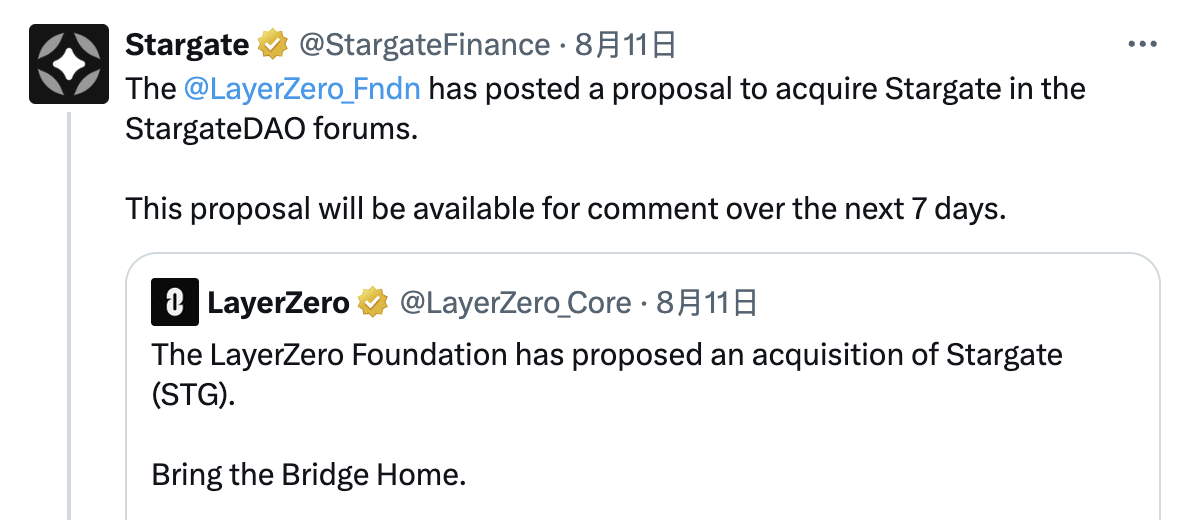
提案公布后,LayerZero 和 Stargate 的官推频频互动,双方大谈“合作共赢”,受此影响当日 ZRO 和 STG 也双双暴涨,但细看 Stargate 的治理论坛讨论内容,绝大多数 Stargate 均对该收购提案持反对态度,认为 LayerZero 的报价过于低估

前期进展:投票启动,大户碾压

8 月 18 日,该提案正式在 Snapshot 上启动投票,STG 持有者将共同决定是否接受该收购要约。相较于最初的提案,LayerZero 并未提高收购报价,而是宣称将向 veSTG 的持有者(即直接投票的用户)分享 Stargate 接下来六个月内总收入 50% 的分成。

投票启动后,不但快速突破了最低票数要求,支持率更是一度上冲至 97% 以上(根据规则,结束时超过 70% 即通过)。LayerZero 联合创始人 Bryan Pellegrino 在参与 CounterParty 的播客时甚至还骄傲地大谈:“这是 Stargate 历史上参与票数最多的投票。”
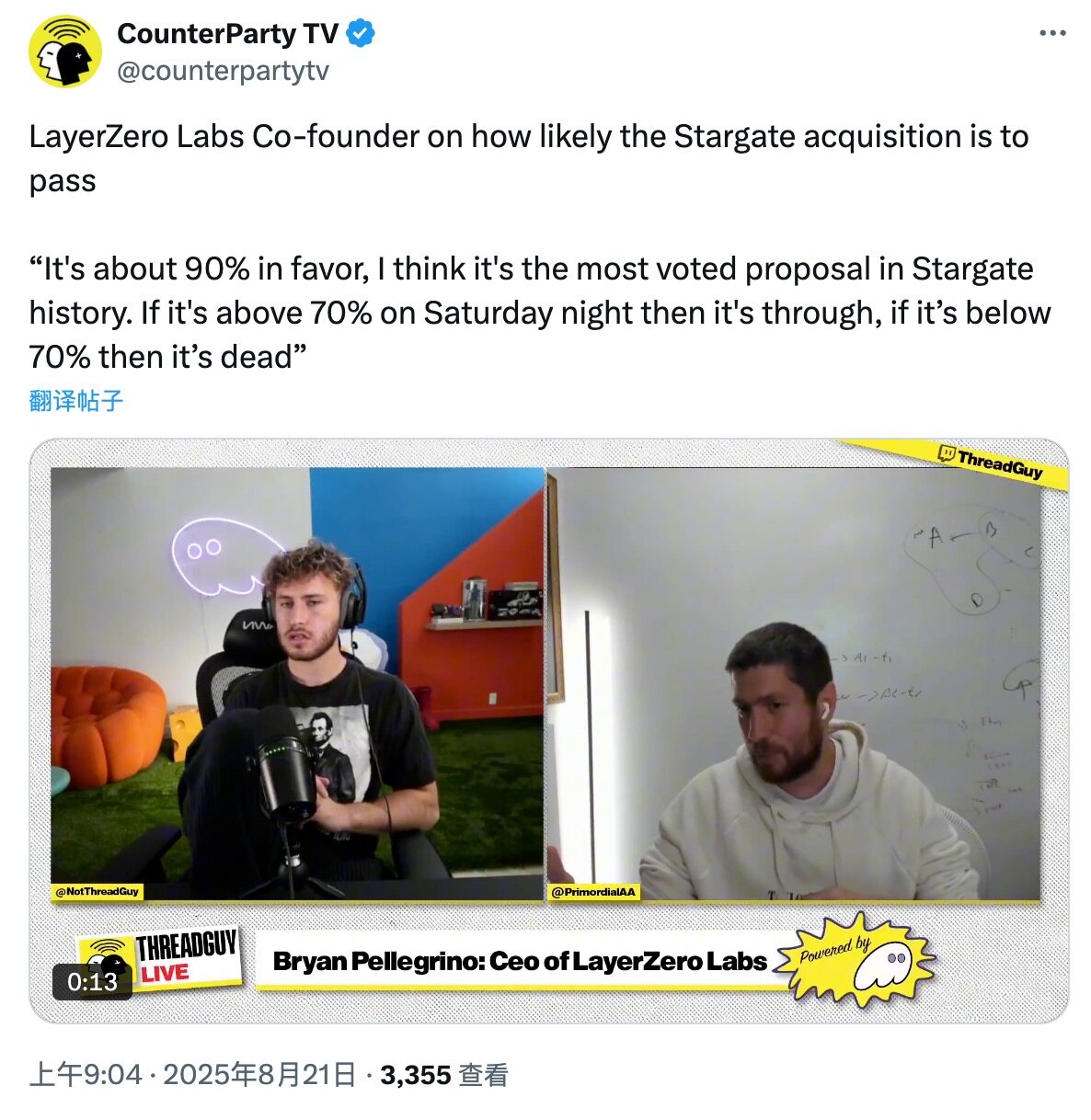
如此一边倒的票型并不令人意外,虽然许多 Stargate 社区成员对报价持反对态度,但 LayerZero 和 Stargate 作为完全绑定的后端协议与前端产品,两家项目本就很难作为两个独立实体看待,甚至于 Stargate 基金会一半的董事会成员都由 LayerZero 方面出任……再结合 LayerZero 和 Stargate 的互动话术来看,不难想象双边的利益相关方本就控制着足够的票权,说白了这就是一场“注定会通过,但需要有个过场”的投票

Wormhole 的阳谋:即便抢不动,也得恶心你一下

可能就连 LayerZero 和 Stargate 双方都没想到,Wormhole 会在如此关键的时刻横插一脚。

截至发文,有别于 LayerZero 提出收购后双方频频互动的“和谐景象”,在 Wormhole 提出有意收购后,Stargate 官方推特没有发布任何一条相关动态,而 LayerZero 方面也仅有联合创始人 Bryan 疑似回应了一句:“这不可能发生。”

截至发文,Wormhole 方面尚未提出正式报价,而原因也让人哭笑不得 —— Wormhole 声称需要更多时间对 Stargate 的估值进行尽调,因为他们不像 LayerZero 那样熟悉 Stargate,熟悉到占了后者半数的基金会董事席位……
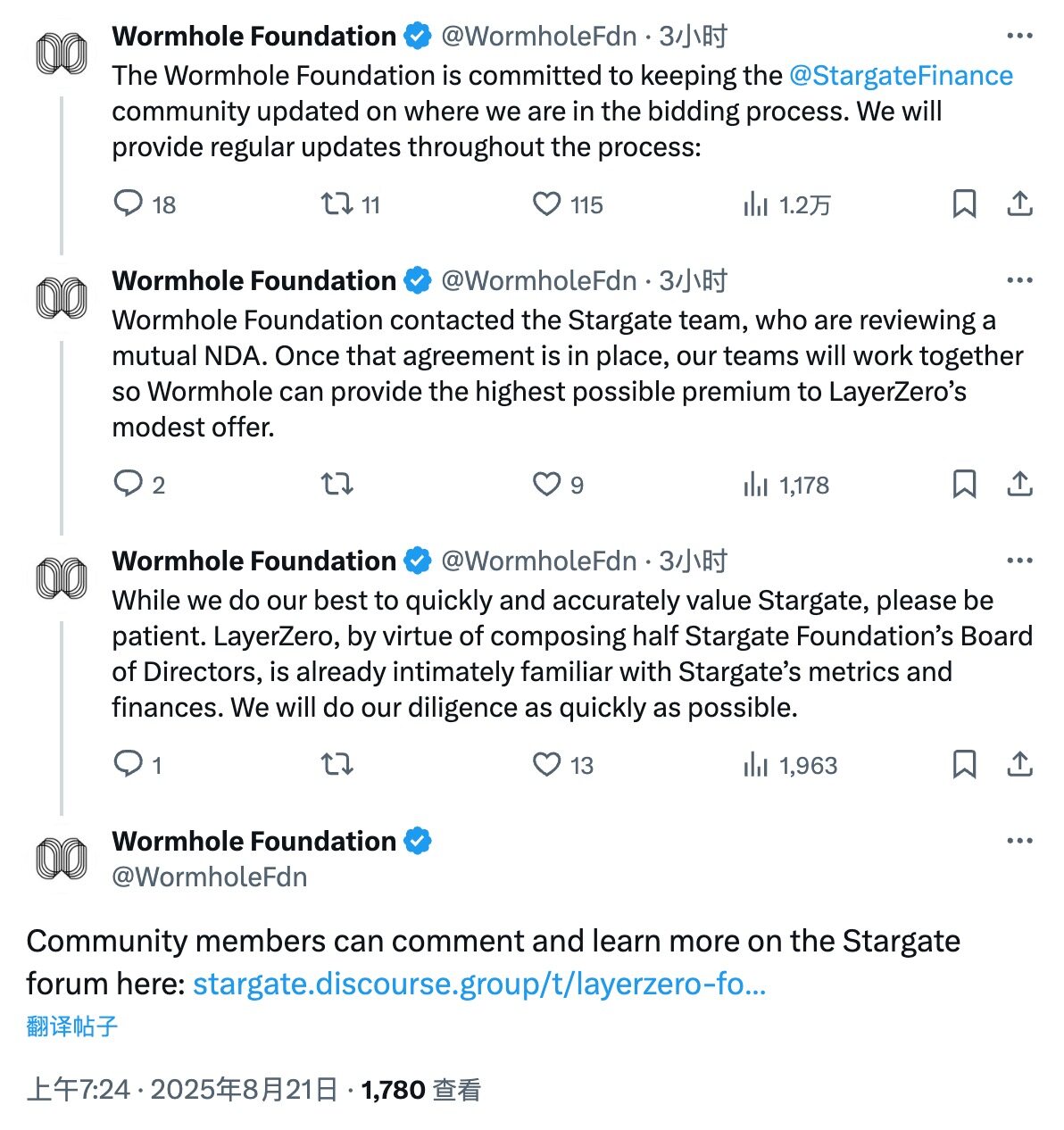
综合目前的情况看来,该起事件后续的发展无非以下四种情况,而无论哪种情况,Wormhole 都会乐见其成。

  • 第一种情况是 Stargate 方面暂停投票,继而进入 Wormhole 和 LayerZero 的竞价,最终假设 Wormhole 获胜。如此一来,Wormhole 将直接夺走最大竞争对手的核心产品,从而抢占更多的市场份额。
  • 第二种情况则是假设 LayerZero 竞价获胜,或是 LayerZero 单方面提高报价并推进提案,如此一来 LayerZero 将支付给多资金给予 STG 持币用户,Wormhole 一分钱不出也能看着对手消耗更多。
  • 第三种情况则是 Stargate 方面以流程已启动为由无视 Wormhole 的报价,提案将以原状况继续推进(目前支持率仍超),如此一来假设 LayerZero 完成了收购,利益上错失更高报价的 STG 必然会因此而恼怒,Wormhole 很乐于看到 LayerZero 方面的社区分裂。
  • 第四种情况也是 Stargate 强行推进投票,假设提案最终以 Stargate 社区反对而失败(目前支持率仍超 88%,失败可能性极低),Wormhole 阻挠计划成功。

综合来看,我个人会更倾向第二种和第三种剧本,毕竟 Stargate 作为 LayerZero 的核心产品,后者绝对不愿意承担损失该产品的后果。

Fluid 首席运行官 DMH 很精炼地概括了当下的状况:“显然 Stargate 和 LayerZero 在提案之前就已经达成一致;Wormhole 很生气,LayerZero 竟然用一袋米买了新加坡;因此 Wormhole 选择抬价,试图扰乱 LayerZero 的收购计划;但 Stargate 最终一定会被 LayerZero 吸收,这一点市场都心知肚明,所以不会有出现任何戏剧情况。”

Wormhole 可能在报价之前也已知道最终的结果早就注定,但动动嘴皮子就能让最大的竞争对手极度恶心,且自己毫无损失,这波简直是顶级阳谋。

İlgili Okumalar

Bernstein's 97-Page Report Decoded: The Battle for AI Data Center Connectivity, Who Will Be the True Winner by 2026?

Bernstein's 97-page report analyzes the AI data center connectivity landscape. It argues that the bottleneck is shifting from raw compute (GPU) to the systems connecting GPUs, crucial for cluster efficiency. Copper and optical interconnects are not in a simple replacement cycle but will coexist long-term, with copper dominating short-distance "scale-up" connections and optics favored for longer "scale-out" scenarios. While Co-Packaged Optics (CPO) is the long-term direction for power and cost savings, its widespread adoption faces manufacturing and reliability hurdles, with mass deployment unlikely before 2028. Transitional technologies like Linear Pluggable Optics (LPO) and Near-Packaged Optics (NPO) are seen as near-term leaders. A key insight is that CPO will fundamentally reshape the value chain, shifting profits from traditional optical module suppliers towards chip designers (e.g., NVIDIA, Broadcom), advanced packaging (e.g., TSMC), and system integrators. For 2026, the report highlights more immediate and certain investment opportunities in the essential "infrastructure" enabling this connectivity shift. This includes upgrades for PCBs, ABF substrates, and CCLa driven by new AI server/switch platforms, alongside demand for 1.6T optical modules, LPO/NPO, and the testing/validation equipment required for future CPO scale-up.

marsbit35 dk önce

Bernstein's 97-Page Report Decoded: The Battle for AI Data Center Connectivity, Who Will Be the True Winner by 2026?

marsbit35 dk önce

Understanding the New Economic Model of Tokenization

Understanding the New Token Economics Model The commercialization of AI applications is evolving from selling software and subscriptions to selling token call capacity. Tokens, the fundamental unit of information processing for large language models (LLMs), have become the basis for API billing and consumption. With call volumes exploding, tokens themselves are now being traded—procured, routed, split, and resold—forming a new intermediary market. This layer connects upstream LLM providers with downstream developers and enterprises, acting as a global wholesale-to-retail liquidity network. The rise of this business is fueled by a massive surge in China's daily token call volume—growing over a thousandfold from 100 billion in early 2024 to over 140 trillion by March 2026—and significant improvements in domestic LLM capabilities, which are now competitive globally. The core value of token distribution platforms extends beyond simple arbitrage. Key functions include aggregating multiple models (like GPT, Claude, and domestic models such as Kimi and DeepSeek) under a unified API, lowering network and payment barriers, and providing enterprise services like model selection, prompt engineering, and system integration. Profit models are diversifying: (1) resale margins; (2) technical premiums from proprietary inference acceleration (e.g., reducing costs to 1/10 of the industry standard); and (3) enterprise value-added services. High-consumption scenarios like marketing, short-form video, gaming, and e-commerce are primary drivers. Investment opportunities are seen in both companies with strong model capabilities (e.g., Alibaba, Tencent, MiniMax) and those with high-consumption client scenarios (e.g., marketing agencies with overseas reach). However, risks are significant: low entry barriers leading to intense competition, capital requirements and bad debt risks from advance payments, and dependency on policy changes from upstream LLM providers who control API pricing and access.

marsbit56 dk önce

Understanding the New Economic Model of Tokenization

marsbit56 dk önce

Farewell to the Copper Era: Understanding the Logic of the AI Silicon Photonics Industry Chain and Key US Stock Players

**Summary: The Era of Silicon Photonics and Key AI Infrastructure Stocks** The article delves into the transition from copper-based interconnects to silicon photonics (SiPh) as a critical enabler for next-generation AI data centers. It explains that copper faces fundamental physical limits—the bandwidth wall, density wall, and power wall—at high data rates (1.6T+), making a material shift essential. Silicon photonics, which integrates components like lasers, modulators, and detectors onto a silicon chip, offers a solution by leveraging mature CMOS manufacturing for cost-effective, high-volume production. A key challenge is that silicon itself is not an efficient light source, making Indium Phosphide (InP) lasers a critical and supply-constrained component. A major industry catalyst was NVIDIA's 2025 GTC announcement, declaring optical interconnects a "standard" from its Rubin platform onward, followed by strategic investments to secure the supply chain. The industry is structured in four key layers: 1. **Foundries:** TSMC leads with its COUPE platform, while Tower Semiconductor (specialized SiPh foundry) and GlobalFoundries are major players. 2. **Core Component Suppliers:** Lumentum is highlighted as the sole volume manufacturer of the crucial 200G/lane EML laser, with orders locked by NVIDIA through 2027. 3. **Module & System Manufacturers:** Coherent holds significant market share, with Chinese manufacturers like InnoLight also noted for scale. 4. **System Integrators:** NVIDIA, Broadcom, and Marvell dominate this layer, setting standards and integrating technology. The article identifies core public investment targets: **NVIDIA (NVDA)** as the ecosystem driver; **Broadcom (AVGO)** and **Marvell (MRVL)** in networking/switching chips; **Lumentum (LITE)** and **Coherent (COHR)** for critical components; and foundries **TSMC (TSM)** and **Tower Semiconductor (TSEM)**. Private companies Lightmatter and Ayar Labs are noted as key IPO candidates. The silicon photonics shift is driving a re-rating of company valuations, moving them from traditional telecom/industrial metrics to premium AI infrastructure multiples. The industry features high barriers to entry (e.g., multi-year lead times for InP laser capacity, complex 3D integration/thermal management, and lengthy customer qualification cycles), suggesting a "winner-takes-most" dynamic. Risks include dependence on hyperscaler capex cycles, potential technology disruption among competing optical approaches (LPO, CPO, OCS, Optical I/O), and a timeline where widespread CPO deployment may not occur until ~2028, with LPO serving as a transitional technology. The conclusion advises that betting on the overall industry trend may be safer than betting on any single company.

marsbit1 saat önce

Farewell to the Copper Era: Understanding the Logic of the AI Silicon Photonics Industry Chain and Key US Stock Players

marsbit1 saat önce

İşlemler

Spot
Futures
活动图片