Bitcoin breaks ATH – Identifying why BTC’s rally is just getting started!

Ambcrypto2025-07-12 tarihinde yayınlandı2025-12-29 tarihinde güncellendi

Özet

The signs of market exhaustion and widespread profit-taking were not here for Bitcoin despite the swift short-term rally.

Key Takeaways

Bitcoin hit $118.8K on the 11th of July, but on-chain data showed low retail activity, moderate MVRV Ratio, reduced Short-Term Holder profits, and declining Miner Position Index. All of these signal the rally isn’t over yet.

Bitcoin [BTC] was trading at $117,783, after clocking a fresh all-time high of $118,856 earlier that day, as bullish sentiment started to drive the market upward.

Google Trends showed that the Bitcoin topic was still not popular in the United States, and was far away from the peaks of 2020, or even November 2024.

No retail frenzy in sight
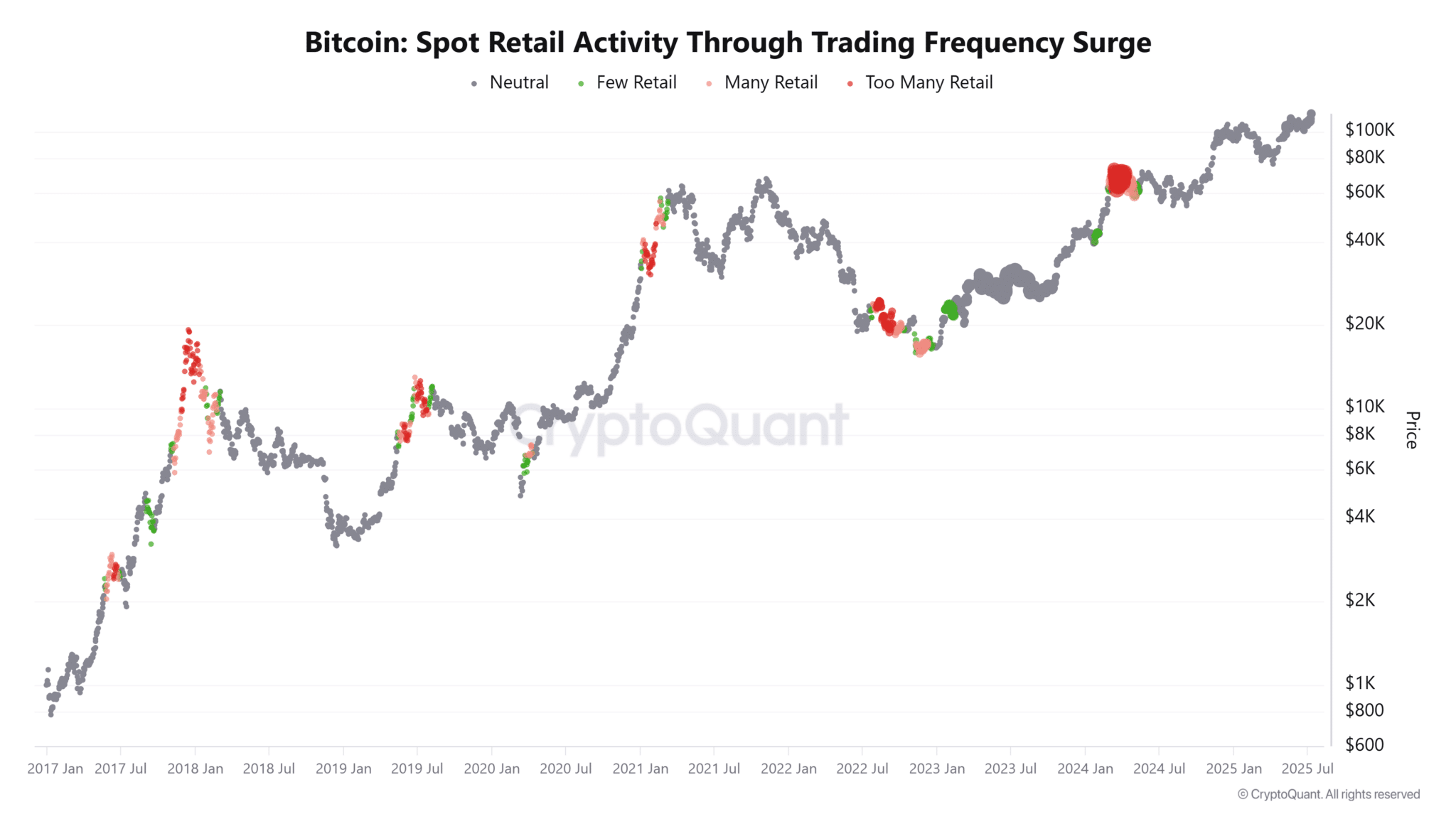
The trend of a lack of retail euphoria was visible in the Spot Retail Activity.

Using the trading frequency and position size to understand whether retail participation was increasing, this metric is a useful tool in understanding whether smaller market participants were flooding in.

According to CryptoQuant, this metric hasn’t seen a retail surge since March 2024. That mirrors earlier cycles too: in February 2021, retail jumped in, and BTC soon met rejection near $60k.

Further evidence that the Bitcoin market has not overheated
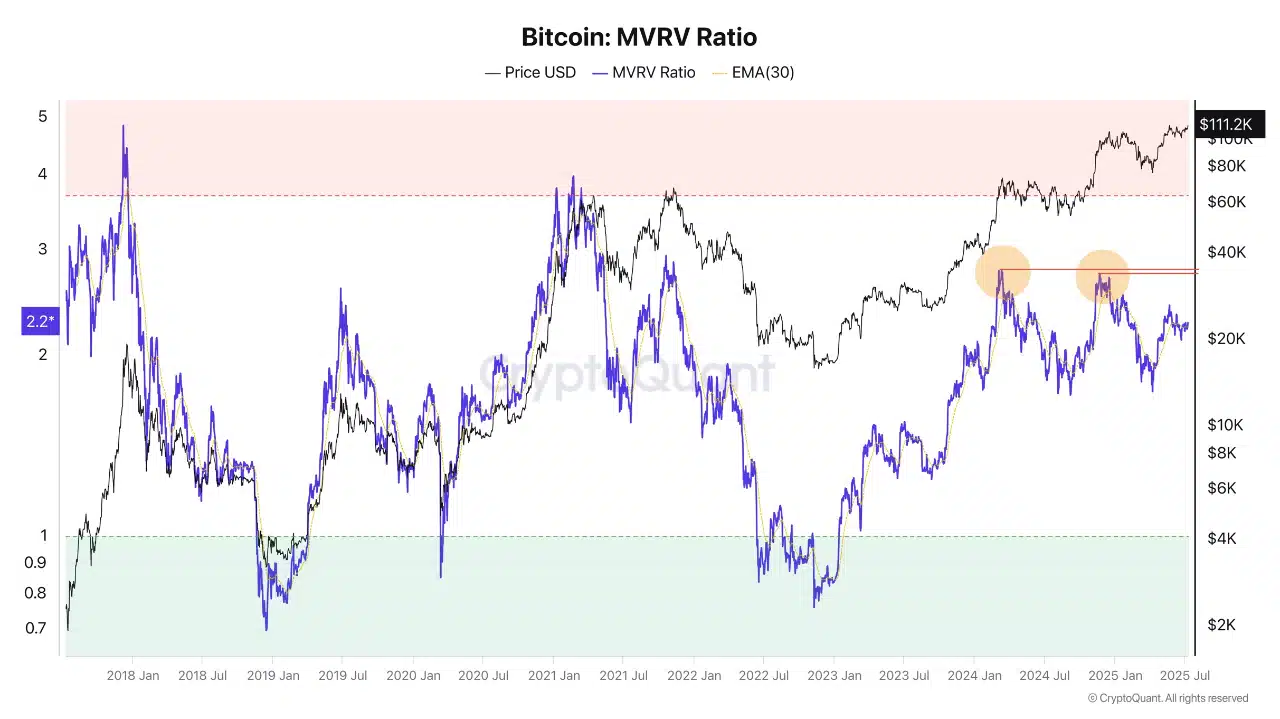
In a post on CryptoQuant Insights, analyst Avocado_onchain demonstrated how the market sentiment and dynamics were strikingly different from the previous market peaks.

The MVRV Ratio exceeded 2.7 in March and December 2024. On the 11th of July, though, the reading hovered around 2.2—a signal of healthier market conditions.
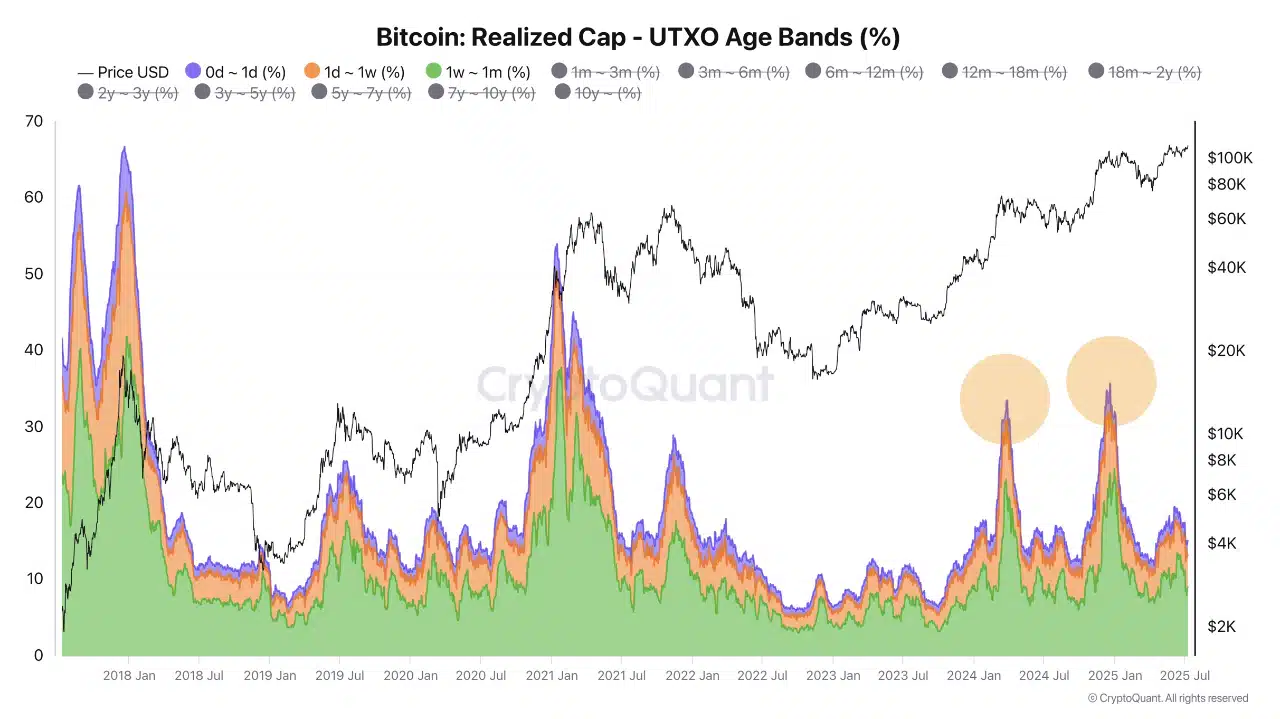
Another important cue came from the UTXO Age Bands, which analyze how long each Bitcoin remains unspent.

Data showed that 15% of the BTC supply belonged to Short-Term Holders (STH)—wallets holding coins for under a month. For context, this figure sat near 30% at prior cycle peaks.
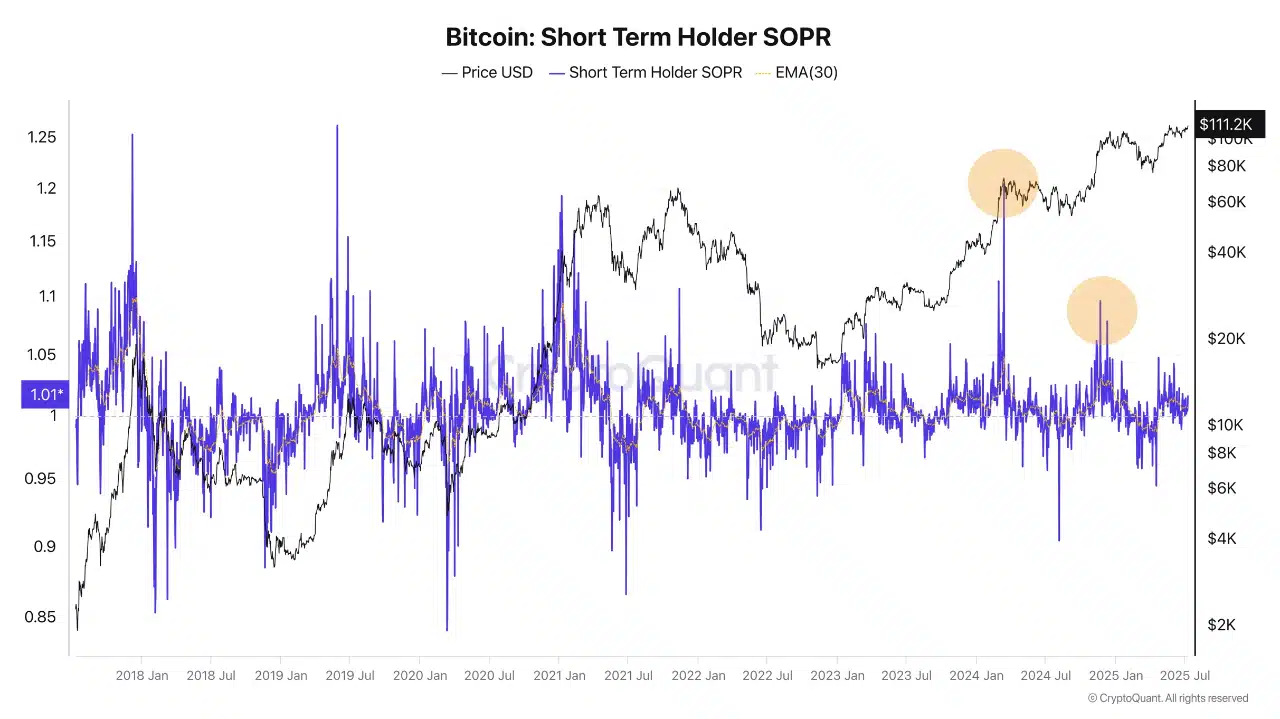
Moreover, the STH SOPR showed that holders were not sitting on large profits. This was another clue of minimal sell pressure from profit-taking activity from STH Bitcoin wallets.

Miners keep stacking – another reason bulls aren’t done
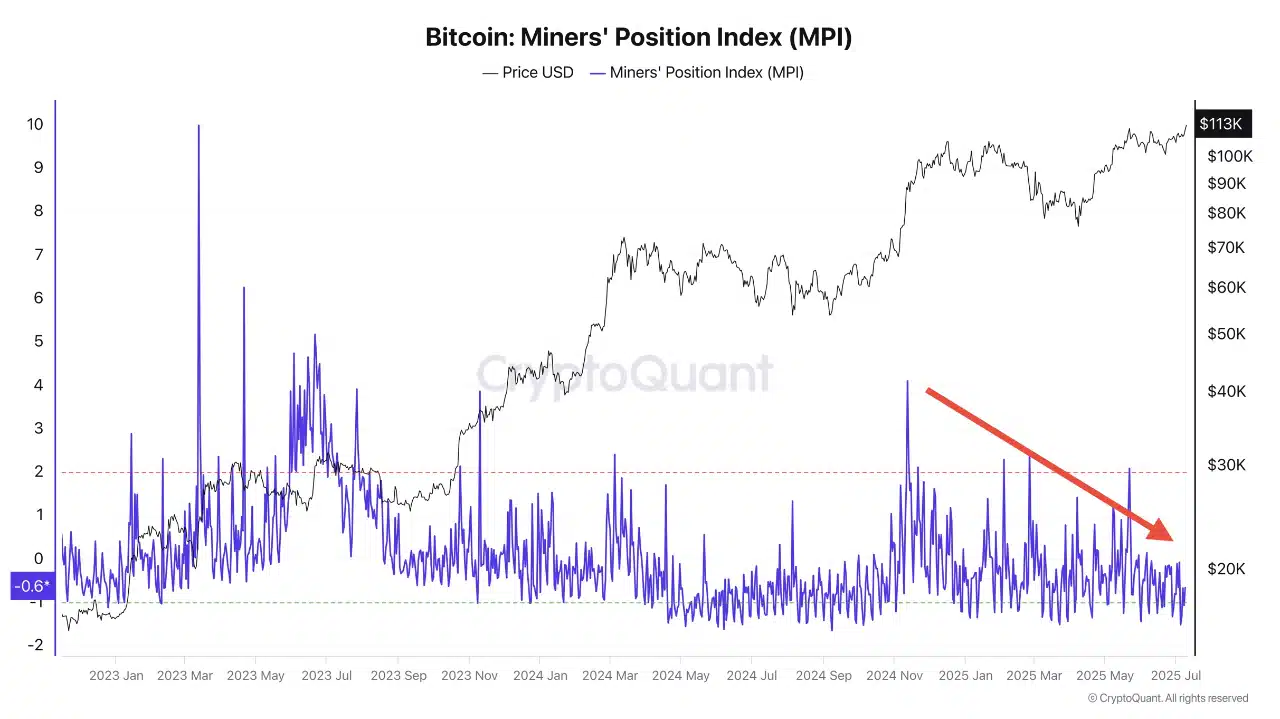
Finally, the Miner Position Index was also trending downward since November 2024. This showed reduced selling pressure from miners.

Mining companies have tended to accumulate Bitcoin instead of selling it, showing that they expected prices to continue to grow.

Overall, the signs of market exhaustion and widespread profit-taking were not here. There was hope that Bitcoin’s price would trend higher in the coming months, and the bull run was not yet over.


İlgili Okumalar

What Does $150 Billion in Annual Derivatives Liquidations Mean for the Market?

According to CoinGlass data, forced liquidations in the cryptocurrency derivatives market reached $150 billion in 2025. While seemingly alarming, this reflects a structural norm in a market where derivatives dominate price discovery. Liquidations act as a periodic cost of leverage, occurring against a backdrop of $85.7 trillion in annual derivatives trading volume. Record-high open interest, crowded long positions, and high leverage—particularly in altcoins—combined with a global risk-off sentiment triggered a major market reversal in October, resulting in over $19 billion in liquidations within days, mostly from long positions. The core issue lies in risk amplification mechanisms: while routine liquidations are absorbed by insurance funds, Automatic Deleveraging (ADL) mechanisms can exacerbate selling during extreme volatility, especially hurting neutral strategies and smaller assets. High exchange dominance (the top four control 62% of derivatives trading) intensified the contagion risk, as synchronized de-risking and similar liquidation logic led to concentrated sell-offs. Infrastructure strain on bridges and fiat channels further hampered arbitrage and liquidity. The $150 billion in yearly liquidations signifies not systemic chaos but the cost of risk transfer. While no default cascades occurred in 2025, the event highlighted structural vulnerabilities of exchange concentration, high leverage, and certain mechanisms—underscoring the need for more robust systems and rational trading practices to prevent future crises.

marsbit11 dk önce

What Does $150 Billion in Annual Derivatives Liquidations Mean for the Market?

marsbit11 dk önce

Looking Back at Prediction Markets by the End of 2025: Scale, Players, and the Watershed Moment

By the end of 2025, prediction markets have fundamentally shifted from being event-driven tools reliant on black swan events to platforms sustained by structural trading demand. The total monthly trading volume has grown from under $100 million in early 2024 to over $1 billion by late 2025, indicating a phase of explosive growth and consistent liquidity. The industry has evolved into five distinct segments: 1. **Compliant Markets**: Kalshi (CFTC-regulated, exchange-like) and Polymarket (globally liquid, later US-compliant) lead with institutional and high-frequency trading, especially in sports contracts. 2. **Crypto-Native Experiments**: Platforms like Opinion explore high-risk, crypto-policy, and speculative events, driving innovation but facing regulatory uncertainty. 3. **High-Frequency Trading Platforms**: Limitless shortens contract cycles, blurring lines between prediction markets and derivatives trading. 4. **Embedded Markets**: Myriad Markets integrates prediction features into wallets and super-apps, reducing user acquisition costs and making participation more casual. 5. **Native Information Markets**: Platforms like predict.fun and media integrations use incentives and community mechanisms to blend prediction with content and social interaction. Regulation in 2025 has not meant full liberalization but rather the establishment of boundaries—predictive contracts are recognized as financial instruments, yet state-level gambling laws remain a friction point. The core shift for users is understanding that these markets now price uncertainty and reflect consensus, not just binary outcomes. Looking ahead, prediction markets are becoming tools for understanding uncertainty rather than mere betting arenas, with projections suggesting significant future growth. 2025 marks the beginning of this structural transformation.

比推22 dk önce

Looking Back at Prediction Markets by the End of 2025: Scale, Players, and the Watershed Moment

比推22 dk önce

İşlemler

Spot
Futures

Popüler Makaleler

Tartışmalar

HTX Topluluğuna hoş geldiniz. Burada, en son platform gelişmeleri hakkında bilgi sahibi olabilir ve profesyonel piyasa görüşlerine erişebilirsiniz. Kullanıcıların BTC (BTC) fiyatı hakkındaki görüşleri aşağıda sunulmaktadır.

活动图片