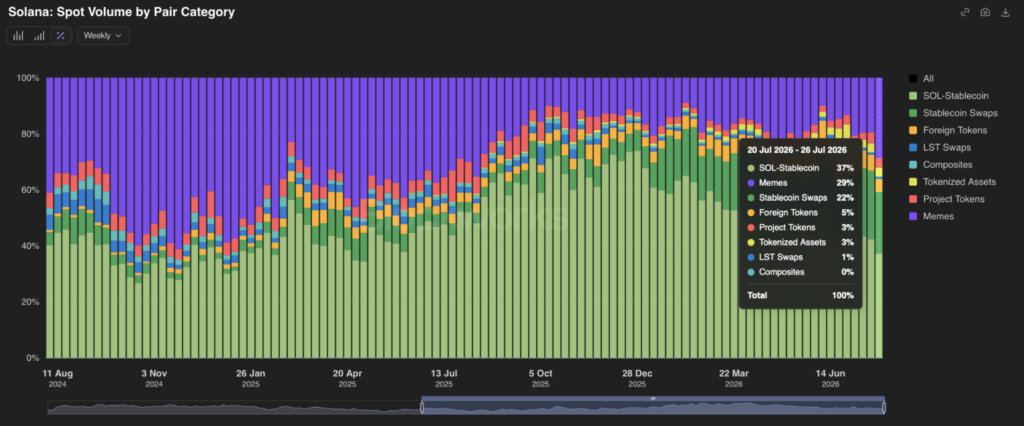
During the week of July 20-26, memecoin activity on Solana reached levels not seen since August of last year. Data from Blockworks shows that memecoins accounted for 29% of the network's decentralized exchange spot volume, a significant jump from figures just a few weeks earlier, which ranged from 10% to 15%.
Source: Blockworks
The rest of the chart counters the simplistic conclusion that Solana is a meme-dominated network. SOL-stablecoin pairs accounted for 37% of trading volume for the same week, while stablecoin swaps made up another 22%. Foreign tokens comprised 5%, with project tokens and tokenized assets each at 3%. Memes took second place, not first.
$ANSEM Brought Dormant Traders Back to Work
The revival of memecoins on the network can actually be traced back to a single token. $ANSEM, or "The Black Bull," was launched on Pump.fun in late June. It has no product, team, or roadmap. However, its advantage lies in its connection to Ansem, one of the most active traders on Solana, after an anonymous developer airdropped a large portion of the supply to his wallet, and he decided to engage with it rather than ignore it. He then promised to redistribute his content creation fees from Pump.fun to holders via weekly distributions. It was this promise, not any protocol mechanism, that traders were buying into.
$ANSEM saw an explosive rise of approximately 18,000% in just three days. The growth didn't stop there, and on July 7th, the market capitalization peaked around $449 million. That alone was able to breathe new life into Solana. Trading volumes on Pump.fun gradually began to climb, and according to DefiLlama, about $614 million of Solana's roughly $1.65 billion daily DEX volume is now traded on that platform.
Notably, this is happening at a time when sentiment in the crypto sector is still in the fear zone, at a level of 29.
Stablecoin Volume Surpassed $15 Billion and Remained at That Level Throughout the Downturn
The memecoin revival does not mean the network has regained memechain status. That definition ceased to fit Solana some time ago, and the volume structure is just the tip of the iceberg of reasons why.
In July, the stablecoin supply volume exceeded $15 billion. Non-USDC and non-USDT stablecoins account for about $4.81 billion of that sum. The crucial point is not the peak amount, but its resilience. This liquidity did not disappear during the 2026 downturn, when speculative capital is typically the first to leave.
Two companies have leveraged this chain. Western Union placed USDPT on Solana as a settlement layer, and B2C2 named this chain its primary network for stablecoin settlements. B2C2 is an institutional market maker, so this is an operational decision concerning where trade settlements actually occur. It is not a partnership announcement.
In Terms of Tokenized Real-World Asset Alliances, Solana Quietly Took a Leading Role
Solana hosts 2,582 tokenized real-world assets, more than any other network by asset count, according to rwa.xyz data. The total value of distributed assets in the network has surpassed $3.5 billion. Only Robinhood Chain has more asset holders, with Robinhood's holder base being formed by a single broker bringing its users onto the network, while Solana's is formed by a broader range of issuers.
Stablecoins and RWAs are the unglamorous half of the network. However, it is this half that grew while prices fell.
Memecoin volumes are cyclical by nature. Over twelve months, they fell from 29% to single digits and returned to previous levels, and this will repeat the next time a ticker grows 300% in a week. The stablecoin supply and the volume of Risk-Weighted Assets (RWAs) moved in one direction over the same period, including through the parts that no one enjoyed.