Not AI, Not War: What the US Stock Market Should Worry About Is Japan?

marsbit2026-07-24 tarihinde yayınlandı2026-07-24 tarihinde güncellendi

Özet

Global markets may be underestimating a systemic risk from Japan. As the yen hits multi-decade lows and domestic asset appeal rises, the world's largest pension fund, the Government Pension Investment Fund (GPIF), faces policy pressure to repatriate substantial assets. Such a shift could pressure U.S. stocks, bonds, and the dollar. GPIF manages roughly $1.8 trillion, with about half invested overseas. Even a modest reallocation to Japan could boost yen demand and Japanese government bond buying, potentially raising U.S. yields and weakening the dollar. Unwinding of yen carry trades could further pressure risk assets. This potential move is driven by improving fundamentals in Japan: rising inflation, economic recovery, and narrowing yield gaps with the U.S. The yen's depreciation to levels not seen since 1986 also enhances domestic investment appeal. While markets currently price in limited risk, key indicators like the dollar-yen cross-currency basis swap are showing subtle shifts. A surge in hedging demand for yen appreciation could tighten liquidity and impact U.S. equities. Conversely, GPIF repatriation could benefit Japanese equities, which trade at a discount to U.S. markets and are driven by corporate governance reforms. However, persistent yen weakness remains a major hurdle for foreign investors' returns.

Author: Zhao Ying

The global market is underestimating a potential systemic risk—Japan. As the yen falls to multi-decade lows and the appeal of domestic Japanese assets rises, the world's largest pension fund is facing policy pressure to repatriate its massive asset holdings back to Japan on a large scale. Once this process begins, the US stock market, bond market, and the US dollar may come under simultaneous pressure.

Recently, Japanese Prime Minister Takaichi Sanae stated that the government will promote the Government Pension Investment Fund (GPIF) and other national pension funds to increase their investment in domestic Japanese financial assets. Finance Minister Katayama Satsuki previously gave a similar signal. Although the GPIF has not announced any formal asset allocation adjustments, the market has already begun to assess its potential impact: if the fund repatriates its overseas holdings back to Japan, US Treasury yields may rise, the US dollar may weaken, and risk assets may come under pressure.

Currently, the market's pricing of the aforementioned risk remains relatively calm, but some technical indicators are already showing subtle changes, and investors should not be complacent.

The $1.8 Trillion Variable

The GPIF manages approximately $1.8 trillion, with domestic and foreign assets each accounting for about half, of which its overseas holdings total about $930 billion. In recent years, the fund's holdings of Japanese government bonds have decreased from about $770 billion to about $515 billion, while its holdings of foreign bonds have increased from about $128 billion to about $470 billion.

This structural change means that even a small-scale asset reallocation could trigger significant waves in the global market. According to a MarketWatch report, analyst Michael Kramer pointed out that if the GPIF repatriates some of its overseas assets back to Japan, it will directly boost demand for the yen and introduce a massive buying wave into the Japanese government bond market—a positive for Japan, but for the US, it implies higher interest rates and a weaker dollar.

At the same time, any large-scale unwinding of yen carry trades (i.e., borrowing low-interest yen, converting to US dollars, and investing in US assets) would further pressure the performance of risk assets.

Yen and JGBs: The Appeal of Domestic Assets Is Rising

Driving the potential GPIF reallocation is a substantial improvement in the fundamentals of Japanese domestic assets. With Japan's inflation recovering and economic growth resuming, the appeal of domestic investment opportunities has significantly increased. In February, the yield spread between US and Japanese two-year government bonds narrowed to its lowest level since early 2022.

At the same time, the yen has continued to weaken, with USD/JPY breaking above 163, reaching its highest level since 1986. From a technical analysis perspective, if the exchange rate rises further, the next resistance level is around 176. According to a report by the Financial Times, Fredrik Repton of Neuberger Berman believes that if GPIF allocates more funds to domestic assets, this could be a "very elegant solution" to Japan's macroeconomic problems, but other domestic financial institutions would also need to follow suit, and "this process will take a long time."
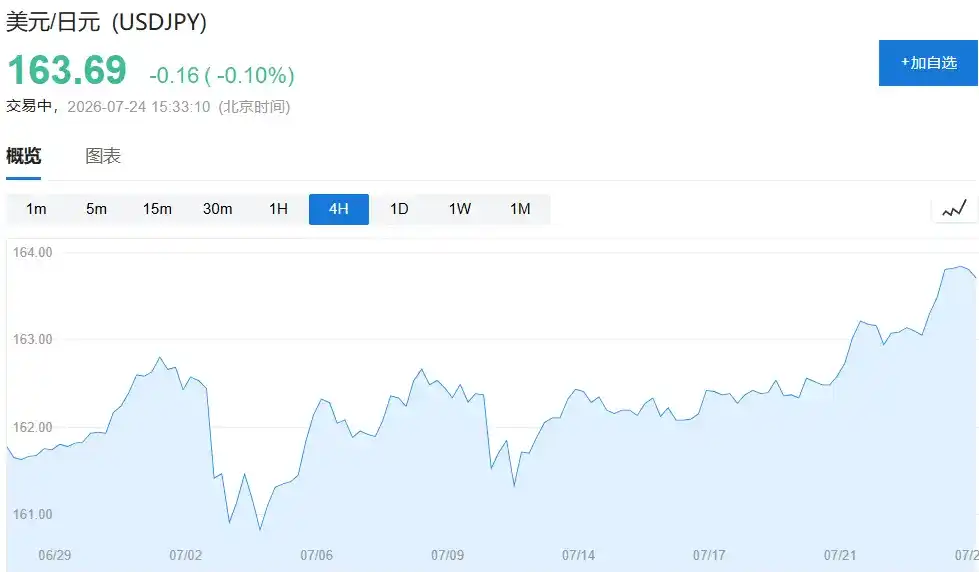
Japan's 10-year government bond yield recently touched 2.7%, the first time in 30 years. Deutsche Bank analyst Mallika Sachdeva pointed out in a recent report that the focus of Japanese authorities' policy may be shifting from exchange rate management to yield management, and if this shift materializes, it will put further pressure on the yen.

Market Not Yet Pricing It In, But Signals Are Emerging

Currently, the global market's reaction to the risk of Japanese capital repatriation remains relatively restrained. The five-year USD/JPY cross-currency basis swap recently stood at about minus 30 basis points, the narrowest level since this data series began in 2021, indicating that the market's hedging demand for a stronger yen has not yet risen significantly.

However, this indicator itself is a key signal for observing whether capital flows are beginning to shift. Historical data shows that the S&P 500 index and the cross-currency basis swap have moved in sync during multiple periods—whenever hedging demand rises sharply, the US stock market often declines as liquidity tightens accordingly. Once market expectations for yen appreciation heat up, the demand for USD hedging will climb accordingly, and the liquidity tightening effect will become more pronounced.

Japanese Stocks: The Other Side of the Risk

It is worth noting that while the potential asset reallocation by GPIF may bring pressure to US markets, it also provides a new narrative logic for Japanese stocks. The Japanese stock market is benefiting from drivers that are distinctly different from those in the US market: the concentration of the technology sector in the Topix index is much lower than in the S&P 500, its exposure to artificial intelligence is relatively limited, and its valuation still trades at a discount of more than 20% compared to the S&P 500.

Corporate governance reform is a core catalyst for Japanese stocks. Dan Rasmussen of Verdad Advisers points out that there are still about 1,000 companies in Japan whose stock prices are below book value, and among the cheapest quintile of companies, cross-shareholdings still account for about 40% of their market capitalization. As cross-shareholdings are gradually unwound, a large amount of historically accumulated profits is expected to be released, having a materially positive impact on corporate earnings.

However, for foreign investors, the persistently weakening yen is the biggest obstacle—over the past two years, yen depreciation has significantly eroded the real returns of foreign capital in the Japanese stock market. How to handle currency hedging, and whether the hedging cost is bearable, remain core issues facing global investors.


Trend Kriptolar

İlgili Sorular

QWhat is the main systemic risk that global markets are currently underestimating according to the article?

AThe article states that global markets are underestimating the potential systemic risk posed by Japan. Specifically, the risk arises from the possibility that Japan's Government Pension Investment Fund (GPIF) and other national pension funds might reallocate a significant portion of their foreign assets back to domestic Japanese investments.

QWhat would be the likely impact on the US if GPIF repatriates a portion of its foreign assets back to Japan?

AIf GPIF repatriates part of its foreign assets, it would likely lead to higher U.S. Treasury yields, a weaker U.S. dollar, and pressure on U.S. risk assets like stocks. This is due to reduced demand for U.S. bonds and dollars, alongside potential unwinding of yen carry trades.

QWhat is the current approximate size of GPIF's foreign asset holdings?

AGPIF's foreign asset holdings amount to approximately $930 billion, which is about half of its total assets under management of roughly $1.8 trillion.

QWhat is one of the key fundamental improvements in Japan that makes domestic assets more attractive, according to the article?

AOne key improvement is the recovery in Japanese inflation and economic growth, which enhances the attractiveness of domestic investment opportunities. This is evidenced by the narrowing yield gap between U.S. and Japanese two-year government bonds.

QWhat is a major catalyst for the Japanese stock market mentioned in the article, distinct from U.S. market drivers?

AA major catalyst for the Japanese stock market is corporate governance reform. This includes the unwinding of cross-shareholdings, which could release historically accumulated profits and substantially boost corporate earnings, unlike the U.S. market which is more driven by technology and AI concentration.

İlgili Okumalar

SemiAnalysis on the Epic Plunge: It's Not Over Yet

SemiAnalysis Weekly discusses the recent sharp correction in the semiconductor market after a historic first half. Analysts Doug O'Loughlin and Dylan note that despite healthy fundamentals, markets like South Korea's KOSPI have plunged 40%, wiping out leveraged retail investors. A core debate focuses on AI demand versus supply constraints. Dylan cites SemiAnalysis's internal use of AI coding agents, leading to a 100x increase in AI spending, as evidence of powerful demand. Doug agrees demand is strong but questions its exact magnitude, calling it a "trillion-dollar question." His primary concern is physical and financial bottlenecks: a shortage of 100,000 electricians in the US, massive $450B in corporate debt issuance by hyperscalers (funded by a shrinking pension pool), and labor/scale limits in regions like Taiwan, where TSMC constitutes 20% of GDP. The conversation covers market dynamics, including the typical semiconductor cycle where over-ordering leads to crashes, China's growing memory capacity, and the potential for older chips like the H100 to lose value as models scale. Politically, AI is seen as a likely scapegoat in upcoming elections, though not a top-tier voter priority. The analysts conclude that while the long-term potential is significant, the scaling path is narrowing. The challenge is matching exponential compute demands with real-world constraints on capital, labor, and permits, risking scenarios where massive investment outpaces near-term revenue generation.

marsbit6 dk önce

SemiAnalysis on the Epic Plunge: It's Not Over Yet

marsbit6 dk önce

After Robinhood's Aggressive Entry, Why is PUMP Defying the Trend and Rising?

Amid a prolonged crypto bear market that has strained many projects, Pump.fun stands out by maintaining strong profitability. Despite a major token unlock in mid-July that was expected to cause selling pressure, its native token PUMP has risen nearly 48% over the past month. Analysis shows only a small portion of unlocked tokens were sold, with 92% of investor allocations still held. A buyback-and-burn mechanism has also supported the price, though daily回购 funds have declined by 77.5% from their peak, partly due to a change in tokenomics and lower platform revenue. Pump.fun remains a top revenue generator in crypto, with annualized revenue of around $450 million, ranking just behind giants like Tether and Circle. However, its daily revenue is down about 69% from its all-time high, reflecting dependence on meme coin market cycles. The platform also faces a class-action lawsuit alleging market manipulation and securities violations. New competition has emerged with Robinhood Chain's launchpad, which recently saw higher weekly volume and active addresses than Pump.fun. While Pump.fun's metrics haven't declined yet, it has responded with a new token launch mechanism called BOOST to improve liquidity. This has increased platform activity but raised community concerns about potential exploitation for short-term pumps. Ultimately, Pump.fun's success remains tightly linked to meme coin speculation and broader market sentiment.

marsbit6 dk önce

After Robinhood's Aggressive Entry, Why is PUMP Defying the Trend and Rising?

marsbit6 dk önce

China Business Journal Unveils Cryptocurrency Extortion Scheme

China Business Journal, a state-run Chinese newspaper, has issued a warning about scammers using its name to extort cryptocurrency from companies. According to the publication, fraudsters are sending emails impersonating its journalists. These emails threaten to publish damaging information about a company unless a Bitcoin payment is made. The scammers, using Proton Mail addresses, claim to possess compromising material from a secretive investigation. The newspaper's representatives have clarified that it has no involvement with these messages. They emphasized that the publication does not engage in such practices, never demands payment to suppress stories, and does not negotiate in this manner. The editorial team believes the criminals are exploiting the newspaper's authoritative reputation to pressure companies into making hasty decisions under threat of reputational harm. China Business Journal stated it is collecting evidence of this brand misuse, analyzing the fraudulent emails, and preparing materials for law enforcement. It reserves the right to pursue both civil and criminal liability against the scheme's organizers. Companies are urged to carefully verify any communication purportedly from the newspaper, avoid transferring cryptocurrency to unknown recipients, and report such incidents to the authorities. The newspaper confirmed it will continue its own investigation into the matter.

cryptonews.ru42 dk önce

China Business Journal Unveils Cryptocurrency Extortion Scheme

cryptonews.ru42 dk önce

İşlemler

Spot

Popüler Makaleler

WAR Nasıl Satın Alınır

HTX.com’a hoş geldiniz! WAR (WAR) satın alma işlemlerini basit ve kullanışlı bir hâle getirdik. Adım adım açıkladığımız rehberimizi takip ederek kripto yolculuğunuza başlayın. 1. Adım: HTX Hesabınızı OluşturunHTX'te ücretsiz bir hesap açmak için e-posta adresinizi veya telefon numaranızı kullanın. Sorunsuzca kaydolun ve tüm özelliklerin kilidini açın. Hesabımı Aç2. Adım: Kripto Satın Al Bölümüne Gidin ve Ödeme Yönteminizi SeçinKredi/Banka Kartı: Visa veya Mastercard'ınızı kullanarak anında WAR (WAR) satın alın.Bakiye: Sorunsuz bir şekilde işlem yapmak için HTX hesap bakiyenizdeki fonları kullanın.Üçüncü Taraflar: Kullanımı kolaylaştırmak için Google Pay ve Apple Pay gibi popüler ödeme yöntemlerini ekledik.P2P: HTX'teki diğer kullanıcılarla doğrudan işlem yapın.Borsa Dışı (OTC): Yatırımcılar için kişiye özel hizmetler ve rekabetçi döviz kurları sunuyoruz.3. Adım: WAR (WAR) Varlıklarınızı SaklayınWAR (WAR) satın aldıktan sonra HTX hesabınızda saklayın. Alternatif olarak, blok zinciri transferi yoluyla başka bir yere gönderebilir veya diğer kripto para birimlerini takas etmek için kullanabilirsiniz.4. Adım: WAR (WAR) Varlıklarınızla İşlem YapınHTX'in spot piyasasında WAR (WAR) ile kolayca işlemler yapın.Hesabınıza erişin, işlem çiftinizi seçin, işlemlerinizi gerçekleştirin ve gerçek zamanlı olarak izleyin. Hem yeni başlayanlar hem de deneyimli yatırımcılar için kullanıcı dostu bir deneyim sunuyoruz.

299 Toplam GörüntülenmeYayınlanma 2024.12.11Güncellenme 2026.06.02

WAR Nasıl Satın Alınır

Tartışmalar

HTX Topluluğuna hoş geldiniz. Burada, en son platform gelişmeleri hakkında bilgi sahibi olabilir ve profesyonel piyasa görüşlerine erişebilirsiniz. Kullanıcıların WAR (WAR) fiyatı hakkındaki görüşleri aşağıda sunulmaktadır.

活动图片