Earnings Beat Expectations and Cloud Business Soars, So Why Is Google Still Falling?

链捕手2026-07-24 tarihinde yayınlandı2026-07-24 tarihinde güncellendi

Özet

Despite reporting better-than-expected Q2 earnings and explosive growth in its cloud business, Alphabet's stock price fell. Key results included total net revenue of $103.6B, beating estimates, and Google Cloud revenue surging 82% year-over-year to $24.8B. However, the market reacted negatively to a significant increase in the company's 2026 capital expenditure guidance, now projected between $195B and $205B, up approximately $15B. This elevated spending is expected to result in negative free cash flow for 2026 and 2027. Other concerns include the lack of share buybacks in Q2 and a planned $40B at-the-market equity offering, which could dilute shares. While search and YouTube revenues met or slightly exceeded expectations, they showed some moderation compared to prior quarters. Bank of America maintains a "Buy" rating with a $430 price target, arguing that the increased capital investment is directly linked to strong cloud demand, as evidenced by a massive $514B backlog. At current levels, the stock's valuation is seen as attractive relative to its growth prospects.

Author: Zhui Feng Trading Desk

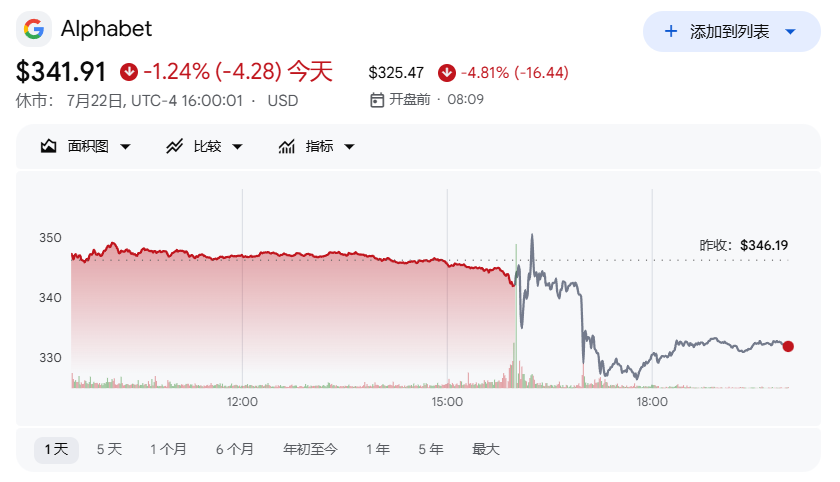
Alphabet, Google's parent company, delivered a stellar second-quarter report card, with cloud business growth far exceeding expectations, and overall revenue and earnings per share significantly beating Wall Street estimates. However, the stock still plunged, reflecting market concerns over deeper underlying issues such as a sharp spike in capital expenditures, negative free cash flow, and equity dilution.

According to a Bank of America Securities research report, Alphabet's Q2 net revenue reached $103.6 billion, higher than the market expectation of $101.1 billion. Google Cloud revenue grew 82% year-over-year, far surpassing the market expectation of 65%, with the acceleration being particularly notable.

Simultaneously, the company raised its fiscal year 2026 capital expenditure guidance by $15 billion to a range of $195 billion to $205 billion, a significant increase from the previous guidance of $180 billion to $190 billion. This news became the core variable suppressing the stock price.

Bank of America Securities analyst Justin Post maintained a "Buy" rating on Alphabet with a price target of $430 in the report. He pointed out that despite the negative market reaction to the raised capex guidance, the backlog of cloud business, customer overconsumption, and the continued expansion of cloud profit margins all indicate that incremental investments are directly translating into revenue growth.

In pre-market trading, Google's decline widened to nearly 5%.
Explosive Growth in Cloud Business, the Biggest Highlight of the Quarter

Google's cloud business achieved impressive accelerated growth this quarter.

Second-quarter cloud revenue reached $24.8 billion, an 82% year-over-year increase, not only significantly exceeding the market expectation of 65% but also accelerating by 19 percentage points compared to Q1's 63% growth. The cloud business operating margin rose to 35.6%, also higher than the market expectation of 31.3%, up 270 basis points from the previous quarter and nearly 15 percentage points from a year ago.

The Bank of America Securities report points out that behind the cloud business's strong performance, multiple data points support its sustainability: Cloud business backlog grew 11% sequentially and approximately 375% year-over-year in Q2, reaching $514 billion; actual customer spending exceeded contractual commitments by over 50%, higher than Q1's 45%; the rate of new customer acquisition is more than double that of the same period last year.

Furthermore, this quarter included new revenue from selling TPU chips to external customers. Management stated that even excluding TPU sales, cloud business growth would still be "significantly accelerating."

Google's model APIs currently process about 22 billion tokens per minute, a significant increase from last quarter's 16 billion; the weekly active users of the AI agent development platform AntiGravity have exceeded 2.4 million. Bank of America Securities expects Google Cloud revenue growth to further accelerate to 93% in Q3.

Search and Overall Performance: Exceeding Expectations but Highlights Uneven

Overall, Alphabet's Q2 GAAP earnings per share were $9.11, significantly beating the market expectation of $2.90. However, note that this included about $98 billion in other income, primarily from revaluation gains on Anthropic, whereas the market had previously expected this item to be only $0.8 billion. Excluding this one-time factor, the core business performance is more genuine.

Search revenue was $63.3 billion, a 17% year-over-year increase, roughly in line with market expectations but slightly weaker than the previous quarter's strong beat, seen by the market as a temporary "cooling" signal for the recent AI uptrend narrative.

Management also indicated that search business will face higher year-over-year comparables in Q3.

YouTube ad revenue was $11.1 billion, up 13% year-over-year, exceeding the market expectation of $10.8 billion, partially benefiting from brand advertising demand driven by the FIFA World Cup. Regarding operating margin, the Q2 GAAP operating margin was 39.3%, below the market expectation of 40.3%, mainly dragged down by G&A expense overruns—actual G&A spending was $6.46 billion, far above the market expectation of $5.1 billion. Management attributed this to several legal and other matters but did not provide detailed disclosure.

Soaring Capital Expenditures and Negative Free Cash Flow, the Market's Biggest Worry

The negative market reaction to this quarter's earnings stems from the core conflict surrounding the significant increase in capital expenditures and its impact on cash flow.

Alphabet raised its fiscal year 2026 capital expenditure guidance to $195 billion to $205 billion, an increase of about 8% from previous guidance and significantly higher than the market expectation of $187 billion. Bank of America Securities expects full-year 2026 free cash flow to be negative $16 billion, also negative in 2027.

Meanwhile, Alphabet did not conduct any share repurchases in Q2, and free cash flow was negative $5.9 billion. After completing a $45 billion hybrid capital financing in June this year, the company plans to launch a $40 billion at-the-market (ATM) equity offering in Q3. Bank of America Securities expects this will lead to an approximate 1% sequential increase in diluted shares outstanding in the second half of the year.

Bank of America Securities analyst Justin Post noted that while the above factors create short-term pressure, the increase in capital expenditures is directly linked to the rapid growth of the cloud business backlog—the $514 billion backlog size far exceeds the $15 billion incremental capital expenditure, meaning the logic of "more capacity equals more sales" still holds. He maintains his forecast for ~$200 billion in 2026 capital expenditures and raises his 2027 capital expenditure forecast to ~$300 billion, a ~51% year-over-year increase.

Valuation and Rating: Current Price Still Attractive

Bank of America Securities maintains its "Buy" rating on Alphabet and its $430 price target, based on a 27x P/E multiple applied to its 2027 adjusted GAAP EPS of $15.55, plus $11 per share in cash.

The report raises its 2026 net revenue forecast by 2% to $433.6 billion and EPS by 4% to $20.58; raises its 2027 net revenue forecast by 3% to $552.8 billion and EPS by 2% to $15.01.

At the after-hours price level of around $332, Alphabet trades at about 22x its 2027 GAAP EPS, in line with the company's 10-year historical average. However, Bank of America Securities expects 2027 revenue growth to be 27%, far above the average of 14% from 2023-2025.

From a sum-of-the-parts valuation perspective, after excluding assets like YouTube, the cloud business, Waymo, and cash, the implied valuation for Google's core ads and Play business is only 13x expected 2026 earnings, below the S&P 500's 20x.


Trend Kriptolar

İlgili Sorular

QWhy did Alphabet's stock fall despite exceeding earnings expectations and strong cloud growth?

AThe stock fell primarily due to concerns over significantly increased capital expenditure guidance, negative free cash flow, and upcoming equity dilution. The company raised its FY2026 capex guidance by $150 billion to $195-205 billion, leading to expected negative free cash flow for both 2026 and 2027. Additionally, no share buybacks were executed in Q2, and a $40 billion at-the-market (ATM) equity offering is planned for Q3, which will dilute existing shareholders.

QWhat were the key highlights of Alphabet's cloud business performance in Q2?

AGoogle Cloud revenue was $24.8 billion, up 82% year-over-year, significantly beating expectations of 65% growth. Cloud operating margins improved to 35.6%. Key supporting metrics include a 11% sequential increase in cloud backlog to $514 billion, customer consumption exceeding commitments by over 50%, and new customer acquisition being double the rate of a year ago. Revenue also included initial sales of TPU chips to external customers.

QWhat are the main concerns for investors regarding Alphabet's future financials?

AThe main concerns are the surge in capital expenditures, leading to projected negative free cash flow (-$16 billion for 2026, also negative for 2027), and expected shareholder dilution. The company plans a $40 billion ATM equity offering in Q3, which analysts estimate will increase diluted shares outstanding by approximately 1% in the second half of the year.

QHow did Alphabet's core advertising businesses perform in Q2?

ASearch revenue was $63.3 billion, up 17% year-over-year, essentially in line with market expectations but seen as a slight disappointment compared to prior outperformance. YouTube advertising revenue was $11.1 billion, up 13%, slightly beating expectations of $10.8 billion, partly benefiting from FIFA World Cup-related brand advertising. Overall GAAP operating margin was 39.3%, missing expectations due to higher-than-expected General & Administrative (G&A) expenses.

QWhat is Bank of America's investment rating and price target for Alphabet, and what is the valuation rationale?

ABank of America maintains a 'Buy' rating on Alphabet with a $430 price target. The target is based on a 27x P/E multiple applied to their 2027 adjusted GAAP EPS estimate of $15.55, plus $11 per share in cash. They view the current stock price (around $332) as attractive, trading at about 22x their 2027 GAAP EPS estimate, which is in line with its 10-year historical average, despite forecasted revenue growth of 27% in 2027, significantly higher than the 14% average from 2023-2025.

İlgili Okumalar

Altman Admits: Overestimated AI Snatching Jobs! Huang Renxun: The Unemployment Narrative Is Completely Backwards

Sam Altman has revised his earlier predictions about AI rapidly replacing jobs, admitting he overestimated the speed at which AI would eliminate entry-level white-collar roles. Speaking on the "Invest Like the Best" podcast, he stated that people do not truly want an AI CEO, as accountability and human connection remain critical. He found that individuals prefer interacting with people who can be held responsible for decisions. Similarly, NVIDIA's Jensen Huang argued that the narrative of AI destroying jobs is misguided. He distinguishes between tasks and jobs, noting that while AI can automate specific tasks, entire jobs—encompassing communication, judgment, coordination, and accountability—are not eliminated. He cited examples like radiologists and software engineers, where demand for these roles has increased as AI handles repetitive tasks, allowing for business expansion and the creation of more positions. Data from a University of Maryland and LinkUp study supports this, showing that U.S. job postings for new graduates have actually risen, countering the fear of vanishing entry-level roles. However, a significant shift is occurring: the traditional entry-level tasks that help newcomers gain experience are being automated, making initial career access more challenging. The key insight is that as AI takes over standardized tasks, the enduring value of human work shifts toward areas of responsibility, trust-building, and final decision-making—aspects that AI cannot replicate. The real "moat" for professionals lies in these irreplaceable human elements.

marsbit4 dk önce

Altman Admits: Overestimated AI Snatching Jobs! Huang Renxun: The Unemployment Narrative Is Completely Backwards

marsbit4 dk önce

Weekly Editor's Picks (0725-0731)

Weekly Editor's Picks (0725-0731) provides a curated selection of deep analysis, filtering out market noise. Key themes from this week include: **Macro & Policy:** The Federal Reserve's upcoming meeting is marked by high uncertainty, balancing cooling inflation data against persistent price pressures. Meanwhile, the U.S. crypto regulatory Clarity Act faces critical political hurdles, with its 2026 passage probability seen as low. **Investing & Crypto:** Analysis suggests long-term crypto success depends on conviction through volatile cycles, focusing on assets like Bitcoin and core smart contract platforms. A trend noted is the increasing similarity between global equity markets (especially tech) and crypto, driven by narrative and leverage. Several major crypto protocols show strong revenue growth, but this isn't always translating to token price appreciation due to sell pressure and structural factors. **AI & Semiconductors:** Nvidia's rising credit default swap rates signal market concern over AI infrastructure financing risks. The storage sector experienced volatility as markets began pricing in potential 2027 oversupply. Despite a record profitable quarter, SK Hynix's results were deemed "below expectations," reflecting heightened investor demands for future growth visibility. **Markets & DeFi:** TradeXYZ demonstrated remarkable accuracy in pre-market pricing for a major A股 listing. The token ONDO saw gains, linked to its growing role in the on-chain tokenized stock ecosystem. **Ethereum:** Post-Pectra upgrade, a major structural shift is underway as Lido begins migrating millions of ETH to new validator architectures designed for capital efficiency. **Also Highlighted:** Butian's bullish stock market move; OpenAI's Altman promising major advances; Samsung and SK Hynix securing large AI chip deals; Apple reaching a $5T market cap; and ongoing discussions around exchange security following Poolin's bankruptcy case.

marsbit38 dk önce

Weekly Editor's Picks (0725-0731)

marsbit38 dk önce

Low Investment Isn't Apple's Immunity Pass

While Meta and Google face investor scrutiny over ballooning AI capital expenditures, Apple's minimal AI investment has paradoxically become a strength. Its market cap recently reclaimed the global top spot, surpassing $5 trillion. The irony is deep: Apple's own AI efforts have lagged, with "Apple Intelligence" delayed and core talent lost, forcing reliance on partners like Google Gemini and Alibaba's Qianwen. Its Q3 FY2026 (Q2 CY) earnings initially seemed stellar. Revenue hit $109.4B (up 16% YoY), with iPhone and Mac sales, growing 22% and 29% respectively, driving most of the growth. However, the stock fell over 8% post-earnings. The primary concern was a weaker Q4 revenue growth forecast of 9-11%, below expectations, due to looming supply chain constraints. Apple is feeling the indirect cost of the AI boom. Soaring memory and chip prices, fueled by massive data center investments from Microsoft, Amazon, and others, are forcing Apple to raise Mac and iPad prices significantly. The upcoming iPhone launch is also expected to see substantial price hikes. Despite avoiding heavy AI infrastructure spending—its capital expenditures are actually down 28%—Apple cannot escape the industry-wide supply and cost pressures. While Apple's operating cash flow remains robust, its substantial R&D spending (up 32% YoY) has yet to yield major AI breakthroughs. As Tim Cook prepares to step down as CEO, Apple faces a challenging transition: balancing its premium hardware success against the strategic and cost pressures of the AI era it has so far cautiously navigated.

marsbit1 saat önce

Low Investment Isn't Apple's Immunity Pass

marsbit1 saat önce

PA Graphics Explanation | One Chart to Understand the Major Web3 Events in August 2026

**PANews Crypto Calendar: Key Web3 Events in August 2026** PANews introduces its revamped crypto calendar, featuring comprehensive coverage, flexible filtering, and easy export options. The market in August will be shaped by multiple key events across macroeconomics, regulation, tokenomics, and project developments: * **Macro & Policy:** Key US economic data releases (July Non-Farm Payrolls, CPI), the Federal Reserve meeting minutes, and the Jackson Hole Economic Symposium will be in focus. On the regulatory front, the US Senate plans to release a new draft of the *CLARITY Act*, while the EU's expanded crypto ban against Belarus comes into effect. * **Token Unlocks:** Significant token unlocks are scheduled for assets including ENA, AVAX, CONX, ZRO, and KAITO, which may influence market volatility. * **Project Updates & Shutdowns:** Several services, including Exchange Art, Ctrl Wallet, Zapper, NFTfi, and Summer.fi, are set to cease operations or undergo major adjustments. Users are advised to manage their assets accordingly. * **Corporate Activity:** Q2 earnings reports from companies like SpaceX, Circle, and Nvidia are due. Unitree Robotics will initiate its IPO subscription on the STAR Market, and Moonshot AI plans to begin a Pre-IPO financing round. * **Industry Events:** Major conferences such as Bitcoin Asia 2026 and the 2026 Digital Expo will take place. The overarching market narrative for August will revolve around macroeconomic expectations, regulatory developments, token unlock schedules, and ongoing industry consolidation.

marsbit1 saat önce

PA Graphics Explanation | One Chart to Understand the Major Web3 Events in August 2026

marsbit1 saat önce

İşlemler

Spot

Popüler Makaleler

BEAT Nasıl Satın Alınır

HTX.com’a hoş geldiniz! Audiera (BEAT) satın alma işlemlerini basit ve kullanışlı bir hâle getirdik. Adım adım açıkladığımız rehberimizi takip ederek kripto yolculuğunuza başlayın. 1. Adım: HTX Hesabınızı OluşturunHTX'te ücretsiz bir hesap açmak için e-posta adresinizi veya telefon numaranızı kullanın. Sorunsuzca kaydolun ve tüm özelliklerin kilidini açın. Hesabımı Aç2. Adım: Kripto Satın Al Bölümüne Gidin ve Ödeme Yönteminizi SeçinKredi/Banka Kartı: Visa veya Mastercard'ınızı kullanarak anında Audiera (BEAT) satın alın.Bakiye: Sorunsuz bir şekilde işlem yapmak için HTX hesap bakiyenizdeki fonları kullanın.Üçüncü Taraflar: Kullanımı kolaylaştırmak için Google Pay ve Apple Pay gibi popüler ödeme yöntemlerini ekledik.P2P: HTX'teki diğer kullanıcılarla doğrudan işlem yapın.Borsa Dışı (OTC): Yatırımcılar için kişiye özel hizmetler ve rekabetçi döviz kurları sunuyoruz.3. Adım: Audiera (BEAT) Varlıklarınızı SaklayınAudiera (BEAT) satın aldıktan sonra HTX hesabınızda saklayın. Alternatif olarak, blok zinciri transferi yoluyla başka bir yere gönderebilir veya diğer kripto para birimlerini takas etmek için kullanabilirsiniz.4. Adım: Audiera (BEAT) Varlıklarınızla İşlem YapınHTX'in spot piyasasında Audiera (BEAT) ile kolayca işlemler yapın.Hesabınıza erişin, işlem çiftinizi seçin, işlemlerinizi gerçekleştirin ve gerçek zamanlı olarak izleyin. Hem yeni başlayanlar hem de deneyimli yatırımcılar için kullanıcı dostu bir deneyim sunuyoruz.

304 Toplam GörüntülenmeYayınlanma 2026.01.22Güncellenme 2026.06.02

BEAT Nasıl Satın Alınır

Tartışmalar

HTX Topluluğuna hoş geldiniz. Burada, en son platform gelişmeleri hakkında bilgi sahibi olabilir ve profesyonel piyasa görüşlerine erişebilirsiniz. Kullanıcıların BEAT (BEAT) fiyatı hakkındaki görüşleri aşağıda sunulmaktadır.

活动图片