Congress Advances CBDC Ban Until 2030 Through Major Housing Reform Bill

TheNewsCryptoPublicado a 2026-06-17Actualizado a 2026-06-17

Resumen

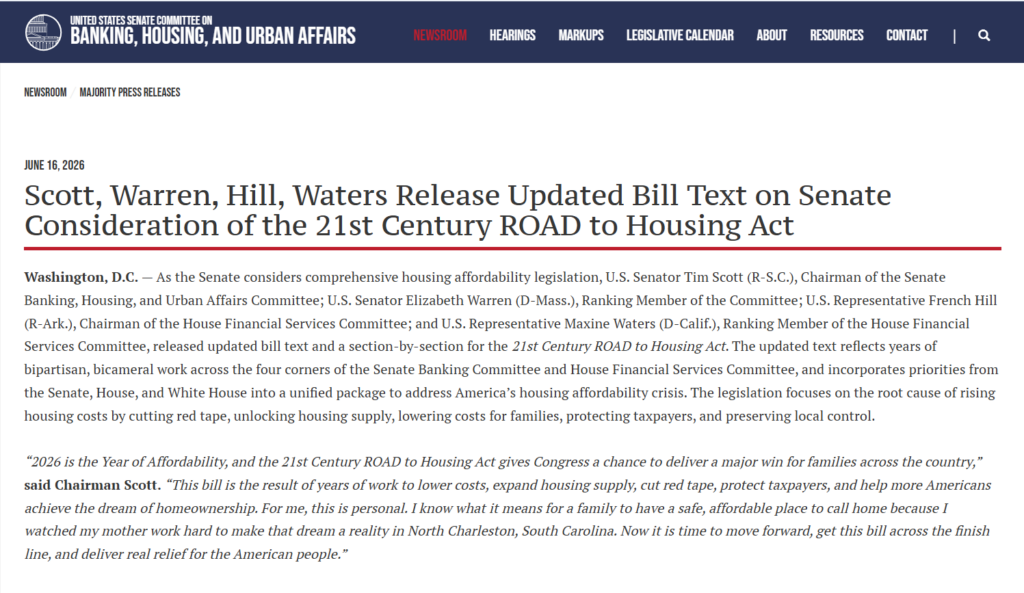
Congress has passed the 21st Century Road to Housing Act, a bipartisan bill primarily focused on housing reform to improve affordability and supply. Included within it is a significant provision that bans the Federal Reserve from issuing a central bank digital currency (CBDC) or "digital dollar" before December 31, 2030. The measure defines a CBDC as a dollar-denominated digital asset, a direct liability of the Fed, accessible to all Americans. Proponents argue the ban allows more time to study a digital dollar's impacts and addresses concerns about privacy, financial surveillance, and government overreach in digital payments. The provision specifically targets a retail CBDC but does not restrict permissionless blockchain networks. This crypto-related language, embedded in broader housing legislation, has drawn considerable attention for its potential to shape the future of digital assets and payments in the U.S. The bill's final passage will determine if the ban takes effect for the next decade.

Legislators have passed a bill aimed at pushing housing reforms that feature a temporary ban on a Federal Reserve CBDC. The ban forms one of the many proposals included in the bipartisan bill, the 21st Century Road to Housing Act. The bill seeks to improve affordable housing, boost the supply of houses, and bring about various reforms.

A proposal in the bill bans the Federal Reserve from creating a digital dollar before December 31, 2030. Lawmakers inserted the provision into the broader housing bill rather than introducing it as a standalone crypto-related measure. Under the proposal, lawmakers classify a CBDC as a dollar-denominated digital asset. This serves as a direct liability of the Federal Reserve and remains accessible to all Americans.
Supporters of the provision argue that it gives policymakers additional time to evaluate the potential impacts of a digital dollar. The ban also reflects concerns that some lawmakers have raised about privacy, financial surveillance, and government involvement in digital payment systems. On the other hand, this proposal does not impose restrictions on permissionless blockchain networks.

Focus on Crypto Policy in Housing Legislation

Lawmakers designed the housing legislation to address housing supply challenges through permitting reforms, regulatory changes, and expanded financing opportunities. Nevertheless, it is the CBDC policy language that caught much attention in the cryptocurrency community. Since it impacts the issuance of the digital dollar in the future. The language was adopted in Congress in light of further discussions. This was regarding the place of digital assets in the country’s financial system.

In accordance with the language, the ban applies to the efforts of the Federal Reserve to issue a retail CBDC regardless of whether it will be issued directly by the institution or by means of intermediaries. In addition, there are some drafts of the bill that have an exception in the case when private digital dollars retain privacy traits comparable to those of physical dollars.

The market analysts are continuing to watch the developments since the legislation could affect further discussions about digital payments and cryptocurrencies. Although the housing bill is what lawmakers are concentrating on, the clause regarding CBDCs can be seen as an important factor in terms of the cryptocurrency sector. The next few steps in the legislation process will decide whether or not the ban will be enforced within the next decade.

Highlighted Crypto News:

Ethereum Advances Glamsterdam Upgrade Ahead of Planned 2026 Launch

TagsBlockchainCBDCcrypto legislationFederal ReserveU.S Congress

Criptos en tendencia

Preguntas relacionadas

QWhat is the main purpose of the 21st Century Road to Housing Act as mentioned in the article?

AThe main purpose of the 21st Century Road to Housing Act is to improve affordable housing, boost the supply of houses, and bring about various reforms.

QWhat specific restriction does the bill place on the Federal Reserve regarding a Central Bank Digital Currency (CBDC)?

AThe bill bans the Federal Reserve from creating a digital dollar, or retail CBDC, before December 31, 2030.

QWhy did supporters of the CBDC provision include it in the bill according to the text?

ASupporters argue the provision gives policymakers additional time to evaluate the potential impacts of a digital dollar and reflects concerns about privacy, financial surveillance, and government involvement in digital payment systems.

QHow does the article describe the focus of the housing legislation versus the attention it received?

AWhile the housing legislation is designed to address housing supply challenges, it was the CBDC policy language within the bill that caught much attention in the cryptocurrency community.

QAccording to the bill's language, does the CBDC ban apply to private, permissionless blockchain networks?

ANo, the proposal does not impose restrictions on permissionless blockchain networks. Some drafts of the bill even have an exception for private digital dollars that retain privacy traits comparable to physical dollars.

Lecturas Relacionadas

The Verdict in Choi Tae-won's Divorce Case: Revealing the Inheritance Undercurrent Behind SK Hynix's Trillion-Won Empire

SK Group Chairman Chey Tae-won's high-profile divorce case, involving a record 1.38 trillion won settlement, has drawn attention to the succession plans for Korea's second-largest conglomerate, especially its crown jewel, SK hynix. Unlike traditional chaebol scripts centered on the eldest son, Chey's three children from his marriage to former President Roh Tae-woo's daughter, Roh Soh-yeong, are carving distinct, non-traditional paths. Eldest daughter Chey Yun-jung (b. 1989) is seen as the most evident successor. With a scientific and consulting background, she holds executive roles at SK bioscience and SK Inc.'s growth support department, focusing on future strategy and biopharma. Her marriage is to an AI infrastructure entrepreneur, not a traditional business alliance. Second daughter Chey Min-jung (b. 1991) took a unique route, voluntarily serving as a South Korean naval officer, including an anti-piracy deployment. She later worked on policy and strategy for SK hynix in Washington D.C. before co-founding an AI-driven healthcare startup. She married a former U.S. Marine Corps officer, connecting her to U.S. defense and policy circles—networks crucial for a global semiconductor giant. The only son, Chey In-geun (b. 1995), who studied physics like his father, worked briefly at SK E&S before joining McKinsey. Despite fitting the traditional "heir" profile as the eldest son, he remains silent and holds no public position or shares in SK, suggesting the old succession playbook is obsolete. As SK hynix's valuation soars, becoming a geopolitical asset in the AI era, the heirs' legitimacy is no longer automatic. They must prove themselves in fields like AI biotech, global policy, and strategic consulting. Their marriages also reflect new elite networks in tech and defense, not old political alliances. Their inheritance is the complex challenge of navigating a globalized, tech-driven world, not just a corporate throne.

marsbitHace 2 días 09:06

The Verdict in Choi Tae-won's Divorce Case: Revealing the Inheritance Undercurrent Behind SK Hynix's Trillion-Won Empire

marsbitHace 2 días 09:06

From OpenSea to OpenRouter: Is Alex Atallah Repeating His 'Exit at the Peak' Playbook?

From OpenSea to OpenRouter: Is Alex Atallah Repeating His "Exit at the Peak" Playbook? According to the Wall Street Journal, payments giant Stripe is in talks to acquire the AI model aggregation platform OpenRouter in a potential deal valuing the company near $100 billion. This would mark founder Alex Atallah's second creation of a company reaching a $100 billion valuation, following his co-founding of NFT marketplace OpenSea. OpenRouter, founded just over three years ago, has grown rapidly by acting as a unified gateway for developers to access over 400 AI models. It currently has about 10 million users and processes over 200 trillion tokens monthly. While the platform's annualized revenue is around $50 million, its valuation has skyrocketed from $1.3 billion in March 2026. The potential acquisition by Stripe, a company OpenRouter's founder once likened it to, represents a major expansion into AI infrastructure for the payments leader. This move echoes Atallah's previous timing with OpenSea, where he departed before the NFT market's significant downturn. For OpenRouter, selling now may be strategic. Despite its scale, its business model—charging a 5-5.5% fee on AI inference calls—faces pressure from competition, open-source models, and potential price wars among model providers, limiting its profitability narrative for an IPO. A key asset for potential acquirers like Stripe is OpenRouter's vast repository of real-world AI usage data, which offers unique insights into model performance and developer preferences that are difficult to replicate. Whether this potential deal signifies a new valuation benchmark for AI infrastructure or another market peak signal remains to be seen.

链捕手Hace 2 días 08:42

From OpenSea to OpenRouter: Is Alex Atallah Repeating His 'Exit at the Peak' Playbook?

链捕手Hace 2 días 08:42

Trading

Spot

Artículos destacados

Cómo comprar BAN

¡Bienvenido a HTX.com! Hemos hecho que comprar Comedian (BAN) sea simple y conveniente. Sigue nuestra guía paso a paso para iniciar tu viaje de criptos.Paso 1: crea tu cuenta HTXUtiliza tu correo electrónico o número de teléfono para registrarte y obtener una cuenta gratuita en HTX. Experimenta un proceso de registro sin complicaciones y desbloquea todas las funciones.Obtener mi cuentaPaso 2: ve a Comprar cripto y elige tu método de pagoTarjeta de crédito/débito: usa tu Visa o Mastercard para comprar Comedian (BAN) al instante.Saldo: utiliza fondos del saldo de tu cuenta HTX para tradear sin problemas.Terceros: hemos agregado métodos de pago populares como Google Pay y Apple Pay para mejorar la comodidad.P2P: tradear directamente con otros usuarios en HTX.Over-the-Counter (OTC): ofrecemos servicios personalizados y tipos de cambio competitivos para los traders.Paso 3: guarda tu Comedian (BAN)Después de comprar tu Comedian (BAN), guárdalo en tu cuenta HTX. Alternativamente, puedes enviarlo a otro lugar mediante transferencia blockchain o utilizarlo para tradear otras criptomonedas.Paso 4: tradear Comedian (BAN)Tradear fácilmente con Comedian (BAN) en HTX's mercado spot. Simplemente accede a tu cuenta, selecciona tu par de trading, ejecuta tus trades y monitorea en tiempo real. Ofrecemos una experiencia fácil de usar tanto para principiantes como para traders experimentados.

611 Vistas totalesPublicado en 2024.12.11Actualizado en 2026.06.02

Cómo comprar BAN

Discusiones

Bienvenido a la comunidad de HTX. Aquí puedes mantenerte informado sobre los últimos desarrollos de la plataforma y acceder a análisis profesionales del mercado. A continuación se presentan las opiniones de los usuarios sobre el precio de BAN (BAN).

活动图片