Perspective: Tokens on alt.fun are double-layered leverage

marsbitPublicado a 2026-05-18Actualizado a 2026-05-18

Resumen

**Title:** Tokens on alt.fun are Double-Layered Leverage **Summary:** Tokens on alt.fun (like ALT) are not simple 5x leveraged bets on HYPE. Instead, they represent a **double layer of leverage**. The core mechanism involves HyperSwap V2 pools. After "graduation," these tokens are paired not with USDC, but with **HYPE5L**—a 5x long leverage token (LT) issued by BounceTech that tracks HYPE. Therefore, an alt.fun token's price in USDC is determined by multiplying two independent factors: 1. **AMM Exchange Rate:** The pool's ratio between the alt token and HYPE5L, driven by trading activity on alt.fun. 2. **LT Net Asset Value (NAV):** HYPE5L's value, which moves at approximately 5x the daily return of HYPE. This creates a compounding effect: * If HYPE rises 1%, HYPE5L's NAV rises ~5%. Profit-taking HYPE5L holders may then buy alt tokens, increasing demand and pushing the AMM exchange rate higher. The alt token's total gain thus exceeds 5%, potentially reaching 8-15%. * Conversely, if HYPE falls, losses are amplified beyond 5x due to combined NAV decline and AMM selling pressure. During crashes, large sell orders may fail due to non-atomic redemption paths, potentially trapping later sellers. In contrast, platforms like pump.fun pair tokens with stable assets like SOL, applying only the AMM amplifier to a 1x underlying asset. Alt.fun's use of a pre-leveraged quote asset (HYPE5L) fundamentally shifts the risk profile, creating a **second-order product with floating, of...

Author:798.eth

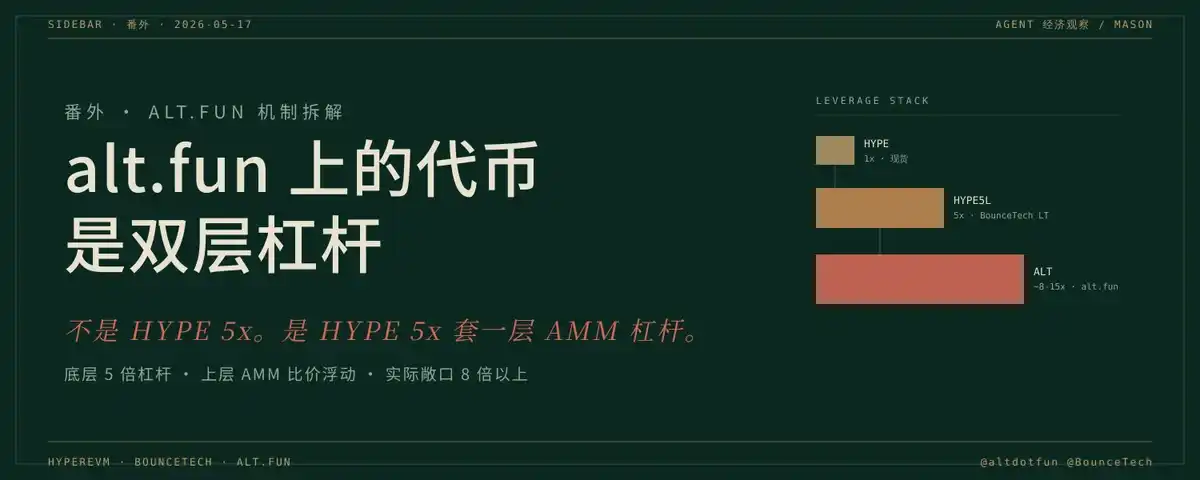
The alt tokens on alt.fun are not 5x leverage on HYPE. They are 5x leverage on HYPE with an additional layer of AMM leverage stacked on top.

This isn't obvious intuitively. You'll understand after reviewing the mechanism. First, let's look at current data for reference.

HYPE spot price is 42.84 USDC.

HYPE5L (the HYPE 5x long leverage token LT issued by BounceTech) has a current NAV of 0.870 USDC, which is a 13% decay from its issue price of 1 USDC.

In the HyperSwap V2 pool for the alt.fun flagship token ALT, there are 18.58 million ALT tokens and 129,400 HYPE5L tokens. 1 ALT equals 0.00697 HYPE5L. Converted to USDC price, that's 0.00606. The USDC price of ALT is the product of two things.

Note: After graduation, the pool contains no USDC; the paired asset is HYPE5L LT. This is the starting point for all understanding.

ALT's USDC price = The exchange rate of ALT to HYPE5L in the pool multiplied by HYPE5L's current NAV.

The first factor is the AMM price ratio. The fewer ALT and more HYPE5L in the pool, the higher the ratio, meaning ALT is more expensive. The opposite makes it cheaper. This factor is determined by buy/sell pressure and is unrelated to the HYPE price.

The second factor is the LT's Net Asset Value. When HYPE rises 1%, HYPE5L's NAV rises approximately 5%, and vice versa. This factor is determined by BounceTech's actual perp position on Hyperliquid and is unrelated to trading activity on alt.fun.

These two factors are independent. Multiply them together to get ALT's final USDC price.

Why this constitutes double-layered leverage.

HYPE rises 1%.

The second layer (LT) amplifies it to 5%. HYPE5L NAV rises 5%.

The first layer (AMM) will amplify further. When HYPE5L rises, holders who are making money may go to alt.fun to buy more alt tokens (leveraged exposure plus alt narrative exposure). This buying increases HYPE5L in the pool and decreases ALT, causing the AMM price ratio to rise. The same 1% HYPE increase is amplified once more in the AMM layer.

Ultimately, ALT's USDC price increase will likely be between 8% and 15%, depending on AMM pool depth and buying intensity. But it will always be greater than 5%.

The same logic applies in reverse when the price falls. If HYPE falls 1%, HYPE5L falls 5%, alt holders see amplified losses, and some start selling ALT for HYPE5L to redeem. Selling pressure pushes down the AMM price ratio, likely causing ALT's USDC price to fall between 8% and 15%.

When falling, there's also an asymmetric effect. The alt.fun docs themselves warn that large sell orders may revert due to the path not being atomic (the path from alt to HYPE5L to USDC redemption; if the order is large, the LT redemption on BounceTech's side can't handle it). This means when the pool is thin, retail investors wanting to stop losses can't. The first ones out sell at high prices, later ones at lower prices, and those after get stuck in the contract.

The five alt tokens backed by HYPE5L—ALT, HBULL, HYPE Life, BALD, HLC—are now all graduated. Every trade they make on HyperSwap V2 moves the AMM price ratio. Simultaneously, the HYPE price moves the HYPE5L NAV. The two layers stack.

HYPE5L is an LT issued by BounceTech. Theoretically 5x exposure, but due to frequent rebalancing, it suffers from volatility decay. In ranging markets, actual exposure is less than 5x; in trending markets, it's more than 5x.

So when you open the alt.fun UI and see an alt token labeled "HYPE 5x Long," the USDC price displayed in the UI is the result of the HYPE price being amplified by BounceTech's 5x leverage, then amplified again by the HyperSwap V2 AMM. You think you're buying 5x exposure to HYPE, but you're actually buying a floating exposure of 8x to 15x.

This floating exposure makes you earn much more than 5x when prices rise, and lose much more than 5x when prices fall. This is the full meaning of double-layered leverage.

Comparing with pump.fun makes it clearer.

Tokens on pump.fun are paired with SOL. SOL is a 1x exposure spot asset. If SOL falls 10%, a pump.fun token's USDC price falls 10% plus the AMM selling pressure, roughly 15% to 25%. The AMM is an amplifier, but the underlying asset has no leverage.

Tokens on alt.fun are paired with HYPE5L. HYPE5L is already a 5x exposure derivative. If HYPE falls 10%, HYPE5L falls 50%, and an alt token's USDC price falls 50% plus the AMM selling pressure, roughly 60% to 80%. The AMM is an amplifier, but the underlying asset itself already carries 5x leverage.

Both are launchpads, both use AMM pairing, but alt.fun, by changing the quote asset, pulls the overall risk curve to a completely different magnitude. This is not prominently highlighted anywhere on the alt.fun UI.

A final word for retail investors.

You open alt.fun, see a token labeled "HYPE 5x Long," and intuitively think this is 5x leveraged exposure to HYPE. That intuition is wrong.

The underlying leverage is 5x. The AMM layer adds another 1x to 2x of floating exposure. In trending markets, you outperform 5x by a lot. In ranging markets, volatility decay eats away at you. During a crash, large sells won't go through; early sellers exit at high prices, later ones get stuck in the contract.

This is not HYPE 5x long. It's a second-order product: HYPE 5x long wrapped in a layer of AMM leverage.

Not investment advice, just trying to figure things out clearly.

Criptos en tendencia

Preguntas relacionadas

QAccording to the author, why is the alt token on alt.fun considered a double-layer leverage?

AThe author explains that the alt token is backed by HYPE5L (a 5x leveraged token) in its liquidity pool. This creates a two-layer effect: First, HYPE5L provides ~5x exposure to HYPE's price movements. Second, buying and selling pressure on the alt.fun AMM further amplifies the alt token's price relative to HYPE5L's NAV. This results in a total leverage that fluctuates, often between 8x to 15x, rather than a fixed 5x.

QWhat are the two independent factors that determine the USDC price of an alt token like ALT on alt.fun?

A1) The AMM exchange rate: The ratio between the alt token (e.g., ALT) and its paired asset (HYPE5L) in the HyperSwap V2 pool. This rate changes based on trading activity on alt.fun. 2) The NAV (Net Asset Value) of HYPE5L: The underlying value of the 5x leveraged token from BounceTech, which moves based on HYPE's price on Hyperliquid. The final USDC price is the product of these two factors.

QHow does the risk profile of an alt.fun token differ from a pump.fun token, according to the article?

AThe article states that pump.fun tokens are paired with SOL, which has 1x spot exposure. A drop in SOL leads to a drop in the token's USDC price plus AMM selling pressure. In contrast, alt.fun tokens are paired with HYPE5L, a 5x leveraged derivative. Therefore, a drop in HYPE leads to a magnified drop in HYPE5L's NAV (e.g., -50% for a -10% HYPE move), which is then further amplified by AMM selling pressure on alt.fun. This results in a significantly higher risk profile for alt.fun tokens.

QWhat potential issue does the article highlight for users trying to sell their alt tokens during a market downturn?

AThe article points out an asymmetric risk during downturns. Large sell orders may fail (revert) because the exit path is not atomic: selling alt for HYPE5L and then redeeming HYPE5L for USDC. If the sell pressure is high, BounceTech's redemption mechanism for the leveraged token (LT) might not be able to handle it. This means early sellers get out at a higher price, later sellers at a lower price, and some users may get stuck in the contract, unable to sell at all.

QWhat misconception does the author warn retail users about regarding the 'HYPE 5x Long' label on alt.fun?

AThe author warns that the intuitive understanding of a 'HYPE 5x Long' token is incorrect. It is not simply a 5x leveraged exposure to HYPE. Instead, it is a second-order product: a 5x leveraged token (HYPE5L) wrapped with an additional layer of variable leverage from the alt.fun AMM dynamics. The actual leverage fluctuates, often exceeding 5x, which is not clearly communicated on the platform's user interface.

Lecturas Relacionadas

Ethereum's 11th Year: Why Is This Year Particularly Crucial?

Ethereum's 11th year proved pivotal, marked by a dual evolution in its technical roadmap and organizational structure. The year saw the completion of the Fusaka upgrade, introducing PeerDAS to make data availability sampling more efficient and laying groundwork for future L2 scaling. This was followed by a significant reorganization of the Ethereum Foundation (EF). The EF downsized, redefining its core mandate around user sovereignty and CROPS principles, while spinning off key functions. Independent entities like Ethlabs (non-profit R&D), Ethereum Institutional (institutional onboarding), and EthSystems (institutional privacy solutions) now operate separately. Technologically, the community debated a bold, long-term vision outlined in Justin Drake's "Lean Ethereum" proposal and the collaborative "Strawmap." These point toward a "third major iteration" for Ethereum, targeting goals like faster finality (~1 second), gigagas-scale L1 throughput, teragas-scale L2 capacity, post-quantum cryptography, and protocol-level privacy. Data underscores Ethereum's dominant position: its L1 still holds roughly half of all stablecoin value, leads in tokenized Real-World Assets (RWA), and commands over 55% of total DeFi TVL. While L2s now handle over 10x more transactions than the mainnet, high-value assets remain concentrated on L1. The launch of Robinhood Chain, an EVM-compatible L2 for stock tokens, signals growing institutional adoption. The immediate roadmap includes the Glamsterdam upgrade (featuring ePBS for in-protocol proposer-builder separation and Block Access Lists for parallelism), potentially followed by Hegotá focusing on anti-censorship via FOCIL. In summary, Ethereum's 11th year was defined by setting ambitious technical foundations for its next decade and restructuring its core development ecosystem to be more modular and sustainable, all while maintaining its role as the leading settlement layer for decentralized finance and assets.

marsbitHace 9 min(s)

Ethereum's 11th Year: Why Is This Year Particularly Crucial?

marsbitHace 9 min(s)

Notable Forecast from an Analytical Company Regarding Bitcoin (BTC): After This Date, a New Bull Season Could Begin!

Bitcoin continues to trade sideways around $64,000 amid ongoing uncertainty regarding U.S. monetary policy and geopolitical risks in the Middle East. As BTC struggles for direction, an analyst predicts the next major uptrend could commence after the U.S. midterm elections. João Wedson, founder and CEO of crypto analytics firm Alphractal, revisited the connection between Bitcoin's price movements and the U.S. election calendar in his latest analysis. Wedson claims that analyzing past market cycles reveals similar patterns in Bitcoin's price behavior, particularly around U.S. midterm and presidential elections. Historically, Bitcoin has faced headwinds leading up to midterms but tends to recover once election-related uncertainty subsides. Based on historical data, Bitcoin entered bear markets roughly a year before past midterm elections, only to initiate prolonged bull markets after the elections concluded. In some cycles, price bottoms formed just days before the vote, while in others, the low occurred immediately after. The analyst also noted presidential elections have a distinct impact: Bitcoin experiences strong rallies each time a president wins re-election and approaches the peak of its main cycle shortly after the presidential inauguration. As an example, Wedson pointed to XRP, which began a sharp rise on the day Donald Trump won the 2024 election and reached a local peak on January 20, 2025, his inauguration day.

cryptonews.ruHace 24 min(s)

Notable Forecast from an Analytical Company Regarding Bitcoin (BTC): After This Date, a New Bull Season Could Begin!

cryptonews.ruHace 24 min(s)

Lummis: The CLARITY Act mechanism "is not working" as the Senate drags its feet

U.S. Senator Cynthia Lummis has argued that the current regulatory framework for digital assets is inadequate, harming industry, investors, and regulators alike. She is urgently pushing for the Senate to pass the Digital Asset Market Clarity Act (H.R. 3633/CLARITY Act) before the August recess, warning the current momentum for the bill is a unique opportunity this decade. The legislation aims to divide oversight between the SEC and CFTC. Time is running out, as the Senate must act before its August 8th recess. Delays would push the debate to September, further squeezing the legislative calendar before the midterm elections. Forecasting platforms now estimate only a 30% chance of the bill becoming law in 2026, a sharp drop from over 80% in February. Passage requires 60 votes, meaning at least seven Democrats must join Republicans, a task complicated by Democratic opposition. Key objections from figures like Senator Elizabeth Warren center on concerns the bill could weaken oversight of decentralized finance (DeFi) and consumer protection, potentially endangering the financial system. Over 200 crypto industry organizations, including Coinbase and Ripple, are lobbying for a vote, arguing continued uncertainty drives innovation and jobs overseas. Lummis contends the bill's custody and disclosure rules are precisely the consumer protections needed to close existing loopholes. The bill's fate now hinges on whether Senate Majority Leader John Thune schedules a vote this week or delays it until the fall session, where it would face an even more constrained political environment.

cryptonews.ruHace 24 min(s)

Lummis: The CLARITY Act mechanism "is not working" as the Senate drags its feet

cryptonews.ruHace 24 min(s)

Trading

Spot

Artículos destacados

Cómo comprar HYPE

¡Bienvenido a HTX.com! Hemos hecho que comprar Hyperliquid (HYPE) sea simple y conveniente. Sigue nuestra guía paso a paso para iniciar tu viaje de criptos.Paso 1: crea tu cuenta HTXUtiliza tu correo electrónico o número de teléfono para registrarte y obtener una cuenta gratuita en HTX. Experimenta un proceso de registro sin complicaciones y desbloquea todas las funciones.Obtener mi cuentaPaso 2: ve a Comprar cripto y elige tu método de pagoTarjeta de crédito/débito: usa tu Visa o Mastercard para comprar Hyperliquid (HYPE) al instante.Saldo: utiliza fondos del saldo de tu cuenta HTX para tradear sin problemas.Terceros: hemos agregado métodos de pago populares como Google Pay y Apple Pay para mejorar la comodidad.P2P: tradear directamente con otros usuarios en HTX.Over-the-Counter (OTC): ofrecemos servicios personalizados y tipos de cambio competitivos para los traders.Paso 3: guarda tu Hyperliquid (HYPE)Después de comprar tu Hyperliquid (HYPE), guárdalo en tu cuenta HTX. Alternativamente, puedes enviarlo a otro lugar mediante transferencia blockchain o utilizarlo para tradear otras criptomonedas.Paso 4: tradear Hyperliquid (HYPE)Tradear fácilmente con Hyperliquid (HYPE) en HTX's mercado spot. Simplemente accede a tu cuenta, selecciona tu par de trading, ejecuta tus trades y monitorea en tiempo real. Ofrecemos una experiencia fácil de usar tanto para principiantes como para traders experimentados.

266 Vistas totalesPublicado en 2024.12.11Actualizado en 2026.06.02

Cómo comprar HYPE

Discusiones

Bienvenido a la comunidad de HTX. Aquí puedes mantenerte informado sobre los últimos desarrollos de la plataforma y acceder a análisis profesionales del mercado. A continuación se presentan las opiniones de los usuarios sobre el precio de HYPE (HYPE).

活动图片