Iran Opens Fire on an Oil Tanker That Paid Bitcoin Transit Fees to Scammers

marsbitPublicado a 2026-04-22Actualizado a 2026-04-22

Resumen

Iran announced plans to charge Bitcoin and USDT transit fees for oil tankers passing through the Strait of Hormuz. Within two weeks, scammers impersonated Iranian officials and sent fraudulent messages to stranded vessels, demanding cryptocurrency payments in exchange for safe passage. At least one tanker that paid the fake fee was fired upon by Iranian Revolutionary Guard boats when attempting to cross. Maritime risk firm MARISKS confirmed the scam exploited shipowners’ anxiety amid heightened regional tensions. Chain analysis firms TRM Labs and Chainalysis found no evidence of large-scale crypto payments actually being made to Iranian entities. Legal experts warned that even payments made to scammers—if intended for Iran—could violate international sanctions. The incident highlights how cryptocurrency’s irreversibility, often touted as a strength, becomes a critical risk in conflict-driven fraud. While Iran’s proposal initially sparked excitement in crypto circles, it ultimately created a new attack vector for deception, leaving ships trapped, fined, or even under fire.

Author: Deep Tide TechFlow

Deep Tide Introduction: Less than two weeks after Iran announced it would collect Bitcoin transit fees in the Strait of Hormuz, scammers impersonated Iranian officials and sent fake messages to stranded oil tankers demanding BTC and USDT.

At least one tanker that paid the fake transit fee was fired upon by the Iranian Revolutionary Guard Corps when attempting to pass. Chain analysis firms TRM Labs and Chainalysis both stated that no large-scale on-chain evidence of cryptocurrency payments has been found so far.
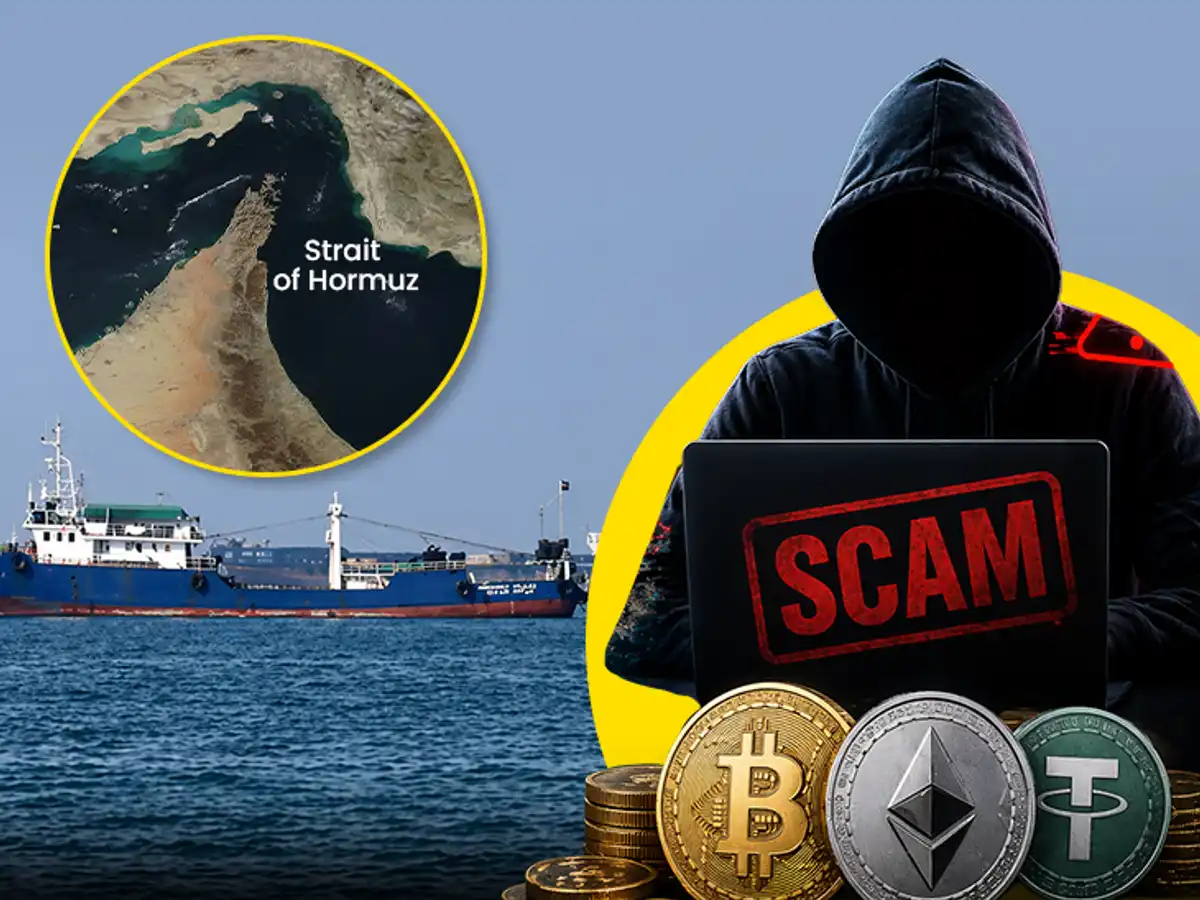
Iran announced it would collect transit fees in Bitcoin, and within two weeks, scammers turned this narrative into a weapon.

According to a Reuters report on April 21, the maritime risk management company MARISKS issued a warning: unidentified individuals are posing as Iranian authorities and sending false messages to ships stranded on the western side of the Strait of Hormuz, demanding payment of "transit fees" in BTC or USDT in exchange for safe passage. MARISKS believes that at least one of the vessels fired upon by Iranian Revolutionary Guard Corps speedboats on April 18, when Iran briefly opened the strait, was a victim of this scam.

The absurdity of the incident lies in the entire chain of causality: a sovereign state announces it will collect Bitcoin transit fees, scammers copy this rhetoric to commit fraud, shipowners believe it and pay, and then get shot at by the real Iranian military.

From "National-Level Settlement Tool" to Attack Surface for Scammers

The story begins in early April.

From March 30 to 31, the Iranian parliament passed the "Hormuz Strait Management Plan," formally writing into law the transit fee system that the Islamic Revolutionary Guard Corps had already been implementing since mid-March. According to the Financial Times, Hamid Hosseini, spokesperson for the Iran Oil, Gas, and Petrochemical Products Exporters Union, confirmed that fully loaded tankers are required to pay a fee of $1 per barrel, with payment methods including Bitcoin, USDT, or Chinese yuan. A supertanker carrying 2 million barrels of crude oil could face a single transit fee of up to $2 million.

Upon the news, Bitcoin's price jumped 5%, briefly breaking through $72,700. The crypto community quickly interpreted this as a milestone validation of Bitcoin as a "neutral settlement layer for international trade." Institutions like Bitwise even linked it to predictions of Bitcoin reaching $1 million.

But there were also many skeptics.

Sam Lyman of the Bitcoin Policy Institute pointed out in a report on April 15 that large-scale collection of Bitcoin transit fees with existing technology is "almost impossible." Ari Redbord, global policy head at TRM Labs, told Fortune magazine that on-chain data does not show transit fee payments occurring on a large scale. Chainalysis, in its analysis report, noted that on-chain activities of entities linked to Iran primarily rely on USDT on the Tron network, not Bitcoin.

Scammers don't care about these technical debates. They only need a credible narrative, and the Iranian government has already written the script for them.

Ships That Paid the Fake Fee Got Shot at for Real

According to Reuters and DL News, the wording of the scam messages highly imitates official language. The scammers required shipowners to submit ship documents, claiming they would be assessed by the "Iranian security department." After passing the assessment, payment in BTC or USDT would be required, after which the ship could "safely pass through the strait at the scheduled time."

Approximately 400 ships and about 20,000 crew members are currently stranded in the Persian Gulf. With the U.S. blockading Iranian ports and Iran repeatedly opening and closing the strait for passage, the anxiety of shipowners is understandable. The scammers precisely exploited this anxiety.

On April 18, Iran briefly opened the strait, and some ships attempted to pass. According to the UK Maritime Trade Operations (UKMTO), two Iranian Revolutionary Guard Corps speedboats opened fire on an oil tanker trying to exit the strait, forcing it to turn back. MARISKS believes this tanker had previously paid the cryptocurrency "transit fee" to scammers, thinking it had obtained passage permission.

They paid, but the money didn't go to Iran. The ship was still shot at.

Paying Scammers Could Also Violate Sanctions Laws

Even more ironically, even if shipowners realize they have been scammed, the legal risks won't disappear.

Xue Yin Peh, investigation strategy head at Chainalysis, told Decrypt that regardless of whether the recipient is actually the Iranian authorities, as long as the payer intended to pay a sanctioned regime, it could constitute a violation of OFAC, EU, and UK sanctions regulations. In other words, even if you thought you were paying Iran and the money ended up in a scammer's pocket, regulators could still pursue your "subjective intent."

Isabella Chase, head of policy for Europe, the Middle East, and Africa at TRM Labs, also warned that any wallet addresses associated with such demands should be considered "high-risk," and cryptocurrency payments do not provide any "safe harbor" in terms of sanctions compliance.

This creates a nearly unsolvable dilemma for shipowners: paying Iran violates sanctions, paying scammers might also violate sanctions, and not paying means continuing to drift in the Persian Gulf.

"Bitcoin's Irreversibility" Turns from Advantage to Flaw

The most noteworthy aspect for the crypto industry to reflect on is how Bitcoin's core characteristics performed in this scenario.

Benzinga's report highlighted the key issue: cryptocurrency payments cannot be reversed once sent. Traditional bank transfers at least offer the possibility of freezing and recovery, but once Bitcoin or USDT is transferred, the funds are lost. This feature is called "trustless settlement" in normal commercial contexts but becomes "irrecoverable loss" in the combined scenario of war and fraud.

This might be the most absurd crypto story of 2026... Iran's plan to collect transit fees in Bitcoin may never have been truly implemented, but scammers have already made money from this story, and an oil tanker got shot because of it.

Criptos en tendencia

Preguntas relacionadas

QWhat did Iran announce regarding the Strait of Hormuz in early April, and what was the proposed payment method?

AIran announced a toll system for oil tankers passing through the Strait of Hormuz, requiring a fee of $1 per barrel of oil. The payment methods included Bitcoin, USDT, or Chinese Yuan.

QHow did scammers exploit Iran's announcement about cryptocurrency toll payments?

AScammers impersonated Iranian authorities and sent fake messages to ships stranded in the Strait of Hormuz, demanding payments in BTC or USDT as 'tolls' for safe passage, capitalizing on the anxiety of shipowners.

QWhat happened to at least one ship that paid the fake toll to scammers?

AAt least one ship that paid the fake toll was fired upon by Iranian Revolutionary Guard Corps boats when it attempted to pass through the strait during a brief opening, forcing it to turn back.

QAccording to chain analysis firms TRM Labs and Chainalysis, was there evidence of large-scale cryptocurrency toll payments to Iran?

ANo, both TRM Labs and Chainalysis stated that there was no on-chain evidence of large-scale cryptocurrency toll payments being made to Iran.

QWhat legal risk do shipowners face even if they pay scammers instead of the actual Iranian authorities?

AShipowners could still be deemed in violation of OFAC, EU, and UK sanctions laws because the intent to pay a sanctioned regime (Iran) is what matters, regardless of whether the funds actually reached Iranian authorities or scammers.

Lecturas Relacionadas

The Verdict in Choi Tae-won's Divorce Case: Revealing the Inheritance Undercurrent Behind SK Hynix's Trillion-Won Empire

SK Group Chairman Chey Tae-won's high-profile divorce case, involving a record 1.38 trillion won settlement, has drawn attention to the succession plans for Korea's second-largest conglomerate, especially its crown jewel, SK hynix. Unlike traditional chaebol scripts centered on the eldest son, Chey's three children from his marriage to former President Roh Tae-woo's daughter, Roh Soh-yeong, are carving distinct, non-traditional paths. Eldest daughter Chey Yun-jung (b. 1989) is seen as the most evident successor. With a scientific and consulting background, she holds executive roles at SK bioscience and SK Inc.'s growth support department, focusing on future strategy and biopharma. Her marriage is to an AI infrastructure entrepreneur, not a traditional business alliance. Second daughter Chey Min-jung (b. 1991) took a unique route, voluntarily serving as a South Korean naval officer, including an anti-piracy deployment. She later worked on policy and strategy for SK hynix in Washington D.C. before co-founding an AI-driven healthcare startup. She married a former U.S. Marine Corps officer, connecting her to U.S. defense and policy circles—networks crucial for a global semiconductor giant. The only son, Chey In-geun (b. 1995), who studied physics like his father, worked briefly at SK E&S before joining McKinsey. Despite fitting the traditional "heir" profile as the eldest son, he remains silent and holds no public position or shares in SK, suggesting the old succession playbook is obsolete. As SK hynix's valuation soars, becoming a geopolitical asset in the AI era, the heirs' legitimacy is no longer automatic. They must prove themselves in fields like AI biotech, global policy, and strategic consulting. Their marriages also reflect new elite networks in tech and defense, not old political alliances. Their inheritance is the complex challenge of navigating a globalized, tech-driven world, not just a corporate throne.

marsbitHace 12 hora(s)

The Verdict in Choi Tae-won's Divorce Case: Revealing the Inheritance Undercurrent Behind SK Hynix's Trillion-Won Empire

marsbitHace 12 hora(s)

From OpenSea to OpenRouter: Is Alex Atallah Repeating His 'Exit at the Peak' Playbook?

From OpenSea to OpenRouter: Is Alex Atallah Repeating His "Exit at the Peak" Playbook? According to the Wall Street Journal, payments giant Stripe is in talks to acquire the AI model aggregation platform OpenRouter in a potential deal valuing the company near $100 billion. This would mark founder Alex Atallah's second creation of a company reaching a $100 billion valuation, following his co-founding of NFT marketplace OpenSea. OpenRouter, founded just over three years ago, has grown rapidly by acting as a unified gateway for developers to access over 400 AI models. It currently has about 10 million users and processes over 200 trillion tokens monthly. While the platform's annualized revenue is around $50 million, its valuation has skyrocketed from $1.3 billion in March 2026. The potential acquisition by Stripe, a company OpenRouter's founder once likened it to, represents a major expansion into AI infrastructure for the payments leader. This move echoes Atallah's previous timing with OpenSea, where he departed before the NFT market's significant downturn. For OpenRouter, selling now may be strategic. Despite its scale, its business model—charging a 5-5.5% fee on AI inference calls—faces pressure from competition, open-source models, and potential price wars among model providers, limiting its profitability narrative for an IPO. A key asset for potential acquirers like Stripe is OpenRouter's vast repository of real-world AI usage data, which offers unique insights into model performance and developer preferences that are difficult to replicate. Whether this potential deal signifies a new valuation benchmark for AI infrastructure or another market peak signal remains to be seen.

链捕手Hace 12 hora(s)

From OpenSea to OpenRouter: Is Alex Atallah Repeating His 'Exit at the Peak' Playbook?

链捕手Hace 12 hora(s)

Trading

Spot

Artículos destacados

Cómo comprar IR

¡Bienvenido a HTX.com! Hemos hecho que comprar Infrared Finance (IR) sea simple y conveniente. Sigue nuestra guía paso a paso para iniciar tu viaje de criptos.Paso 1: crea tu cuenta HTXUtiliza tu correo electrónico o número de teléfono para registrarte y obtener una cuenta gratuita en HTX. Experimenta un proceso de registro sin complicaciones y desbloquea todas las funciones.Obtener mi cuentaPaso 2: ve a Comprar cripto y elige tu método de pagoTarjeta de crédito/débito: usa tu Visa o Mastercard para comprar Infrared Finance (IR) al instante.Saldo: utiliza fondos del saldo de tu cuenta HTX para tradear sin problemas.Terceros: hemos agregado métodos de pago populares como Google Pay y Apple Pay para mejorar la comodidad.P2P: tradear directamente con otros usuarios en HTX.Over-the-Counter (OTC): ofrecemos servicios personalizados y tipos de cambio competitivos para los traders.Paso 3: guarda tu Infrared Finance (IR)Después de comprar tu Infrared Finance (IR), guárdalo en tu cuenta HTX. Alternativamente, puedes enviarlo a otro lugar mediante transferencia blockchain o utilizarlo para tradear otras criptomonedas.Paso 4: tradear Infrared Finance (IR)Tradear fácilmente con Infrared Finance (IR) en HTX's mercado spot. Simplemente accede a tu cuenta, selecciona tu par de trading, ejecuta tus trades y monitorea en tiempo real. Ofrecemos una experiencia fácil de usar tanto para principiantes como para traders experimentados.

541 Vistas totalesPublicado en 2025.12.17Actualizado en 2026.06.02

Cómo comprar IR

Discusiones

Bienvenido a la comunidad de HTX. Aquí puedes mantenerte informado sobre los últimos desarrollos de la plataforma y acceder a análisis profesionales del mercado. A continuación se presentan las opiniones de los usuarios sobre el precio de IR (IR).

活动图片