Crypto Scandal: Zerebro’s Co-Founder Allegedly Fakes Death While His Wallets Dump Tokens

bitcoinistPublished on 2025-05-08Last updated on 2025-05-08

Abstract

The co-founder of the Artificial Intelligence (AI) crypto project Zerebro has been accused of faking his death and dumping on...

Trusted Editorial content, reviewed by leading industry experts and seasoned editors. Ad Disclosure

The co-founder of the Artificial Intelligence (AI) crypto project Zerebro has been accused of faking his death and dumping on investors after recent reports claim the developer pulled the stunt as an “exit liquidity strategy.”

Crypto Developer Allegedly Dies On Livestream

This week, the crypto community was hit with the shocking news of the apparent death of a developer due to mental health issues. Reports online announced the passing of Zerebro’s co-founder, Jeffy Yu, who had seemingly committed suicide during a Pump.fun livestream on May 4.

The video, which was later shared on X, showed the project’s co-founder smoking a cigarette while taking his own life with a gun. Seemingly confirming his death, an obituary for Yu was published on the obituary platform Legacy, claiming he died at the age of 22.

crypto

Yu's obituary on Legacy. source: Lookonchain on X


On Sunday, Yu introduced the concept of “Legacoins,” a term derived from “legacy memecoin,” in a Mirror blog post. As he explained, these tokens don’t promise returns, as they are not investments, but are an “interactive performance art” where “the chart is the canvas / you are the art.”

After his alleged passing, Zerebro’s official X account and Yu’s X account were deactivated. In a scheduled post, he stated, “If you’re reading this, it’s because my 72 hour deadman’s switch triggered so i’m not here, at least physically.”

The May 6 announcement unveiled Yu’s “final art piece,” the Solana-based LLJEFFY legacoin. The developer expressed his discontent with money, stating that the token was “my burning ritual / my hatred for money made manifest.”

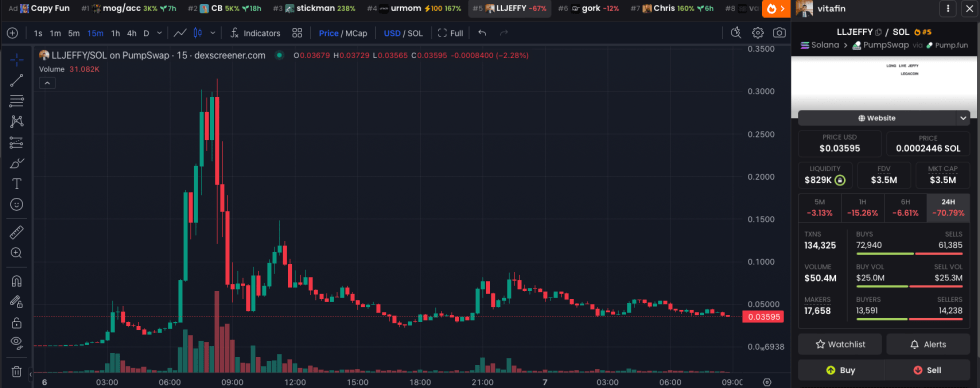
DexScreener data shows that LLJEFFY’s price skyrocketed over 1,000% after the news spread. However, the cryptocurrency’s price quickly plummeted by over 90%, resulting in losses for many investors.
crypto

LLJEFFY's price action over the past 24 hours. Source: DexScreener

On-chain analytics firm Lookonchain reported that the news of Yu’s death “caused the price of $LLJEFFY to soar and plummet in a short period, causing some traders who FOMO bought to suffer losses,” adding that one trader lost $93,000 in one hour.

Nonetheless, crypto community members started to question whether the co-founder had faked his death, as online reports suggested otherwise based on suspicious on-chain activity.

A ‘Calculated’ Exit Scam?

According to Bubblemaps’ timeline, the LLJEFFY creator wallet and several linked wallets began to trade and burn the token after Yu’s alleged suicide rumor started on X, with one of the addresses selling over $170,000 worth on ZEREBRO through multiple transactions by Tuesday afternoon.

On Wednesday, Lookonchain shared that a wallet likely linked to Yu sold 35.55 million ZEREBRO for 8,572 SOL, worth around $1.27 million, on Tuesday night. The address then transferred 7,100 SOL, valued at $1.06 million, to the LLJEFFY developer wallet “G5sjgj.”

Crypto influencer Irene Zhao also affirmed to have spoken to someone familiar with the matter, who confirmed that Yu had faked his death and was fine. Meanwhile, an X user claimed the developer was alive, and the crypto industry had “just witnessed its first pseudocide exit strategy.”

Per the post, “He sent a detailed letter directly to an early investor who round tripped it all,” with no remorse, “just a calculated exit.” The alleged letter states that Zerebro’s developer deliberately created a video simulating shooting himself, arguing that it was his “only viable exit” from constant harassment, blackmail, and threats after being doxxed.

He explained that publicly stepping away would have tanked the price of the ZEREBRO and OPAIUM projects, another reason for the stunt. The letter closes by stating that Yu is “physically and mentally sound,” and not seeking assistance.

Soon after, the Legacy obituary was deleted, fueling the speculation that Yu’s passing was false. As Lookonchain noted, “The official Zerebro team has made no public statement, and it remains unconfirmed whether Jeffy Yu is actually dead or faked his death. Be cautious with the news and don’t FOMO trade.”
crypto, Solana, SOL, SOLUSDT

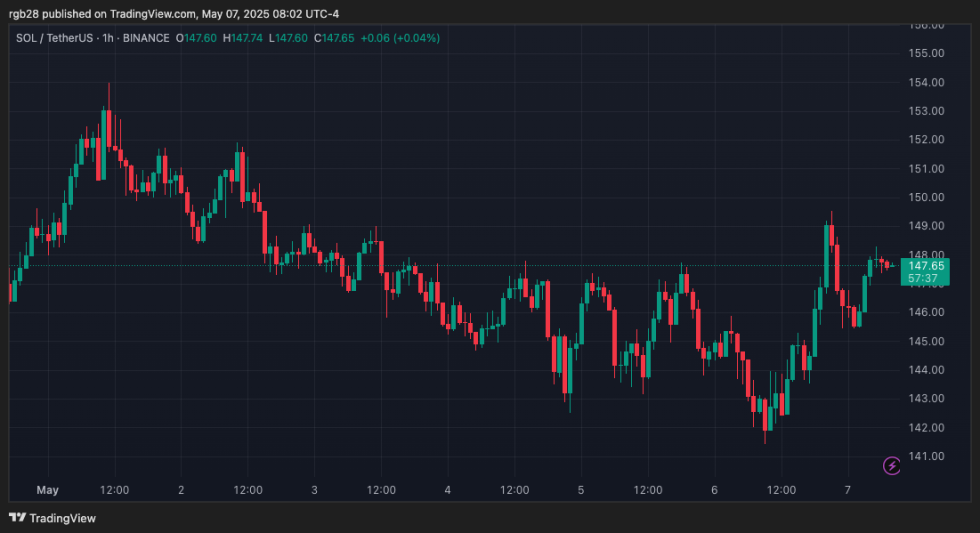
Solana (SOL) trades at $147.65 in the one-week chart. Source: SOLUSDT on TradingView
Featured Image from Unsplash.com, Chart from TradingView.com
Editorial Process for bitcoinist is centered on delivering thoroughly researched, accurate, and unbiased content. We uphold strict sourcing standards, and each page undergoes diligent review by our team of top technology experts and seasoned editors. This process ensures the integrity, relevance, and value of our content for our readers.

Rubmar is a crypto enthusiast who likes learning and improving constantly. She enjoys reporting on the latest news and developments in the crypto industry. Rubmar also enjoys scrapbooking, crafting, simulation games, and watching football.

Trending Cryptos

Related Reads

After Three Consecutive Quarters of Decline, Can the Crypto Market Find a Window for Stabilization in Q3?

The cryptocurrency market has just concluded its worst-performing quarter since 2022, with total capitalization dropping 12.6% to $2.1 trillion. All core metrics indicate capital is leaving the sector, not just rotating within it. Bitcoin fell 14.2% and Ethereum dropped 25.4% in Q2, breaking their previous correlation with US tech stocks. A key driver is the reversal in US spot Bitcoin ETF flows, which saw a net outflow of approximately $4.67 billion in Q2, including a record monthly outflow near $4.5 billion in June. While recent data suggests long-term holders are accumulating again, sustained ETF outflows mean continued selling pressure. Market focus is now singularly on the Federal Reserve. The upcoming July FOMC meeting is seen as the most critical event for Q3. A dovish signal could support Bitcoin reclaiming a $68,000-$84,000 range, while a hawkish stance might establish a new trading band around $50,000-$56,000. Additionally, regulatory uncertainty persists, with the progress of the crucial *CLARITY Act* stalling in the Senate, reducing its perceived 2026 passage probability to 40-45%. Despite the broad downturn, a few sectors showed growth. Prediction markets saw nominal volume surge 48.7% year-over-year to $113.8 billion, and tokenized collectibles transaction volume rose 143% quarterly to $1.4 billion. The Real-World Asset (RWA) tokenization sector also continued steady growth, now representing ~$28.1 billion in on-chain value. The market's foundation for an extreme crash appears limited, with Bitcoin price hovering near its 200-week moving average. However, the trading paradigm has shifted from narrative-driven speculation to decisions based on price action, policy developments, and interest rate expectations, making a broad sentiment-driven rally unlikely in the near term.

marsbitYesterday 08:36

After Three Consecutive Quarters of Decline, Can the Crypto Market Find a Window for Stabilization in Q3?

marsbitYesterday 08:36

BIT Trading Moment: BTC Still Suppressed by Weekly 200 EMA, Rejection May Restart Decline; Storage and Semiconductors that Surged Last Night Begin Falling in Evening Trading

**Crypto & Stock Market Wrap: Bitcoin Tests Resistance, Stocks Retreat After AI Surge** Bitcoin consolidates around $66,000, facing key resistance near $68,000—an area seen as a major psychological and technical hurdle where previous rallies have failed. Analysts note the cryptocurrency is caught between its 200-week moving average (~$63,333) and 200-week EMA (~$68,328). A clear break above $68k is needed to signal a stronger bullish trend, while a rejection could lead to a retest of $63k support. Market sentiment remains cautious, with low futures open interest pointing to a low-liquidity rebound rather than a full bull market. Bitcoin spot ETFs saw another $203 million inflow. US stock futures pointed lower after a strong Tuesday session led by a massive rebound in semiconductors and memory stocks. The rally was fueled by renewed optimism about AI-driven hardware demand, with Micron, SanDisk, and SK Hynix surging. However, those gains reversed in pre-market trading. Super Micro Computer (SMCI) soared over 20% after hours on strong guidance and a record backlog. Other standouts included Rocket Lab and nuclear energy plays Oklo and X-Energy. Rising oil prices (Brent above $91) and climbing Treasury yields (10-year near 4.64%), however, are reigniting inflation concerns and acting as a headwind for equities. In Asia, markets were mixed. South Korea's KOSPI pared early gains to close slightly higher as semiconductor stocks like SK Hynix gave back initial surges. Japan's Nikkei edged lower as the yen hit a fresh 38-year low against the dollar, raising fears of potential market intervention. Key events to watch include the Samsung Galaxy launch, AMD's AI event, and a slew of major tech earnings from Alphabet, Tesla, and IBM after the close on Wednesday, followed by the ECB meeting and Intel's earnings on Thursday.

marsbitYesterday 08:28

BIT Trading Moment: BTC Still Suppressed by Weekly 200 EMA, Rejection May Restart Decline; Storage and Semiconductors that Surged Last Night Begin Falling in Evening Trading

marsbitYesterday 08:28

Former CFTC Chairman, Circle President Tarbert: Preaching Long-Termism While Cashing Out $30 Million Himself

Former CFTC Chairman and Circle President Heath Tarbert has consistently advocated for a long-term vision in public, urging patience from investors as Circle’s stock price has fallen significantly from its peak. However, it has been revealed that since Circle’s IPO, Tarbert has continuously sold his CRCL shares through pre-arranged trading plans, cashing out approximately $30 million, without making any public market purchases. This contrast between his public messaging and personal actions has drawn criticism. Tarbert joined Circle in July 2023 as Chief Legal Officer, leveraging his regulatory experience to help guide the company through its IPO and expansion. Despite promoting stablecoins as long-term infrastructure, he established a 10b5-1 trading plan just before Circle went public, leading to substantial stock sales over the following year. In March 2026, he initiated another plan to sell more shares. His career trajectory highlights a pattern of moving between high-level regulatory roles and influential positions in the financial sector. After resigning as CFTC Chairman in early 2021, he joined Citadel Securities as Chief Legal Officer just 27 days later, during a period of intense regulatory scrutiny for the firm. He later joined Circle, aiding its efforts to navigate regulatory challenges for its public listing. While Tarbert's expertise in policy and compliance is valuable to companies like Circle, his actions—advocating long-term confidence while personally divesting—raise questions about the alignment between his public statements and his private financial decisions, leaving investors who followed his advice to bear the market risks.

marsbitYesterday 08:06

Former CFTC Chairman, Circle President Tarbert: Preaching Long-Termism While Cashing Out $30 Million Himself

marsbitYesterday 08:06

Gate Research Institute: The 'Wall Street-ization' Wave of Crypto Financial Products – Competition or Integration?

The article titled "Gate Research Institute: Are Crypto Financial Products Sparking a 'Wall Street' Wave—Competition or Convergence?" explores the evolving relationship between the crypto ecosystem and traditional finance (TradFi). The piece begins by reflecting on Bitcoin's original 2009 vision of decentralization, disintermediation, and moving away from banks. It then contrasts this with the 2024 landscape, where key crypto assets like Bitcoin are increasingly held through Wall Street products like ETFs issued by giants like BlackRock. The article questions whether this signifies that TradFi is systematically taking over the rights to issue, price, custody, and distribute crypto financial assets. The core argument is that this is not a zero-sum takeover but rather a bidirectional convergence where each side addresses the other's weaknesses. Crypto offers 24/7 global markets, programmable settlement, and open access but lacks compliant channels, institutional-grade custody, deep fiat liquidity, and mainstream distribution. TradFi possesses these but is constrained by legacy systems, limited operating hours, and slow settlement. Two primary convergence paths are highlighted: * **Path A (CEX to TradFi):** Exemplified by Gate, which has progressed from offering tokenized stocks and CFDs to providing direct, real stock trading (US, Hong Kong, South Korea) within its platform, using USDT. * **Path B (TradFi to Crypto):** Exemplified by Robinhood, which has integrated crypto trading, acquired exchanges like Bitstamp, and is moving traditional assets like stocks onto the blockchain via tokenization and its own Layer 2. Both paths are ultimately competing to become the next-generation, unified financial account—a "super account" where users can seamlessly trade cryptocurrencies, stocks, ETFs, RWA (Real World Assets), and tokenized treasury products in one interface. The growth of RWA and tokenized treasuries (e.g., BlackRock's BUIDL) is presented as the asset-layer fusion, providing stable, yield-bearing assets on-chain and acting as a bridge between the two worlds. In conclusion, the "Wall Street-ization" of crypto is framed as a mutual transformation. Decentralized ideals persist in the protocol layer, while at the application layer, a more efficient, global, and accessible unified capital market is emerging from this convergence. The future competition lies not between crypto exchanges and stockbrokers, but between platforms vying to offer the most comprehensive asset coverage, liquidity, and user experience within a single account.

marsbitYesterday 08:01

Gate Research Institute: The 'Wall Street-ization' Wave of Crypto Financial Products – Competition or Integration?

marsbitYesterday 08:01

Trading

Spot

Hot Articles

How to Buy ZEREBRO

Welcome to HTX.com! We've made purchasing Zerebro (ZEREBRO) simple and convenient. Follow our step-by-step guide to embark on your crypto journey.Step 1: Create Your HTX AccountUse your email or phone number to sign up for a free account on HTX. Experience a hassle-free registration journey and unlock all features.Get My AccountStep 2: Go to Buy Crypto and Choose Your Payment MethodCredit/Debit Card: Use your Visa or Mastercard to buy Zerebro (ZEREBRO) instantly.Balance: Use funds from your HTX account balance to trade seamlessly.Third Parties: We've added popular payment methods such as Google Pay and Apple Pay to enhance convenience.P2P: Trade directly with other users on HTX.Over-the-Counter (OTC): We offer tailor-made services and competitive exchange rates for traders.Step 3: Store Your Zerebro (ZEREBRO)After purchasing your Zerebro (ZEREBRO), store it in your HTX account. Alternatively, you can send it elsewhere via blockchain transfer or use it to trade other cryptocurrencies.Step 4: Trade Zerebro (ZEREBRO)Easily trade Zerebro (ZEREBRO) on HTX's spot market. Simply access your account, select your trading pair, execute your trades, and monitor in real-time. We offer a user-friendly experience for both beginners and seasoned traders.

3.4k Total ViewsPublished 2024.12.17Updated 2026.06.02

How to Buy ZEREBRO

Discussions

Welcome to the HTX Community. Here, you can stay informed about the latest platform developments and gain access to professional market insights. Users' opinions on the price of ZEREBRO (ZEREBRO) are presented below.

活动图片