dogwifhat jumps 16% – but massive resistance stands in WIF’s path to more gains

ambcrypto2026-06-28 tarihinde yayınlandı2026-06-28 tarihinde güncellendi

Özet

Dogwifhat (WIF) surged 16% in 24 hours, marking a potential rebound after a 38% year-to-date decline. However, the rally faces a major obstacle: a persistent descending resistance line that has rejected price advances three times previously. While key indicators like Accumulation/Distribution and the Money Flow Index signal strong buying pressure and capital inflow, WIF must achieve a confirmed breakout and close above this resistance to sustain its upward momentum. Additionally, liquidation data suggests limited near-term upside and room for further downside. The token's outlook hinges on decisively overcoming this key technical barrier.

dogwifhat [WIF] is staging a comeback after spending most of the year subdued, with the memecoin down 38% on a year-to-date basis yet up 16% over the past day.

Market analysis shows that a stronger rally could still take shape once the asset overcomes the key structural level that could keep its price from staging a surge.

A descending resistance line caps WIF’s rally

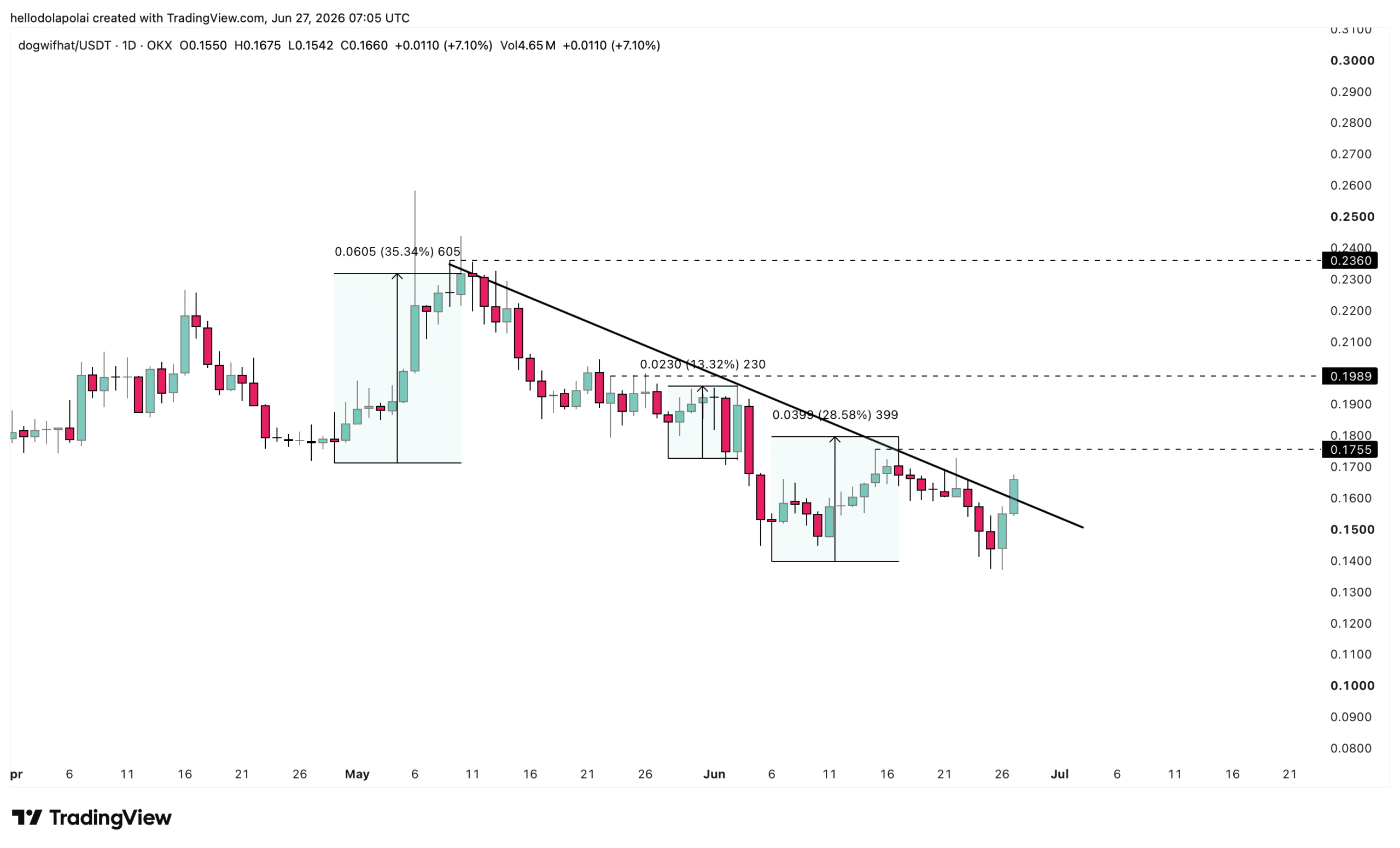
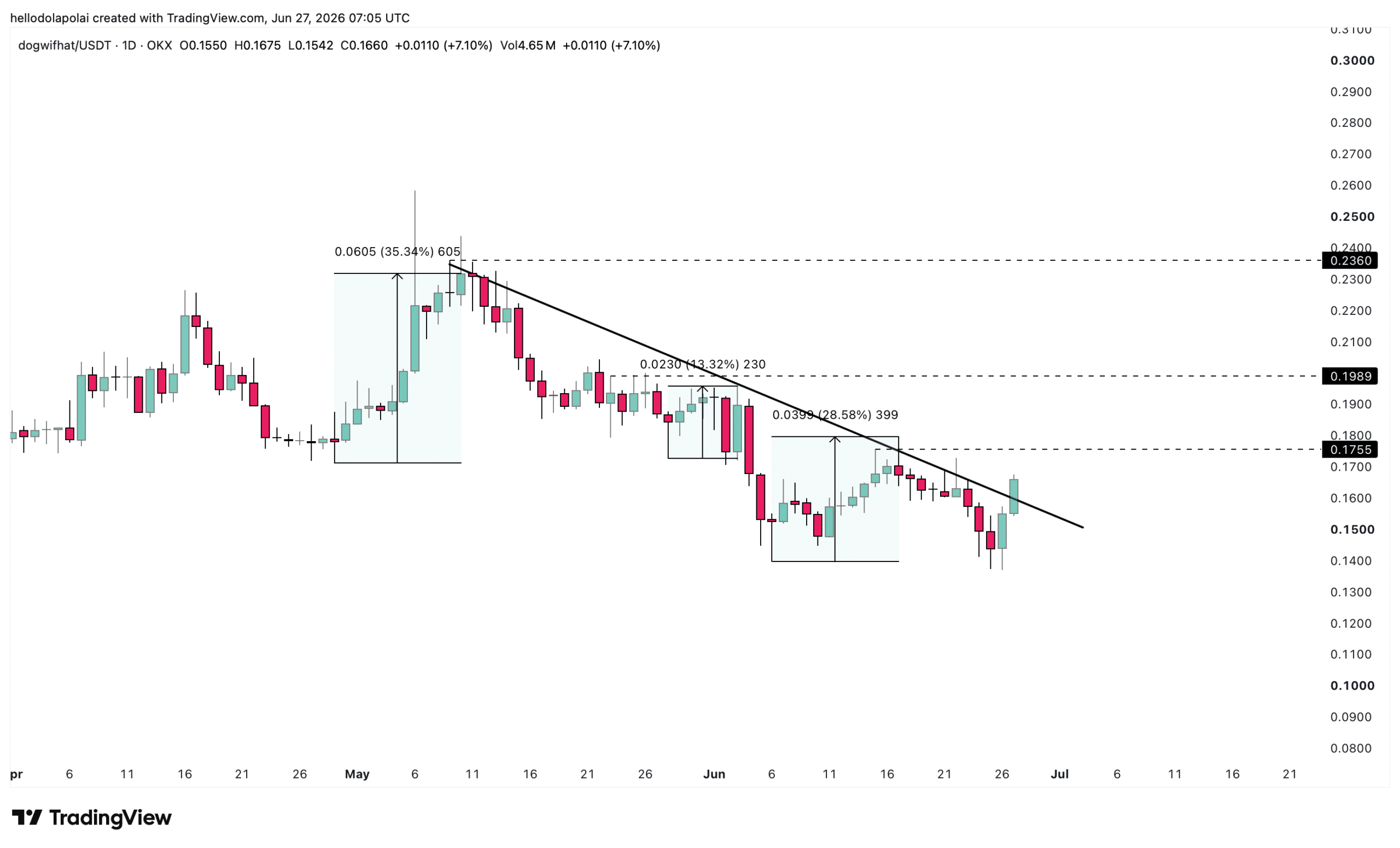
The major obstacle standing between WIF and a sizeable rally remains the descending resistance line that price has only marginally crossed.

The breakout cannot be confirmed as bullish yet. WIF’s price has not closed above the descending line, nor has it continued along the bullish path it began carving out days earlier.
Source: TradingView

For context, this same resistance has repeatedly capped WIF’s advances and forced the token to trade lower thrice in a row, even though each run leading into the level delivered double-digit gains.

A failure to push higher would leave WIF trudging beneath the resistance line for an extended period, adding to the 48 days it has already spent trading below this barrier.

Capital and buying indicators back WIF

WIF stands a strong chance of a major upswing, with the key indicators that track capital flow and buying activity all pointing in the same direction.

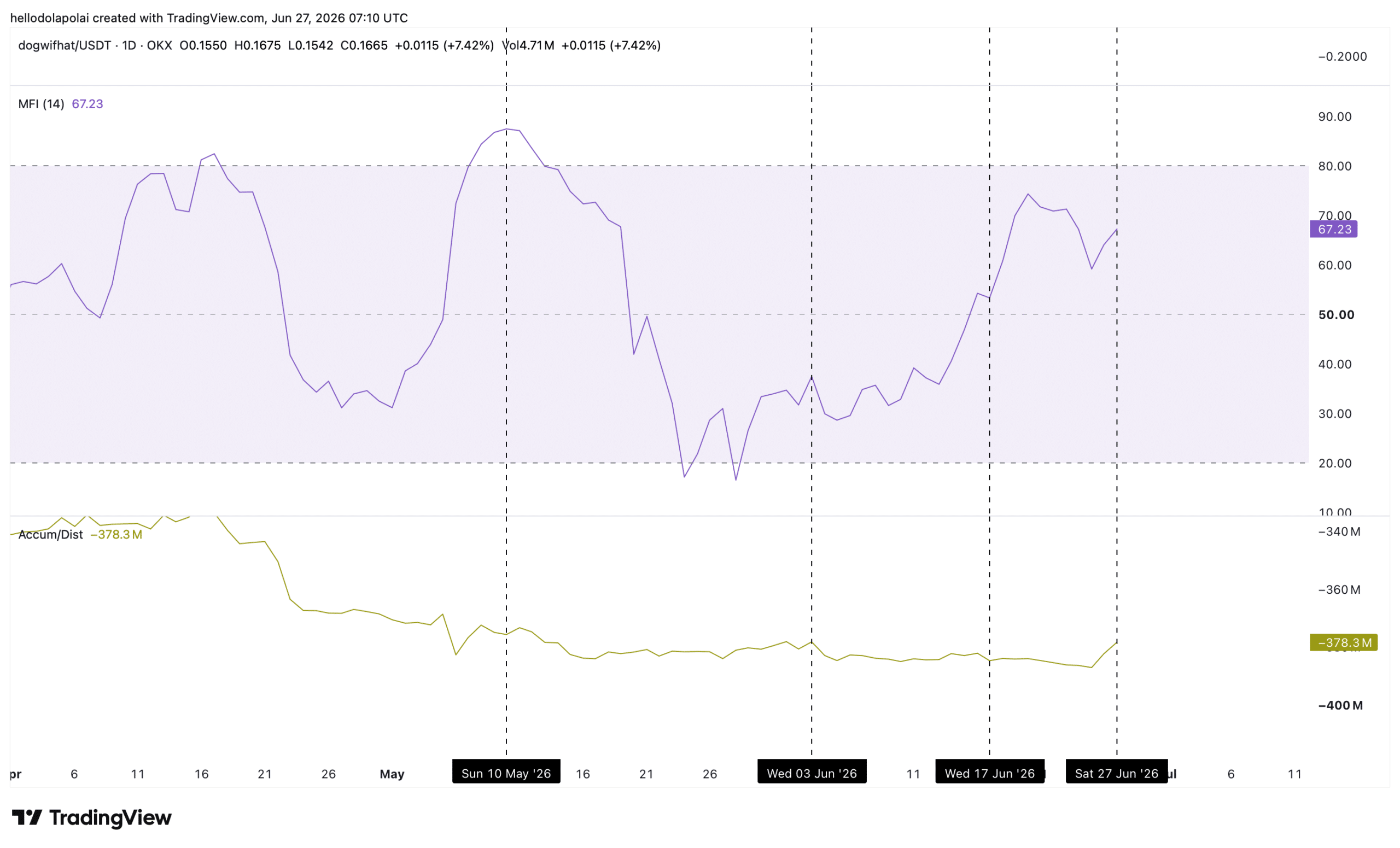
The accumulation/distribution indicator is showing a powerful upswing, which implies sustained buying, while total volume has settled at around 378 million WIF traded over the past 24-hour window.

Adding to this, the money flow index—which measures the movement of capital into and out of an asset—is surging upward at a reading of 67, signaling that more capital has flowed into WIF. More importantly, that reading sits in the bullish zone above 50, suggesting investors are actively buying.
Source: TradingView

The pattern worth noting appears at the vertical lines marking the points where price failed to breach the resistance mentioned earlier, where both indicators rallied into the level together—unlike previous instances in which one indicator rose while the other lagged, or one sat in overvalued territory.

A continued upward move would meaningfully reshape the outlook for WIF, since it would confirm a close above the resistance and establish a sustained bullish pattern.

Liquidation clusters limit WIF’s upside

The liquidation chart shows that WIF’s possible upside is limited, based on the arrangement of its clusters, which mark the levels where unfilled orders sit.

The downside below the current price level extends even further, suggesting WIF could still fall well beneath its present position despite the bullish momentum on display.

An important caveat applies here, as the liquidation heatmap offers only a glimpse rather than an extended view across a broader price spectrum. That leaves it unknown whether more buy orders sit beyond what the chart currently displays.


Final Summary

  • WIF has bounced 16% in a day after a rough year down 38%, and the signals that track buying activity suggest investors are stepping back in.
  • The rally isn’t safe yet, as WIF still needs to firmly clear a price ceiling that has rejected it three times before, and there’s room for it to slip lower first.


İlgili Sorular

QWhat is the current short-term performance of the dogwifhat (WIF) token mentioned in the article?

AAccording to the article, dogwifhat (WIF) has jumped 16% over the past day.

QWhat is identified as the major obstacle preventing WIF from a stronger rally?

AA descending resistance line is identified as the major obstacle. The price has not confirmed a bullish breakout as it hasn't closed above this line, which has rejected price advances three times before.

QWhat do the Accumulation/Distribution indicator and Money Flow Index suggest about buying activity for WIF?

AThe Accumulation/Distribution indicator shows a powerful upswing, implying sustained buying. The Money Flow Index is surging at a reading of 67, which is above 50, signaling that more capital is flowing into WIF and investors are actively buying.

QAccording to the article, what does the liquidation heatmap suggest about WIF's potential price movement?

AThe liquidation heatmap suggests that WIF's possible upside is limited by the arrangement of liquidation clusters. It also indicates that the downside below the current price level extends further, meaning WIF could still fall well beneath its present position despite the current bullish momentum.

QWhat two key points are summarized at the end of the article regarding WIF's outlook?

AFirst, WIF has bounced 16% with buying indicators suggesting investor interest is returning. Second, the rally isn't safe yet as WIF needs to firmly clear a key price resistance level that has rejected it three times, and there is room for the price to slip lower first.

İlgili Okumalar

720 Attacks, 0 Successes: Claude Code Defaults to Auto-Approval, AI Clicks 'Agree' for You

The era of manually approving every action for Claude Code is ending. Starting August 14th, Claude Code will default to an "Auto Mode" for Pro, Max, and Team plans, where AI automatically approves actions instead of prompting users for permission each time. This change is driven by a security report from Trajectory Labs commissioned by Anthropic, which tested 720 attack scenarios across Claude's latest models with zero successful breaches. The defense relies on a three-layer system: the aligned model itself, an input-side probe to detect hijacking attempts, and an output-side classifier to vet actions before execution. Anthropic claims this stack has made prompt injection attacks undemonstrable even internally. Tests showed the Auto Mode blocked 89% of dangerous commands, far surpassing the 13.6% interception rate by human users, who often develop "approval fatigue." However, experts like Simon Willison express caution, warning of potential blind spots. Independent research suggests vulnerabilities may persist, particularly with indirect attacks like malicious commands in third-party packages. While Auto Mode improves efficiency and reduces human error from repetitive prompts, it shifts approval authority from the user to AI. The article concludes that while the system is more reliable than fatigued users, it does not eliminate risk, and ultimate responsibility remains with the human user.

marsbit7 dk önce

720 Attacks, 0 Successes: Claude Code Defaults to Auto-Approval, AI Clicks 'Agree' for You

marsbit7 dk önce

Interview with Kalshi's Founders: Sports Trading Accounts for 95%; Disagreement on Philosophy with Polymarket

Interview with Kalshi Founders: Sports Trading at 95%, Disagreement with Polymarket on Philosophy Kalshi, a US-based prediction market platform founded in 2018 by MIT graduates Tarek Mansour and Luana Lopes Lara, has reached a $220 billion valuation. Operating under CFTC regulation, the platform allows users to trade on event outcomes, from sports to politics. Currently, sports-related trading dominates, accounting for about two-thirds of volume, down from 95% last year. Mansour argues this liquidity boosts other categories like crypto and politics, where major events can see $50-100 million in volume. He defends the concept of "financializing everything," stating markets transform partisan debates into objective, incentive-aligned systems for truth-seeking. A key point of contention is the regulatory approach. Mansour emphasizes Kalshi's commitment to a compliant path, contrasting it with rival Polymarket, which he accuses of operating without proper safeguards. He views established financial platforms like Robinhood and CME as his real competition. The industry faces legal challenges, including a lawsuit from New York's Attorney General alleging illegal gambling, and scrutiny over potential insider trading. Kalshi cites identity verification, surveillance systems, and full transparency as its defenses. On management, Mansour describes a flat, non-hierarchical structure adapted from his upbringing in Lebanon, focusing on agility. He credits his success to consistent, extreme effort. In rapid-fire questions, Mansour highlighted a trade on computing power prices, uses ChatGPT to analyze Kalshi's own election data, and advises young entrepreneurs to experiment boldly and avoid most outside advice.

marsbit26 dk önce

Interview with Kalshi's Founders: Sports Trading Accounts for 95%; Disagreement on Philosophy with Polymarket

marsbit26 dk önce

Vitalik Updates Ethereum Roadmap: From Merge to 'Lean Refactoring', with STARK, AI, and Privacy Reshaping the Technical Foundation

Vitalik Buterin has updated Ethereum's long-term roadmap, outlining a major shift from the post-Merge evolution toward a "Lean Ethereum" vision. The update builds on the 2023 framework but reorders priorities and introduces new concepts. Key continuations include improving consensus (single-slot finality), scaling data availability (larger blobs), simplifying light client verification with SNARKs/STARKs, and protocol simplification. Major adjustments involve significantly prioritizing quantum resistance due to heightened perceived threats, while deprioritizing items like VDFs and some EVM improvements. Technical replacements are planned, such as moving from Verkle trees to a unified Binary Tree and eventually PBTs, and rethinking state management with "New State Types." Notable new additions are: 1. Making **privacy a top-tier priority**, aiming to build it natively into the protocol. 2. **Radical scaling under post-quantum conditions**, using techniques like leanSPHINCS signatures and zkzk frames. 3. **Protocol "Lean-ification" and formal verification**, leveraging modern AI tools to make full formal verification feasible. 4. Exploring **Blob and Gas futures** for future capacity. 5. Developing **Native Rollups**, deeply integrating rollup capabilities into the protocol. 6. **Reimagining the EVM's future**, potentially exposing a simpler, modern instruction set (e.g., leanISA or RISC-V), with EVM becoming a compatibility layer. The core philosophy shifts toward specializing mechanisms for high-load activities (transfers, swaps, privacy) to gain scalability, rather than attempting to infinitely scale all activities. It also elevates **recursive STARKs and AI-assisted formal verification** as foundational infrastructure. In summary, Ethereum is embarking on a systemic "third-generation" redesign—Lean Ethereum—involving replacements or rewrites of major components. The goal is to achieve a quantum-safe, privacy-first, secure, decentralized, and highly scalable network while maintaining a lean and verifiable protocol.

marsbit52 dk önce

Vitalik Updates Ethereum Roadmap: From Merge to 'Lean Refactoring', with STARK, AI, and Privacy Reshaping the Technical Foundation

marsbit52 dk önce

İşlemler

Spot
活动图片