After 50x Storage Surge, Justin Sun Always Looks to the Next Decade

marsbitPublished on 2026-05-11Last updated on 2026-05-11

Abstract

Sun Yuchen, known for his controversial stunts like a $30 million lunch with Warren Buffett (canceled due to a kidney stone) and eating a $6.2 million duct-taped banana, is often overshadowed by a significant fact: his decade-long track record of spotting major investment trends. In 2016, he famously advised young people to invest in Bitcoin, Nvidia, Tesla, and Tencent instead of buying property. A hypothetical $20,000 investment in Nvidia and Tesla from that list would now be worth over 50 million RMB. His latest major call was on November 6, 2025, predicting a "50x storage opportunity" tied to the AI boom, which materialized with Sandisk's stock surging nearly 50-fold by 2026. Looking ahead, Sun now focuses on the next frontier: Physical AI. He identifies four key areas: 1. **Embodied AI/Robotics**: He sees this reaching its "iPhone moment," with companies like UBTech and Galaxy General leading in commercialization. 2. **Drones**: Viewed as the first commercially viable form of Physical AI, revolutionizing sectors from warfare (e.g., AeroVironment's Switchblade) to logistics. 3. **Spatial Computing**: Beyond VR, it's about AI understanding physical space, a foundational technology for robotics and autonomous systems, exemplified by Apple's Vision Pro. 4. **Space Exploration**: After a 2025 suborbital flight with Blue Origin, Sun advocates for space as the ultimate frontier, discussing blockchain's potential role in space asset management and data transactions. His in...

Most people in China know Justin Sun from his bizarre stories.

Spending 30 million to have dinner with Warren Buffett, only to cancel at the last minute due to a kidney stone; buying a duct-taped banana for 6.2 million dollars at an auction and eating it in front of everyone at a press conference; investing 75 million dollars to become the largest backer of the Trump family's crypto project, securing a seat at a White House dinner; and at the age of 35, flying past the Kármán line, declaring himself the youngest Chinese commercial astronaut.

There are also many negatives. In 2023, he was sued by the SEC for market manipulation, with accusations including over 600,000 wash trades to inflate the price of TRX and hiring celebrities for promotion without disclosing payments. Currently, he is in a lawsuit with the Trump family-related project WLFI.

These stories spread so widely that they almost overshadowed a serious matter. This man, over the past decade in the secondary capital markets, has almost never missed betting on any trend.

From buying BTC starting in late 2013, to 2016, advising post-90s generations not to buy houses, but to buy:

Bitcoin, NVIDIA, Tesla, Tencent.

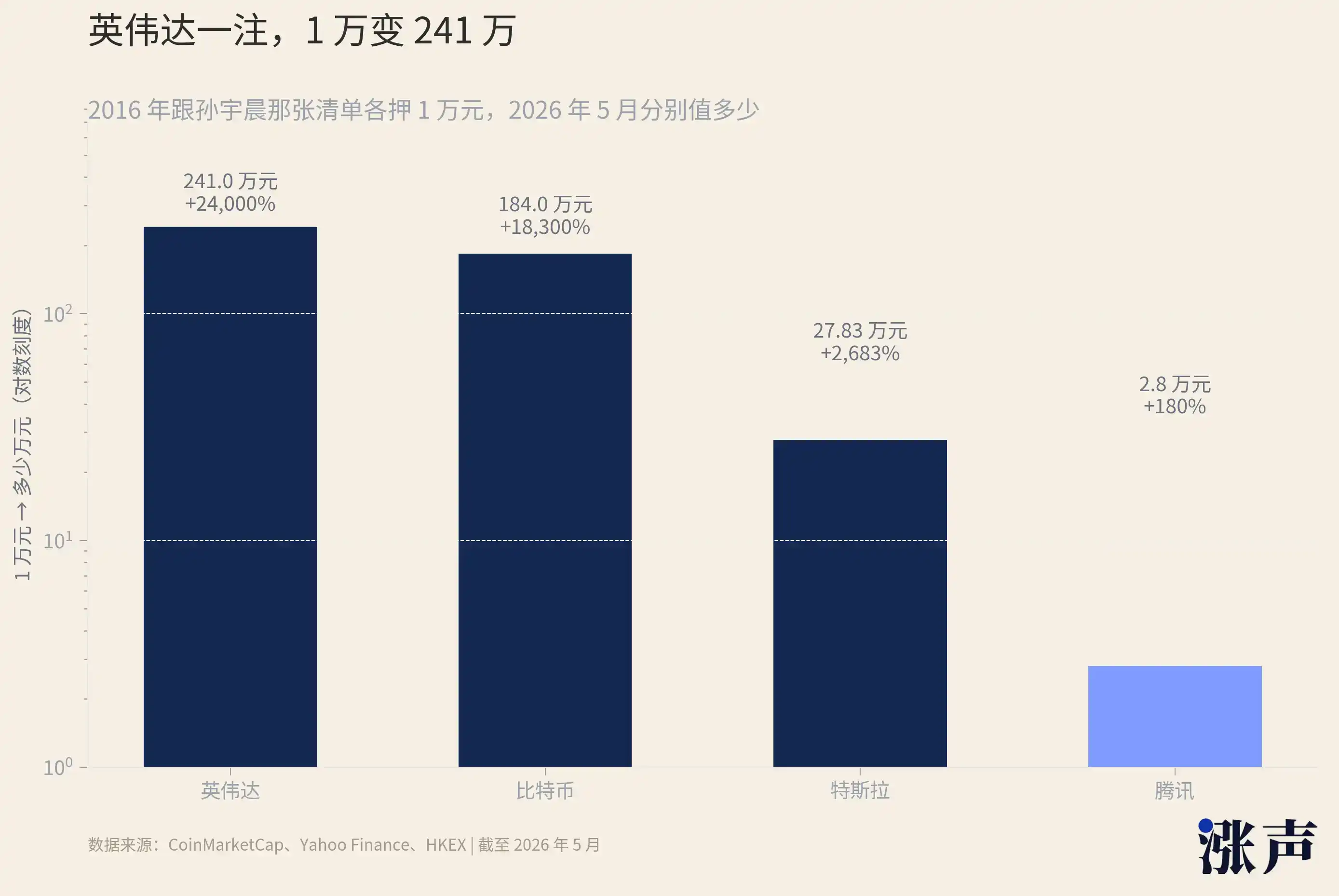
Ten years have passed. As of May 2026, Tesla's total return is approximately 2683%, and NVIDIA's total return is nearly 24000%.

If you had listened to Brother Sun back then and invested 10,000 yuan in NVIDIA, it would be 2.4 million today; 10,000 yuan in Tesla would be 278,000 today. A listener who bet 200,000 yuan on each item on that list in 2016 would have seen just the NVIDIA bet turn into approximately 48 million, and the Tesla bet into approximately 5.4 million, totaling over 53 million.
And this man continues to take shots today. On November 6, 2025, Justin Sun dropped a statement:

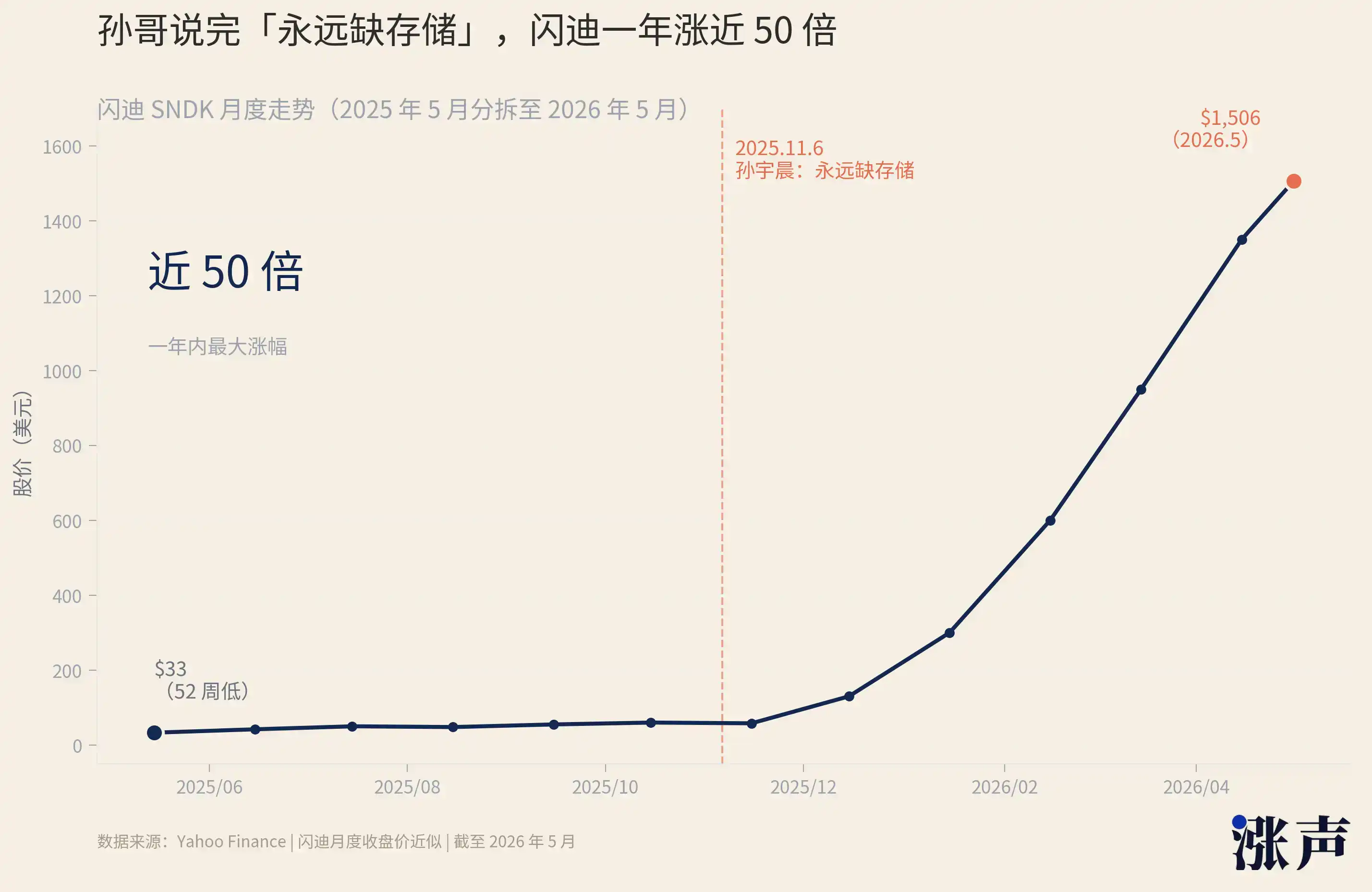
The capital market's reaction to this statement didn't reach fever pitch until 2026. SanDisk (SNDK), spun off from Western Digital, rose from a low of around $35 to $1,439 in a year, a maximum increase of nearly 50 times.
HBM memory capacity from Samsung, SK Hynix, and Micron was fully booked for 2026, already sold out, with orders scheduled through 2027-2028.

While everyone is still chasing the memory concept frenzy, in early 2026, Justin Sun changed his tune again in a video.

That video was originally about the outlook for 2026. Besides topics leaning towards wellness like putting health on the new year's list, he dedicated a segment to advise young people: embodied AI, drones, spatial computing, space exploration.

The author collected Justin Sun's public statements over the past two years regarding these four directions. Stringing them together, preliminary capital leaders have also emerged on each path.

Who Is the Next Storage Stock?

The first area Justin Sun pointed to was embodied AI.

The concept of robots has been discussed by humans for at least a hundred years. The Czech playwright Čapek coined the word "Robot" in 1920; industrial robotic arms have been used since the 1980s; Honda's ASIMO could climb stairs over twenty years ago. But the real bottleneck has always been the brain.

In the last two years, the entire industry has shifted towards VLA models—Vision-Language-Action. In plain terms, robots used to act based on code; now robots are starting to act based on seeing the world.

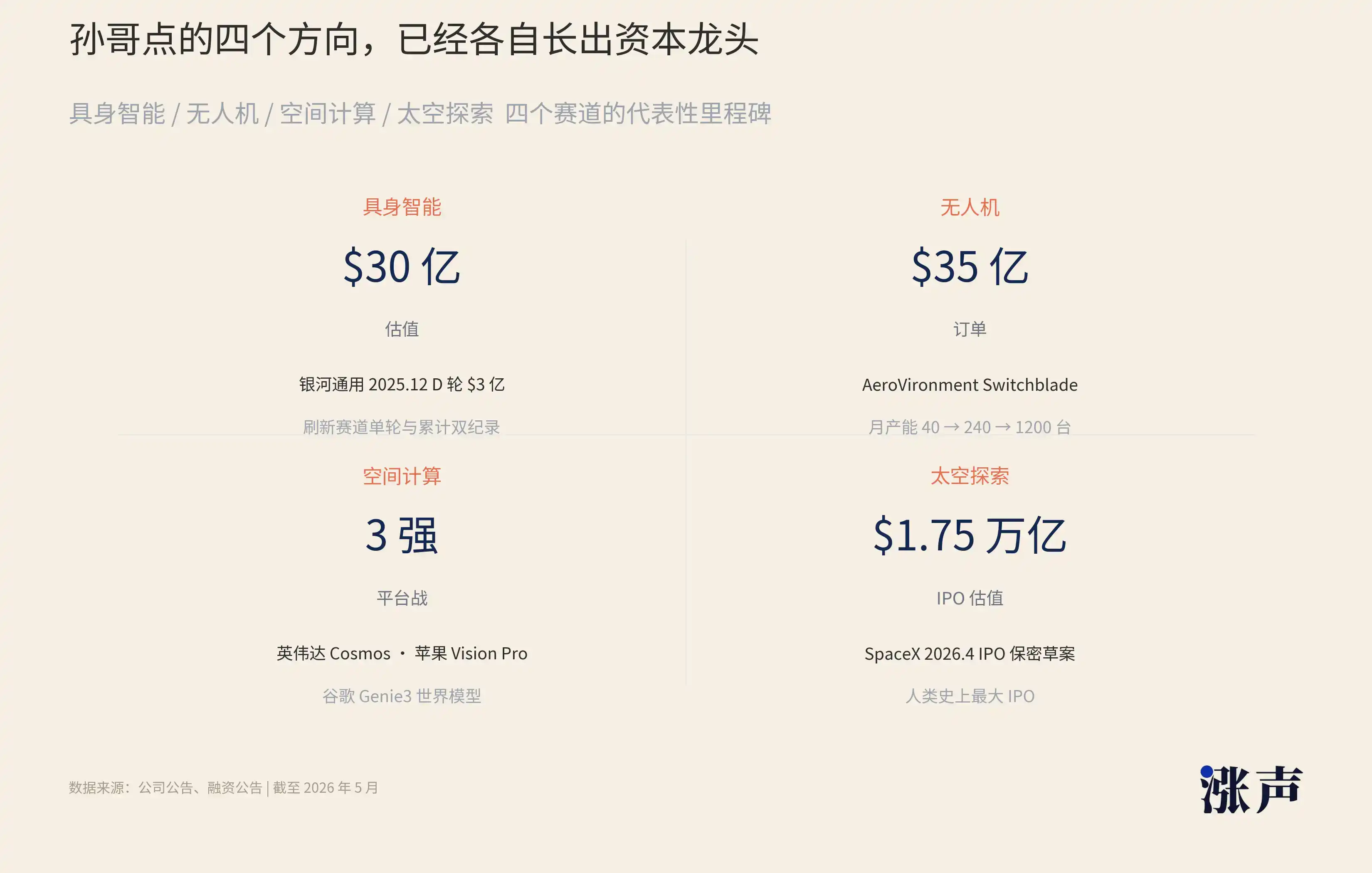
Unitree shipped over 5,500 humanoid robots in 2025, ranking first globally, and applied for a Science and Technology Innovation Board IPO in March 2026. Galaxy General raised a new round of $300 million (approx. 2.1 billion RMB) in December 2025, with cumulative funding of about $800 million and a valuation of $3 billion (approx. 21.1 billion RMB), setting new records for both single-round and total funding in the embodied AI sector.

Justin Sun said he likely won't personally venture into building robots, but he has a nose for narratives and the direction of capital flow. He said in a Bloomberg interview, "In a market where 99% of people don't know what a wallet is, the cost of education must be factored into the business model."

This statement, used to explain stablecoins in 2018, applies equally well in 2026. 99% of Chinese haven't used an embodied AI robot yet, but as long as that robot can cook, move boxes, or care for the elderly, the remaining 1% is the next opportunity.

The second sector he pointed to is drones.

While humanoid robots are still ramping up production, drones have already taken a step ahead into commercial deployment. They are naturally suited for what AI does best, from autonomous navigation to swarm coordination to data collection. They don't need to walk; flying is simpler than bipedal locomotion.

On the Russia-Ukraine battlefield, AI drone swarms have already taken over a large part of the role of tank units; Ukraine's annual drone production target has climbed to several million units. Over rice fields in rural China, DJI's agricultural drones fly, one replacing ten farm workers. In Shenzhen, Meituan has operationalized drone delivery, with order-to-delivery times not exceeding 15 minutes.

Drones are ahead of humanoid robots. They are the first form where AI has achieved a commercial closed-loop in the physical world.

The third area Justin Sun mentioned is spatial computing. This is the least mainstream among the directions he pointed out.

When Apple released the Vision Pro in 2024, most people saw it as a VR headset that cost several times more. This might be a misreading.

The Vision Pro's ambition has little to do with VR. It's Apple's first attempt to make AI understand space—how big your living room is, how far the table is from you, whether the coffee cup is to the left or right of the sofa, if you can reach it when you stretch your hand. This sounds simple but is ten times harder than training ChatGPT. Large language models only need to understand language; spatial computing needs to understand physics.

This is precisely the common prerequisite for robots, drones, and autonomous driving—they all require a form of spatial intelligence. NVIDIA's Cosmos platform, Google's Genie 3 world model, Tesla's FSD, are all doing the same thing: transitioning AI from understanding text to understanding the world.

ChatGPT only needs to understand language, but the next generation of AI needs to understand the world itself.

For the first three sectors, Justin Sun only verbally pointed them out. When it comes to space, he actually went there in person.

On August 3, 2025, he boarded Blue Origin's "New Shepard" NS-34 capsule and flew past the Kármán line.

After returning to Earth, he expressed an ambition: to make his company not just a "cryptocurrency exchange" but a "service provider for space economy infrastructure," using blockchain to solve space asset ownership, satellite data trading, and interplanetary payments. It sounds like science fiction. But look back at how he evangelized USDT ten years ago—people thought that was science fiction too back then.
Back on Earth, his message to young people was more direct: "Space exploration is a common mission for all humanity. I hope this flight inspires more young people to devote themselves to technology and innovation, collectively shaping humanity's interstellar future."

Brother Sun's Investment Logic

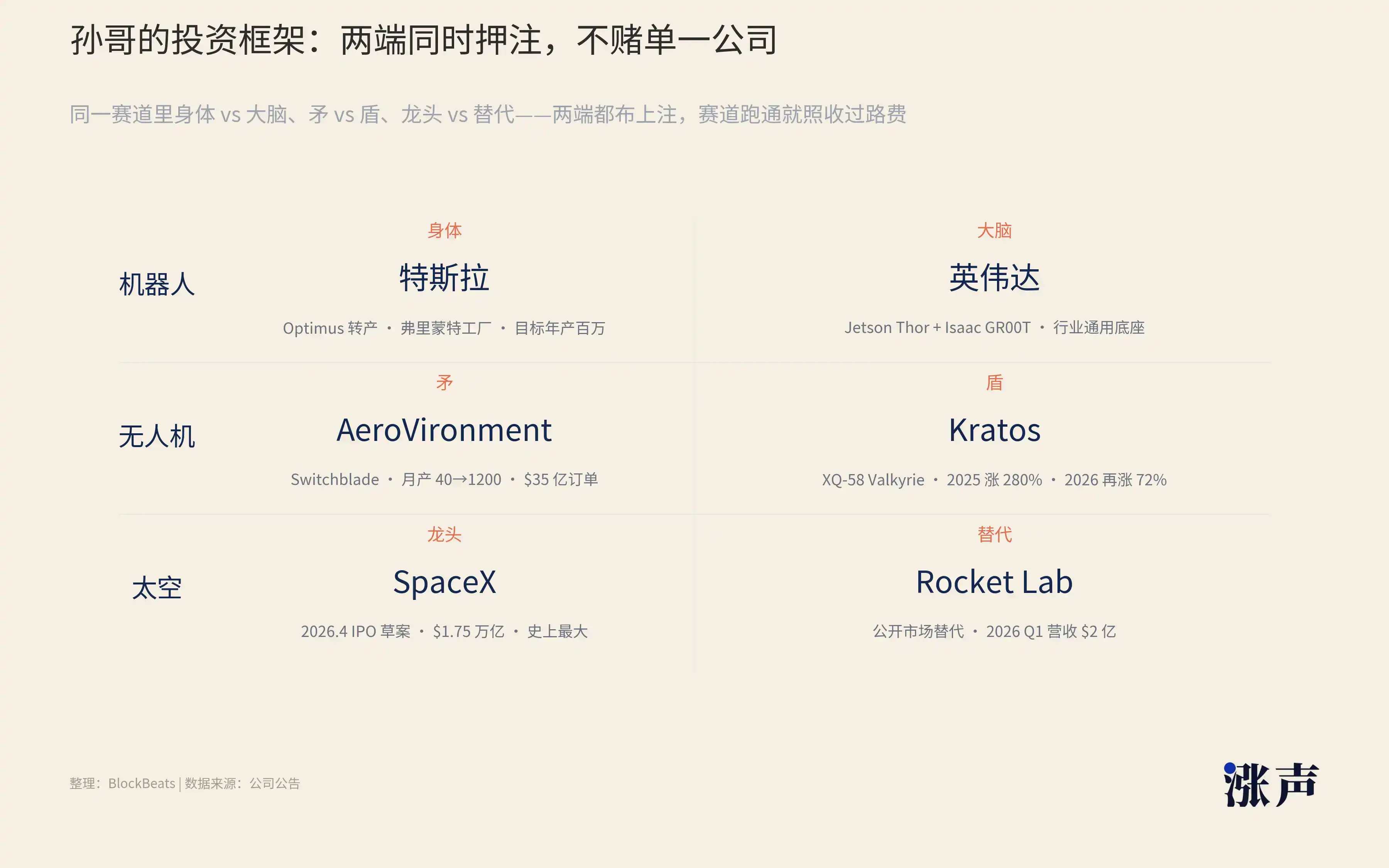
Justin Sun's publicly expressed investment logic is: find sectors with a clear direction, place bets on both ends, and do not gamble on the execution of a single company.

On the robotics line, his framework is to bet separately on the body and the brain.

Bet on Tesla for the body. In early 2026, Tesla announced discontinuing Model S and Model X, converting the Fremont factory into an Optimus production line, targeting an annual output of one million units with a mass-production unit price of about $20,000 to $25,000; current version Optimus robots are already handling parts transport and sorting at Austin and Fremont factories; the Gen 3 production line is scheduled to start in summer 2026.

Bet on NVIDIA for the brain. Jetson Thor puts server-grade AI inference into the robot body, Isaac GR00T has almost become the industry's common base, and Jensen Huang declared at GTC that there will be 1 billion humanoid robots globally by 2035.

Whether Optimus delivers on schedule is Elon Musk's problem, not NVIDIA's. As long as the sector takes off, the toll will be collected.

On the drone line, the core judgment is the irreversibility of Physical AI in military scenarios.

AeroVironment's Switchblade loitering munition became an iconic weapon in Ukraine, with monthly production capacity increased from 40 to 500 units, targeting 1,200 units; a $3.9 billion order locks in revenue for the next three years in advance. Kratos' XQ-58 Valkyrie is the "loyal wingman" to the F-35—manned aircraft on missions, drones on the flanks—with a unit price less than a fraction of a fifth-generation fighter jet, rising 280% in 2025 and another 72% in 2026.

One makes tanks uneconomical, the other makes manned fighter jets redundant—the logic on both ends is complementary.
On the space line, Justin Sun bid $28 million for a Blue Origin flight seat in 2021. This money was donated to the Blue Origin STEM charity fund, distributed among 19 non-profit organizations. On August 3, 2025, he boarded the New Shepard NS-34 mission, completing a suborbital flight.

In public markets, SpaceX filed a confidential IPO draft with the SEC in April 2026, targeting a valuation of $1.75 trillion, poised to become the largest IPO in human history; Rocket Lab's Q1 2026 revenue exceeded $200 million, making it the most direct alternative investment when SpaceX isn't available.

Once SpaceX goes public, the entire space sector's valuation framework will be rewritten.

Listen to Brother Sun

Stringing together Justin Sun's statements over the past two years, "AI, robotics, and blockchain have reached their iPhone moment" is his judgment on embodied AI. "Robot armies, robot police" is his prophecy for autonomous weaponized AI. "The integration of AI, robotics, and spatial computing" is his bet on the next generation of human-machine interfaces. "Earth is too small; it's our home" is his perspective shift after flying past the Kármán line.

These four things pieced together form the complete picture of Physical AI.

Over the past two decades, the internet changed the way information flows. WeChat replaced letters, Taobao replaced markets, Douyin replaced TV.

But the underlying rules of the physical world didn't change. Workers are still workers, factories are still factories.

In the next two decades, AI might change the very way the real world operates. Factories will have tireless humanoid robots, roads will have autonomous vehicle traffic, battlefields will roar with drone swarms, and the first "residents" on the Moon and Mars are likely to be pioneering AI robots.

That young man who in 2016 told everyone not to buy houses has now flown past the Kármán line.

And most of us are probably still waiting for the next Yanjiao.

Trending Cryptos

Related Questions

QWhat is the core of Sun Yuchen's investment philosophy as presented in the article?

ASun Yuchen's core investment philosophy, as presented, is to identify long-term, trend-based themes with high potential for change, and then invest in multiple key players across that entire value chain rather than betting on a single company. His approach focuses on the structural change of an industry.

QWhich sectors or technologies does Sun Yuchen point to as the next big opportunities after the success in the storage sector?

ASun Yuchen points to four key areas as the next big opportunities: Embodied AI/Robotics, AI Drones, Spatial Computing (the AI-powered understanding of physical space), and Space Exploration. He sees these as the frontiers where AI will begin to materially alter the physical world.

QHow does Sun Yuchen's investment strategy in the robotics sector exemplify his broader logic?

AIn the robotics sector, his strategy is to invest in both the 'body' and the 'brain' separately. He cites Tesla (Optimus) as a bet on the physical robot platform (the body) and Nvidia (Jetson Thor, Isaac platform) as a bet on the AI intelligence and operating system (the brain). This way, he benefits from the growth of the overall sector regardless of which specific company executes best.

QAccording to the article, what is the author's perspective on the historical impact of AI and its future potential?

AThe author argues that the internet and AI have so far primarily changed information flow and digital services. The future potential lies in AI fundamentally altering the operation of the physical world itself—through robots in factories, autonomous vehicles, drone swarms, and even AI/robotics pioneers in space—representing a much deeper transformation of reality.

QWhat is the significance of Sun Yuchen's space flight in the context of his overall vision?

AHis space flight on Blue Origin's New Shepard is symbolic of his shift towards a long-term, frontier-oriented vision. It represents his ambition to move beyond cryptocurrency into 'space economy infrastructure' and serves as a personal statement to inspire younger generations to engage with transformative, long-horizon technologies like space exploration.

Related Reads

After Three Consecutive Quarters of Decline, Can the Crypto Market Find a Window for Stabilization in Q3?

The cryptocurrency market has just concluded its worst-performing quarter since 2022, with total capitalization dropping 12.6% to $2.1 trillion. All core metrics indicate capital is leaving the sector, not just rotating within it. Bitcoin fell 14.2% and Ethereum dropped 25.4% in Q2, breaking their previous correlation with US tech stocks. A key driver is the reversal in US spot Bitcoin ETF flows, which saw a net outflow of approximately $4.67 billion in Q2, including a record monthly outflow near $4.5 billion in June. While recent data suggests long-term holders are accumulating again, sustained ETF outflows mean continued selling pressure. Market focus is now singularly on the Federal Reserve. The upcoming July FOMC meeting is seen as the most critical event for Q3. A dovish signal could support Bitcoin reclaiming a $68,000-$84,000 range, while a hawkish stance might establish a new trading band around $50,000-$56,000. Additionally, regulatory uncertainty persists, with the progress of the crucial *CLARITY Act* stalling in the Senate, reducing its perceived 2026 passage probability to 40-45%. Despite the broad downturn, a few sectors showed growth. Prediction markets saw nominal volume surge 48.7% year-over-year to $113.8 billion, and tokenized collectibles transaction volume rose 143% quarterly to $1.4 billion. The Real-World Asset (RWA) tokenization sector also continued steady growth, now representing ~$28.1 billion in on-chain value. The market's foundation for an extreme crash appears limited, with Bitcoin price hovering near its 200-week moving average. However, the trading paradigm has shifted from narrative-driven speculation to decisions based on price action, policy developments, and interest rate expectations, making a broad sentiment-driven rally unlikely in the near term.

marsbit14h ago

After Three Consecutive Quarters of Decline, Can the Crypto Market Find a Window for Stabilization in Q3?

marsbit14h ago

BIT Trading Moment: BTC Still Suppressed by Weekly 200 EMA, Rejection May Restart Decline; Storage and Semiconductors that Surged Last Night Begin Falling in Evening Trading

**Crypto & Stock Market Wrap: Bitcoin Tests Resistance, Stocks Retreat After AI Surge** Bitcoin consolidates around $66,000, facing key resistance near $68,000—an area seen as a major psychological and technical hurdle where previous rallies have failed. Analysts note the cryptocurrency is caught between its 200-week moving average (~$63,333) and 200-week EMA (~$68,328). A clear break above $68k is needed to signal a stronger bullish trend, while a rejection could lead to a retest of $63k support. Market sentiment remains cautious, with low futures open interest pointing to a low-liquidity rebound rather than a full bull market. Bitcoin spot ETFs saw another $203 million inflow. US stock futures pointed lower after a strong Tuesday session led by a massive rebound in semiconductors and memory stocks. The rally was fueled by renewed optimism about AI-driven hardware demand, with Micron, SanDisk, and SK Hynix surging. However, those gains reversed in pre-market trading. Super Micro Computer (SMCI) soared over 20% after hours on strong guidance and a record backlog. Other standouts included Rocket Lab and nuclear energy plays Oklo and X-Energy. Rising oil prices (Brent above $91) and climbing Treasury yields (10-year near 4.64%), however, are reigniting inflation concerns and acting as a headwind for equities. In Asia, markets were mixed. South Korea's KOSPI pared early gains to close slightly higher as semiconductor stocks like SK Hynix gave back initial surges. Japan's Nikkei edged lower as the yen hit a fresh 38-year low against the dollar, raising fears of potential market intervention. Key events to watch include the Samsung Galaxy launch, AMD's AI event, and a slew of major tech earnings from Alphabet, Tesla, and IBM after the close on Wednesday, followed by the ECB meeting and Intel's earnings on Thursday.

marsbit14h ago

BIT Trading Moment: BTC Still Suppressed by Weekly 200 EMA, Rejection May Restart Decline; Storage and Semiconductors that Surged Last Night Begin Falling in Evening Trading

marsbit14h ago

Former CFTC Chairman, Circle President Tarbert: Preaching Long-Termism While Cashing Out $30 Million Himself

Former CFTC Chairman and Circle President Heath Tarbert has consistently advocated for a long-term vision in public, urging patience from investors as Circle’s stock price has fallen significantly from its peak. However, it has been revealed that since Circle’s IPO, Tarbert has continuously sold his CRCL shares through pre-arranged trading plans, cashing out approximately $30 million, without making any public market purchases. This contrast between his public messaging and personal actions has drawn criticism. Tarbert joined Circle in July 2023 as Chief Legal Officer, leveraging his regulatory experience to help guide the company through its IPO and expansion. Despite promoting stablecoins as long-term infrastructure, he established a 10b5-1 trading plan just before Circle went public, leading to substantial stock sales over the following year. In March 2026, he initiated another plan to sell more shares. His career trajectory highlights a pattern of moving between high-level regulatory roles and influential positions in the financial sector. After resigning as CFTC Chairman in early 2021, he joined Citadel Securities as Chief Legal Officer just 27 days later, during a period of intense regulatory scrutiny for the firm. He later joined Circle, aiding its efforts to navigate regulatory challenges for its public listing. While Tarbert's expertise in policy and compliance is valuable to companies like Circle, his actions—advocating long-term confidence while personally divesting—raise questions about the alignment between his public statements and his private financial decisions, leaving investors who followed his advice to bear the market risks.

marsbit15h ago

Former CFTC Chairman, Circle President Tarbert: Preaching Long-Termism While Cashing Out $30 Million Himself

marsbit15h ago

Gate Research Institute: The 'Wall Street-ization' Wave of Crypto Financial Products – Competition or Integration?

The article titled "Gate Research Institute: Are Crypto Financial Products Sparking a 'Wall Street' Wave—Competition or Convergence?" explores the evolving relationship between the crypto ecosystem and traditional finance (TradFi). The piece begins by reflecting on Bitcoin's original 2009 vision of decentralization, disintermediation, and moving away from banks. It then contrasts this with the 2024 landscape, where key crypto assets like Bitcoin are increasingly held through Wall Street products like ETFs issued by giants like BlackRock. The article questions whether this signifies that TradFi is systematically taking over the rights to issue, price, custody, and distribute crypto financial assets. The core argument is that this is not a zero-sum takeover but rather a bidirectional convergence where each side addresses the other's weaknesses. Crypto offers 24/7 global markets, programmable settlement, and open access but lacks compliant channels, institutional-grade custody, deep fiat liquidity, and mainstream distribution. TradFi possesses these but is constrained by legacy systems, limited operating hours, and slow settlement. Two primary convergence paths are highlighted: * **Path A (CEX to TradFi):** Exemplified by Gate, which has progressed from offering tokenized stocks and CFDs to providing direct, real stock trading (US, Hong Kong, South Korea) within its platform, using USDT. * **Path B (TradFi to Crypto):** Exemplified by Robinhood, which has integrated crypto trading, acquired exchanges like Bitstamp, and is moving traditional assets like stocks onto the blockchain via tokenization and its own Layer 2. Both paths are ultimately competing to become the next-generation, unified financial account—a "super account" where users can seamlessly trade cryptocurrencies, stocks, ETFs, RWA (Real World Assets), and tokenized treasury products in one interface. The growth of RWA and tokenized treasuries (e.g., BlackRock's BUIDL) is presented as the asset-layer fusion, providing stable, yield-bearing assets on-chain and acting as a bridge between the two worlds. In conclusion, the "Wall Street-ization" of crypto is framed as a mutual transformation. Decentralized ideals persist in the protocol layer, while at the application layer, a more efficient, global, and accessible unified capital market is emerging from this convergence. The future competition lies not between crypto exchanges and stockbrokers, but between platforms vying to offer the most comprehensive asset coverage, liquidity, and user experience within a single account.

marsbit15h ago

Gate Research Institute: The 'Wall Street-ization' Wave of Crypto Financial Products – Competition or Integration?

marsbit15h ago

Trading

Spot

Hot Articles

How to Buy SUN

Welcome to HTX.com! We've made purchasing SUN (SUN) simple and convenient. Follow our step-by-step guide to embark on your crypto journey.Step 1: Create Your HTX AccountUse your email or phone number to sign up for a free account on HTX. Experience a hassle-free registration journey and unlock all features.Get My AccountStep 2: Go to Buy Crypto and Choose Your Payment MethodCredit/Debit Card: Use your Visa or Mastercard to buy SUN (SUN) instantly.Balance: Use funds from your HTX account balance to trade seamlessly.Third Parties: We've added popular payment methods such as Google Pay and Apple Pay to enhance convenience.P2P: Trade directly with other users on HTX.Over-the-Counter (OTC): We offer tailor-made services and competitive exchange rates for traders.Step 3: Store Your SUN (SUN)After purchasing your SUN (SUN), store it in your HTX account. Alternatively, you can send it elsewhere via blockchain transfer or use it to trade other cryptocurrencies.Step 4: Trade SUN (SUN)Easily trade SUN (SUN) on HTX's spot market. Simply access your account, select your trading pair, execute your trades, and monitor in real-time. We offer a user-friendly experience for both beginners and seasoned traders.

7.5k Total ViewsPublished 2024.03.29Updated 2026.06.02

How to Buy SUN

Discussions

Welcome to the HTX Community. Here, you can stay informed about the latest platform developments and gain access to professional market insights. Users' opinions on the price of SUN (SUN) are presented below.

活动图片













