
Sadii
06/23 07:03
Distributed AI training, validated for intercontin
#World Cup Predictions: 100,000 USDT Daily #HTX Invites You to Share 600K USDT in Gift Packs #BTC Prophet: 20-Day 380 Million HTX Challenge Distributed AI training, validated for intercontinental workloads
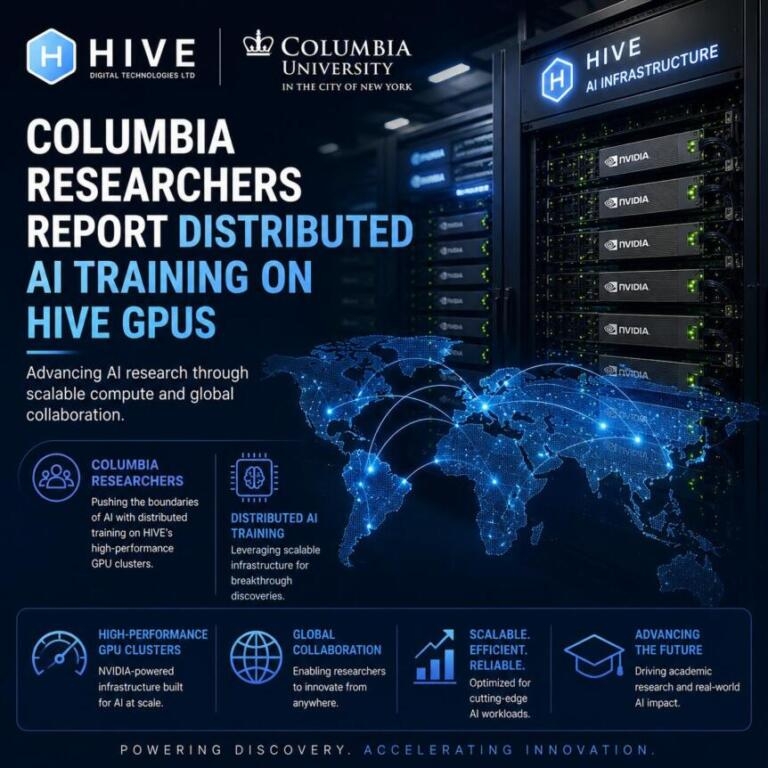
Columbia University’s Department of Industrial Engineering and Operations Research has been involved in a research effort that, according to its organizers, demonstrates remote AI model training using GPU infrastructure located in Paraguay. The work is described as a first AI research project completed on HIVE Digital Technologies’ (NASDAQ: HIVE) GPU cluster in Asunción, with results submitted for consideration at NeurIPS, one of the largest machine learning conferences.
What the study claims
In the reported setup, researchers based in New York trained AI models on HIVE’s GPU infrastructure in Paraguay, a distance of more than 5,000 miles. The key theme is the feasibility of distributed AI training across geographies, where latency, network reliability, and software performance can materially affect training efficiency.
The organizers also say the study found that software optimizations allowed HIVE’s A40 GPU infrastructure to deliver performance that was comparable to newer-generation H100 systems once normalized for hardware capabilities. Normalization matters in these comparisons because raw throughput often varies by model, batch size, and the software stack, making apples-to-apples benchmarking difficult without explicit methodology.
Why NeurIPS submission matters
For the AI infrastructure market, peer-reviewed or conference-submitted research serves as a signal that performance claims are at least reproducible within a defined experimental framework. NeurIPS is typically used as a venue where methods, measurements, and system constraints are scrutinized by other researchers.
That said, the announcement describes a project completion and submission, not the final peer-reviewed acceptance of results. For investors and operators, the practical value will
1Поделиться
Все комментарии0НовыеВ тренде