Zhou Hang: How Much is SpaceX Really Worth?

marsbitPublicado em 2026-06-02Última atualização em 2026-06-02

Resumo

Summary: Author Zhou Hang argues that while SpaceX is arguably one of the greatest industrial companies of the past 50 years, its anticipated IPO valuation of approximately $1.75 trillion is likely overvalued by about $1.25 trillion. The analysis acknowledges SpaceX's monumental success in slashing launch costs, achieving near-monopoly in commercial launches, and building the Starlink satellite internet constellation. However, using a projected 2030 revenue of $50-80 billion and applying a generous tech company valuation multiple yields a "reasonable" valuation range of only $500 billion to $1.2 trillion. The $1.25 trillion gap stems from premiums for its long-term vision (e.g., Starship, space-based computing), its status as a U.S. strategic national asset, and retail investor enthusiasm driven by the Elon Musk narrative. The article outlines three post-IPO scenarios: valuation solidification (25% probability), sideways consolidation (50%), or a correction to fundamental value (25%). The probability-weighted expected valuation is $1.3-1.5 trillion, suggesting negative expected returns for buyers at the IPO price. The conclusion cautions investors to separate the company's undeniable greatness from the stock's price, advising against chasing the IPO and to wait for key milestones or a lower entry point.

Author: Zhou Hang

SpaceX may be overvalued by $1.25 trillion around its IPO.

This is not to deny SpaceX's greatness. On the contrary, anyone seriously discussing SpaceX must first acknowledge: it is likely one of the greatest industrial companies of the past 50 years.

But the greatness of a company and whether a stock is worth buying at any price are two completely different things.

SpaceX can simultaneously be "the greatest industrial entity of the 21st century" and also a "severely overvalued investment target." These two things are not mutually exclusive.
First, Acknowledge Its True Greatness

Any honest discussion about SpaceX's valuation must start with this statement: It is the most successful industrial company of the past 25 years, bar none—even more successful than Tesla. This is not mere praise; it is a fact of engineering economics.

Tesla disrupted a 150-year-old mature industry—automobiles. Its rivals are Mercedes-Benz, Ford, Toyota. These opponents are certainly not weak, but they are commercial companies, not backed by national interests, lacking political barriers; competition is essentially about product, brand, supply chain.

SpaceX disrupted a 60-year-old state-monopolized industry—space. Its rivals are NASA, Roscosmos, ESA, CNSA. This is an entirely different level of difficulty: higher engineering barriers, greater capital density, more complex regulation, deeper entanglement with national interests. When Musk founded SpaceX in 2002, the entire space industry was essentially an extension of national missions; commercial companies were not believed capable of building rockets, let alone rockets cheaper than national ones.

Over 20 years later, SpaceX slashed launch costs from $54,500/kg in the Space Shuttle era to $1,500/kg—a 36-fold reduction. It now launches 165 times a year, one company exceeding the total launch count of all other nations and all commercial players combined. It built humanity's first truly reusable rocket, a single Falcon 9 first stage flying 32 times, with a success rate exceeding 99%. It established the world's first global satellite internet—covering over a billion users, becoming a decisive strategic asset on the first day of the Ukraine war.

Tesla in 2025 still faces fierce competition from Chinese EVs; SpaceX's share in the global commercial launch market, is nearing monopoly.

SpaceX is a great company, perhaps the greatest industrial company on Earth in the past 50 years. Any critique of its valuation must first acknowledge this fact.

What Does $1.75 Trillion Mean?

Let's understand through a set of comparisons:
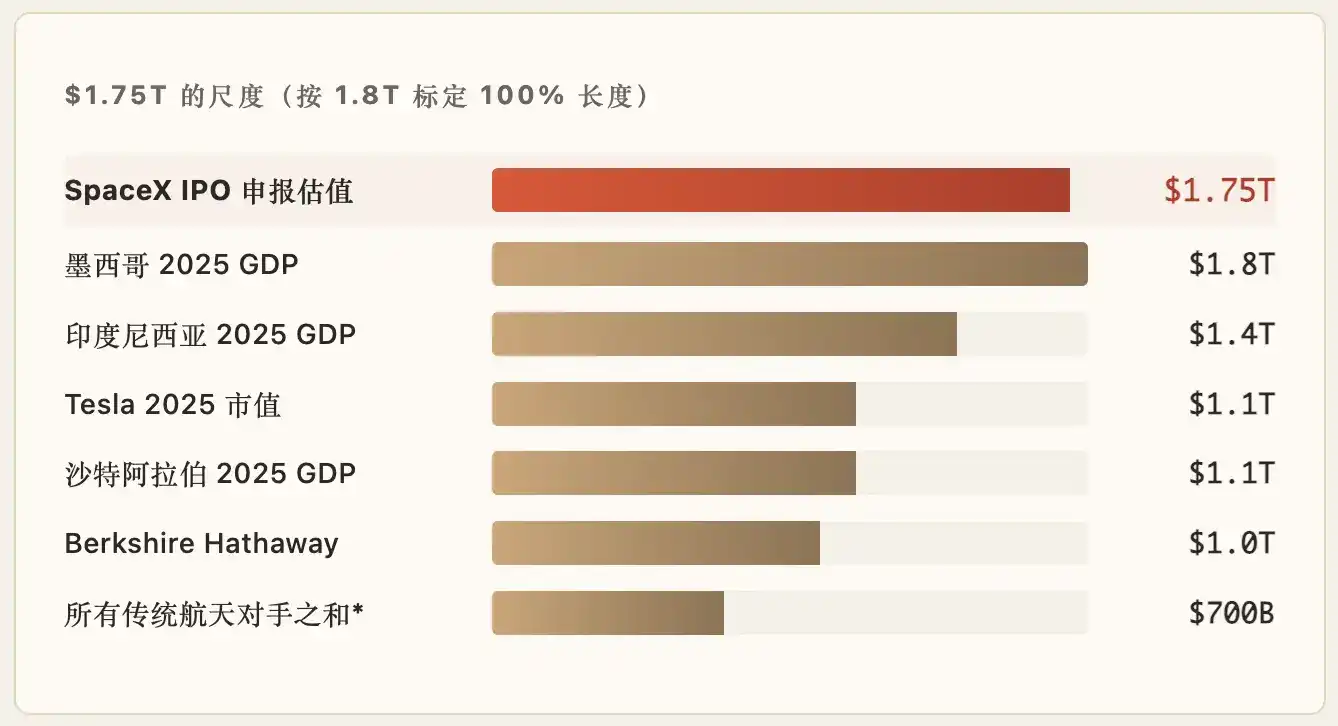
* Combined market cap of Boeing + Lockheed + Northrop + RTX + GD. SpaceX alone is valued at 2.5 times the sum of these 5.

In other words, the valuation of SpaceX alone will exceed Mexico's annual GDP, exceed either Tesla or Berkshire, and is 2.5 times the total market cap of all traditional space rivals.

This itself is not the issue—great companies deserve great valuations. But the 2.5x ratio means the market is not pricing it as a "space company," nor as an "industrial company." The market is pricing it using a hybrid paradigm closer to "sovereign asset + AI-era infrastructure + narrative premium."

Is this pricing reasonable?

List SpaceX's current businesses and seriously calculate how much revenue it can generate by 2030, assuming a reasonably optimistic scenario for each line:
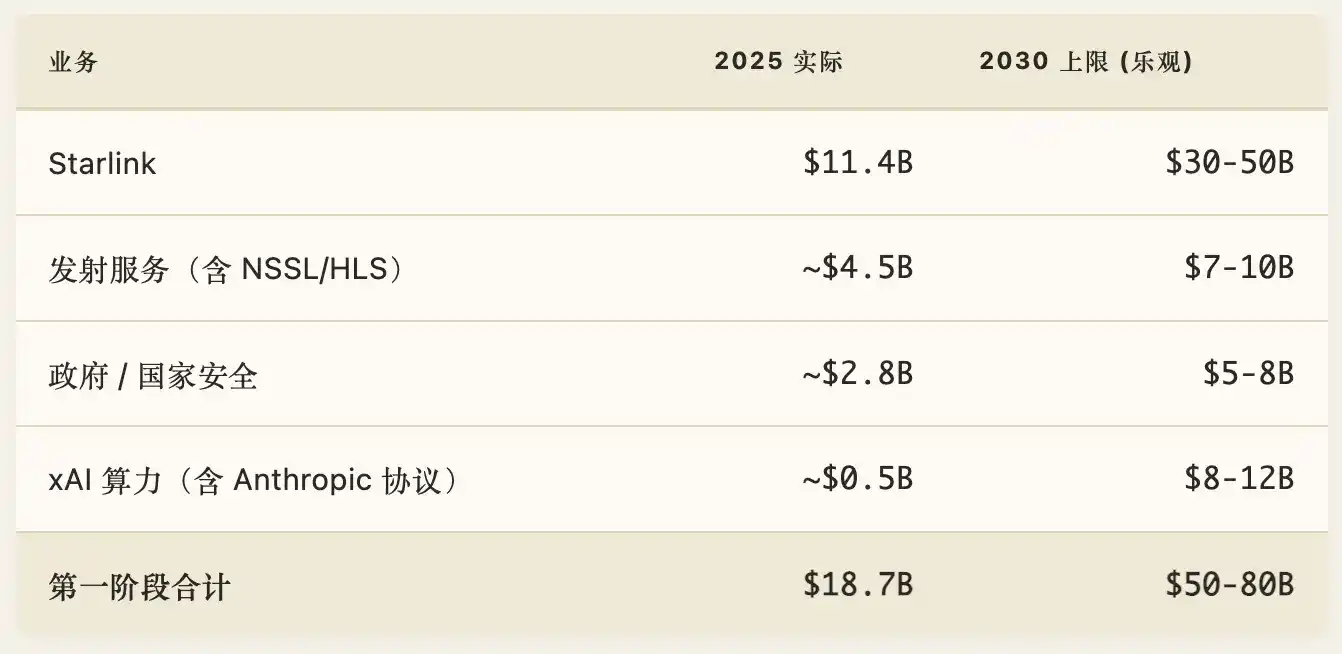
If SpaceX achieves revenue of $50-80B in 2030, corresponding EBITDA (Earnings Before Interest, Taxes, Depreciation, and Amortization, roughly understood as the operating cash profitability of the company's main business) would be approximately $20-35B (assuming a 40% margin, already a very optimistic estimate).

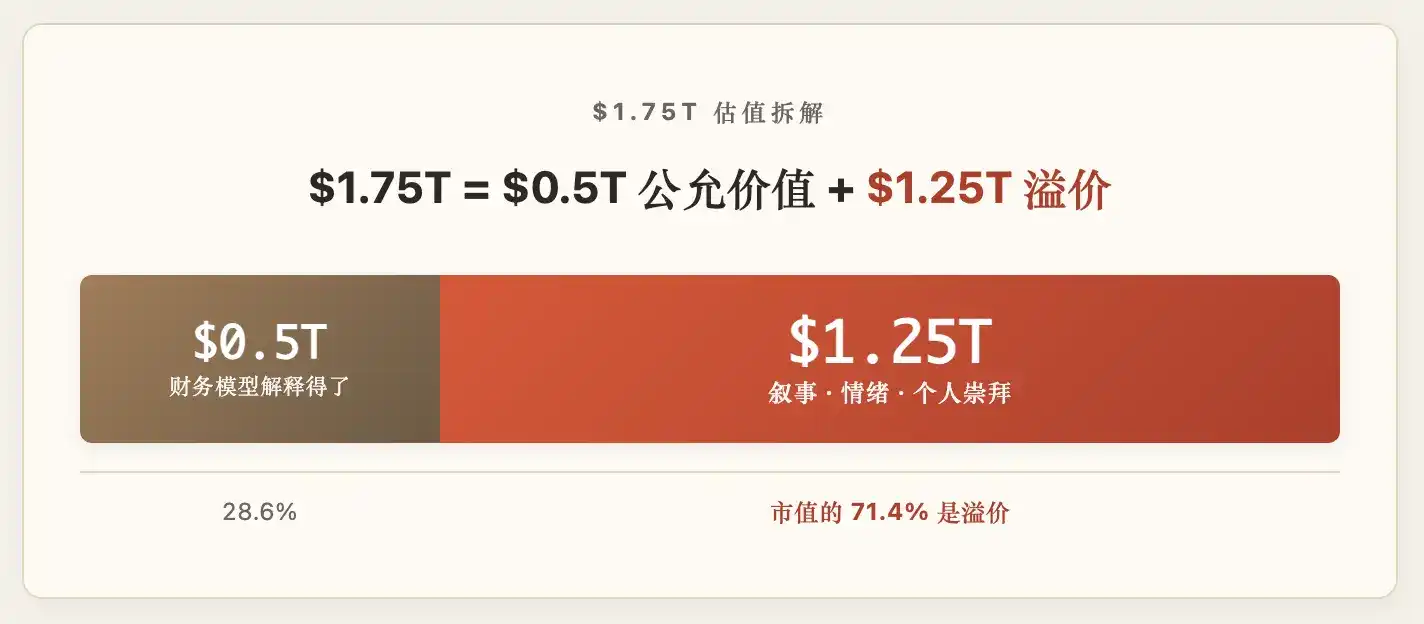
Using the standard SaaS/diversified EV/EBITDA multiple of 25-35x—which is already a premium valuation for tech companies—SpaceX's "reasonable valuation" range in 2030 is between $500B and $1.2T.

Take the conservative anchor point of $500B (i.e., valuing all 2030 businesses reasonably, not wildly) versus the market price of $1.75T.

Difference: $1.25T.

This difference cannot be explained by any standard financial model. It is not the result of DCF (Discounted Cash Flow), not derived from P/S multiples, nor from comparable company analysis—none of these methods yield $1.75T.
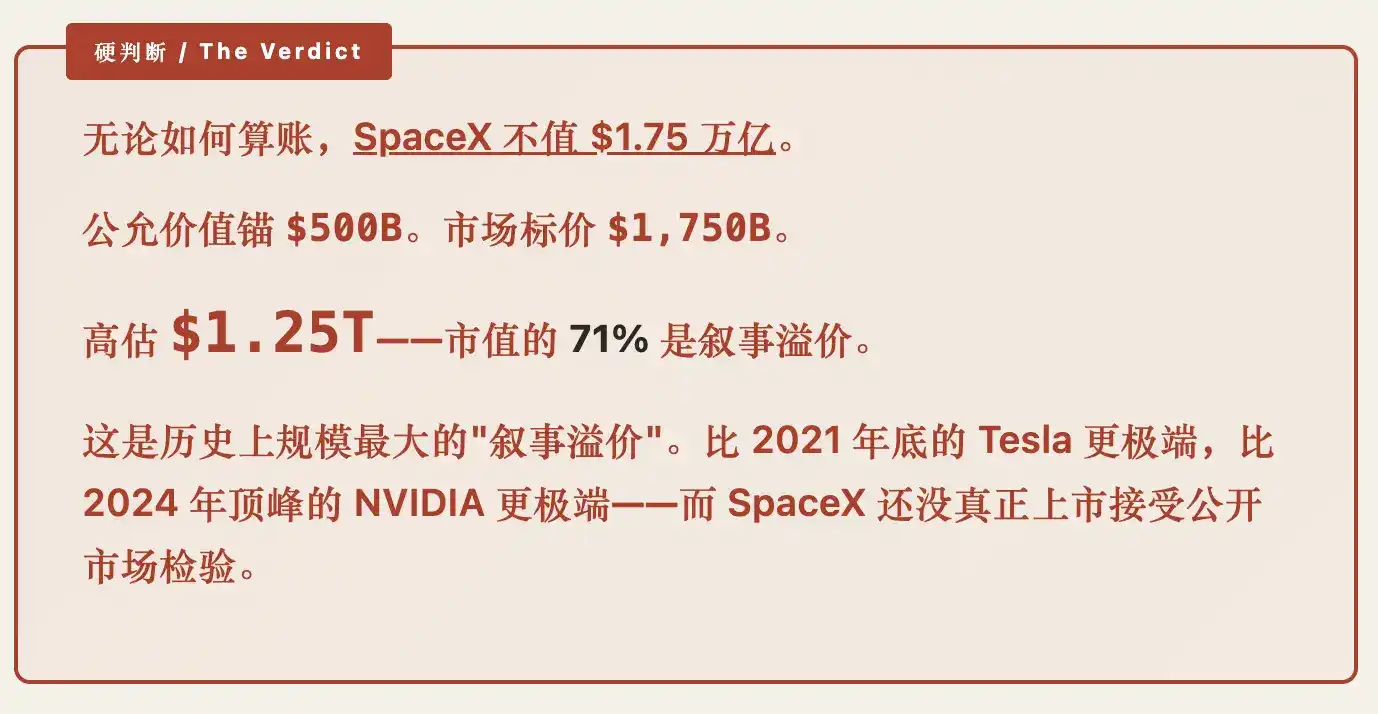
This difference does not appear out of thin air. It has three real sources:

First Source: Long-Term Vision Premium. If Starship operates stably in 2027-2030, launch costs could drop to $200/kg or lower. Capacity increases 30-fold—enough to support new businesses (in-orbit data centers, lunar commerce, deep-space robotics). Anthropic has publicly expressed interest in "being willing to pay for GW-scale space computing." If this narrative materializes, SpaceX plus new businesses could address a total market of $200-500B/year by 2040. This upper limit is indeed massive—so it's rational for the market to leave room for "vision premium."

Second Source: Sovereign Asset + Strategic Position Premium. SpaceX is no longer just a commercial company; it is a U.S. national strategic asset. $22B in government contracts, HLS lunar lander, NRO reconnaissance constellation, Golden Dome missile tracking—these integrate SpaceX into the U.S. national security system. With international communication order fracturing (China bloc / U.S. bloc / third parties), Starlink automatically gains "soft sovereignty" in all markets it can serve. The monetization of this status may take 10+ years to fully manifest, but the premium is real.

Third Source: Retail Investors' Desire for Heroic Narratives + Musk Personal Cult. This is the hardest to quantify, but anyone familiar with capital markets knows its power. Musk has 200 million followers on platform X; his persona is a valuation variable. SpaceX's story—a private company sending humans to Mars, building a global internet, making humanity multi-planetary—is the most heroic commercial story of the past 50 years.

Retail investors are not buying EBITDA; they are buying a ticket to participate in history.

The first two premiums are "real, but slow"; the third premium is "large, but fragile." The current $1.75T valuation bets that all three will hold true and encounter no problems. This is a difficult combination to sustain.

What Happens After IPO?

Assuming SpaceX completes its IPO in the second half of 2026, the next 3-5 years will likely look like this:

Scenario A: Valuation Solidifies (Probability ~25%). Starship V3 successfully launches in 2027, enters stable operation in 2028, the first GW-scale space computing contract lands in 2028. Lunar commerce progresses per NASA schedule. While Starlink growth slows, the Aviation + Maritime + D2C segments offset residential market deceleration. In this scenario, $1.75T "starts to look cheap"—the market would revalue it to $2-3T.

Scenario B: Flat Volatile Valuation (Probability ~50%). Starship materializes slower than expected—5/25 = 20% flight test success in 2025. If this realization rate continues in 2026-2027, V3 may not mature until 2029-2030. Starlink growth slows to +20%/year, the xAI-Anthropic agreement brings real cash flow but no major follow-up contracts. The market realizes "narrative is ahead of reality," and valuation oscillates between $1.2T - $1.8T for 3-5 years. This is the most probable scenario.

Scenario C: Valuation Reckoning (Probability ~25%). Persistent Starship delays, xAI falling significantly behind in AI competition, a Musk personal risk event (health, reputation, politics) triggers. Sentiment premium rapidly contracts. The market reprices using financial models—valuation falls back to the $800B-$1.2T range, equivalent to "the reasonable valuation an excellent industrial company deserves." This scenario is actually good for long-term holders—but means a 30-50% paper loss for retail investors who buy post-IPO.
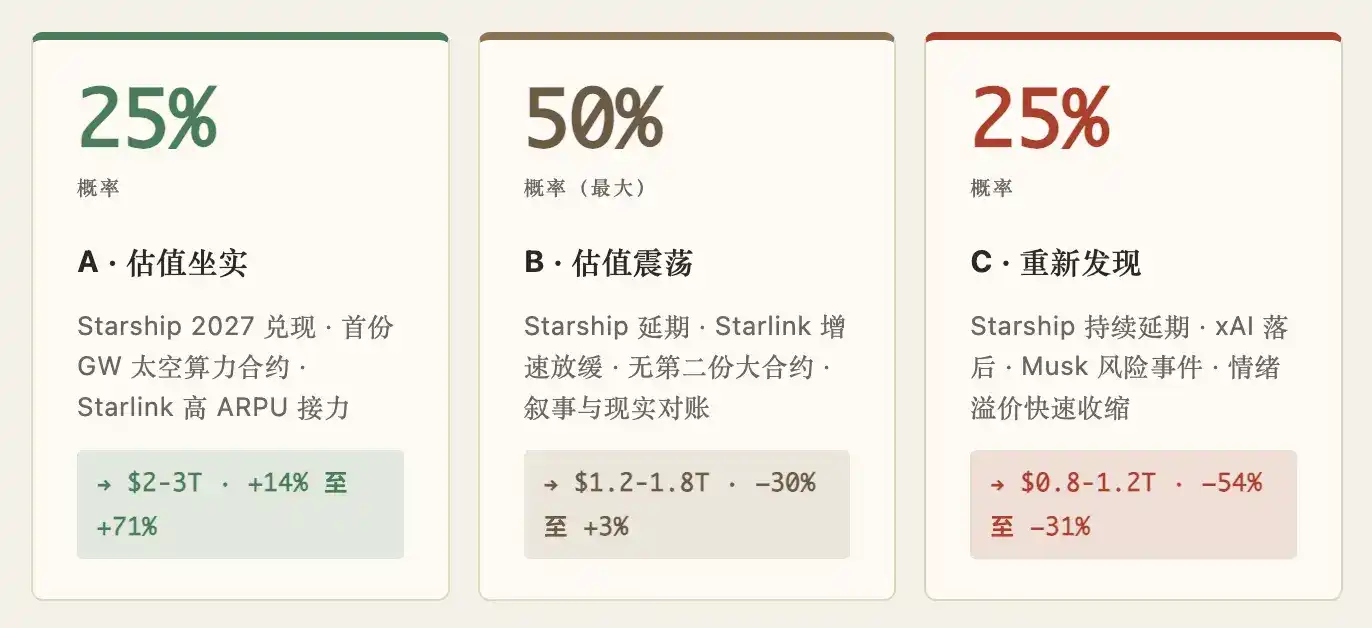
Probability-weighted = 0.25 × Upside + 0.50 × Flat + 0.25 × Downside ≈ Expected Value $1.3-1.5T, lower than the IPO filing price of $1.75T.

Weighting the three probabilities, the expected central range for SpaceX's valuation over the next 3-5 years is approximately $1.3-1.5T—lower than the current IPO filing price.

In plain language: buying at $1.75T on IPO day yields negative expected returns over 5 years. This is the inevitable conclusion after weighting the three scenarios by probability: you get no return in the highest-probability scenario; you lose 30-50% in the worst scenario; only in 1/4 of cases do you make money.

As Charlie Munger would say: this is not a bet with favorable odds.

To Those Planning to Buy on IPO Day

SpaceX is a great company, but a great company does not equal a stock you should buy at any price. These are two different things.

Tesla at the end of 2021 was also considered by many as "should buy at any price"—its market cap was $1.2T then. Over the next two years, Tesla fell 70%, from $1.2T to $400B. Not because Tesla became a bad company—it remains an excellent EV company. It's because price got too far ahead of fundamentals.

SpaceX's current situation is highly similar to Tesla's at the end of 2021—possibly more dangerous, because SpaceX's "vision premium" is a larger component, the story is grander, and retail participation may be deeper.

If you truly believe in SpaceX's long-term vision and are willing to hold for over 10 years without selling, then buying at the IPO price may be fine—the company will likely be worth more in 10 years. But if you expect to "double your money in 1-3 years after buying," the math is not on your side.

A more rational strategy is:

  • Do not chase the high on IPO day.
    Premium is typically highest on the first day of any mega IPO.
  • Wait for at least one of three things to happen.
    Starship V3 stable operation, the first GW-scale space computing contract, or the stock price falling below $1T.
  • If you must buy now, limit your position.
    Don't treat it as a "sure bet"—it is not. It is a "meaningful long-term +/- 30% uncertainty."

A Great Company Can Also Be an Expensive Stock

A company's greatness is fact; whether a stock's price is reasonable is math. Facts don't change, math changes daily. In SpaceX's current valuation structure, financial models can only explain half; the other half is market sentiment + sovereign status + personal cult—this part is not non-existent, but it is fragile.

After IPO, one thing will happen: retail investors start measuring the company with quarterly earnings. The first quarterly report, the second, the third—each will force the market to reconcile "story" with "reality." This reconciliation process is typically unfriendly to short-term valuation.

If you're buying the company—the great industrial entity, the post-Starship human infrastructure, the sovereign asset—then the IPO price is just a point in a 20-year marathon, no need to obsess.

If you're buying the story—participating in history, following a hero, contributing to us becoming a multi-planetary species—then admit this is consumption, not investment. Consumption can be expensive, but you need to know what you're doing.

The company can be world-class, the stock can simultaneously be overvalued by $1.25 trillion. Both are facts, but they must be viewed separately. Distinguish whether you're buying the company, or the story.


Perguntas relacionadas

QWhat is the core argument of the article regarding SpaceX's $1.75 trillion valuation?

AThe article argues that SpaceX's projected $1.75 trillion IPO valuation is likely overvalued by approximately $1.25 trillion. While acknowledging SpaceX as an exceptionally great industrial company, it contends that at this price, the valuation has priced in significant premiums for long-term vision, sovereign/strategic status, and narrative/Musk-centric enthusiasm that are not fully supported by near-to-mid-term financial projections based on its core businesses.

QAccording to the author's analysis, what would be a more reasonable valuation range for SpaceX by 2030 based on standard financial metrics?

ABased on the author's analysis of SpaceX's potential 2030 revenues ($50-80B) and EBITDA ($20-35B), and applying a premium tech company valuation multiple (25-35x EV/EBITDA), a more reasonable valuation range for SpaceX in 2030 would be $500 billion to $1.2 trillion. This is significantly lower than the speculated $1.75 trillion IPO price.

QWhat are the three main sources of the '$1.25 trillion' valuation gap identified in the article?

AThe three main sources of the $1.25 trillion valuation gap are: 1) **Long-term vision premium**: For future Starship-enabled businesses like in-orbit data centers and lunar commerce. 2) **Sovereign asset & strategic status premium**: Due to its role as a U.S. national strategic asset with major government contracts and Starlink's geopolitical importance. 3) **Retail enthusiasm for the heroic narrative & Musk's personal cult**: Where investors buy the 'story' and participation in history rather than just financial metrics.

QWhat are the three probable scenarios for SpaceX's post-IPO valuation trajectory, and what is the most likely outcome according to the article?

AThe three scenarios are: A) **Valuation is validated** (~25% probability): Starship succeeds quickly, new contracts materialize, valuation rises. B) **Valuation trades sideways/volatile** (~50% probability - *most likely*): Execution is slower than the narrative, leading to a prolonged period of valuation churn. C) **Valuation is rediscovered (downwards)** (~25% probability): Significant delays or Musk-related risks trigger a contraction of narrative premiums, reverting to a valuation based more on financials. The weighted expectation centers around $1.3-1.5T, below the $1.75T IPO price.

QWhat practical advice does the author give to potential retail investors considering buying SpaceX stock at its IPO?

AThe author advises potential retail investors to: 1) **Avoid buying at the IPO peak** on day one, as溢价 is typically highest then. 2) **Wait for key catalysts** like Starship V3 stable operation, a major GW-scale space compute contract, or a significant price drop (e.g., below $1T). 3) **If buying immediately, limit position size** and recognize it as a long-term, uncertain bet rather than a sure thing. The core message is to separate the admiration for the company from the investment math of the stock price.

Leituras Relacionadas

Vitalik: Building Index-Tracking Assets Based on Options Rather Than Debt

Vitalik Buterin proposes constructing index-tracking assets using synthetic options rather than debt-based mechanisms. The core problem is enabling exposure to a price index (T, e.g., USD/ETH) in a trust-minimized environment where only ETH is a trustless asset, relying solely on a decentralized oracle. Traditional approaches, like algorithmic stablecoins, use debt positions and require real-time, binding oracles for liquidations, which are difficult to secure. This article suggests a paradigm shift: eliminating liquidation and using options as the fundamental building block, requiring only a "slow" oracle. The design defines two synthetic assets, P and N, with parameters for the index T, a strike price S, and an expiry M. At any time, 1 ETH can be split to create a (P, N) pair or merged back. At expiry M, the oracle determines T's value x. P receives min(1, S/x) ETH, and N receives max(0, 1 - S/x) ETH. This structure inherently avoids insolvency risk (P+N=1) and can share an oracle with prediction markets. To gain stable exposure to T (e.g., USD), a user would hold deeply "in-the-money" P options (with S significantly below the current price) and periodically "roll" them to lower strikes as the price approaches the current strike, rebalancing their portfolio. This transfers the decision of *when* to act from a protocol-enforced liquidation (requiring a real-time oracle) to the user or an automated wrapper. Users can manage MEV risk and oracle dependency by choosing their rebalancing timing and data sources. A key trade-off is accepting some quadratic drift (deviation from perfect peg), estimated at 1-4% annualized volatility. Buterin argues this cost is reasonable compared to fiat currency volatility or equilibrium shifts in other stablecoins. The success of this model depends heavily on designing low-slippage market mechanisms for the rebalancing process, leveraging users' low time preference to execute trades patiently.

marsbitHá 23m

Vitalik: Building Index-Tracking Assets Based on Options Rather Than Debt

marsbitHá 23m

"Water Scarcity": The Hidden Fatal Flaw of AI Infrastructure

“Water Scarcity: The Hidden Vulnerability of AI Infrastructure” In June 2026, SpaceX revised its IPO prospectus to highlight a core resource constraint alongside power and processors: water. This move signals a pivotal shift where water scarcity has transformed from an operational cost to a major, uncontrollable investment risk, directly threatening AI data center expansion. The scale of the problem is immense. U.S. data centers consumed an estimated 17 billion gallons of water for direct cooling in 2023, with indirect water use for power generation exceeding 211 billion gallons. Giants like Google alone use billions of gallons annually, with single sites consuming volumes equivalent to a medium-sized city. This water is largely “consumptive,” evaporated into the atmosphere and lost. This massive demand is colliding with scarcity. Tech companies are building “water tigers” in arid regions, sparking community protests in places like Mexico and Arizona, where data centers can legally use millions of gallons daily—enough for tens of thousands of residents. These conflicts are not about illegality, but about a mismatch between historic water allocation frameworks and new, colossal demand. The consequences are real. Community opposition, largely centered on water, has reportedly stalled or canceled $64 billion in U.S. data center projects over two years. Simultaneously, investors are pressuring companies for greater water footprint transparency, viewing it as a financial risk, not just an ESG metric. Technological solutions like air or liquid cooling involve trade-offs between water and electricity use, with final choices dictated by local constraints. The irony is stark: while industry leaders envision AI as a utility “like water,” its physical infrastructure is straining real-world water supplies. The race for AI supremacy may ultimately be governed not by the fastest chip, but by the slowest water meter.

marsbitHá 1h

"Water Scarcity": The Hidden Fatal Flaw of AI Infrastructure

marsbitHá 1h

Global Card Issuance Enters a Compliance-Driven Era: WasabiCard is Building the Next-Generation Payment Infrastructure

Global card issuance is entering a compliance-driven era, with WasabiCard building next-generation payment infrastructure. The platform asserts that as stablecoins increasingly enter cross-border payments, corporate settlements, and global commerce, the industry is shifting focus from "availability" and "growth-driven" models to long-term, compliant operation under global frameworks. Competition will center on sustainable compliance and global infrastructure capabilities. Stablecoins are evolving from on-chain assets into key payment tools in global business, with card issuance acting as critical infrastructure connecting digital assets to traditional payment networks like Visa and Mastercard. This expansion has revealed structural issues, including cross-regional issuance, BIN resource management, and insufficient AML and risk controls. In response, the industry is moving away from reliance on "grey efficiency" towards prioritizing compliance, risk management, and long-term operational stability. WasabiCard outlines its strategy: collaborating with licensed principals and local partners for localized operations, building robust KYC/AML systems, strictly separating commercial and consumer BIN usage, and enhancing global issuance, payment, and cross-border fund flow infrastructure. The goal is to build stable, scalable payment infrastructure amid evolving global regulations, shifting industry competition from scale to infrastructure capability. As stablecoins integrate further with global commerce, payment infrastructure will become a fundamental, embedded component of internet business. WasabiCard will continue to develop capabilities in global card issuance, stablecoin payments, cross-border fund flows, and API-driven financial workflows.

marsbitHá 1h

Global Card Issuance Enters a Compliance-Driven Era: WasabiCard is Building the Next-Generation Payment Infrastructure

marsbitHá 1h

Zhou Hang: How Much Is SpaceX Really Worth?

**Zhou Hang: How Much is SpaceX Really Worth?** SpaceX, arguably one of the greatest industrial companies of the past 50 years, is reportedly targeting a staggering $1.75 trillion valuation in its potential IPO. However, the author argues this figure is inflated by approximately $1.25 trillion when assessed through standard financial metrics. The analysis begins by acknowledging SpaceX's undeniable success: drastically reducing launch costs, achieving near-monopoly in commercial launches, and building the strategic Starlink network. Its achievement surpasses even Tesla's, given it disrupted a state-monopolized industry. Despite this greatness, a $1.75 trillion valuation places SpaceX above the combined market cap of Boeing, Lockheed Martin, Northrop Grumman, RTX, and General Dynamics. Projecting optimistic 2030 revenues of $50-80 billion and applying generous tech-sector multiples yields a "reasonable" valuation range of $500 billion to $1.2 trillion. The $1.25 trillion gap is attributed to three non-financial premiums: 1. **Long-term vision premium** for future Starship-enabled markets (e.g., space-based computing). 2. **Sovereign asset/strategic premium**, as SpaceX is deeply integrated into U.S. national security. 3. **Retail narrative/Musk cult premium**, driven by a heroic story and personal following. Post-IPO, three scenarios are outlined: valuation solidifying (25% probability), sideways volatility as narrative outpaces reality (50%), or a re-rating down to $800B-$1.2T if execution falters or Musk-related risks emerge (25%). The probability-weighted expected value is $1.3-1.5 trillion, suggesting negative expected returns for those buying at the IPO price. The conclusion advises investors to separate the company's excellence from its stock price. Buying at the IPO likely prices in excessive optimism. A more prudent strategy would be to wait for key milestones (e.g., Starship V3 stability) or a significant price correction before investing, or to treat an early purchase as a long-term, high-conviction hold with limited position size, not a short-term bet.

链捕手Há 1h

Zhou Hang: How Much Is SpaceX Really Worth?

链捕手Há 1h

Trading

Spot
Futuros

Artigos em Destaque

Como comprar T

Bem-vindo à HTX.com!Tornámos a compra de Threshold Network Token (T) simples e conveniente.Segue o nosso guia passo a passo para iniciar a tua jornada no mundo das criptos.Passo 1: cria a tua conta HTXUtiliza o teu e-mail ou número de telefone para te inscreveres numa conta gratuita na HTX.Desfruta de um processo de inscrição sem complicações e desbloqueia todas as funcionalidades.Obter a minha contaPasso 2: vai para Comprar Cripto e escolhe o teu método de pagamentoCartão de crédito/débito: usa o teu visa ou mastercard para comprar Threshold Network Token (T) instantaneamente.Saldo: usa os fundos da tua conta HTX para transacionar sem problemas.Terceiros: adicionamos métodos de pagamento populares, como Google Pay e Apple Pay, para aumentar a conveniência.P2P: transaciona diretamente com outros utilizadores na HTX.Mercado de balcão (OTC): oferecemos serviços personalizados e taxas de câmbio competitivas para os traders.Passo 3: armazena teu Threshold Network Token (T)Depois de comprar o teu Threshold Network Token (T), armazena-o na tua conta HTX.Alternativamente, podes enviá-lo para outro lugar através de transferência blockchain ou usá-lo para transacionar outras criptomoedas.Passo 4: transaciona Threshold Network Token (T)Transaciona facilmente Threshold Network Token (T) no mercado à vista da HTX.Acede simplesmente à tua conta, seleciona o teu par de trading, executa as tuas transações e monitoriza em tempo real.Oferecemos uma experiência de fácil utilização tanto para principiantes como para traders experientes.

422 Visualizações TotaisPublicado em {updateTime}Atualizado em 2026.06.02

Como comprar T

Discussões

Bem-vindo à Comunidade HTX. Aqui, pode manter-se informado sobre os mais recentes desenvolvimentos da plataforma e obter acesso a análises profissionais de mercado. As opiniões dos utilizadores sobre o preço de T (T) são apresentadas abaixo.

活动图片