You Use Claude and Codex Every Day, but Meta Has Restricted Internal Use

marsbitPublicado em 2026-06-30Última atualização em 2026-06-30

Resumo

In May, Meta imposed internal restrictions on its engineers regarding the use of Claude Code and Codex, two widely used AI programming tools. Despite being a major client, Meta's guidelines, still in effect, prohibit these external models from being used for specific tasks to prevent potential "escalations with partners." The core concern is "distillation"—the risk that outputs from Claude or Codex could inadvertently contaminate the training data and evaluation processes for Meta's in-house AI coding assistant, MetaCode. If MetaCode is trained or evaluated using data generated by these external models, it risks learning their capabilities rather than developing its own, blurring the line of intellectual origin. The restrictions are precise: engineers cannot use the external models to generate test questions, debug source code, or suggest test cases. AI-generated content is also barred from environments accessible to MetaCode. However, AI can still assist with peripheral tasks like workflow setup and code organization, provided all outputs are manually reviewed. This caution reflects a broader industry dilemma. While distillation is a common technique, using a competitor's model output for training raises legal and ethical questions about the ownership of derived capabilities. Contractual terms from companies like OpenAI and Anthropic explicitly forbid using their outputs to build competing products, putting enforcement power in the hands of rivals. The move is also financ...

In May of this year, Meta drew a clear line for its own engineers.

People in the Applied AI Engineering department can no longer freely use Claude Code and Codex.
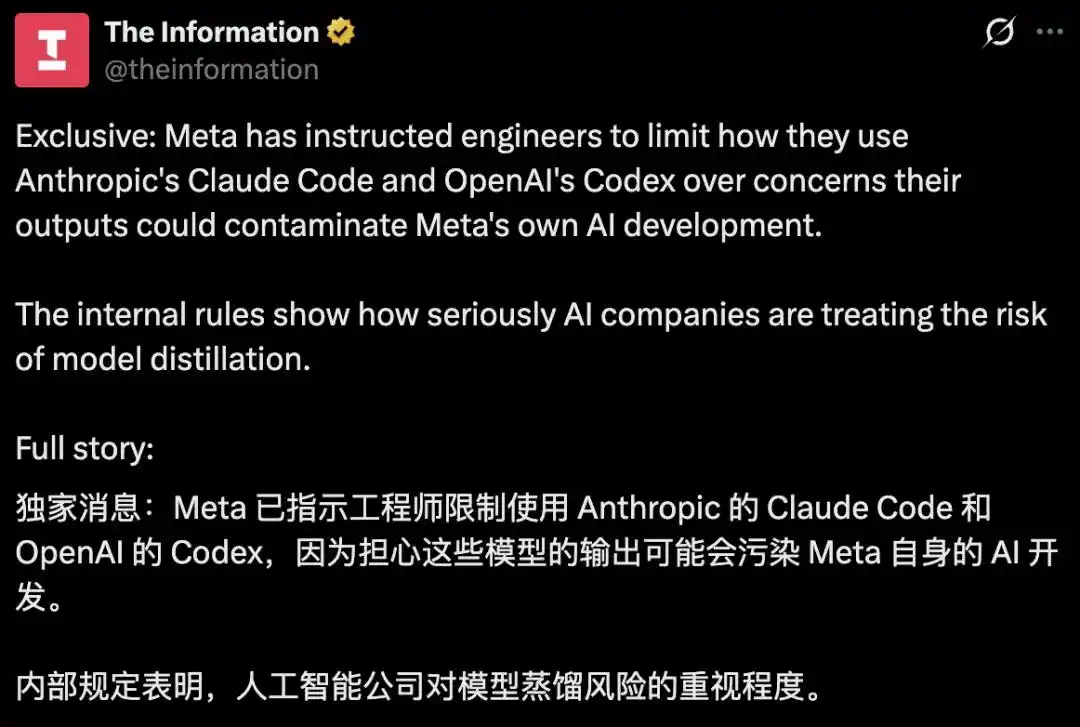
According to an internal guide obtained by The Information, a memo even directly called for a pause on certain tasks involving these two models. The wording was severe, stating this could trigger a "serious escalation with partners."

However, the strangeness lies precisely here.

Meta is one of Claude Code's largest global customers. Its total internal AI bill this year is heading towards tens of billions of dollars.

A tool used daily, purchased by the company at great cost, is now being restricted internally. And the reason for the restriction is probably something you wouldn't expect.

It's not that they aren't useful. On the contrary, it's because they are *too* useful.

This Red Line is Still in Effect

According to The Information report, these restrictions were set in May and are still in effect today.

To understand why Meta is so tense, we need to start with an internal AI coding assistant project.

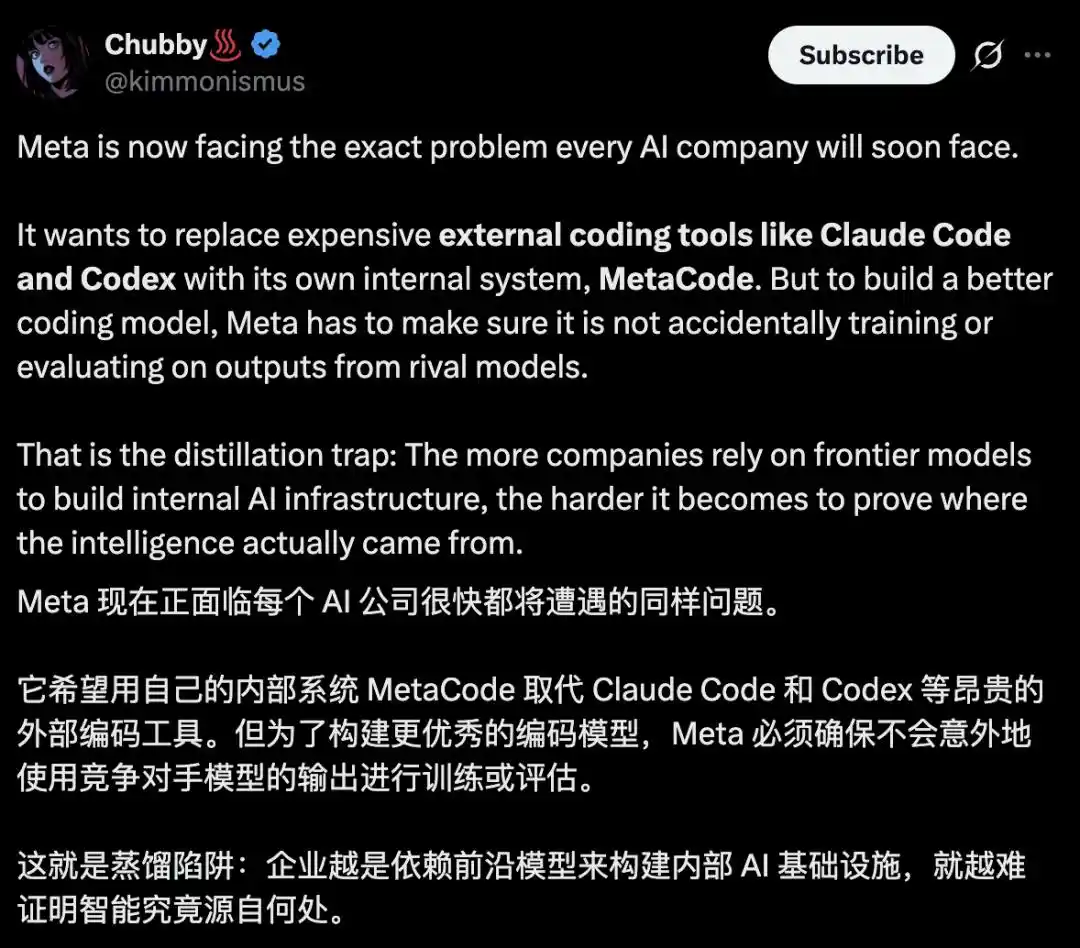
This year, it formed an Applied AI Engineering team, focusing on its self-developed AI coding assistant MetaCode (formerly DevMate).

The goal is to stop Meta from spending huge sums continuing to use others' AI coding models and to train its own.
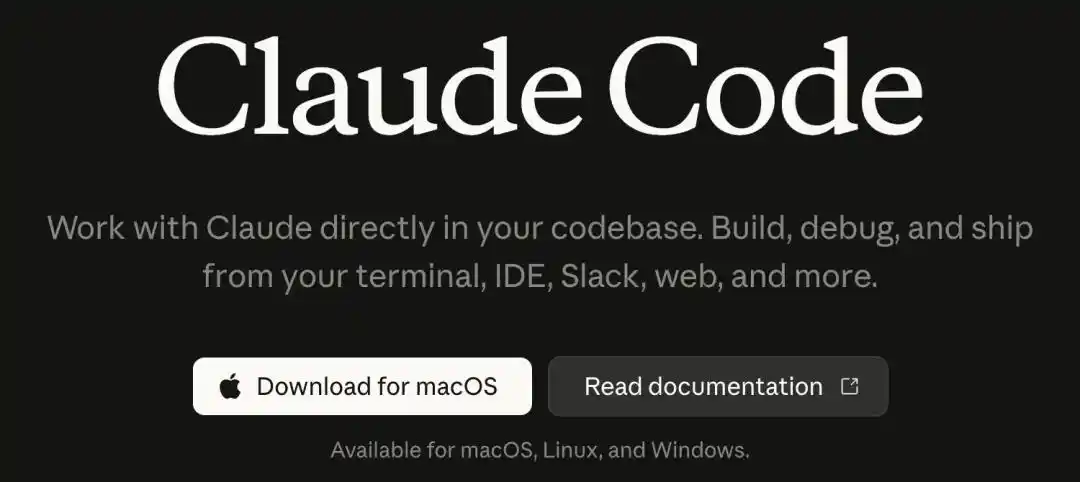
The official interface of Claude Code. Together with OpenAI's Codex, they have become the de facto standard for professional developers doing agentic programming.

But training a model that can write code is not simple.

You need to feed it massive amounts of high-quality data, and also generate enough, sufficiently tricky programming problems for it to practice on and be graded on. This set of problems and evaluations almost determines how powerful a coding model ultimately becomes.

But the problem lies precisely here.

The difficulty Meta encountered is how to prevent employees from becoming too reliant on these external tools while building the internal replacement.

What it worries about is the outputs from these external models seeping into the training data, causing the model it builds to secretly learn the competitor's capabilities.

To understand this concern, you need to know how a model "learns": You feed it what kind of data, it becomes that kind of model.

MetaCode wants to become stronger by relying on the training data and programming problem sets accumulated by engineers.

But once these problems, answers, and even grading criteria come from Claude or Codex, what MetaCode learns is no longer "skills trained by human engineers," but "Claude's skills."

It's copying answers from the competitor's test paper, becoming more and more like the competitor.

Even more hidden is the evaluation part.

Every time a model answers a question, something must tell it if it answered well so it knows where to improve.

If both problem creation and grading are handed to Codex, then MetaCode is evolving towards what "Codex thinks is correct," essentially copying the competitor's judgment standards bit by bit into its own mind.

This is why Meta's guide prohibits AI from being the problem creator or grader, and even governs whether "AI-generated materials can enter the environment accessible to the model under test."

As long as the competitor's output seeps into the training or evaluation chain in any way, the line of "who taught whom" becomes blurred.

Ultimately, Meta's pause on certain tasks is about isolating the training data.

It fears that the AI writes so well that it becomes unclear which skills were trained internally and which were learned from Claude and Codex.

And the latter set of capabilities is rented, not its own.

Surprisingly Detailed Restrictions

It must be clarified first that Meta's internal documents show no actual records of employees violating rules.

A Meta spokesperson also responded that the company has "clear policies" governing the use of AI tools. So this document is more like an internal early warning.

What tasks can't AI handle? Mainly the following three categories:

First, you cannot use Claude or Codex outputs to create test questions for your own model. The guide's exact words are, this "clearly falls into the category where engineers are not in the driver's seat," "We do not want tasks derived from models."

Second, AI cannot find bugs in source code, nor can it help you think about "what to test" based on code analysis.

Third, anything generated by AI cannot be placed anywhere accessible by the model under test.

Simply put, as long as AI participates in the judgment of "what to test" or "whether the answer is correct," the competitor's skills might mix in. The three rules block this opening.

What tasks can AI still do?

Setting up workflows, organizing code and files, building test frameworks for internal tools—these daily chores are allowed. The guide calls this type of work "test scaffolding" and "solution calibration," essentially assisting and building frameworks.

Even for these tasks, there is one ironclad rule: Every line of AI output must be reviewed by a human first.

In Meta's view, once you let a competitor's model create the test and grade it, it becomes unclear whose test this is.

What it truly wants to protect is that line of "who taught whom."

The Unavoidable "Distillation Trap"

What Meta worries about has a specific name in the industry: distillation.

The meaning is easy to understand: Use a stronger model to continuously answer questions, then use these answers to train a weaker model.

It's a bit like having the top student redo the entire exam paper, and the struggling student copies it, catching up to years of effort in months.

The massive investment others put into data, computing power, and research, you almost get for free.

Training a cutting-edge model from scratch costs astronomical sums of money and time. Distillation, however, might only require a batch of outputs from the other model, reducing costs and timelines to a fraction.

Distillation itself is standard industry practice; big companies also often distill their own large models to create smaller, cheaper versions for users.

The trouble only arises: Once you are copying someone else's model, the capabilities you train—are they your own, or borrowed? It's unclear.

Some call this the "distillation trap": The more you rely on the strongest model to build your own foundation, the harder it is to prove where your intelligence actually came from.
In the United States, the law does not explicitly prohibit distillation, and AI-generated content is not protected by copyright. Using the other's output to train your own model basically passes the legal hurdle.

The only barrier is the contract.

Both OpenAI's and Anthropic's terms of service contain similar restrictions: You cannot use the model's outputs to create something that competes with them.

Moreover, the enforcement power for this barrier lies entirely with the competitor.

Last year, Anthropic directly cut off OpenAI's API access to Claude, even though OpenAI claimed it was only for evaluating capabilities and safety, a "standard industry" practice.

Even Musk was forced to admit in a court hearing this past April that his xAI "partially" distilled OpenAI's models.

April 30, 2026, in the witness stand at a California federal court, Musk was asked if xAI used distillation techniques on OpenAI models to train Grok. He first said this was common practice for AI companies.

When pressed if this amounted to a "yes," he replied "partially."

The rules are fuzzy, and "enforcement power" is held by competitors. Who dares to bet their billions in investment that a competitor won't turn hostile?

From this perspective, Meta's tension is not at all excessive.

Here, there's also the consideration of saving money.

According to internal memos, Meta will burn tens of billions of dollars this year just on internal AI use. It has even started setting token usage limits for employees. Even a cash-rich giant like Meta is starting to find AI too expensive and is calculating carefully.

If development work can be shifted from expensive external tools to its own MetaCode, it saves money while avoiding the minefield of distillation—killing two birds with one stone.

A Tightrope-Walking Map

Regarding Meta's internal documents, tech law scholar and legal advisor Mark Leiser has a vivid phrase: This is "almost like a map for walking a tightrope."

On one side, you need to gain the benefits of external models; on the other, you must prevent their capabilities from slipping into your own system.

Of course, Meta isn't the only company walking this tightrope; it touches a vital point for the entire industry.

When you use a sufficiently smart AI to build another equally smart AI, in the end, you might find it hard to say clearly: Is this intelligence something you trained yourself, or did you secretly learn it from someone else's AI?

And this issue isn't that far from ordinary people either.

The code you write with AI, the plans you modify, the materials you compile—feeding them back becomes nourishment for the next generation of models.

In this cycle, who is standing on whose shoulders? That line has become increasingly blurred.

When AI starts helping us build AI, can we still tell whose capabilities are whose?

References:

https://x.com/kimmonismus/status/2071591755351224344

https://www.theinformation.com/articles/internal-docs-show-meta-putting-limits-claude-codex-fearing-distillation

This article is from the WeChat public account "New Zhiyuan", author: ASI Apocalypse

Criptomoedas em alta

Perguntas relacionadas

QWhy did Meta restrict its engineers from using Claude Code and Codex internally?

AMeta restricted their internal use to prevent knowledge distillation, where the outputs from these powerful external AI models could inadvertently influence and shape the training of Meta's own in-house AI coding assistant, MetaCode. The concern is that if MetaCode is trained on data or evaluations generated by Claude or Codex, its capabilities would be learned from the competitor's model rather than developed independently.

QWhat specific tasks does Meta's policy forbid using Claude or Codex for?

AThe policy forbids three main tasks: 1) Using their outputs to create test cases or benchmarks for Meta's own models. 2) Using them to find bugs in source code or to suggest what should be tested. 3) Placing any AI-generated content in an environment accessible by the model being trained (MetaCode).

QWhat is 'distillation' in the context of AI model training, and what is the 'distillation trap' mentioned in the article?

AIn AI, distillation refers to using a larger, more powerful model's outputs to train a smaller or weaker model. The 'distillation trap' is the dilemma where a company heavily relies on a competitor's model outputs to build its own. This makes it difficult to prove that the resulting model's intelligence and capabilities were developed independently rather than being copied or derived from the competitor.

QWhat are the potential consequences for a company if it's found to have distilled a competitor's AI model?

AWhile not explicitly illegal under current US law, using a competitor's model outputs for training likely violates their Terms of Service. The primary consequence is that the competitor can take action, such as cutting off API access (as Anthropic did to OpenAI). This creates significant business and legal risk, potentially jeopardizing a company's multi-billion dollar AI investments.

QBesides avoiding 'distillation,' what is another key reason for Meta to develop and push its own MetaCode assistant?

AAnother key reason is cost reduction. Meta's internal AI usage is projected to cost tens of billions of dollars this year. By shifting development work from expensive external tools like Claude and Codex to its own MetaCode, the company can save significant money while also mitigating the legal and strategic risks associated with knowledge distillation.

Leituras Relacionadas

Why Do We Need an AI Content Perspective Today?

The article "Why Do We Need an AI Content Perspective Today?" explores the complex and often contentious integration of AI into the cultural and creative industries, particularly film and television. It begins with the cancellation of Amazon's AI-generated animation "Punky Duck," highlighting the ethical debates surrounding AI content. AI's rapid advancement is transforming video production, enabling cost-effective, full-length AI films (e.g., "RAPHAEL," "Dreams of Violets") while sparking industry resistance over issues like "synthetic actors." The core debate has shifted from whether to use AI to how to use it responsibly. The article analyzes why AI's entry into film is uniquely unsettling. It distinguishes between "cultural fast food" (short-form, fast-paced content like micro-dramas) and "cultural main courses" (traditional, long-form film/TV). AI currently excels at the former, matching its fragmented narratives, shallow emotional needs, and free-to-consumer models. However, venturing into the latter challenges the human-centric essence of storytelling—creativity, emotional depth, and the unique value of human labor and experience. While AI can generate massive volumes of content and lower costs, it risks devaluing human creativity, leading to homogenized output, and creating unfair competition through potential intellectual property infringement. Its efficiency also amplifies content safety risks, making preemptive governance crucial. To counter these risks, the article proposes establishing clear boundaries guided by a human-centered AI content perspective. It outlines four principles: 1) Amplify, rather than displace, human creative space; 2) Respect and protect human creative output; 3) Ensure human creative control and responsibility remain paramount; and 4) Guarantee transparency and traceability in AI creation. The conclusion emphasizes that humans must act as the "helmsmen" of technology, steering AI development to enhance, not replace, the core human values at the heart of cultural expression.

marsbitHá 1h

Why Do We Need an AI Content Perspective Today?

marsbitHá 1h

Planck Retracted? The Father of Quantum Tripped by an Algorithm

The recent discovery that two articles (published in 1940 and 1942) by Max Planck, the Nobel laureate and founder of quantum theory, are marked as "retracted" on Springer's digital platform highlights a curious clash between historical publishing practices and modern automated systems. An investigation suggests these retractions are algorithmic errors, not due to fraud or misconduct. The papers, philosophical reflections on science published in *Die Naturwissenschaften*, were likely flagged by the platform's systems. One article, a republished lecture, may have been mistaken for duplicate publication. Another, sharing a title with a prior article by a different author (a common practice for continuing debates at the time), may have triggered a similar automated check. The digital versions have even been replaced with blank pages, contrary to normal practice of preserving retracted texts. This incident underscores how contemporary digital infrastructure, built around concepts like "self-plagiarism" and strict copyright, can misclassify and obscure legitimate historical scholarly communication. It serves as a warning that digital archives are not neutral mirrors of the past but are filtered by platform rules, potentially distorting the scientific record. As AI systems increasingly rely on such databases, such erroneous metadata could propagate, affecting how future tools interpret and access historical knowledge.

marsbitHá 1h

Planck Retracted? The Father of Quantum Tripped by an Algorithm

marsbitHá 1h

Refunds! Claude 4.8 Sees Overnight Major 'Dumb-Down', GPT-5.6's Computational Power Reportedly 'Halved'

The AI community is currently alarmed by widespread reports of significant performance degradation in two leading models. This article details a "mass self-testing frenzy" triggered by a mysterious prompt designed to detect a hidden "Juice" value, representing a model's reasoning compute budget. On OpenAI's side, users suspect a covert, limited test of a "GPT-5.6-sol" model is underway. When using a specific XML prompt on the Codex platform, a normal "gpt-5.5 xhigh" model reportedly returns a Juice value of 768. However, some users routed to the suspected GPT-5.6 test receive a drastically reduced value of 128—a six-fold decrease. This has sparked debate on whether it signifies a major efficiency leap or a "watered-down, low-cost version" achieved by slashing reasoning depth to save computational expenses. Simultaneously, Anthropic's Claude models, particularly the flagship Opus 4.8 Max, are facing intense user backlash for a perceived "physical brain cut." Users on platforms like Reddit report a dramatic decline in the model's once-impressive reasoning, with complaints of it becoming "absurdly" weakened, performing worse than older, lighter models like Haiku. Specific criticisms include: losing long-context memory, refusing to think deeply even in high-reasoning modes, providing instant incorrect answers, and engaging in unhelpful, argumentative, or "gaslighting" behavior where it contradicts users unnecessarily. The article speculates these "stealth downgrades" might be a calculated corporate strategy. Companies could initially release models with temporarily boosted compute to create an illusion of a major breakthrough, then silently scale back parameters later to manage unsustainable inference costs. A proposed underlying cause is a tightened funding environment, potentially exacerbated by SpaceX's massive IPO soaking up market liquidity, which could delay AI company IPOs and force cost-cutting measures like model "nerfing." The core issue highlighted is the asymmetry of information: subscribers pay for a service that can be silently and fundamentally altered without notification or explanation. The viral "Juice test" resonates because it represents users' desire for transparency about what they are actually paying for.

marsbitHá 2h

Refunds! Claude 4.8 Sees Overnight Major 'Dumb-Down', GPT-5.6's Computational Power Reportedly 'Halved'

marsbitHá 2h

Trading

Spot

Artigos em Destaque

Como comprar PEOPLE

Bem-vindo à HTX.com!Tornámos a compra de ConstitutionDAO (PEOPLE) simples e conveniente.Segue o nosso guia passo a passo para iniciar a tua jornada no mundo das criptos.Passo 1: cria a tua conta HTXUtiliza o teu e-mail ou número de telefone para te inscreveres numa conta gratuita na HTX.Desfruta de um processo de inscrição sem complicações e desbloqueia todas as funcionalidades.Obter a minha contaPasso 2: vai para Comprar Cripto e escolhe o teu método de pagamentoCartão de crédito/débito: usa o teu visa ou mastercard para comprar ConstitutionDAO (PEOPLE) instantaneamente.Saldo: usa os fundos da tua conta HTX para transacionar sem problemas.Terceiros: adicionamos métodos de pagamento populares, como Google Pay e Apple Pay, para aumentar a conveniência.P2P: transaciona diretamente com outros utilizadores na HTX.Mercado de balcão (OTC): oferecemos serviços personalizados e taxas de câmbio competitivas para os traders.Passo 3: armazena teu ConstitutionDAO (PEOPLE)Depois de comprar o teu ConstitutionDAO (PEOPLE), armazena-o na tua conta HTX.Alternativamente, podes enviá-lo para outro lugar através de transferência blockchain ou usá-lo para transacionar outras criptomoedas.Passo 4: transaciona ConstitutionDAO (PEOPLE)Transaciona facilmente ConstitutionDAO (PEOPLE) no mercado à vista da HTX.Acede simplesmente à tua conta, seleciona o teu par de trading, executa as tuas transações e monitoriza em tempo real.Oferecemos uma experiência de fácil utilização tanto para principiantes como para traders experientes.

498 Visualizações TotaisPublicado em {updateTime}Atualizado em 2026.06.02

Como comprar PEOPLE

Discussões

Bem-vindo à Comunidade HTX. Aqui, pode manter-se informado sobre os mais recentes desenvolvimentos da plataforma e obter acesso a análises profissionais de mercado. As opiniões dos utilizadores sobre o preço de PEOPLE (PEOPLE) são apresentadas abaixo.

活动图片