XRP Trades Like An Asset That’s Survived Its Hardest Trials — Is A Rally Coming?

bitcoinistPublicado em 2025-12-28Última atualização em 2025-12-28

Resumo

XRP is demonstrating resilience after enduring years of regulatory uncertainty and legal challenges, now trading like an asset that has weathered its hardest trials. The narrative has shifted as institutional inflows surge, with XRP-linked ETFs rapidly accumulating over $1 billion in assets under management without a single outflow day. This reflects growing confidence and a more mature market structure. Supply on exchanges is thinning, and long-term institutional holdings are reducing sell pressure. While the current price dip is attributed to broader market conditions, not XRP-specific issues, the fundamentals are strengthening. Institutions are accumulating XRP for its settlement capabilities, on-chain liquidity, and transaction speed, signaling a potential rally ahead.

The narrative surrounding XRP has undergone a fundamental transformation, and the token has begun to trade like an asset that has already endured its most punishing tests. Years of regulatory uncertainty, legal scrutiny, and prolonged underperformance have tempered speculation and reshaped its investor base, leaving behind a market that appears more resilient than reactive.

Why XRP No Longer Reacts To Every Negative Headline

XRP is starting to trade like an asset that has already endured its hardest trials after years of regulatory overhang, which forced it to mature earlier than most digital assets. An ambassador at AstraAIofficial, Winny, revealed on X that the ETFs linked to the token are now live, providing traditional investors with regulated exposure without the operational friction of wallets or exchanges.

At the same time, institutional inflows are rising, with managed assets tied to XRP surpassing $1 billion, a milestone that signals growing confidence. The supply on exchanges balances continues to thin, reinforcing the narrative. Long-term fund purchases don’t trade; they sit, which has changed the pressure dynamics, whether participants would admit to it or not. Most importantly, the regulatory clarity is finally improving, something that the altcoin has lacked for years.

Winny concluded that this is about the altcoin graduating into a different market structure. Meanwhile, all this dynamic doesn’t mean the market will explode tomorrow, but it does mean the fundamentals are quietly shifting, and patience pays.

Institutions Are Choosing The Altcoin For A Reason

Crypto analyst Xfinancebull has explained why it will be too late if no one believes in XRP. The narrative was that ETFs were priced in, but the funds became the fastest altcoin ETF in history to hit $1 billion in Assets Under Management (AUM), with no outflows, no red days, and just steady institutional-sized capital moving in with conviction.

The flow data shows that the funds have absorbed over $666 million in November, followed by another +$470 million in December, with no single outflow day. During the same period, Bitcoin and Ethereum saw hundreds of millions in net outflows, while XRP quietly stacked over 30 consecutive green flow days. Currently, 686 million and 740 million XRP are locked, quietly reducing supply in real-time.
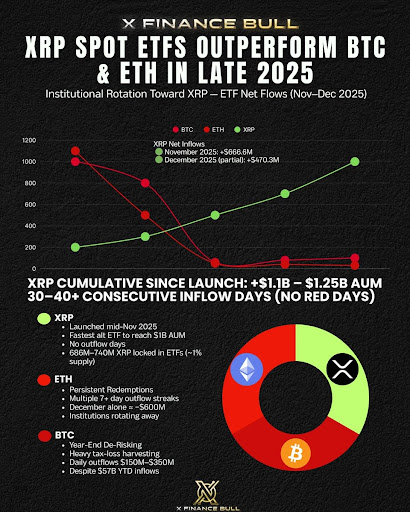
Institutions are flocking into the altcoin | Source: Chart from Xfinancebull on X

However, the reason the altcoin is being chosen is that it solves what institutions actually need, which are complexity-ready settlement, on-chain liquidity, and global transaction speed. XRP’s price is currently down because the entire market is under pressure; that move is macro, not a failure.

In Xfinancebull’s view, institutions are still accumulating the token with patience and intent. The markets often whisper before they move, but this time the data is screaming, and institutions are already stacked.

XRP trading at $1.84 on the 1D chart | Source: XRPUSDT on Tradingview.com

Criptomoedas em alta

Perguntas relacionadas

QAccording to the article, why is XRP starting to trade like an asset that has endured its hardest trials?

AIt has been tempered by years of regulatory uncertainty, legal scrutiny, and prolonged underperformance, which has reshaped its investor base into a more resilient market. The launch of regulated ETFs and rising institutional inflows also signal a fundamental shift.

QWhat milestone did the ETFs linked to XRP achieve, as mentioned by the ambassador?

AThe ETFs became the fastest altcoin ETF in history to hit $1 billion in Assets Under Management (AUM).

QWhat key reason does the article give for institutions choosing to invest in XRP?

AInstitutions are choosing XRP because it solves their actual needs, which include complexity-ready settlement, on-chain liquidity, and global transaction speed.

QHow does the article describe the flow of capital into XRP funds compared to Bitcoin and Ethereum?

AThe XRP funds saw massive inflows with no outflows, including over $666 million in November and another $470 million in December, while Bitcoin and Ethereum experienced hundreds of millions in net outflows during the same period.

QWhat is the current state of XRP's supply on exchanges, and what is its effect?

AThe supply on exchanges is thinning, with 686 million and 740 million XRP locked, which quietly reduces the available supply in real-time and reinforces the asset's resilience.

Leituras Relacionadas

Misjudged A-Shares: Resilience, Expectations, and Confidence

China's A-share market recently faced selling pressure, especially in tech sectors, initially triggered by a global tech sell-off that began in South Korea. However, the article argues this is a case of "mistaken injury" and highlights the market's underlying resilience. This resilience stems from three main pillars: **1) Tech Sector Fundamentals:** Unlike Korea's market dominated by a few memory chip stocks, China's tech sector is diversified across computing, communications, electronics, and semiconductors, supported by dual narratives of global AI supply chains and domestic substitution. Core areas like optical modules and fiber optics continue to show strong earnings growth. **2) "National Team" Support:** State-backed institutions and large corporations have made significant market purchases and announced buybacks, providing liquidity and signaling confidence. This is seen as a stabilizing policy signal, often associated with market bottoms. **3) Broader Market Pillars:** Other major sectors are showing endogenous recovery momentum. Consumer stocks benefit from stabilizing CPI and signs of sector recovery (e.g., liquor price hikes). Cyclical sectors like aluminum have high earnings, potential price increases due to tight supply, and low valuations. The financial sector offers stable dividends and low valuations. The conclusion is that the sell-off was driven by external contagion, not a collapse in fundamentals. With strong policy support and recovering momentum across key sectors, the A-share market possesses the toughness to regain stability.

marsbitHá 27m

Misjudged A-Shares: Resilience, Expectations, and Confidence

marsbitHá 27m

The Clarity Act's Journey Through Congress: The Thorny Path of Bipartisan Compromise in the U.S.

The U.S. Congress is struggling to advance the crypto market structure bill known as the Clarity Act, with bipartisan compromise proving difficult. Key hurdles include unresolved disputes over "yield" products and, more critically, the inclusion of strong ethics provisions for elected officials—a non-negotiable demand for many Democrats. While a compromise on yield was reached in May, securing only limited Democratic support in committee, the separate Senate Agriculture Committee version later passed with no Democratic votes due to the ethics impasse. As Republicans push for a full Senate vote in July, demands for ethics rules have expanded, and other contentious issues like developer protections and concerns from law enforcement and large banks further complicate negotiations. Despite consensus on the need for legislation, the path forward is unclear. Recent discussions between senators and White House officials aim to find acceptable ethics language. Some lawmakers question whether a compromise text can garner enough bipartisan support, with one Democrat stating the current proposal lacks the strong ethics provisions required for their vote. Potential short-term goals for the crypto community include symbolic Senate action before the August recess, a longer-term aim for passage by 2026, or establishing a detailed framework that addresses ethics and other compromises. The process remains arduous, relying on the traditional, vote-by-vote effort to build bipartisan support.

marsbitHá 46m

The Clarity Act's Journey Through Congress: The Thorny Path of Bipartisan Compromise in the U.S.

marsbitHá 46m

Are Kalshi and Polymarket Founders at Odds? This Business Rivalry Is More Brutal Than You Think

"The Rivalry Between Kalshi and Polymarket Founders Turns Bitter and Litigious" The intense feud between Tarek Mansour, CEO of Kalshi, and Shayne Coplan, founder of Polymarket, has escalated far beyond typical business competition into personal animosity and regulatory battles. Both lead billion-dollar prediction market platforms, but their approaches differ sharply. Kalshi positions itself as the compliant operator, securing U.S. regulatory approval before launching. In contrast, Polymarket initially operated offshore, allowing U.S. users to access its platform via VPN, which drew regulatory scrutiny. The conflict reached a peak in November 2024 when FBI agents raided Coplan's New York apartment. While Coplan publicly blamed political motives, his team privately suspected Kalshi was involved. According to sources, Kalshi's lawyers had previously reported Polymarket's operations to federal prosecutors, highlighting its accessibility to U.S. users despite a ban. This incident fueled mutual accusations and underhanded tactics, including social media smear campaigns and attempts to sabotage each other's major business deals. Their rivalry also played out in Washington, influencing regulatory debates. Kalshi actively lobbied against Polymarket's practices, framing them as illegal and unethical. Polymarket, after facing a CFTC fine and investigation, later acquired a licensed U.S. firm to launch a domestic app, regaining a foothold. Despite the hostility, both companies have seen massive growth, with combined trading volumes soaring. However, increased regulatory scrutiny, particularly around insider trading on Polymarket's platform, continues to pose challenges. The founders' deep-seated mutual disdain ensures their battle for market dominance remains as much a personal vendetta as a commercial one.

marsbitHá 55m

Are Kalshi and Polymarket Founders at Odds? This Business Rivalry Is More Brutal Than You Think

marsbitHá 55m

Trading

Spot

Artigos em Destaque

Como comprar O

Bem-vindo à HTX.com!Tornámos a compra de O1 exchange (O) simples e conveniente.Segue o nosso guia passo a passo para iniciar a tua jornada no mundo das criptos.Passo 1: cria a tua conta HTXUtiliza o teu e-mail ou número de telefone para te inscreveres numa conta gratuita na HTX.Desfruta de um processo de inscrição sem complicações e desbloqueia todas as funcionalidades.Obter a minha contaPasso 2: vai para Comprar Cripto e escolhe o teu método de pagamentoCartão de crédito/débito: usa o teu visa ou mastercard para comprar O1 exchange (O) instantaneamente.Saldo: usa os fundos da tua conta HTX para transacionar sem problemas.Terceiros: adicionamos métodos de pagamento populares, como Google Pay e Apple Pay, para aumentar a conveniência.P2P: transaciona diretamente com outros utilizadores na HTX.Mercado de balcão (OTC): oferecemos serviços personalizados e taxas de câmbio competitivas para os traders.Passo 3: armazena teu O1 exchange (O)Depois de comprar o teu O1 exchange (O), armazena-o na tua conta HTX.Alternativamente, podes enviá-lo para outro lugar através de transferência blockchain ou usá-lo para transacionar outras criptomoedas.Passo 4: transaciona O1 exchange (O)Transaciona facilmente O1 exchange (O) no mercado à vista da HTX.Acede simplesmente à tua conta, seleciona o teu par de trading, executa as tuas transações e monitoriza em tempo real.Oferecemos uma experiência de fácil utilização tanto para principiantes como para traders experientes.

167 Visualizações TotaisPublicado em {updateTime}Atualizado em 2026.06.29

Como comprar O

Como comprar PROS

Bem-vindo à HTX.com!Tornámos a compra de Pharos (PROS) simples e conveniente.Segue o nosso guia passo a passo para iniciar a tua jornada no mundo das criptos.Passo 1: cria a tua conta HTXUtiliza o teu e-mail ou número de telefone para te inscreveres numa conta gratuita na HTX.Desfruta de um processo de inscrição sem complicações e desbloqueia todas as funcionalidades.Obter a minha contaPasso 2: vai para Comprar Cripto e escolhe o teu método de pagamentoCartão de crédito/débito: usa o teu visa ou mastercard para comprar Pharos (PROS) instantaneamente.Saldo: usa os fundos da tua conta HTX para transacionar sem problemas.Terceiros: adicionamos métodos de pagamento populares, como Google Pay e Apple Pay, para aumentar a conveniência.P2P: transaciona diretamente com outros utilizadores na HTX.Mercado de balcão (OTC): oferecemos serviços personalizados e taxas de câmbio competitivas para os traders.Passo 3: armazena teu Pharos (PROS)Depois de comprar o teu Pharos (PROS), armazena-o na tua conta HTX.Alternativamente, podes enviá-lo para outro lugar através de transferência blockchain ou usá-lo para transacionar outras criptomoedas.Passo 4: transaciona Pharos (PROS)Transaciona facilmente Pharos (PROS) no mercado à vista da HTX.Acede simplesmente à tua conta, seleciona o teu par de trading, executa as tuas transações e monitoriza em tempo real.Oferecemos uma experiência de fácil utilização tanto para principiantes como para traders experientes.

160 Visualizações TotaisPublicado em {updateTime}Atualizado em 2026.06.29

Como comprar PROS

O que é VERONA

I. Introdução ao Projeto VERONA é uma blockchain construída para todos, em todo o lado, através da abstração da cadeia. Utilizando a sua camada de Abstração Generalizada, a VERONA distingue-se por integrar funcionalidades complexas de blockchain, como contas, assinaturas e interoperabilidade, diretamente ao nível do protocolo. Esta abordagem permite a interação com aplicações de blockchain sem a necessidade de compreender as tecnologias subjacentes.1) Informação Básica Nome: VERONA (VERONA)III. Links Relacionados Link do site oficial: https://xion.burnt.com/ Whitepaper: https://xion.burnt.com/whitepaper.pdf Exploradores: https://explorer.burnt.com/ Mídias Sociais: https://x.com/burnt_xion Nota: A introdução ao projeto provém dos materiais publicados ou fornecidos pela equipa oficial do projeto, que é apenas para referência e não constitui aconselhamento de investimento. A HTX não se responsabiliza por quaisquer perdas diretas ou indiretas resultantes.

778 Visualizações TotaisPublicado em {updateTime}Atualizado em 2026.06.22

O que é VERONA

Discussões

Bem-vindo à Comunidade HTX. Aqui, pode manter-se informado sobre os mais recentes desenvolvimentos da plataforma e obter acesso a análises profissionais de mercado. As opiniões dos utilizadores sobre o preço de A (A) são apresentadas abaixo.

活动图片














